segunda-feira, 9 de setembro de 2013

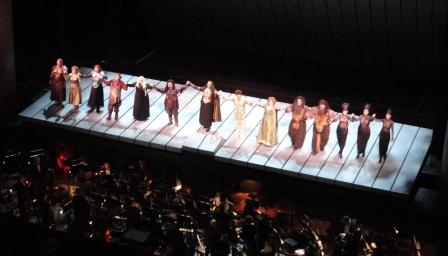
DIE WALKÜRE / A VALQUÍRIA, METropolitan OPERA, Nova Iorque, Maio de 2013


A encenação tem como momentos originais os troncos de árvores, logo no início, entre os quais se vê a perseguição a Siegmund. Mais tarde, quando conta a sua história, vêem-se sombras no tecto da casa de Hunding ilustrando a acção.
No 2º acto o monólogo de Wotan é acompanhado por um conjunto diversificado de imagens projectadas num grande olho, colocado no centro do palco, rodeado por montanhas com lava a escorrer. O final da ópera, com o aprisionamento da Brünhilde entre o fogo sagrado, é também de efeito visual marcante.


 O primeiro acto foi arrasador! O tenor neozelandês Simon O´Neill fez um Siegmund excepcional. É um papel que canta com frequência, e bem. Tem um timbre de invulgar beleza e perfeitamente adequado à personagem. Ouve-se sempre em todos os registos, mantendo a mesma qualidade interpretativa. É pena o cantor estar cada vez mais gordo, o que prejudica o aspecto físico que a personagem exige. Mas, vocalmente, está melhor que nunca.


 A Sieglinde do soprano austríaco Martina Serafin foi também fantástica. A cantora projecta a voz com grande eficácia, ouve-se sobre a orquestra e a afinação é perfeita. Tem uma figura óptima para o papel e é muito convincente na actuação cénica.


 Também insuperável foi o Hunding do baixo-barítono alemão Hans-Peter König. É um cantor fantástico, com um vozeirão brutal que é sempre uma garantia de qualidade no seu máximo esplendor. Foi o que aconteceu mais uma vez.


 O baixo-barítono norte americano Greer Grimsley, que desconhecia, surpreendeu-me muito positivamente como Wotan. Tem um timbre peculiar que serve muito bem a personagem. Também projecta a voz de forma muito eficiente e foi notável ao longo de toda a récita. A actuação em palco foi das melhores a que assisti, muito credível, em que os momentos mais altos foram a morte de Hunding e o diálogo final com a filha.


 A Brünhilde do soprano norte americano Deborah Voight não destoou dos restantes cantores. Foi a mais aplaudida em palco, talvez por “jogar em casa” e pelo que já ofereceu ao público do Met, mas não se destacou. Esteve muito bem, mas há melhores.


 Deixo para último aquela que continuo a considerar a melhor Fricka da actualidade, o mezzo norte americano Stephanie Blythe. Foi arrasadora. A voz é brutal em tamanho e potência e a cantora interpreta o papel com uma emotividade assinalável. Um privilégio ouvi-la. Quando veio agradecer, no final do 2º acto, percebi por que razão faltara na véspera. Está muito incapacitada fisicamente, desloca-se com enorme dificuldade e com a ajuda de uma bengala. Esta noite tivemos a sorte de a ouvir porque, nesta encenação, canta sempre sentada.


 Uma Valquíria excelente!


*****

Die Walküre, Metropolitan Opera, New York, May 2013

The staging has original parts such as as tree trunks, early on, among which we see the persecution of Siegmund. Later, when he tells his story, one sees shadows on the ceiling of Hunding’s house illustrating the action. In the 2nd act Wotan's monologue is accompanied by a diverse set of images projected on a large eye, placed at center stage, surrounded by mountains with lava dripping. The end of the opera, with the Brunhilde between the sacred fire, is also a striking visual effect.

The first act was astonishing! New Zealand tenor Simon O'Neill was an exceptional Siegmund. This is a role that he sings often and well. He has a tone of unusual beauty and perfectly suited to the character. He is always head in all registers, maintaining the same vocal quality. It is a pity that the singer is becoming increasingly fat, which impairs the physical aspect that the character requires. But vocally, he is better than ever.

Austrian soprano Martina Serafin’s Sieglinde was also fantastic. The singer projects her voice with great efficiency, she is always heard above the orchestra and the tuning is perfect. She has a perfect figure for the role and is very convincing onstage.

Also unsurpassed was german bass-baritone Hans-Peter König as Hunding. He is a fantastic singer with a booming voice that  is always a guarantee of quality in full splendor. It happened again.

North American bass-baritone Greer Grimsley, who I did not know, surprised me very positively as Wotan. He has a peculiar tone that serves very well the character. He also projects his voice very efficiently and he was remarkable throughout the performance. The stage performance was among the best I attended, very credible, the highlights were the death of Hunding and the final dialogue with his daughter.

North American soprano Deborah Voight was Brunhilde, at the same high level of the other singers. She was the most applauded on stage, perhaps because she "was at home" and because of what she has already offered to the public at the Met. She was very good, but there are better singers of this role.


I leave it to the end the singer I consider the best Fricka of present times, North American mezzo Stephanie Blythe. She was overwhelming. The voice is brutal in size and power and she sings the role with a remarkable emotionality. A privilege to hear her. When she came to thank at the end of the 2nd act, I realized why she had failed the night before. She was physically very incapacitated, walking with great difficulty and with the help of a cane. Tonight we were lucky to hear because, in this staging, she always sings sitting.

An excellent Valkyrie


*****
terça-feira, 3 de setembro de 2013

O OURO DO RENO / DAS RHEINGOLD, METropolitan OPERA, Maio de 2013


 O Ouro do Reno é o prólogo em quatro cenas do Anel do Nibelungo de R. Wagner.

Na encenação de Robert Lepage os aspectos de efeito mais espectacular nesta primeira ópera são, logo na primeira cena, as filhas do Reno suspensas, a nadar e, quando assentam no fundo do rio e sempre que se movem, provocam a queda de grande quantidade de pequenas pedras. A terceira cena é também muito bem conseguida, não só a descida ao Nibelheim como a actuação de Mime e dos Nibelungos a fundirem o ouro. A transformação de Alberich numa gigantesca serpente e, depois, num sapo, são vistosas. Finalmente, depois da tempestade, a subida dos deuses ao Walhalla que aparece como um arco-íris que vai passando no fundo do palco tem grande impacto visual.


 Os solistas foram, na maioria, de grande qualidade.

O melhor da noite foi o tenor eslovaco Stefan Margita que interpretou o semideus do fogo Loge. Tem uma voz sempre audível e afinada, muito melodiosa e agradável. Aparecia envolvido em luzes que simulavam o fogo e teve um excelente desempenho cénico. Já quando o vi no Anel de Munique, no mesmo papel, foi igualmente notável. Na actualidade não deve haver melhor Loge.


 Fricka foi interpretada pelo mezzo americano Elizabeth Bishop, em substituição de Stephanie Blythe. Esteve à altura do papel e ofereceu-nos uma bela interpretação. Foi vocalmente forte e cenicamente convincente. A voz é bonita, penetrante e sempre bem colocada.


 O baixo-barítono americano Richard Paul Fink foi o elo fraco da noite. Interpretou Alberich de forma deficiente. Ouviu-se mal, a voz é pequena e feia. Não é um cantor com qualidade que justifique a sua actuação num papel solista no Met.


 Wotan foi interpretado pelo baixo-barítono americano Greer Grimsley. Esteve bem, a voz é muito respeitável, ouviu-se sempre sobre a orquestra e foi credível em cena.


 Também de qualidade assinalável foi a interpretação de Freia pelo soprano americano Wendy Bryn Harmer que, no registo mais agudo, foi segura e não gritou.


 Os dois gigantes, Fasolt e Fafner, foram interpretados pelos baixos alemães Franz-Josef Selig e Hans-Peter König e foram dois dos melhores cantores da noite. Vozes potentes, registos graves imponentes e boa presença em palco.


 Se o Froh de Richard Cox foi muito fraco, merecem nota positiva o mezzo americano Meredith Arwady que foi uma Erda poderosa,


 o tenor americano Robert Brubaker que deixou uma óptima impressão como Mime


  e o barítono americano Dwayne Croft como Donner.


 Foram também impecáveis as três filhas do Reno Dísella Làrusdóttir (Woglinde), Jennifer Johnson Cano (Wellgunde) e  Renee Tatum (Flossilde).


Começou bem o Anel de Nova Iorque.

**** 


DAS RHEINGOLD, Metropolitan Opera, May 2013

Das Rheingold is the prologue in four scenes from the Ring of the Nibelung by R. Wagner.

In Robert Lepage´s staging the most spectacular aspects of this first opera are in the very first scene, the daughters of the Rhine suspended, swimming, and when they settle on the river bottom and whenever they move, they cause the fall of large amounts of small stones. The third scene is also very well done, not only the descent to Nibelheim as well as Mime and the Nibelungs merging of the gold. Alberich's transformation into a giant snake and then into a frog are showy. Finally, after the storm, the rising of the gods to Walhalla that appears as a rainbow on the back of the stage has great visual impact.

The soloists were mostly very good.

The best of the night was Slovakian tenor Stefan Margita who played the semi god of fire, Loge. His very melodious and pleasant voice was always audible and tuned, He appeared wrapped in lights that simulated fire and performed excellently. When I saw him in the Munich´s Ring in the same role, he was equally remarkable. At present there should be no better Loge.

Fricka was interpreted by American mezzo Elizabeth Bishop, replacing Stephanie Blythe. She was OK in the role and offered us a beautiful interpretation. She was strong vocally and artistically  compelling. The voice is beautiful, deep and always well projected.

American bass-baritone Richard Paul Fink was the weak link in the night. He interpreted Alberich in a deficient way. We could not hear him well, the voice is small and not nice. He is not a top quality singer to justify a solo role at the Met.

Wotan was interpreted by American bass-baritone Greer Grimsley. He was good, the voice is very respectable, ever heard above the orchestra and he was credible onstage.

Also remarkable was the quality of interpretation of Freia by American soprano Wendy Bryn Harmer that in the top notes, was secure and did not shout.

The two giants, Fasolt and Fafner, were interpreted by German basses Franz-Josef Selig and Hans-Peter König and they were two of the best singers of the night. Powerful voices, imposing bass notes and good stage presence.

If Richard Cox´s Froh was very weak, deserve positive remarks the American mezzo Meredith Arwady that was a powerful Erda, the American tenor Robert Brubaker who left an excellent impression as Mime and American baritone Dwayne Croft as Donner. The three daughters of the Rhine were also very good, Dísella Lárusdóttir (Woglinde), Jennifer Johnson Cano (Wellgunde) and Renée Tatum (Flossilde).

The Met’s Ring had a good start.


****

sábado, 31 de agosto de 2013

O Anel do Nibelungo / Der Ring des Nibelungen, Nova Iorque, Maio de 2013 / New York, May 2013

(in english below) 

Uma breve introdução a esta monumental obra de Richard Wagner pode ler-se aqui.


 Em Nova Iorque assisti a um ciclo completo do Anel. No ano passado já tinha visto esta produção no Met Live e, ao vivo, Die Walküre. Aqui pode ler-se o que então se escreveu neste blogue sobre Das Rheingold, Die Walküre (aqui, aqui e aqui), Siegfried e Götterdämmerung.


 A encenação de Robert Lepage tem sido alvo de discussão e controvérsia. Conto-me entre os que a consideram muito eficaz e original. Há uma gigantesca máquina articulada que ocupa todo o palco e que assume inúmeras formas, constituindo os diferentes cenários, também com a ajuda de projecções.
A máquina, por vezes, faz algum ruído, o que perturba a concentração, mas a originalidade da abordagem cénica e a versatilidade alcançada permitem encará-lo com um pouco de tolerância.


 O maestro que dirigiu as 4 óperas do ciclo foi Fabio Luigi. Fez um excelente trabalho e a Orquestra da Metropolitan Opera mostrou que é uma das melhores orquestras mundiais pois teve um desempenho magnífico e homogéneo ao longo de todo o ciclo.


 Nos próximos dias escreverei umas notas sobre cada uma das óperas.


The Ring of the Nibelung / Der Ring des Nibelungen, New York, May 2013
A brief introduction to this monumental work of Richard Wagner can read here.

In New York I saw a complete Ring cycle. Last year I had seen this production at the cinema in MetLive transmissions, and, live in New York, Die Walküre. You can read here what was written then in this this blog on Das Rheingold, Die Walküre (here, here and here), Siegfried and Götterdämmerung.

The staging by Robert Lepage has been the subject of discussion and controversy. I am among those who consider it very effective and unique. There is a gigantic articulated machine that occupies the entire stage and that takes many forms, constituting the different scenarios, also with the help of projections.
The machine sometimes makes some noise, which disturbs the concentration, but the originality of the approach and the scenic versatility achieved allow to face it with a little tolerance.

The conductor who directed the four operas of the cycle was Fabio Luigi. He did an excellent job and the Orchestra of the Metropolitan Opera shown that it is one of the best orchestras in the world. It had a magnificent uniform performance throughout the cycle.

In the coming days I will write a few notes about each opera.

domingo, 25 de agosto de 2013

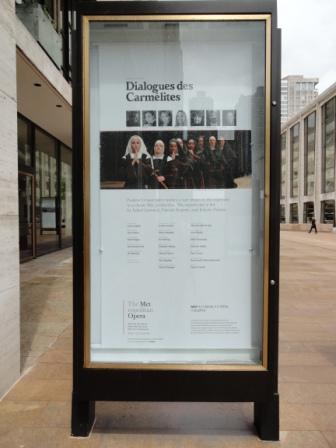
DIALOGUES DES CARMÉLITES, METropolitan OPERA, Nova Iorque, Maio de 2013 / New York, May 2013

(in english below)

 Dialogues des Carmélites é uma ópera de F Poulenc. O enredo pode ler-se aqui.

A encenação, velhinha, de John Dexter, é minimalista mas eficaz. No chão, ao longo da récita, ocupando todo o palco, está uma cruz branca onde as carmelitas aparecem prostradas. O carmélio é representado por 4 estruturas metálicas simulando colunas e, quando há diálogos com o exterior, aparece uma estrutura em forma de rede que separa as carmelitas do exterior. Um Cristo estilizado também aparece suspenso durante parte da acção. Só no final a revolução aparece espelhada no palco, com a entrada de soldados e do povo, antes da decapitação das freiras, já vestidas em trajos correntes. Uma encenação simples, agradável e que respeita a história da ópera.

O maestro francês Louis Langrée dirigiu.

O tenor americano Paul Appleby interpretou sem impressionar o Cevalier de la Force.
Também o seu pai, Marquis de la Force, interpretado pelo barítono Philip Skinner, foi banal.

A protagonista, Blanche de la Force, cantada pelo mezzo norte americano Isabel Leonard esteve muito bem, tanto vocal como cenicamente. Transmitiu insegurança e incerteza no início, determinação no final, como o papel exige.


 A melhor intérprete da noite foi o mezzo inglês Felicity Palmer como Madame de Croissy. Foi excelente na expressão do sofrimento lancinante e na expressão da quebra do comportamento que estaria obrigada a seguir.


 Também em grande forma esteve a irmã Constance interpretada pelo jovem soprano norte americano Erin Morley.

A Madre Marie, cantada pela norte americana Elizabeth Bishop foi outra das melhores da noite. Muito bem cenicamente, a voz é grande e sempre afinada.


 Finalmente uma palavra para outra cantora de voz poderosa, o soprano norte americano, Patricia Racette como Madame Lidoine que, contudo, já denota um vibrato apreciável.


****


DIALOGUES DES CARMELITES,  Metropolitan Opera, New York, May 2013

Dialogues des Carmélites is an opera by F Poulenc. The plot can be read here.

The  old staging by John Dexter, is minimalist but effective. On the floor, along the whole performance, occupying the entire stage, there is on the floor a huge white cross where the Carmelites appear prostrate. The convent is represented by four columns in metal and, when there are contacts with the outside of the convent, a shaped structure that separates it from the outside appears. A suspended stylized Christ also appears during for part of the action. Only at the end of the revolution arrives on stage, with the entry of soldiers and the people, before the decapitation of the nuns, now dressed in current costumes. A simple staging, nice and respecting the story of opera.

French conductor Louis Langrée directed.

American tenor Paul Appleby sung without impressing the role of Cevalier de la Force.
Also his father, Marquis de la Force, played by baritone Philip Skinner, was commonplace.

The soloist, Blanche de la Force, sung by the North American mezzo Isabel Leonard was very good, both vocal and artisticaly. She transmitted insecurity and uncertainty in the beginning, determination at the end, as the role requires.

The best performer of the night was the English mezzo Felicity Palmer as Madame de Croissy. She was excellent in the expression of excruciating suffering and breakage of behavior that would be required for her to follow.

Very good was Sister Constance, interpreted by the young North American soprano Erin Morley.

Mother Marie, sung by North American Elizabeth Bishop was another of the best of the night. She was very well in the artistic performance and the voice was big and always in tune.

Finally a word for another singer with a powerful voice, North American soprano Patricia Racette as Madame Lidoine which, however, already denotes an appreciable vibrato.


****

domingo, 18 de agosto de 2013

DON CARLO, Salzburger Festspiele, Agosto / August 2013

(in english below)

Tivemos ontem a possibilidade de assistir a uma transmissão “quase” directa, pelo canal arte, da nova produção do Don Carlo de G. Verdi, do Festival de Salzburgo. Ouviu-se a versão francesa em 5 actos, traduzida para italiano, sem o ballet. É a minha ópera favorita do compositor e já foi comentada aqui e aqui e aqui.

A produção de Peter Stein é clássica, austera, minimalista, mas agradável. As personagens aparecem quase sempre vestidas de negro, excepto no Auto-de-Fé onde há colorido excessivo. Não se criam ambientes dramáticos, estes são deixados à actuação dos cantores, que os cumpriram na perfeição.

A Orquestra Filarmónica de Viena, o Coro da Ópera de Viena e os solistas foram dirigidos, novamente de forma soberba, pelo maestro Antonio Pappano.

A interpretação do Don Carlo pelo tenor alemão Jonas Kaufmann foi excepcional. Transmitiu de forma marcante o conflito psicológico da personagem, em cena foi sempre expressivo e emotivo. A interpretação vocal foi ao nível do que tem feito neste papel, que já vi ao vivo, absolutamente irrepreensível. A voz é segura e ampla em todos os registos, os agudos são fabulosos e alcançados na perfeição e sem esforço aparente. Ofereceu-nos uma interpretação em crescente e, nos últimos actos, foi excelente.

(Fotografia / Photo: Monika Ritterhaus)

 Também insuperável na qualidade interpretativa foi o soprano alemão Anja Harteros como Elisabetta. Tem uma amplitude vocal invulgar, um timbre muito bonito e mantém a qualidade em todos os registos. Os agudos são estratosféricos, impecavelmente afinados, sem nunca gritar, e os pianissimi são impressionantes. Na ária Tu che le vanità foi arrepiante.

(Fotografia / Photo: Monika Ritterhaus)

Outra cantora marcante foi o mezzo russo Ekaterina Semenchuk na princesa Eboli. A voz é muito poderosa, bela, forte no registo médio, com graves imponentes e agudos brilhantes. Em O don fatale foi insuperável.

(Fotografia / Photo: Monika Ritterhaus)

O barítono americano Thomas Hampson, não tendo a voz ideal para a personagem, foi um Rodrigo muito bom vocalmente e excepcional na interpretação dramática, que alcançou a expressão mais elevada quando é ferido mortalmente e canta O Carlo, ascolta.

(Fotografia / Photo: Monika Ritterhaus)

Matti Salminen, baixo finlandês, foi o rei Filippo II. É um cantor excelente embora vocalmente não tenha estado ao mesmo nível dos anteriores. Mas a interpretação dramática foi tocante e o monólogo Ella giammai m’amo e, depois, o dueto com o Grande Inquisidor foram marcantes.

(Fotografia / Photo: Monika Ritterhaus)

O baixo norte americano Eric Halfvarson foi um Grande Inquisidor duro e autoritário, de voz poderosa e impressionante. É um papel que interpreta frequentemente. Como referi, o dueto com Fillipo foi assinalável.

(Fotografia / Photo: Monika Ritterhaus)

Os cantores secundários também não destoaram. Um Don Carlo de grande qualidade.

****


DON CARLO, Salzburger Festspiele,  August 2013

Yesterday we had the opportunity to watch an "almost" direct broadcast, at arte tv, the new production of Don Carlo by G. Verdi for the Salzburg Festival. It was the French version in 5 acts, translated into Italian and without ballet. It's my favorite opera of the composer and it has been commented here and here and here..

The production by Peter Stein is classic, austere, minimalist but correct. The singers appear almost always dressed in black, except during the Auto-da-Fe where there are excessive colorful. The staging does not create dramatic atmosferes, these are left to the acting of the singers, who perfectly fulfilled them.

The Vienna Philharmonic, the Vienna State Opera Chorus and soloists were directed again superbly by Antonio Pappano.

The interpretation of Don Carlo by German tenor Jonas Kaufmann was exceptional. He transmitted well the psychological conflict of the character, on stage he was always expressive and emotive. The vocal performance was at the level of what he has made in this role, I have seen live, absolutely faultless. The voice is safe and wide in all registers, the top notes are fabulous and achieved flawlessly and without apparent effort. He offered us an interpretation in crescendo and in the last acts, was excellent.

Also unsurpassed in interpretive quality was German soprano Anja Harteros as Elisabetta. She has an unusual vocal range, very beautiful timbre and maintains quality in all registers. The top notes are stratospheric, impeccably tuned, she never screams, and the pianissimi are impressive. In the aria Tu che le vanità she was creepy.

Another striking singer was Russian mezzo Ekaterina Semenchuk the Princess Eboli. The voice is very powerful, beautiful, strong in the middle register, with impressive low notes and bright trebles.
O don fatale was unsurpassed.

American baritone Thomas Hampson, not having the ideal voice for the character, was a very good Rodrigo vocally and exceptional in dramatic interpretation, which reached the highest expression when he was mortally wounded and sang O Carlo, ascolta.

Matti Salminen, Finnish bass, was King Filippo II. He is a great singer vocally, though not at the same level as the previous. But the acting was touching and the dramatic monologue Ella giammai m'amo and then the duet with the Grand Inquisitor were striking.

North American bass Eric Halfvarson was a tough and authoritative Grande Inquisitor,  of powerful and impressive voice.
It is a role that he plays often. As mentioned, the duet with Fillipo was remarkable.

The other supporting singers were also good. A Don Carlo of great quality.

****