

(Review in English below)

Tannhäuser espectacular!! É uma das maiores encenações Wagnerianas de sempre, por Tobias Kratzer! A maneira como a partir do meio a ação que no fundo é como se fosse a ópera a decorrer, se quebra e começa a entrar a realidade paralela criada pelo encenador e se misturam, é de uma genialidade que não é deste mundo! A maneira como o Tannhäuser cede à sua paixão carnal venusiana passando para fora do rectângulo luminoso que é o palco da ópera e depois aí vai vivendo a sua angustia em palco entre ambas as realidades (paixão carnal mas também o seu amor profundo a Elisabeth) voltando depois por fim a entrar de novo no rectângulo luminoso, deixando para trás Vénus, é forte, muito forte, como momento de teatro.
No vídeo original de 2019 a parte inicial tem muito tempo de vistas da carrinha da Vénus a andar em estrada com arvoredo à volta. Hoje cortaram algum desse tempo e introduziram uma piada genial: vê-se a carrinha chegar ao Festival de Salzburgo, com imagem a partir de dentro e depois vista por fora. No tablier sempre houve uma mão com o 3º dedo estendido ligada por mola de modo a que sempre que a carrinha se move, a mão move-se e dá a sensação que está sempre a fazer o sinal do dedo para todo o lado. Aqui vê-se a chegar ao Festival de Salzburgo (não sendo necessariamente um verdadeiro concorrente ou rival do Festival de Bayreuth, é-o um bocadinho porque são talvez os 2 festivais líricos de verão mais famosos) com o dedo a balouçar a mandar o Festival de Salzburgo para … :) O anão sai da carrinha, olha para um mapa dando-lhe umas voltas nas mãos e depois lê-se nos lábios a dizer Scheisse e volta a entrar com a Vénus para a carrinha e partem dali. Muito bom :) Contudo, no seguimento do vídeo, não tem assim tanto sentido porque a Vénus só vai para a zona do Festival de Bayreuth.

No segundo acto, quando o anão e o Gateau estão dentro dos bastidores do festival, passam pelo corredor que tem as fotos dos maestros que já dirigiram em Bayreuth. No original de 2019 o Gateau fazia olhinhos à foto do Thielemann, desta vez o anão cola um coração com as cores da Ucrânia na foto da Oksana Lyniv. Os peregrinos do 3º acto podem ser presos que saíram da prisão para dar uniformidade à encenação. Todos acabam por levar artigos do ferro velho onde está estacionada a carrinha da Vénus. Acho que isso simboliza uma nova vida, a vida depois do encarceramento, tal como uma segunda vida que alguns materiais de ferro velho têm por si.
A Orquestra, dirigida por Alex Kober foi fenomenal, acho que ouvi linhas melódicas a que ainda não tinha dado atenção, e a harpa em palco divinal.

O Stephen Gould está vocal e cenicamente bombástico!!! No 3º acto só não foi espectacular porque a interacção entre Tannhäuser e o Wolfram (e depois também a narração de Roma), apesar de ambos terem estado vocalmente de topo, foram dramaticamente menos convincentes, embora aqui, o Gould tenha levado a melhor. Fez alguma saídas de elevadíssima qualidade mas pecou noutras onde podia ter dado mais naturalidade e veracidade emotiva.

A Ekaterina Gubanova (Venus) está brutal, irrepreensível em toda a sua participação.

O lirismo e clareza de voz do Markus Eiche (Wolfram) foram divinais. Esteve também bastante bem nos monólogos no 3º acto.

O solo (curto mas uma das passagens mais líricas e bonitas desta ópera) do Attilio Glaser que faz de Walther von der Wogelweide foi de uma beleza ímpar.

Lise Davidsen (Elisabeth) fenomenal, a controlar a potência dos agudos excelentemente e com os pianos e transições lindas. Toda a cena desde a altura em que a Elisabete diz para todos deixarem o Tannhäuser em paz porque não são eles que o vão julgar foi de uma perfeição, dramatismo e lirismo de perfurar a alma! O Gould parecia que esta era a última vez que cantava isto. Os seu pedidos de salvação foram de uma potência e de um sentido dramático como nunca o ouvi fazer.
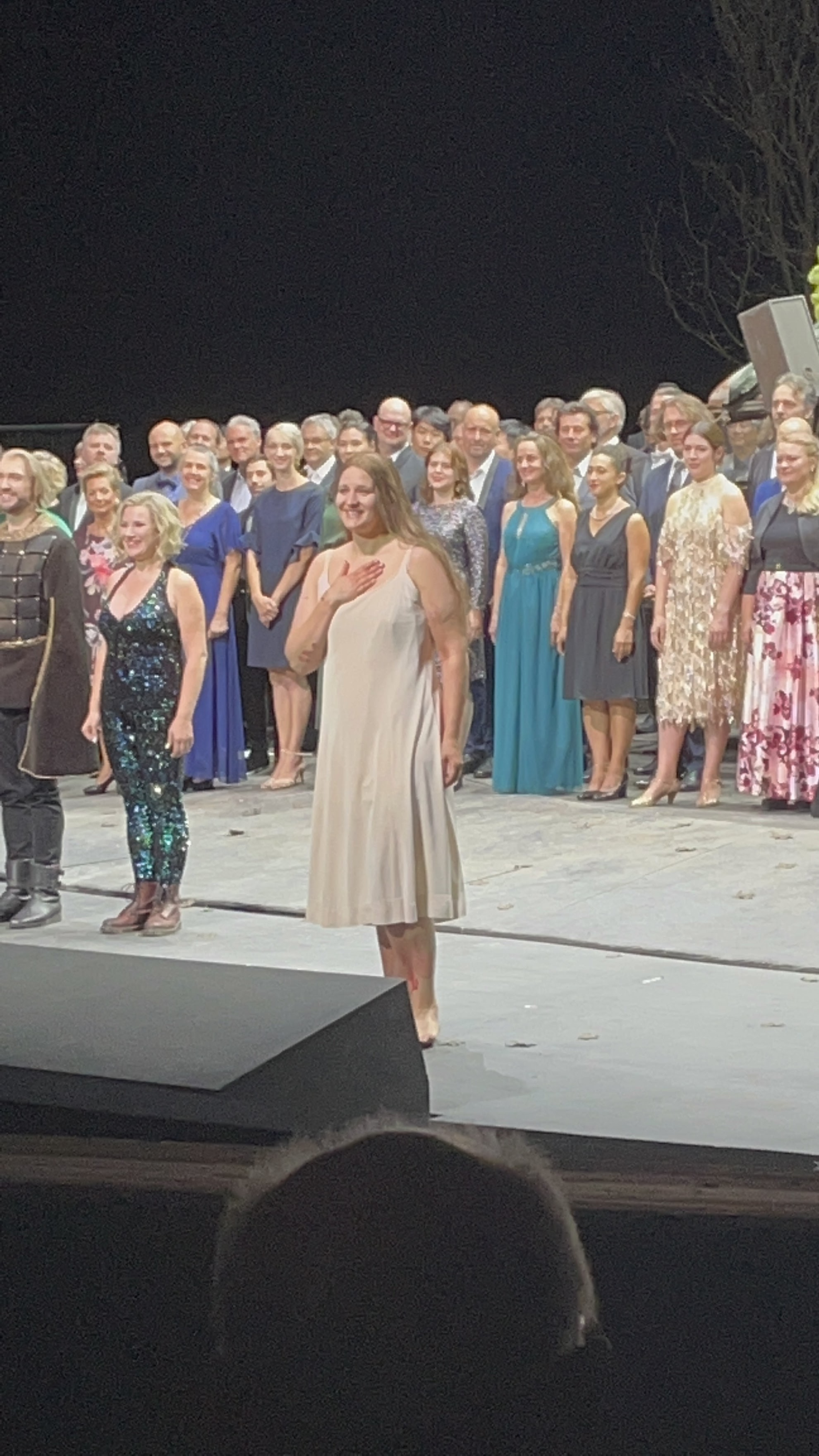
A completar o elenco de solistas de topo estiveram Ólafur Sigurdarson (Biterolf),

Jorge Rodríguez-Norton (Heinrich)
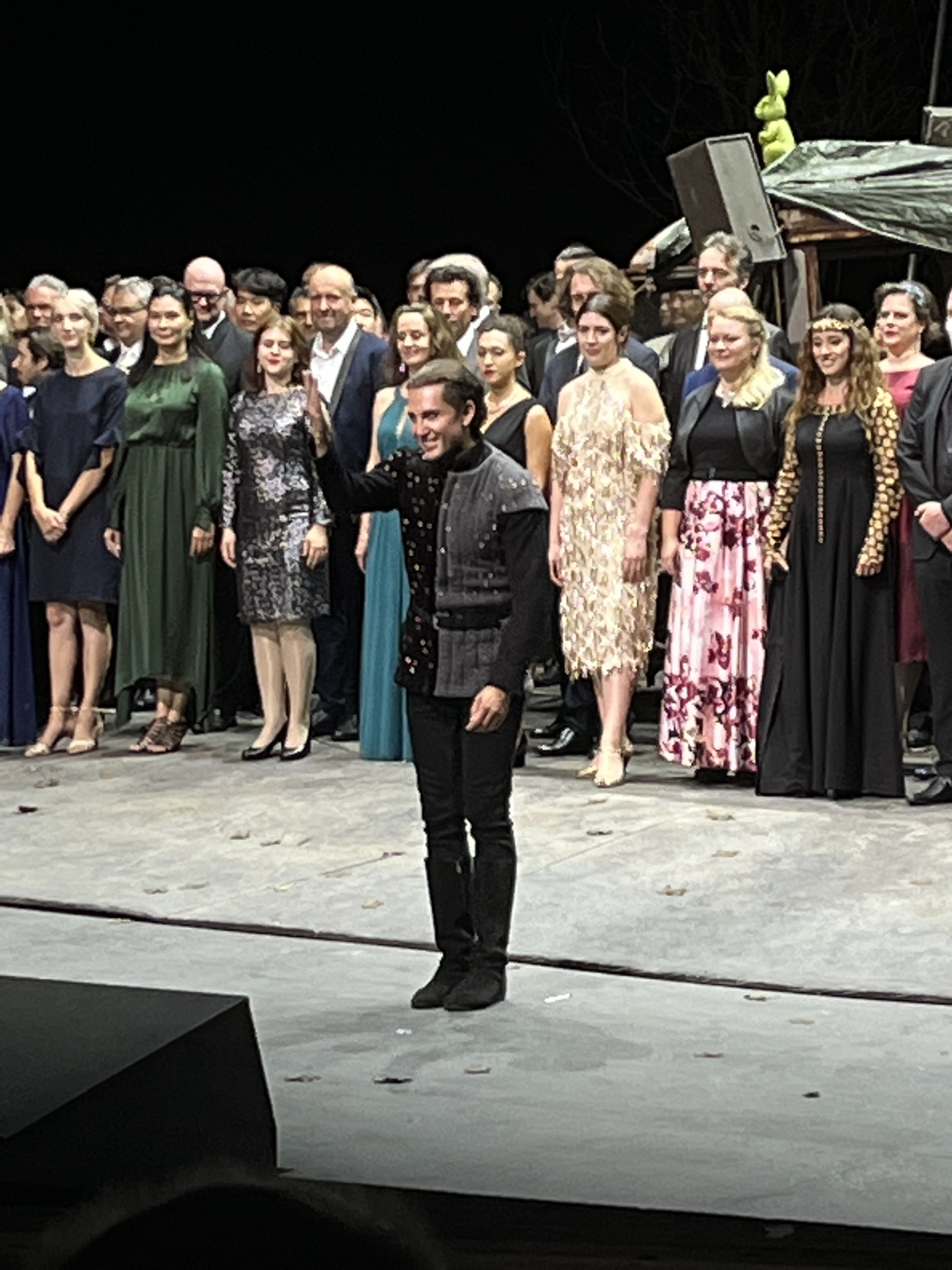
e Jens-Erik Azabo (Reinmar).

E os figurantes Tuuli Takala, Le Gateau Chocolat e Manni Laudenbach.


(Texto e fotos de Wagner_fanatic)
TANNHÄUSER, Bayreuth Festival, August 2022
Spectacular Tannhäuser!! It's one of the greatest Wagnerian stagings ever, by Tobias Kratzer! The way in which, from the middle, the action which in the background is like the opera in progress, breaks down and the parallel reality created by the director begins to enter and mix, is of a genius that is not of this world! The way Tannhäuser gives in to his Venusian carnal passion passing out of the luminous rectangle that is the opera stage and then lives his anguish on stage between both realities (carnal passion but also his deep love for Elisabete) returning then finally entering the luminous rectangle again, leaving Venus behind, is strong, very strong, as for a theater moment.
In the original 2019 video, the initial part has a long time of views of the Venus van driving on a road with trees around it. Today they cut some of that time and introduced a brilliant joke: we can see the van arrive at the Salzburg Festival, with an image from the inside and then seen from the outside of the van. On the dashboard there has always been a hand with the 3rd finger extended, connected by a spring so that whenever the van moves, the hand moves and gives the sensation that it is always making the finger sign everywhere. Here we can see the arrival at the Salzburg Festival (not necessarily being a true competitor or rival of the Bayreuth Festival, it is a little bit because they are perhaps the 2 most famous lyrical summer festivals) with the finger waving to send the Salzburg Festival to … :) The dwarf gets out of the van, looks at a map giving it a few turns in his hands and then we read his lips saying Scheisse and gets back in with Venus to the van and they leave. Very good :) However, following the video, it doesn't make much sense because Venus only goes to the Bayreuth Festival area.
In the second act, when the dwarf and Gateau are backstage at the festival, they pass through the corridor that has photos of the conductors who have directed in Bayreuth. In the 2019 original, Gateau was making eyes at Thielemann's photo, this time the dwarf sticks a heart with the colors of Ukraine to Oksana Lyniv's photo. The pilgrims of the 3rd act can be prisoners who left the prison to give uniformity to the staging. Everyone ends up taking items from the junkyard where the Venus van is parked. I think it symbolizes a new life, life after incarceration, like a second life that some scrap metal has for itself.
The Orchestra, conducted by Alex Kober, was phenomenal, I think I heard melodic lines that I hadn't paid attention to, and the harp on a divine stage.
Stephen Gould was vocally and scenically bombastic!!! The 3rd act wasn't spectacular because the interaction between Tannhäuser and Wolfram (and then also Roma's narration), despite both being vocally top notch, was dramatically less convincing, although here, Gould prevailed. He made some very high quality outings but he sinned in others where he could have given more naturalness and emotional veracity.
Ekaterina Gubanova (Venus) was brutal, irreproachable in all its participation.
The lyricism and clarity of voice of Markus Eiche (Wolfram) was divine. He was also pretty good in his 3rd act monologues.
The solo (short but one of the most lyrical and beautiful passages of this opera) by Attilio Glaser that plays Walther von der Wogelweide was of unparalleled beauty.
Lise Davidsen (Elisabeth) was phenomenal, controlling the top notes power excellently and with the beautiful pianos and transitions. The whole scene from the time when Elisabeth tells everyone to leave Tannhäuser alone because they are not the ones who will judge him was soul-piercing perfection, drama and lyricism! Gould looked like this was the last time he was singing this. His pleas for salvation had a power and a dramatic sense that I have never heard him make.
Rounding out the cast of top soloists were Ólafur Sigurdarson (Biterolf), Jorge Rodriguez-Norton (Heinrich) and Jens-Erik Azabo (Reinmar). And the extras Tuuli Takala, Le Gateau Chocolat and Manni Laudenbach.
(Text and photos by Wagner_fanatic)


