

(review in English below)
Voltei a ter a oportunidade de rever na Royal Opera House a Salome de Richard Strauss na produção marcante de David McVicar. A encenação é violenta e chocante mas nesta reposição as cenas de nudez foram retiradas, aparecendo despido apenas o carrasco, no final da ópera.
Como referi em texto anterior, a acção é transportada para o Séc. XX e decorre no palácio de Herodes. No primeiro andar vê-se (mal) um jantar elegante, à luz de velas. O cenário principal é a cave imunda do palácio, umas casas de banho com paredes com azulejos brancos muito sujos, a condizer com tudo o resto. O profeta João Baptista (Jokanaan) está preso numa cisterna, donde é retirado por algum tempo, a pedido da Salomé. Com o decorrer da acção, todos descem para a cave.

As doentias cenas de assédio da Salomé sobre Jokanaan e de Herodes sobre Salomé são explícitas. Na dança dos sete véus o palco transforma-se radicalmente, aparecendo sucessivamente sete portas em movimento, entre as quais e com a ajuda de curtos filmes, Salomé recorda sete episódios traumáticos passados entre ela e o padrasto (Herodes), terminando com a concretização da relação sexual. A cena final de necrofilia em que a Salomé acaricia e beija a cabeça do Jokanaan totalmente ensanguentada (trazida a escorrer sangue pelo carrasco nu) é ainda mais impressionante. Uma encenação bem conseguida e chocante.

A música de Strauss é poderosa. A sonoridade é grandiosa e rica, o cromatismo sonoro impressionante, há utilização de leitmotive e alternância de consonância com dissonância. A orquestra é a parte maior desta obra. Sob a direcção do maestro Alexander Soddi, a orquestra da Royal Opera House, esteve ao seu melhor nível e proporcionou-nos uma interpretação superior, viva e dramática, dando-nos toda a sumptuosidade tímbrica que faz justiça à música de Strauss.

Os cantores solistas foram todos de topo. A soprano Malin Byström foi uma Salomé de timbre suave e muito bonito, mantendo elevada qualidade vocal ao longo de toda a récita, sempre sobre a orquestra e com um final avassalador. A cantora é magra, alta e aparenta a juventude que a personagem exige, o que ajudou muito a sua óptima interpretação cénica.


O barítono Jordan Shanahan foi um Jokanaan óptimo, de voz marcante e poderosa, com um desempenho cénico perfeito.

Herodes foi interpretado pelo tenor John Daszak que esteve num nível superior. Foi sempre bem audível, o timbre é adequado à personagem e esteve sempre bem na componente cénica.
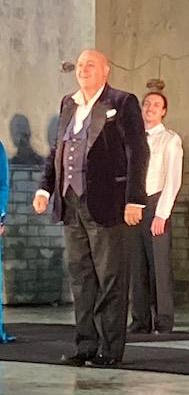
A mezzo Katarina Dalayman foi muito convincente no encorajamento da filha a pedir a cabeça do João Baptista e, no canto, foi óptima.

O Narraboth do tenor Thomas Atkins teve uma interpretação muito emotiva e até comovente, tanto na excelente componente vocal como na interpretação cénica.

Os muitos cantores secundários, apesar de terem interpretações curtas, estiveram ao nível deste excelente espectáculo de ópera.


*****
SALOME, Royal Opera House, London, September / September 2022
I once again had the opportunity to see Salome by Richard Strauss in the remarkable production of David McVicar at the Royal Opera House. The staging is violent and shocking, but in this performance the nude scenes were removed, leaving only the executioner naked at the end of the opera.
As I mentioned in a previous text, the action is transported to the XXth century and takes place in Herod's palace. On the first floor you can see (barely) an elegant dinner, by candlelight. The main setting is the filthy basement of the palace, some bathrooms with walls with very dirty white tiles, in keeping with everything else. The prophet John the Baptist (Jokanaan) is imprisoned in a cistern, from which he is removed for some time, at the request of Salome. As the action progresses, everyone descends to the basement.
The sickening scenes of Salome's harassment of Jokanaan and Herod of Salome are explicit. In the dance of the seven veils, the stage is radically transformed, with seven moving doors appearing successively, between which and with the help of short films, Salomé recalls seven traumatic episodes between her and her stepfather (Herodes), ending with their sexual relationship. The final necrophilia scene in which Salomé caresses and kisses the bloodied Jokanaan's head (brought out by the naked executioner) is even more impressive. A well done and shocking staging.
Strauss' music is powerful. The sound is grandiose and rich, the sound chromaticism is impressive, there are leitmotive and alternation of consonance with dissonance. The orchestra is the biggest part of this work. Under the direction of conductor Alexander Soddi, the was at its best and provided us with a superior, lively and dramatic interpretation, giving us all the timbral sumptuousness that does justice to Strauss' music.
The soloist singers were all of top quality. Soprano Malin Byström was a Salome with a smooth and very beautiful timbre, maintaining high vocal quality throughout the performance, always over the orchestra and with an overwhelming ending. The singer is thin, tall and seems to have the youth that the character demands, which helped a lot in her great scenic performance.
Baritone Jordan Shanahan was a great Jokanaan, with a strong and powerful voice, with a perfect scenic performance.
Herod was interpreted by tenor John Daszak who was at a higher level. He was always very audible, the timbre is suited to the character and he was always good in the scenic component.
Mezzo Katarina Dalayman was very convincing in encouraging her daughter to ask for the head of João Baptista and, in the corner, she was great.
The Narraboth of tenor Thomas Atkins had a very emotional and even moving interpretation, both in the excellent vocal component and in the scenic interpretation.
The many support singers, despite having short interpretations, were at the level of this excellent opera show.
*****


