Mostrar mensagens com a etiqueta Vlada Borovko. Mostrar todas as mensagens

quinta-feira, 2 de agosto de 2018

LA BOHÈME, Royal Opera House, Londres / London, Junho / June 2018


(review in English below)


A encenação de La Bohème de Puccini na Royal Opera House é da autoria de Richard Jones e é muito interessante. É clássica e muito fiel ao libretto, mas a forma como é posta em cena é muito interessante. Há neve a cair desde antes do início da ópera e assim continua. O efeito é de grande impacto visual porque, ao contrario do habitual, a “neve” cai em vários planos, ao longo de toda a profundidade do palco. Todos os componentes cénicos são constituídos por módulos sobre rodas que são colocados e removidos enquanto o espectáculo decorre, sem o perturbar, uma abordagem já vista mas aqui muito bem conseguida.


Os vários actos decorrem em cenários muito fiéis. A nota de maior curiosidade é no 2º acto, no Café Momus, onde a Musetta, quando canta a sua valsa, tira as cuecas e oferece-as ao Marcello. No 4º acto, nas águas furtadas onde os boémios vivem, a Mimi é deitada no chão, pois nem cama têm.


A direcção musical, um pouco estridente por vezes, foi do maestro Nicola Luisotti.


O tenor Atalla Ayan foi um Rodolfo convincente, embora algo contido no desempenho vocal. Tem uma voz de timbre agradável, sempre afinado, mas pouco emotivo em cena.


A soprano Ekaterina Siurina foi uma Mimi excelente. A voz tem um poder enorme mas a cantora soube usá-la sempre com qualidade, mais reservada quando era necessário. Esteve sempre bem, mas achei que nos 1º e 3º actos foi onde o desempenho vocal foi mais marcante.


A mezzo Vlada Borovko foi uma Musetta excessivamente espampanante, mas a culpa não será da cantora. A voz, enorme, é levemente estridente mas globalmente de qualidade e bem colocada.


O Marcello de Rodion Pogossov foi um dos melhores da noite. O cantor tem boa figura, agilidade em palco e a voz, bonita e grande, sempre afinada, adequa-se perfeitamente à personagem.


Também excelente foi o baixo In Sung Sim como Colline. Tem uma voz grande, muito bonita, com um registo baixo verdadeiramente impressionante.


O Schaunard de Andrzej Filonczyk cumpriu com dignidade, embora tenha uma intervenção pequena.


Mais um espectáculo de grande qualidade em Londres.


****


LA BOHÈME, Royal Opera House, London, June 2018

The staging of Puccini’s La Bohème at the Royal Opera House is by Richard Jones and is very interesting. It is classic and very faithful to the libretto, but the way it is put on the scene is very interesting. There is snow falling since before the start of the opera and so it goes until the end. The effect is of great visual impact because, unlike the usual, the "snow" falls in several rows, along the whole depth of the stage. All the stage components are made up of modules on wheels that are placed and removed while the performance goes on, without disturbing it, an approach already seen but here very well achieved.
The various acts take place in very faithful settings. The note of greatest curiosity is in the second act, at Café Momus, where Musetta, when she sings her waltz, takes off her briefs and offers them to Marcello. In the 4th act, in the poor flat where the Bohemians live, Mimi is lying on the floor, because they have no bed.

The musical direction, somewhat strident at times, was by maestro Nicola Luisotti.

Tenor Atalla Ayan was a compelling Rodolfo, though somewhat contained in vocal performance. He has a pleasant voice, always in tune, but occasionally unemotional on the scene.

Soprano Ekaterina Siurina was an excellent Mimi. The voice has enormous power but the singer knew to use it always with quality, more reserved when it was necessary. She was always good, but I thought that in the 1st and 3rd acts it was where the vocal performance was most striking.

Mezzo Vlada Borovko was an overly soulful Musetta, but the fault will not be of the singer. The voice, huge, is slightly strident but overall quality and well tuned.

Rodion Pogossov's Marcello was one of the best of the night. The singer has a good figure, agility on stage and the voice, beautiful and big, always in tune, fits perfectly to the character.

Also excellent was the bass In Sung Sim as Colline. He has a great, very beautiful voice, with a truly impressive low register.

Andrzej Filonczyk's Schaunard sung with dignity, although he has a small intervention.

Another great performance in London.

****

quarta-feira, 13 de setembro de 2017

MITRIDATE, RE DI PONTO, Royal Opera House, Londres / London, Julho / July 2017

(review in English below)

A opera Mitridate, Re di Ponto, escrita por WA Mozart quando tinha apenas 14 anos, com libretto de Vittorio Cigna-Santi, esteve em cena na Royal Opera House.


A encenação foi de Graham Vick. Há duas grandes paredes encarnadas dos lados e painéis também encarnados verticais que, ao longo da ópera, se vão movendo, criando os diversos cenários. Outros adereços são escassos. Muito vistosos e coloridos são os fatos usados pelas personagens, à moda do Séc. XVIII. A ópera é muito barroca, dominada por arias onde as personagens expressam as suas emoções, intercaladas por recitativos.


Mitridate, rei de Ponto é dado como morto enquanto combate os romanos. Farnace, o filho mais velho tenta conquistar Aspasia, noiva do pai, mas ela está apaixonada por Sifare, o irmão mais novo. Mitridate regressa e traz consigo a princesa Ismene, uma noiva para Farnace. Ao saber da aproximação de Farnace aos romanos, Mitridate manda prendê-lo. O filho diz-lhe que Sifare ama Aspasia. Mitridate manda matar a noiva e os filhos, o que acaba por não acontecer. O rei vai combater os romanos e os filhos decidem acompanhá-lo. Os romanos oferecem o trono a Farnace que, arrependido, decide ajudar o pai a derrotá-los. Mortalmente ferido, Mitridate aprova os casamentos de Sifare e Aspasia e de Farnace e Ismene.


O maestro e cravista continuo foi Christophe Rousset que dirigiu com qualidade a orquestra que não esteve isenta de algumas notas falhadas, sobretudo nos sopros.

Nos solistas houve uma série de substituições dos inicialmente anunciados, penso que todas elas para pior. Sifare, filho mais novo de Mitridate foi o soprano georgiano Salome Jicia (substituiu Anett Fritsch). Tem uma voz algo áspera, com agudos estridentes e pouco emotiva na expressividade.


Aspasia, prometida a Mitridate foi a soprano russa Vlada Borovko (substituiu Albina Shagimuratova). Tem uma voz grande mas um timbre pouco agradável, coloratura deficiente e perde muita qualidade no registo agudo.


Marzio, tribuno romano foi tenor inglês Rupert Charlesworth (substituiu Andrew Tortsie) que o pouco que se ouviu foi desinteressante.

Arabate, governador de Nymphaeum foi a soprano irlandesa Jennifer Davis (do Jette Park Young Artists Programme). Enfim...

Farnace, filho mais velho de Mitridate foi o contra tenor americano Bejun Mehta e este foi um dos grandes intérpretes da noite. Sempre audível sobre a orquestra, voz bem colocada, ágil e, nas árias mais introspectivas teve grande qualidade.


Mitridate foi o tenor americano Michael Spyres, outra grande interpretação da noite. Voz com uma paleta de cores muito interessante, sempre afinada e de marcada qualidade em todos os registos. Cenicamente foi também muito bem.


A grande grande intérprete da noite foi a soprano britânica Lucy Crowe no papel de Ismene, filha do rei de Pártia. Fantástica em tudo. Cenicamente parecia uma boneca, movimentação muito graciosa e viva. A voz, um colosso. Um soprano de elevadíssima qualidade, cheio de matizes interessantes que tanto impressionava quando quase sussurrava como quando emitia notas agudas estratosféricas, sempre audíveis em perfeita afinação. Fabulosa!


Um espectáculo raro e de qualidade.


****


MITRIDATE, RE DI PONTO, Royal Opera House, London, July 2017

The opera Mitridate, Re di Ponto, written by WA Mozart when he was only 14, with libretto by Vittorio Cigna-Santi, was on stage at the Royal Opera House.

The staging was by Graham Vick. There are two large red walls on the sides and also red vertical panels that, throughout the opera move, creating the different scenarios. Other props are scarce. Very colorful are the dresses used by the characters, in the style of the 18th century. The opera is very baroque, dominated by arias where the characters express their emotions, interspersed by recitatives.

Christophe Rousset was the harpsichord continuous and directed the orchestra that was not perfect.

In the soloists there were a lot of replacements of the initially announced artists, I think all for the worse. Sifare, Mitridate's youngest son was the Georgian soprano Salome Jicia (replacing Anett Fritsch). She has a rather rough voice, with shrill trebles and unemotional expressiveness.

Aspasia, promised to Mitridate was the Russian soprano Vlada Borovko (replacing Albina Shagimuratova). She has a big voice but the timbre is unpleasant, the coloratura poor, and loses quality in the high register.

Marzio, Roman tribune was English tenor Rupert Charlesworth (replacing Andrew Tortsie) that was heard with difficulty.

Arabate, governor of Nymphaeum was Irish soprano Jennifer Davis (of the Jette Park Young Artists Program). She was ok…

Farnace, the eldest son of Mitridate was American tenor Bejun Mehta and this was one of the great interpreters of the night. Always audible over the orchestra, well placed voice, agile and, in the most introspective arias, had great quality.

Mitridate was American tenor Michael Spyres, another great interpretation of the night. The voice has a very interesting color palette, always tuned and of marked quality in all registers. On xstage he was also very good.

The great great interpreter of the night was the British soprano Lucy Crowe in the role of Ismene, daughter of the king of Partridge. Fantastic in everything. On stage she looked like a doll, very graceful and lively. The voice, a colossus. A very high-quality soprano, full of interesting nuances that equally impressed when she almost whispered as when she emitted sharp stratospheric notes, always audible in perfect tuning. Fabulous!


****

domingo, 28 de maio de 2017

L’ELISIR D’AMORE, Royal Opera House, Londres / London, Maio / May 2017


(review in English below)

Esta é uma ópera de enredo simples, passada numa aldeia basca so Séc. XIX. Adina lê a história de Tristão e Isolda e refere que ela conquistou o Tristão com uma poção mágica. Nemorino, um rapaz da aldeia reconhece que não consegue conquistar uma mulher tão bela como Adina. Declara-lhe o seu amor mas ela rejeita-o. O sargento Belcore com o seu pelotão, declara-se e pede Adina em casamento. Surge o Dr. Dulcamara, um charlatão ambulante a quem Nemorino pede um elixir do amor. Vende-lhe uma garrafa de vinho barato como elixir que fará efeito em 24 horas. Belcore é chamado aos deveres militares e marca casamento de imediato. Adina surpreende-se com a indiferença do Nemorino. Ele quer comprar mais elixir ao Dulcamara mas, como está sem dinheiro, alista-se, recebe um pagamento do Belcore e bebe mais uma garrafa do “elixir” ficando embriagado. Uma das raparigas da aldeia dá a notícia que um tio do Nemorino morreu e deixou-lhe uma fortuna. Todas se interessam subitamente por ele que, desconhecendo as notícias da morte do tio, pensa que é o elixir a surtir efeito. Adina reconhece que ama o Nemorino, paga para o libertar do exército e ele, ao ver uma lágrima furtiva na face de Adina, percebe que ela o ama. O sargento Belcore conforma-se com a perda e o Dr. Dulcamara diz que o seu elixir traz não só amor como fortuna, vende todas as garrafas de vinho barato aos camponeses e abandona a aldeia.


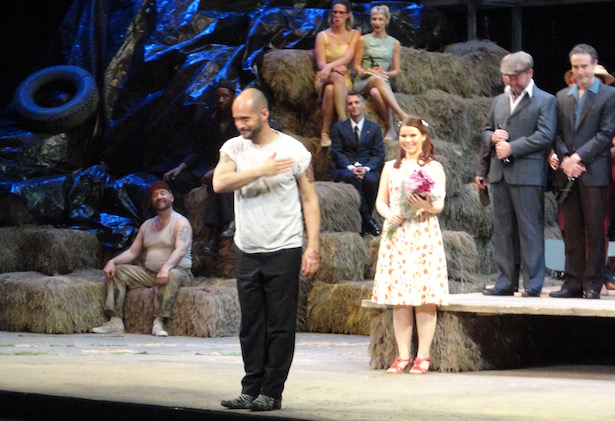
A encenação de Laurent Pelly da opera L’Elisir d’Amore de Donizetti, trazendo a acção para uma aldeia rural italiana nos anos 50-60 do século passado é um regalo para os olhos. Tudo se passa no meio de uma imensidão de fardos de palha, o guarda roupa é excelente, há bicicletas, scooters, tractores e uma camioneta ambulante de venda dos produtos do charlatão Dr. Dulcamara, sempre vestido a preceito. O Nemorino está vestido como um pobre rapaz campónio. O pelotão do sargento Belcore é constituído por dois elementos magros, um negro muito alto e um asiático muito baixo. Os pormenores agradáveis e engraçados são inúmeros, a direcção de actores excelente e, como os solistas são jovens, prestam-se a movimentações acrobáticas que não se costumam ver em cantores de ópera. E há um cão que atravessa o palco em dois momentos, uma maravilha!


O maestro Bertrand de Billy cumpriu sem deslumbrar, a orquestra não foi perfeita, mas o espectáculo foi magnífico.


A Adina foi interpretada pela Sul Africana Pretty Yende. Tem um soprano lírico de extraordinária beleza, sempre afinada em todos os registos, com agudos estratosféricos, nunca grita e com uma coloratura notável. A figura jovem e elegante da cantora ajudaram muito. Foi uma interpretação superlativa.


No mesmo nível de qualidade esteve o Nemorino do tenor arménio Liparit Avetisyan. Tem uma voz muito bonita, segura e sempre bem audível. Foi muito emotivo ao longo de toda a récita e um verdadeiro atleta, vocal e na movimentação cénico, revelando uma invulgar agilidade física. A ária Una furtiva lágrima foi tocante e, por ela, recebeu uma estrondosa e merecida ovação.


E o que dizer do baixo barítono italiano Alex Esposito? Que foi a melhor interpretação do Dr. Dulcamara que vi e ouvi até hoje? Sim, mas muito mais. Voz magnífica, bem timbrada, potente e afinada em todas as intervenções. E em cena foi melhor que muitos actores profissionais. A encenação ajuda muito, está muito focada na sua personagem, a figura do cantor também, mas o principal foi a sua capacidade artística. Fantástico.


Outro barítono italiano, Paolo Bordogna, também esteve ao mais alto nível como Belcore que, em linha com os restantes solistas, foi impecável na interpretação vocal e na cénica.


A jovem soprano russa Vlada Borovko do programa Jette Parker young Artists da ROH fez uma Giannetta muito engraçada, apesar de o papel ser pequeno.


Um espectáculo inesquecível que mostra a ópera em todo o seu esplendor!


*****


L'ELISIR D'AMORE, Royal Opera House, London, May 2017

This is a simple plot opera, occurring in a Basque village in the 19th century. Adina reads the story of Tristan and Isolde and refers that she conquered Tristan with a magic potion. Nemorino, a village boy recognizes that he can not conquer a woman as beautiful as Adina. He declares his love to her, but she rejects him. Sergeant Belcore with his platoon, declares himself and asks Adina to marry him. Dr. Dulcamara appears, a walking charlatan whom Nemorino asks for an elixir of love. He sells ​​him a bottle of cheap wine as the elixir that will take effect in 24 hours. Belcore is called to military duties and wants to marry immediately. Adina is surprised by Nemorino's indifference. He wants to buy more elixir from Dulcamara but, since he's out of money, he enters the army and gets a payment from Belcore. Now he can buy another bottle of the "elixir", getting drunk. One of the girls from the village gives the news that Nemorino's uncle died and left him a fortune. All girls are suddenly interested in Nemorino who, unaware of the news of his uncle's death, thinks that it is the elixir to have an effect. Adina recognizes that she loves Nemorino, pays to free him from the army and he, seeing a furtive tear in Adina's face, realizes that she loves him. Sergeant Belcore complies with the loss and Dr. Dulcamara says that his elixir brings not only love but fortune, he sells all bottles of cheap wine to the peasants and leaves the village.

Laurent Perry's staging of the opera L'Elisir d'Amore by Donizetti, bringing action to an Italian rural village in the 50-60 years of the past century is beautiful. Everything is set amidst a bundle of straw bales, the outfits are excellent, there are bikes, scooters, tractors and a van selling the products of the charlatan Dr. Dulcamara. The pleasant and funny details are numerous, the directors of actors excellent and, as the soloists are young, they lend themselves to acrobatic movements not usually seen in opera singers. And there is a dog that crosses the stage in two moments, a marvel!

The conductor Bertrand de Billy fulfilled without dazzling, the orchestra was not perfect, but the performance was magnificent.

Adina was interpreted by South African Pretty Yende. She has a lyrical soprano of extraordinary beauty, always tuned in every record, with stratospheric top notes and she never screams. The young and elegant figure of the singer helped a lot. She had a superlative performance.

At the same level of quality was Nemorino of the Armenian tenor Liparit Avetisyan. He has a very beautiful voice, firm and always well audible. He was very emotional throughout the performance and a true athlete, vocal and in the scenic movement, revealing an unusual physical agility.

And what about the Italian bass baritone Alex Esposito? Was his the best interpretation of Dr. Dulcamara I've seen and heard to this day? Yes, but much more. Magnificent voice, beautiful timbre, powerful and tuned in all the interventions. And on the scene he was better than many professional actors. The staging helps a lot, it is very focused on his character, the figure of the singer too, but the main thing was his artistic ability.

Another Italian baritone, Paolo Bordogna, was also at the highest level as Belcore, who, in line with the other soloists, was impeccable in vocal and stage acting.

The young Russian soprano Vlada Borovko from ROH's Jette Parker Young Artists programme was a very funny Giannetta, even though the role was small.

An unforgettable performance that shows the opera in all its splendour!


*****