


Pagliaci com
música e libretto de Ruggero Leoncavallo,
é uma obra do verismo italiano, em que a ficção se confunde com a realidade.
Numa troupe de commedia dell’arte,
Nedda, a jovem mulher de Canio, o palhaço, está apaixonada por Sílvio, um jovem
camponês. Tonio, membro da troupe, é rejeitado por Nedda e denuncia-a ao marido
Canio. No final e em plena representação da comédia, mata-os, terminando o
espectáculo e a ópera e com a expressão “La
commedia è finita”.

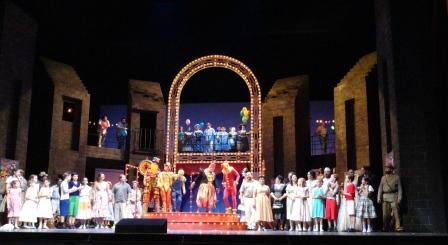
A encenação de Grischa
Asagaroff é muito boa, cheia de cor, com saltimbancos e todo o ambiente
adequado ao enredo. Também a movimentação em palco e os cenários são muito bem
conseguidos.
O maestro Alexander
Vedernikov ofereceu-nos uma bela direcção da obra.

O soprano Elena Mosuc
foi excelente como Nedda. A voz é potente, afinada e expressiva. A actuação
cénica também de grande nível.

O tenor Zoran Todorovich
tem uma voz excelente, poderosa, de timbre muito agradável e, sobretudo, muito
expressiva Ofereceu-nos um Canio dilacerado pela desconfiança e ciúme, o que
deu muita credibilidade à interpretação.


O Tonio do barítono Lucio
Gallo esteve muito bem, apesar de o papel ser pequeno.

Apenas o barítono Elliot
Madore esteve aquém dos restantes solistas. Fez um Sílvio cenicamente
interessante mas de voz pequena e pouco expressiva.

Um espectáculo muito agradável!


****
PAGLIACI,
Opernhaus Zürich, January 2013
Pagliaci with music and libretto by Ruggero Leoncavallo, is a masterpiece of Italian verismo, where fiction is indistinguishable from reality. In a group of commedia dell'arte, Nedda, the young wife of Canio, the clown, is in love with Silvio, a young peasant. Tonio, a member of the group, is rejected by Nedda and denounces her to her husband Canio. At the end and during the performance of the comedy, he kills them, ending the show and the opera with the expression "La commedia è finita."
The staging of Grischa Asagaroff is very attractive, full of color, with acrobats and all the proper environment for the plot. Also the action on stage and the scenarios are very effective.
Pagliaci with music and libretto by Ruggero Leoncavallo, is a masterpiece of Italian verismo, where fiction is indistinguishable from reality. In a group of commedia dell'arte, Nedda, the young wife of Canio, the clown, is in love with Silvio, a young peasant. Tonio, a member of the group, is rejected by Nedda and denounces her to her husband Canio. At the end and during the performance of the comedy, he kills them, ending the show and the opera with the expression "La commedia è finita."
The staging of Grischa Asagaroff is very attractive, full of color, with acrobats and all the proper environment for the plot. Also the action on stage and the scenarios are very effective.
Conductor Alexander Vedernikov offered us a nice
direction of the work.
Soprano Elena Mosuc was excellent as Nedda. The
voice is powerful, refined and expressive. The action on stage was also of great artistic level.
Tenor Zoran Todorovich has an excellent, powerful voice and a very pleasing timbre. He offered us a Canio torn by distrust and jealousy, which gave much credence to the performance.
Baritone Lucio Gallo was a very good Tonio, despite the role being small.
Only baritone Elliot Madore was behind the other soloists.He was a Silvio with a small and not very expressive voice.
A very enjoyable performance!
****
Tenor Zoran Todorovich has an excellent, powerful voice and a very pleasing timbre. He offered us a Canio torn by distrust and jealousy, which gave much credence to the performance.
Baritone Lucio Gallo was a very good Tonio, despite the role being small.
Only baritone Elliot Madore was behind the other soloists.He was a Silvio with a small and not very expressive voice.
A very enjoyable performance!
****


