Mostrar mensagens com a etiqueta adam Plachetka. Mostrar todas as mensagens

quinta-feira, 1 de dezembro de 2022

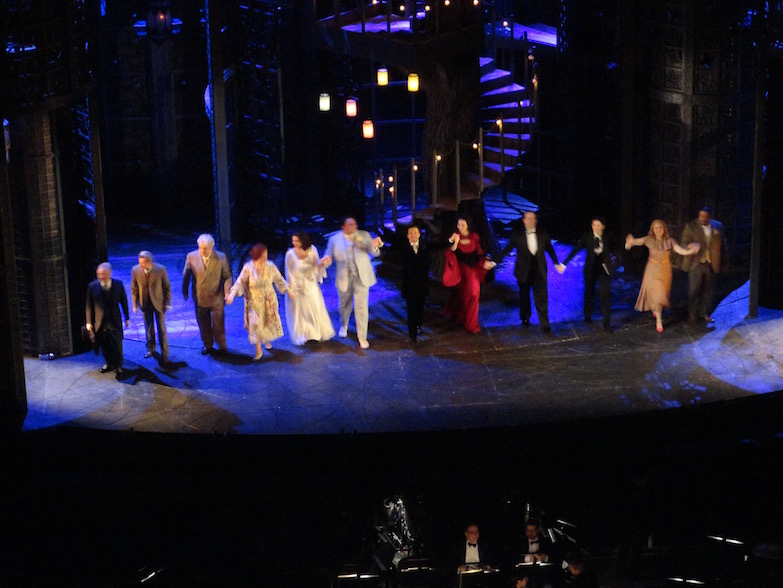
PETER GRIMES, METropolitan OPERA, New York, Outubro / October 2022


(Review in English below)

A ópera Peter Grimes de B Britten passa-se numa pequena aldeia piscatória no litoral de Inglaterra. O pescador Peter Grimes, contra a vontade dos aldeões, é ilibado da morte do seu mais recente aprendiz e não deverá contratar outros. Poucos dias depois um boticário arranja num orfanato um novo aprendiz, John. A comunidade desaprova mas a professora Ellen Orford e um comandante reformado, Balstorde, apoiam-no. Grimes quer enriquecer com a pesca para casar com Ellen. Aproxima-se uma grande tempestade e ele quer ir para o mar. Ellen contraria-o e critica-o por ter molestado John que tem cicatrizes no pescoço. A população dirige-se à cabana de Grimes. Nas traseiras, a tempestade originou um desabamento de terras e John cai para o mar e  morre. Grimes lança-se atrás dele e desaparecem ambos. Balstrode, dias mais tarde, vê o barco de Grimes e, com Ellen, recolhe-o. A aldeia está vazia. Balstrode aconselha-o a levar o barco para o mar e afundá-lo. No dia seguinte os aldeões vêem um barco afundar-se, mas longe de mais para poder ser salvo.


A encenação de John Doyle é relativamente simples mas muito eficaz. Uma enorme fachada de casa em madeira, com portas a várias alturas, funciona bem nas várias cenas. As paredes também se afastam, o que permite criar situações adicionais de bom efeito cénico. Há ocasionalmente projecções excelentes (em particular do mar revolto). O ambiente é escuro como a ópera, os aldeões (coro) aparecem de cinzento escuro ou negro e não se misturam com Grimes. 


O maestro foi Nicholas Carter. A Orquestra tocou bem e o Coro salientou-se nas muitas e expressivas intervenções. 


A música de Britten não é das que mais aprecio, tem passagens líricas alternadas com dissonâncias. Contudo, os interlúdios musicais alusivos ao mar são impressionantes, muito ajudados pela encenação, com as projecções de mar agitado já referidas.


O tenor Allan Clayton foi Peter Grimes. Cantou bem, sempre sobre a orquestra e conseguiu transmitir a sua exclusão da comunidade, uma componente essencial da ópera.  


A soprano Nicole Car foi para mim a melhor da noite no papel de Ellen Orford. É uma cantora que muito aprecio graças à beleza vocal e ao seu empenho marcante nas interpretações que leva à cena. Mais uma vez, foi óptima. 


O barítono Adam Plachetka foi um Balstrode afinado, bem audível e, dentro do que a personagem permite, correcto na postura cénica.

Vários cantores secundários têm pequenas participações, incluindo Harold Wilson (Hobson), Patrick Carfizzi (Swallow), Michaela Martens (Mrs. Sedley), Denyce Graves (Auntie), Chad Shelton (Bob Boles), Tony Stevenson (Rev. Adams) e Justin Austin (Ned Keene).


***

PETER GRIMES, METropolitan OPERA, New York, October 2022

The opera Peter Grimes by B Britten takes place in a small fishing village on the coast of England. 

The fisherman Peter Grimes, against the wishes of the villagers, is cleared by a lawyer of the death of his latest apprentice and must not hire others. A few days later, an apothecary finds a new apprentice, John, in an orphanage. The community disapproves but professor Ellen Orford and a retired sea captain, Balstorde, support him. Grimes wants to get rich from fishing to marry Ellen. A big storm is coming and he wants to go to sea. Ellen antagonizes him and criticises him for molesting John who has scars on his neck. The villagers head to Grimes' hut. In the back, the storm caused a landslide and John falls into the sea and dies. Grimes launches after him and they both disappear. Balstrode, days later, sees Grimes' boat and, with Ellen, picks him up. The village is empty. Balstrode advises Grimes to take the boat out to sea and sink it. The next day the villagers see a boat sinking, but too far away to be saved.

John Doyle staging is relatively simple but very effective. A huge wooden house facade, with doors at various heights, works well in the different scenes. The walls also move away, which makes it possible to create additional situations with a good scenic effect. There are occasionally excellent projections (particularly of the rough sea). The atmosphere is dark like the opera, the villagers (chorus) appear dressed in dark gray or black and don't mix with Grimes.

The conductor was Nicholas Carter. The Orchestra played well and the Choir stood out in its many expressive interventions.

Britten's music is not one of my favorites, it has lyrical passages alternating with dissonances. However, the musical interludes alluding to the sea are impressive, greatly aided by the staging, with the previously mentioned rough sea projections.

Tenor Allan Clayton was Peter Grimes. He sang well, always over the orchestra and managed to convey his exclusion from the community, an essential component of the opera.

Soprano Nicole Car was for me the best of the night in the role of Ellen Orford. She is a singer that I really appreciate thanks to her vocal beauty and her remarkable commitment to the interpretations she brings to the scene. Once again, she was great.

Baritone Adam Plachetka was a finely tuned Balstrode, very audible and, as far as the character allows, correct in the scenic posture.

Several supporting singers participate, including Harold Wilson (Hobson), Patrick Carfizzi (Swallow), Michaela Martens (Mrs. Sedley), Denyce Graves (Auntie), Chad Shelton (Bob Boles), Tony Stevenson (Rev. Adams) and Justin Austin (Ned Keene).

***

sexta-feira, 8 de maio de 2020

LE NOZZI DI FIGARO / AS BODAS DE FIGARO METropolitan Opera, Fevereiro / February 2020


 (review in English below)

As Bodas de Fígaro de Mozart na produção da da METropolitan Opera de Nova Iorque tem encenação de Richard Eyre.


A acção passa-se em Sevilha e foi trazida para os anos 1930, mas a encenação é convencional e desinteressante. A distinção entre os nobres e os criados só é evidente no guarda roupa e esgota-se por aí. O palco é rotativo e vêem-se várias partes do palácio, incluindo o salão, o quarto da condessa, o quarto do Fígaro e os jardins. As paredes têm uma decoração mourisca e são muito altas, minimizando por vezes o que se passa no palco.


Logo na abertura é dado o mote, aparecendo uma mulher nua da cintura para cima a vestir-se apressadamente e, depois, o conde em robe vermelho e com ar satisfeito, enquanto a condessa dorme sozinha no seu quarto. Tudo o resto se passa no mesmo cenário que, apesar da rotação do palco, não tem grande interesse.


O maestro Cornelius Meister não fez um bom trabalho. Alguns desencontros, sobretudo no início e a orquestra sempre morna. Nem parecia Mozart.
Adam Plachetka foi um Figaro apagado vocalmente, com emissão irregular e sem grande vivacidade no palco.


Hanna-Elisabeth Müller esteve bem como Susanna, tanto no canto como na representação cénica.


Maurizio Muraro foi de longe o melhor como Dr. Bartolo, com uma voz grave poderosa e afinada.


Etienne Dupuis fez um Conde desinteressante, estático e que se deixou afogar pela orquestra várias vezes.


Amanda Woodbury foi uma Condessa de voz bonita e afinada. Contudo, em palco cumpriu sem encantar.


MaryAnn McCormick foi uma Marcellina banal, Marianne Crebassa um óptimo Cherubino, 


e Maureen McKay uma Barbarina apagada.


Esperava melhor destas Bodas.


***


LE NOZZI DI FIGARO, METropolitan Opera, February 2020

Mozart's Marriage of Figaro in the staging of New York's METropolitan Opera was produced by Richard Eyre.
The action takes place in Seville and was brought to the 1930s, but the staging is conventional and uninteresting. The distinction between nobles and servants is only evident in the clothes and ends there. The stage is rotating and one can see several parts of the palace, including the hall, the countess's room, Figaro's room and the gardens. The walls have a Moorish decor and are very tall, sometimes minimizing what goes on the stage.
Right at the opening the motto is given, a naked woman appears from the waist up, hurriedly dressing, and then the count in a red robe and looking satisfied, while the countess sleeps alone in her room. Everything else takes place in the same scenario that, despite the rotation of the stage, has little interest.
Conductor Cornelius Meister did not do a good job. Some failures, especially at the beginning and the orchestra was always lukewarm. It didn't even sound like Mozart.

Adam Plachetka was a Figaro vocally erased, with irregular emission and without great vividness on the stage. Hanna-Elisabeth Müller was just well as Susanna, both in singing and performing. Maurizio Muraro was by far the best as Dr. Bartolo, with a powerful and tuned bass voice. Etienne Dupuis made an uninteresting, static Count who was drowned by the orchestra several times. Amanda Woodbury was a Countess with a beautiful and tuned voice. However, on stage she fulfilled without enchantment. MaryAnn McCormick was a banal Marcellina, Marianne Crebassa a great Cherubino, and Maureen McKay a trivial Barbarian.

I expected better from this marriage.

***

segunda-feira, 24 de outubro de 2016

DON GIOVANNI, METropolitan Opera, New York, Outubro / October 2016


(review in English below)

A produção de Michael Grandage do Don Giovanni de W.A. Mozart esteve novamente em cena na Metropolitan Opera de Nova Iorque.

É uma encenação clássica, feia, escura e pouco imaginativa, passada numa cidade espanhola no Sec. XVIII (assim diz o programa). Mas apenas se vêm três andares de janelas exteriores. Há alguma mobilidade do palco mas nada é  interessante. Apenas a cena final em que o Don Giovanni é consumido pelas chamas foi um pouco diferente da rotina em que tudo o resto decorreu, mas ainda assim sem originalidade.


O maestro Fabio Luigi dirigiu de forma sofrível, sem qualquer ímpeto mozartiano, a excelente Orquestra da Metropolitan Opera.


Em relação aos solistas, um conjunto muito heterogéneo de cantores:

A soprano russa Hibla Gerzmava (Dona Anna) ofereceu-nos uma interpretação vocalmente marcante. A voz é poderosíssima e a afinação boa em todos os registos. Mas canta sempre em forte e é excessivamente dura (e com vibrato marcado) em partes que mereciam maior lirismo.


A Zerlina da mezzo Serena Malfi foi excelente e, para mim, a melhor da noite. A cantora tem uma voz jovem, muito bonita, ricamente colorida e muito expressiva, sempre bem audível. E teve uma presença em palco muito boa.


A soprano sueca Malin Byström foi uma Dona Elvira de voz lírica potente e sempre bem na afinação, embora haja algo no timbre que não sei explicar mas que me desagrada.


Simon Keenlyside, barítono inglês que sempre apreciei, fez um Don Giovanni de voz bonita, expressiva, mas com uma prestação irregular ao longo do espectáculo. Em cena foi fisicamente muito activo e convincente, tendo optado por um Don rude e pouco polido.


Os dois baixos foram as melhores interpretações masculinas, Matthew Rose foi um Masetto excelente, de voz bonita e sempre bem audível, e Kwangchul Youn um Comendador imponente, apesar de cantar pouco.


Don Ottavio foi cantado pelo tenor norte americano Paul Appleby. A voz foi pequena e com grandes limitações no registo mais agudo, parecia cantar em falsete. Houve várias desafinações ao longo da récita, mas não deixou de ser fortemente aplaudido, no final, pelos seus compatriotas.


O baixo-barítono checo Adam Plachetka fez um Leoporello para esquecer. Voz muito fraca que, por vezes, mal se ouvia. Foi pena, porque é uma das personagens principais da ópera e, cenicamente, não passou da mediania. A troca de casacos (e de identidades) entre ele (um homem de grande porte) e o Don (interpretado por um homem pequeno em estatura) no início do 2º acto foi ridícula, mas os cantores disto não tiveram culpa.


Não se ouviu Mozart nesta récita do Don Giovanni!


**

Don Giovanni, Met Opera, New York, October 2016

The Michael Grandage's production of W. A. ​​Mozart’s Don Giovanni was again on stage at the Metropolitan Opera in New York.

It's a classic, ugly, dark and unimaginative staging, occuring in a Spanish town in Sec. XVIII (so says the program). But we only see three floors of exterior windows. There was some mobility of the stage but nothing was interesting. Only the final scene where Don Giovanni is consumed by the flames was a little different from the routine in which everything else took place, but still unoriginal.

Maestro Fabio Luigi conducted the excellent Orchestra of the Metropolitan Opera without any Mozartian momentum.

Regarding soloists, a very heterogeneous set of singers:

Russian soprano Hibla Gerzmava (Dona Anna) offered us a vocally striking interpretation. The voice is powerful and tuned in all registers. But she always sang in forte and was too harsh (and with marked vibrato) in parts that deserved greater lyricism.

Zerlina of mezzo Serena Malfi was excellent and, for me, the best of the night. The singer has a young, very beautiful, richly colored and very expressive voice, and was always audible. And she had a very good presence on stage.

Swedish soprano Malin Byström was a Dona Elvira with powerful lyrical voice and always well in pitch, although there is something in the tone I cannot explain but that displeases me.

Simon Keenlyside, English baritone that I always appreciated, made a Don Giovanni of nice expressive, voice, but with an uneven performance throughout the show. On stage he was physically very active and convincing, having adopted to be a rude and impolite Don.

The two basses were the best male interpreters, Matthew Rose was an excellent Masetto, with beautiful voice and always well audible, and Kwangchul Youn an imposing Comendatore, although his singing is short.

Don Ottavio was sung by North American tenor Paul Appleby. The voice was small and with major limitations in the high register, seemed to sing in falsetto. There were several mistakes along the performance, but he was strongly applauded in the end.

Czech bass-baritone Adam Plachetka made a Leoporello to forget. The voice was very weak and sometimes barely audible. Too bad, because it is one of the main characters of the opera and on stage, he has not passed from mediocrity. The exchange coats (and identities) between him (a large man) and Don (played by a small man in stature) at the beginning of the 2nd act was ridiculous, but the singers did not have this fault.

Mozart was not heard in this Don Giovanni performance!


**