Mostrar mensagens com a etiqueta Tara Erraught. Mostrar todas as mensagens

segunda-feira, 16 de outubro de 2017

LES CONTES D’HOFFMANN, METropolitan Opera, Outubro / October 2017

(review in English below)

Na Metropolitan Opera esteve novamente em cena a ópera Les Contes d’Hoffmann  de Jacques Hoffenbach.

A encenação de Bartlett Sher é vistosa e diversificada, mas irregular. O prólogo e o epílogo decorrem numa taberna alemã convencional. O primeiro acto, a história de Olympia, é o mais bem conseguido. Passa-se numa feira, na barraca de Spalanzani, onde a utilização de guarda-chuvas com olhos desenhados tem um efeito de grande impacto. O segundo acto é, teatralmente, decepcionante porque não há nada para ver. O palco está vazio e podia passar-se em Munique ou em qualquer outro local. Em contraste, o 3º acto é cenicamente exagerado, com uma mistura de prostitutas e outros figurantes exuberantemente vestidos (recuperando-se as referencias aos actos anteriores) numa Veneza com gôndolas.


 A direcção musical foi muito boa, pelo maestro Johannes Debus. 

O tenor italiano Vittorio Grigolo foi um Hoffmann de grande qualidade. Tem uma voz sempre bem audível, bonita e afinada em todos os registos. Em palco o cantor tem uma agilidade invulgar, que dá grande credibilidade à personagem.


A estreante mezzo irlandesa Tara Erraught interpretou a musa / Nicklausse com grande qualidade vocal e uma presença cénica algo estática, embora intercalada com partes muito boas, como aquela em que imitou a Olympia.


O baixo-barítono francês Laurent Naouri nos papéis diabólicos, Lindorf / Copéllius / Doctor Miracle e Dappertutto foi outro dos melhores intérpretes da noite. Tem um registo grave muito interessante, a voz é poderosa e de grande musicalidade. O cantor tem uma excelente figura o que o ajudou muito na prestação cénica.


A soprano norte-americana Erin Morley foi uma Olympia excelente. A voz é potente, afinada, muito maleável e perfeita para o papel. A prestação cénica foi também ao mais alto nível e a cantora foi a mais aplaudida da noite.


A Antonia e a Stella foram interpretadas pela soprano romena Anita Hartig. Foi outra grande intérprete. Tem um timbre muito agradável, sempre audível sobre a orquestra e de afinação perfeita. A cantora foi muito convincente na emotividade que colocou na interpretação.


A Giulietta foi cantada pela mezzo bielorrussa Oksana Volkova que cumpriu o papel sem encantar. A belíssima barcarola Belle nuit, ô nuit d’amour foi boa, mas há quem a cante bem melhor.


Nos papeis secundários cantaram Christophe Mortagne como Andrés, Cochenille, Frantz e Pitichinaccio, Mark Schowalter como Nathanael e Spalanzani, Robert Pomakov como Luther e Crespel, Olesya Petrova como mãe de Antónia e David Crawford como Hermann.

Um espectáculo de grande qualidade.


*****


LES CONTES D'HOFFMANN, METropolitan Opera, October 2017

Jacques Hoffenbach's opera Les Contes d'Hoffmann was once again in the season of the Metropolitan Opera.

Bartlett Sher's staging is colorful and diverse, but irregular. The prologue and the epilogue take place in a conventional German tavern. The first act, the Olympia story, is the most successful. It's at a fair in Spalanzani's tent, where the use of umbrellas with drawn eyes has a great impact. The second act is theatrically disappointing because there is nothing to see. The stage is empty and could be in Munich or anywhere else. In contrast, the third act is excessively populated, with a mixture of prostitutes and other exuberantly dressed extras (recalling references to previous acts) in a Venice with gondolas.

 Musical direction was very good, by the conductor Johannes Debus.

Italian tenor Vittorio Grigolo was a Hoffmann of top quality. He has a voice that is always well audible, beautiful and tuned in every register. On stage the singer has an unusual agility, helped by his handsome figure, which gives great credibility to the character.

Newcomer Irish mezzo Tara Erraught played the muse / Nicklausse with great vocal quality but a somewhat static stage presence, though interspersed with very good parts, such as the one in which she mimicked Olympia.

French bass-baritone Laurent Naouri in the diabolical roles, Lindorf / Copéllius / Doctor Miracle and Dappertutto was another of the best performers of the night. He has a very impressive bass register, the voice is powerful and of great musicality. The singer has also an excellent figure, which helped him a lot in the scenic performance.

American soprano Erin Morley was an excellent Olympia. The voice is powerful, tuned, very malleable and perfect for the paper. The stage performance was also at the highest level and the singer was the most applauded of the night.

Antonia and Stella were performed by Romanian soprano Anita Hartig. She was another great interpreter. She has a very pleasant tone, always audible over the orchestra and perfectly tunned. The singer was very convincing in the emotion she put into the performance.

Giulietta was sung by Belarusian mezzo Oksana Volkova who sang the role without enchanting. The beautiful barcarola Belle nuit, ô nuit d'amour was good, but there are other singers who sing it better.

In secondary sang Christophe Mortagne as Andrés, Cochenille, Frantz and Pitichinaccio, Mark Schowalter as Nathanael and Spalanzani, Robert Pomakov as Luther and Crespel, Olesya Petrova as Antonia's mother, and David Crawford as Hermann.

A performance of top quality.


*****

terça-feira, 14 de junho de 2011

I CAPULETI E I MONTECCHI – Bayerische Staatsoper, Munique, Abril de 2011

(review in English below) 

 I Capuleti e i Montecchi é uma ópera de Vicenzo Bellini com libreto de Felice Romani. A história baseia-se no amor trágico de Romeu e Julieta.


 O resumo da história pode ler-se aqui.


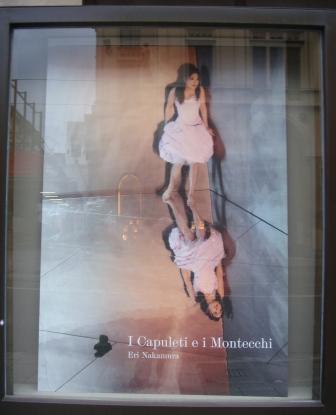
 Vicent Boussard foi o encenador. A Munique também já chegou a moda de as personagens serem vestidas por costureiros famosos, no presente caso Christian Lacriox.. As senhoras estavam, de facto, com fatos vistosos. Julieta tinha um exuberante vestido claro creme e azul e, apesar de ter andado sempre descalça durante todo o espectáculo, estavam-lhe destinados uns sapatos verdes, que nunca calçou. As mulheres do coro tinham vestidos compridos muito coloridos, tropeçavam frequentemente neles pois o cenário tinha nessas partes uma grande escadaria. Pareciam prostitutas vitorianas, mas enfim…


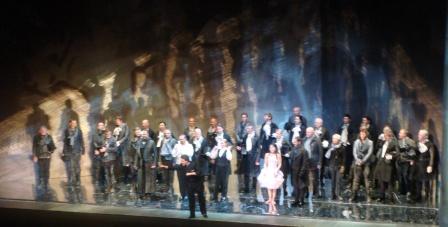
 A encenação, embora com notável impacto visual, foi bizarra. Na primeira cena há múltiplas celas de cavalos penduradas no tecto e os homens cantam vestidos de fato e cartola. Não há mais nada no palco. A primeira aparição de Julieta é no quarto e tem como únicos adereços uma pequena estátua suspensa no cimo e um lavatório. Ela empoleira-se nesse lavatório e aí, em equilíbrio precário, passa grande parte da cena, cantando nessa posição a belíssima ária Oh! Quante volte. Aparece Romeu e, sempre que ambos estão presentes, ao longo da ópera, Julieta parece evitá-lo a todo o custo. As restantes cenas passam-se com o palco envolvido numa moldura gigante, num efeito muito semelhante ao que vi aqui 


 A cena final, no túmulo, também é bizarra. Romeu entra e encontra Julieta “morta”, deitada no chão com o vestido de sempre. Em dado momento, ainda antes do acordar, Romeu puxa-a por um braço e ela fica em pé, imóvel, como que petrificada. Ao puxá-la o Romeu deu uma valente queda para trás, mas foi um pequeno acidente hilariante da noite. Depois de se envenenarem ambos e morrerem, avançam a passo lento para a boca de cena e cai o pano.
Foi, de facto, uma encenação diferente, mas vistosa.

(algumas fotografias são da Bayerische Staatsoper)

 O maestro Yves Abel dirigiu de forma assinalável e a Orquestra da Bayerische Staatsoper correspondeu com elevada qualidade. Foram notáveis os solos de harpa, violoncelo, flauta e oboé que tanto enriquecem a beleza melódica da partitura. No final, durante os agradecimentos, Yves Abel teve a delicadeza de fazer levantar cada um destes instrumentistas, o que lhe ficou muito bem.


 Romeu foi interpretado pelo jovem mezzo-soprano irlandês Tara Erraught, que substituiu Vesselina Kasarova, doente. Não conhecia esta cantora e deixou-me uma boa impressão. A voz é firme e bem audível. No registo mais grave é segura e muito agradável mas nos agudos perde um pouco a qualidade melódica. Evita gritar, apesar de cantar em esforço. Cenicamente não impressionou, mas o papel também não ajuda (apesar de tudo é uma mulher) e a encenação ainda menos.


 Julieta foi cantada pelo soprano japonês Eri Nakamura. Esta foi a grande surpresa da noite. Já a havia ouvido aqui, onde não me impressionou.


 Desta vez foi bem diferente. Teve uma interpretação fabulosa. A voz é de uma potência impressionante e de uma beleza ímpar. Mantém a qualidade em todos os registos, nomeadamente quando sobe para as notas mais agudas. O legato é também de grande qualidade e, nos duetos com Romeu, foi melhor, embora as duas vozes se conjugassem bem. Em cena foi quase uma artista de circo pois teve que cantar em posições de equilíbrio pouco estável por diversas vezes, quer em pé no lavatório do quarto no 1º acto, quer em cima da moldura no 2º acto. Ao que os encenadores obrigam os cantores!


 Lembro-me que, há cerca de 2 anos, me desloquei a Londres para ver I Capuleti e i Montecchi com Anna Netrebko e Elina Garanca. Na récita anterior à que assisti a Netrebko havia cancelado (tinha sido mãe há poucos meses) e fora substituída por Eri Nakamura, na altura estudante do programa Jette Parker para jovens artistas da Royal Opera House. Suspirei de alívio quando o espectáculo começou e tive a certeza que era a Netrebko que ia cantar. Essa foi uma récita daquelas que nunca esquecerei, mas hoje verifiquei que a Nakamura também está à altura do papel.


Tebaldo foi interpretado pelo tenor americano Dimitri Pittas Foi o elo mais fraco da noite. Apesar de ter cantado de forma decente, a voz perdia qualidade e potência quando cantava notas mais agudas e era notório o esforço do cantor para as manter audíveis.


 O baixo americano Steven Humes teve também uma boa prestação tanto cénica como vocal. Ofereceu-nos uma voz redonda, forte, expressiva e muito agradável.


 Como já referi neste blogue, sou um grande apreciador de belcanto e Bellini é, neste campo, o compositor que mais aprecio. Foi, por isso, com muita satisfação que voltei a ouvir esta ópera, apesar de encenada de uma forma totalmente inesperada.


****


I Capuleti ei Montecchi - Bayerische Staatsoper, Munich, April 2011

I Capuleti e i Montecchi is an opera by Vincenzo Bellini with libretto by Felice Romani.
The story is based on the tragic love of Romeo and Juliet.

The summary of the story can be read here

Vincent Boussard was the director. The “fashion” of the singers to be dressed by famous fashion designers has also arrived to Munich. In this case, the designer was Christian Lacriox.  The ladies were, in fact, with flashy dresses. Juliet had an exuberant light cream and blue dress and, despite having always walked barefoot throughout the performance, there were there green shoes for her, although she never put them on. Women's choir dresses were very colourful, the choir singers often stumbled on them because the scenery in these parts had a big staircase. They looked like Victorian prostitutes, but anyway ...

The staging, though with remarkable visual impact, was bizarre. In the first scene there are multiple cells of horses hanging from the ceiling and the men sing dressed in suit and tall hat. There's nothing else on stage. The first appearance of Juliet is in her bedroom and on the stage there are only a small statue ornament suspended from the top and a sink. She perches on the sink and there, in precarious balance, spends much of the scene, singing the beautiful aria Oh! Quante volte. in that position. Romeo appears and whenever both are present, throughout the opera, Juliet seems to avoid him at all costs. Most of the remaining scenes are with the stage surrounded by a giant frame, an effect very similar to that seen recently here. 

The final scene in the tomb is also bizarre. Romeo enters and finds Juliet "dead," lying on the floor. At one point, before she wakes up, Romeo pulls her by the arm and she stands, motionless, as if petrified. To pull her, Romeo gave a mighty fall backwards, but this was a minor hilarious accident of the night. After both have poisoned themselves and die, they walk at a slow pace for the proscenium arch and the curtain falls.
It was indeed a different staging.

Conductor Yves Abel was remarkable and the Orchestra of the Bayerische Staatsoper corresponded with high quality. Harp, cello, flute and oboe solos were noticeable, enriching the melodic beauty of the score. In the end, during curtain calls, Yves Abel had the courtesy to make stand up each of these instrument soloists, which was nice to see.

Romeo was played by the young Irish mezzo-soprano Tara Erraught, who replaced Vesselina Kasarova. I did not know this singer before and she left me a good impression. The voice is firm and very audible. In the low register it is firm and very nice but it looses melodic quality in the high register. She avoids shouting, despite singing in effort. Artistically she was unimpressive, but the character does not help (after all she is a woman) and the staging even less.

Juliet was sung by Japanese soprano Eri Nakamura. She was the big surprise of the night. I had already heard her here, and she did not impress me. This time was different. She had a fabulous interpretation. The voice is of impressive power and beauty. She maintains quality in all registers, especially when she sings top notes. The legato is also of great quality and, in duets with Romeo, she was better, though the two voices were in perfect harmony.
On stage she was almost a circus performer because she had to sing in unstable equilibrium positions several times, either standing on the sink of her bedroom in the first act, either on top of the frame in Act 2.
About two years ago, I went to London to see I Capuleti ei Montecchi with Anna Netrebko and Elina Garanca  In the performance prior to that I had attended Netrebko canceled (she had been mother a few months before) and had been replaced by Eri Nakamura, at the time a student of the Jette Parker Young Artists program of the Royal Opera House. I was relieved when the performance began and I confirmed I was going to have Netrebko on stage. This was one of those performances I will never forget, but today I consider that Nakamura is also a good interpreter of the role.

Tebaldo was played by American tenor Dimitri Pittas. He was the weakest of the night. Despite having sung in a decent manner, the voice lost quality and power when he sang high notes and the singer's effort to keep them audible was notorious.

American bass Steven Humes also had a good performance both artistic and vocal. He offered us a round strong, expressive and very nice voice.

As I mentioned in this blog, I'm a big fan of belcanto and Bellini is the composer who I most appreciate. It was therefore with great satisfaction that I had the chance to see this opera again, though staged in totally unexpected manner.

****