Mostrar mensagens com a etiqueta Riccardo Zanellato. Mostrar todas as mensagens

segunda-feira, 24 de outubro de 2022

MESSA DA REQUIEM, Verdi, Teatro Regio di Parma, Setembro / September 2022

(review in English below)

O Requiem de Verdi foi colossal!!! Isto é que é Verdi e isto é que faz qualquer um apaixonar-se por esta obra! 

O Mariotti é um dos meus maestros verdianos favoritos e hoje, mais uma vez, pude constatar que o seu conhecimento, a sua sensibilidade, a sua entrega a Verdi é ímpar e o resultado, quando se tem uma orquestra fenomenal e um coro sólido e harmonioso, só pode ser memorável. O detalhe às indicações vocais aos cantores, a dinâmica imprimida, tudo fantástico.


Dos solistas só não conhecia a contralto. A harmonia entre os 4 timbres individuais foi perfeita, sem sobreposições de qualidade numa homogeneidade perfeita. Riccardo Zanellato foi um autêntico sólido rochedo dramático. O Stefan Pop sublime nos seus pianos no Ingemisco e no Hostias, seguro, estabilidade vocal e emoção sincera a 100%. 


A contralto Varduhi Abrahamyan tem uma voz perfeita, timbre muito bonito e expressividade fantástica. A Marina Rebeka, já amplamente nossa conhecida, é um colosso. Voz inconfundível, daquelas que sabemos de quem é a voz só de a ouvir, com agudos seguros, transições sem falhas e suaves para os pianos e uma expressividade que o mundo da ópera lhe trouxe e que ela vai “devolvendo” sempre que canta. 


O Lacrymosa foi celestial, com uma harmonia entre todos tão… tão bonita. O Agnus Dei, uma perfeição das vozes femininas e as entradas do coro sem falhas, em uníssono, numa intensidade sonora tão equilibrada, tão celestial.

Que grande noite! 


(Texto de Wagner_fanatic)


REQUIEM, Verdi, Teatro Regio di Parma, September 2022

Verdi's Requiem was colossal!!! This is what Verdi is and this is what makes anyone fall in love with this work!

Mariotti is one of my favorite Verdian conductors and today, once again, I could see that his knowledge, his sensitivity, his dedication to Verdi is unique and the result, when you have a phenomenal orchestra and a solid and harmonious choir can only be memorable. The detail to the vocal prompts to the singers, the imprinted dynamics, all fantastic.

Of the soloists, I just didn't know the alto. The harmony between the 4 individual timbres was perfect, without quality overlaps in perfect homogeneity. Riccardo Zanellato was a solid dramatic rock. Stefan Pop sublime in his pianos at Ingemisco and Hostias, confidence, vocal stability and 100% sincere emotion.

Contralto Varduhi Abrahamyan has a perfect voice, very beautiful timbre and fantastic expressiveness. Marina Rebeka, already widely known to us, is a colossus. Unmistakable voice, of those we know whose voice it is just by listening to it, with safe highs, flawless and smooth transitions for pianos and an expressiveness that the world of opera brought her and that she “gives back” whenever she sings.

Lacrymosa was heavenly, with a harmony between everyone so… so beautiful. The Agnus Dei, a perfection of the female voices and the flawless choir entries, in unison, in a sound intensity so balanced, so heavenly.

What a great night!

(Text by Wagner_fanatic)

segunda-feira, 3 de outubro de 2022

Simon Boccanegra, Festival Verdi, Teatro Regio di Parma, Setembro 2022


(Review in English below)

Assisti à ópera Simão Boccanegra numa encenação de Valentina Carrasco, sob a direcção musical de Riccardo Frizza.

Não sendo uma daquelas noitonas operáticas, foi especial e interessante. Em parte e ilusoriamente, senti-me como que a assistir à estreia de uma nova ópera de Verdi. O que foi levado a palco neste Festival foi a versão original de 1857 e não a que Verdi reviu em 1881 e que é a que hoje em dia conhecemos e que vai a cena em todo o lado. Os 2º e 3º actos foram pouco alterados em 1881 e, tirando algumas variações das linhas melódicas, e pareceu-me que também do texto, é quase tudo igual. No prólogo e no 1º acto é que as coisas são mais contrastantes. A “abertura” é diferente mas com alguns motivos “conhecidos” e que depois aparecem durante a ópera, ária de Fiesco é muito parecida, a da Amélia só no início, o dueto entre Simão e Amélia diria 1/4 igual, a cena do Concílio não existe e aqui é mudada para uma festa do povo. A sensação que dá a quem ouve isto pela primeira vez como me aconteceu é que esta versão de 1857 é dramática e melodicamente mais fraca que a de 1881 e esta ideia não é só porque já tenho entranhada a de 1881, mas sim porque realmente as opções melódicas não são por vezes tão felizes, harmoniosas e unificadoras da acção.

A encenação, na minha opinião, foi muito bem conseguida. A encenadora transpôs a acção para o século XX (talvez anos 50) para o Porto de Génova, com o povo a ser os trabalhadores desse mesmo porto, principalmente no negócio das carnes. Paolo (Devid Cecconi) é caracterizado como pseudo-chefe de armazém, mafioso-like, (e aqui o cantor tem o físico excelente para o efeito) 

ajudado por um Pietro (Adriano Gramigni) mais franzino mas com aspecto similar. 

No final do prólogo aparecem fotos projectadas de uma espécie de movimento revolucionário de trabalhadores, com aqueles cartazes de mão, em pau de madeira, quando na obra se exulta Simão a Doge. Aqui neste tempo, a sensação que dá é que o contexto da encenação é mais restrito, mais familiar, e que seria mais para uma espécie de líder sindical do que propriamente para uma figura de relevo político mais abrangente. A Amélia é uma florista, Gabriele Adorno talvez um dos trabalhadores (roupa pouco indicadora). A cena do Concílio não existe e é, na versão de 1857, uma festa popular. Aqui foi feita a encenação de um arraial, tipo Santos Populares, com bandeirinhas triangulares, bancas, assadores e tudo. Achei coerente. O 2º acto e 3º actos passam-se não no palácio do Doge da versão de 1881, mas sim dentro de um matadouro no Porto de Génova. Triste ver as pessoas do publico logo com “boos” antes da música começar porque vêm umas metades de vacas penduradas em cabides e trabalhadores nesses preparos. Na bancada, antes da música começar, Paolo dava ordens a uns dos trabalhadores que punham em cima da bancada um corpo humano tapado que depois sai de cena - acho que aqui uma alusão ao carácter mafioso de Paolo. Todo o 2º e 3º actos lidam com a morte (envenenamento e morte de Simão) ou desejo de morte (tentativa de assassinato de Simão por Gabriele Adorno) e por isso, no ambiente geral escolhido pela encenadora, fazer esta acção num matadouro parece-me extremamente coerente. A cena final entre Fiesco e Simão, com ambos a passarem por entre as carcaças das vacas, é genial porque, como sabe, Simão pensa que Fiesco está morto e chega a dizer “Fia ver? Risorgon dalle tombe i morti?” e Fiesco diz, seguindo a ideia, “Simone, i morti ti salutano”. Ali estão eles, no matadouro, no meio da morte. Por isso, só posso dizer que o “boo” fácil desta malta que vem para aqui passear vestidos e manias, sem perceberem nada da ópera ou de encenações, é tão triste que até dói na alma, tanta é a estupidez e a iliteracia…

No final, com tudo o que antecede a morte de Simão, os ganchos com as carcaças sobem do palco até desaparecerem e surge no fundo do mesmo, uma foto de um céu em crepúsculo, com uns holofotes colocados a meia luz simbolizando, a meu ver, as duas possibilidades de crepúsculo - um nascer de um novo dia, uma nova vida, para Amelia e Gabriele Adorno porque se acabaram de casar (aparecem ambos vestidos de branco, roupa muito simples) ao mesmo tempo que cresce no chão trigo, sinal também de vida, de alimento, de força; e um final de dia, final de vida, para Simão que agora morre. O corpo de Simão é coberto por espigas de trigo, colocadas por homens e mulheres vestidas de branco, simbolizando possivelmente a ascensão ao céu de Simão tal como o dia da espiga o é para os cristãos na ascensão de Jesus; e uma dessas mulheres com uma ovelha/cordeiro vivo ao colo, penso que também aqui com uma alusão ao seu simbolismo católico transposto para esta cena final.

Do ponto de vista dos principais cantores estiveram todos num grande momento. Piero Pretti, que ouvi ao vivo pela primeira vez, esteve fenomenal, bastante expressivo, muito emotivo, a voz muito bonita e perfeita para o papel. 


A sua interacção/química com Roberta Mantegna foi muito natural tendo esta também cantado com grande segurança e dramatismo. 

Riccardo Zanellato foi um Fiesco colossal a todos os níveis. 


Vladimir Stoyanov, embora vocalmente bastante bem, por vezes faltou-lhe alguma credibilidade cénica. Contudo, arrasou completamente no final, do ponto de vista dramático.

Foi pena que os aplausos do público tivessem sido tão contidos. Vi alguma desilusão, por isso, na cara de Stoyanov e Pretti nos agradecimentos. Não se ouviu a melhor versão do Simão Boccanegra, é certo (a de 1881 bate a original em tudo) mas foi uma grande produção, com cantores, maestro, orquestra e encenadora que mereciam muito mais reconhecimento do público no final.


(Texto de Wagner_fanatic)


Simon Boccanegra, Festival Verdi, Teatro Regio di Parma, September 2022

I watched the opera Simon Boccanegra produced by Valentina Carrasco, under the musical direction of Riccardo Frizza.

Not being one of those operatic nights, it was special and interesting. In part and delusionally, I felt as if I were attending the premiere of a new Verdi opera. What was put on stage at this Festival was the original version from 1857 and not the one that Verdi revised in 1881 and which is the one we know today and which is on stage everywhere. The 2nd and 3rd acts were little changed in 1881 and, apart from some variations in the melodic lines it seems to me that the text is almost the same. In the prologue and in the 1st act, things are more contrasting. The “opening” is different but with some “known” motifs that later appear during the opera, Fiesco’s aria is very similar, Amélia’s only at the beginning, the duet between Simon and Amelia would say 1/4 the same, the scene of the Council does not exist and here it is changed to a people's party. The feeling it gives to those who hear this for the first time as it happened to me is that this 1857 version is dramatically and melodically weaker than the 1881 one and this idea is not just because I already have the 1881 version ingrained, but because really the melodic options are sometimes not so happy, harmonious and unifying of the action.

The staging, in my opinion, was very well done. The director transposed the action to the 20th century (perhaps the 50s) to the Port of Genoa, with the people being the workers of that same port, mainly in the meat business. Paolo (Devid Cecconi) is characterized as a mobster-like, pseudo-warehouse boss (and here the singer has the excellent physique for the purpose) helped by a thinner Pietro (Adriano Gragnini) with a similar appearance.

At the end of the prologue, there are projected photos of a kind of revolutionary movement of workers, with those hand-held posters, on wooden sticks, when Simon and the Doge are exulted in the work. Here at this time, the feeling it gives is that the context of the staging is more restricted, more familiar, and that it would be more for a kind of union leader than for a figure of broader political importance. Amelia is a florist, Gabriele Adorno perhaps one of the workers (clothing not very indicative). The Council scene does not exist and is, in the 1857 version, a popular festival. Here, a staging of a village was made with triangular flags, stalls, roasters and everything. I found it coherent. The 2nd and 3rd acts take place not in the Doge's palace of the 1881 version, but inside a slaughterhouse in the Port of Genoa. Sad to see people in the audience with “boos” right before the music starts because there are halves of cows hanging on hangers and workers in these preparations. On the bench, before the music started, Paolo would give orders to one of the workers who would place a covered human body on top of the bench that later leaves the scene - I think here an allusion to Paolo's mafia character. All the 2nd and 3rd acts deal with death (poisoning and death of Simon) or death wish (attempted murder of Simon by Gabriele Adorno) and therefore, in the general environment chosen by the director, doing this action in a slaughterhouse seems to me extremely coherent. The final scene between Fiesco and Simon, with both passing between the carcasses of the cows, is brilliant because Simon thinks Fiesco is dead and even says “Fia ver? Risorgon dalle tombe i morti?” and Fiesco says, following the idea, “Simone, i morti ti salutano”. There they are, in the slaughterhouse, in the midst of death. Therefore, I can only say that the easy “boo” of these people who come here to walk around dressed and quirky, without understanding anything about the opera or staging, is so sad that it even hurts the soul, so much is the stupidity and illiteracy...

In the end, with everything that precedes Simon's death, the hooks with the carcasses go up from the stage until they disappear and a photo of a twilight sky appears at the back of the stage, with spotlights placed in half light, symbolizing the two possibilities of twilight - a dawning of a new day, a new life, for Amelia and Gabriele Adorno because they have just got married (they are both dressed in white, very simple clothes) at the same time that wheat grows on the ground, a sign also of life, of strength; and an end of day, end of life, for Simon who is now dying. Simon's body is covered with ears of wheat, placed by men and women dressed in white, possibly symbolizing Simon's ascension to heaven as the day of the ear is for Christians in the ascension of Jesus; and one of those women with a live lamb on her lap, I think also here with an allusion to her Catholic symbolism transposed to this final scene.

From the point of view of the main singers, they were all of top quality. Piero Pretti, who I heard live for the first time, was phenomenal, very expressive, very emotional, his voice very beautiful and perfect for the role.His interaction / chemistry with Roberta Mantegna was very natural and she also sang with great confidence and drama. Riccardo Zanellato was a colossal Fiesco on every level. Vladimir Stoyanov, although vocally quite good, sometimes lacked some stage credibility. However, he completely rocked it in the end, from a dramatic point of view.

It was a pity that the audience's applause had been so restrained. I saw some disappointment on the faces of Stoyanov and Pretti. The best version of Simon Boccanegra was not heard, it is true (the 1881 version beats the original in everything) but it was a great production, with singers, conductor, orchestra and director that deserved much more recognition from the public at the end.

(Text by Wagner_fanatic)

quarta-feira, 4 de março de 2020

NABUCCO, Teatro Regio, Turim, Fevereiro / February 2020


(review in English below)

Texto de wagner_fanatic

Nabucco de Verdi esteve em cena no Teatro Regio de Turim numa encenação de Andrea Cigni. Uma encenação calorosa, sem invenções desnecessárias, e apoiando excelentemente a música e intérpretes.


Dirigiu a Orquestra e Coro do Teatro Regio Torino o maestro Donato Renzetti. A direção foi impecável, orquestra sem falhas e produzindo som verdiano invejável, com coros sublimes.


Nesta récita os solistas foram Leo Nucci (Nabucco), Csilla Boross (Abigaille),  
Stefan Pop (Ismaele), Riccardo Zanellato (Zaccaria) e Enkelejda Shkosa (Fenena).


Penúltima récita de sempre de Leo Nucci, num papel que também, a par com o de Rigoletto, soube fazer seu. Estreia para mim no fabuloso Teatro Regio de Turim, com uma acústica fenomenal e uma disposição em anfiteatro com todas as vantagens conhecidas em relação a disposições de outros teatros italianos. 


E a primeira e última vez que o vejoiço ao vivo neste papel.


Não me canso de dizer que Nucci é uma Lenda viva, Ouro de outros tempos, tempos em que a ópera cresceu para todo o Mundo, onde os cantores atingiam o Olimpo vindos, na maioria, de origens humildes e, alguns, humildes seguiram sabendo que o que davam, em palco e fora dele, era muito mais que notas, mais que sons, mais que palavras. Eram Emoções, era Vida.


Nucci esteve hoje ao nível que me habituou nestes últimos 2 anos. Parece custar um pouco mais levantar-se quando se ajoelha mas a voz está lá, cada vez ainda mais expressiva, nuanciada ao mais perfeito nível, com agudos impressionantes e uma presença de palco que, transportando nos ombros a sua história passada, a sua carreira operática de mais 50 anos, não é nela que os olhos e ouvidos rejubilam, mas sim no momento presente, no que se está a ver e ouvir em palco.


O seu dueto com Abigaile foi excelente, o seu “Dio di Giuda!” divinal e o final de cena de “Porta fatal...” imperioso.

Eu respeito a sua decisão de abandonar os palcos mas... mais um ano, Leo... mais um ano cantando uma ou duas récitas isoladas em 2 ou 3 produções, que podiam até ser das que encena (como será no Baile de Máscaras em Génova em Março), atrasariam um adeus que Nucci também, no fundo, não quer, que eu e todos os que o admiram não querem, que Verdi não quer, que o Tempo não quer e que Deus, aparentemente, também não quer.


Stefan Pop cresce a olhos vistos e está num nível bastante bom como tenor verdiano.


Riccardo Zanellato bastante melhor que em Parma na Luisa Miller mas, mesmo assim, timbre por vezes menos bonito.


Vozes femininas em grande forma completaram espetáculo.


Viva Nucci, Viva Verdi!


NABUCCO, Teatro Regio, Turin, February 2020

Text by wagner_fanatic 

Nabucco by Verdi was on stage at Teatro Regio in Turin in a production by Andrea Cigni. A warm staging, without unnecessary inventions, and excellently supporting music and performers.

Maestro Donato Renzetti conducted the Regio Torino Theater Orchestra and Choir. The direction was impeccable, the orchestra was flawless and producing an enviable Verdean sound, with sublime choirs.

The soloists included Leo Nucci (Nabucco), Csilla Boross (Abigaille),
Stefan Pop (Ismaele), Riccardo Zanellato (Zaccaria) and Enkelejda Shkosa (Fenena).

Leo Nucci's penultimate performance, in a role that also, along with Rigoletto's, he knew how to make his own. My premiere at the fabulous Teatro Regio in Turin, with phenomenal acoustics and an amphitheater layout with all the known advantages over other Italian theaters. It is the first and last time that I see Nucci live in this role.

I can't get enough of saying that Nucci is a living Legend, Gold from other times, times when the opera grew to the whole world, where the singers reached Olympus coming, mostly, from humble origins and, some humble ones continued knowing that what they gave, on stage and off, was much more than notes, more than sounds, more than words. They were Emotions, it was Life.

Today, Nucci was at the level he used to be for the past 2 years. He seemed to cost a little more to get up when kneeling but the voice was there, ever more expressive, nuanced at the most perfect level, with impressive top notes and a stage presence that, carrying on its shoulders his past history, his career operatic for more than 50 years, it is not in it that eyes and ears rejoice, but in the present moment, in what is being seen and heard on stage.

His duet with Abigaile was excellent, his “Dio di Giuda!” divine and the final scene of "Porta fatal ..." imperious.

I respect his decision to leave the stage but ... another year, Leo ... another year singing one or two isolated recitals in 2 or 3 productions, which could even be the stage (as it will be at the Masked Ball in Genoa in March), would delay a farewell that Nucci also, basically, does not want, that I and all who admire him do not want, that Verdi does not want, that Time does not want and that God apparently does not want either.

Stefan Pop clearly grows and is at a very good level as a Verdian tenor.

Riccardo Zanellato is much better than in Parma at Luisa Miller, but even so, the tone is sometimes less beautiful.

Great female voices completed the performance.

Viva Nucci, Viva Verdi!

domingo, 27 de outubro de 2019

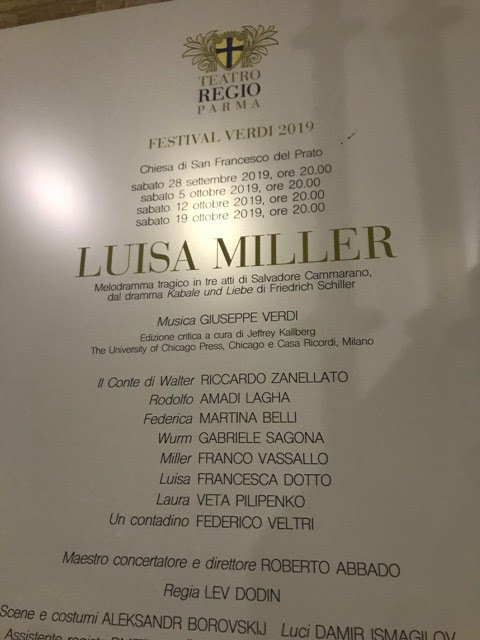
LUISA MILLER, Chiesa di San Francisco del Prato, Parma, Outubro 2019


(review in English below)

Texto de Wagner_fanatic

Ainda estou em estado de choque e não estou a exagerar. Em nada se prende com o facto da ópera ter sido numa igreja. Não ia com grandes expectativas porque o bilhete que me conseguiram era na 8a fila, não tinha a noção como aquilo estava em termos de filas e disposição, era numa igreja e provavelmente ia haver eco ou reverberação do som (embora eu de acústica não perceba nada) e esperava o pior... Sentei-me e à frente um grisalho de meia idade - pensei: “Pronto, já foste” e depois olhando para todos os lados era só andaimes e pensei: “Vou estar a rezar a ópera toda para que não me caia um na cabeça”. Mas dos andaimes esqueci-me e da cabeça o homem ia-se afundando na cadeira, negando o apoio lombar da mesma, retomando a posição normal apenas para aplaudir. Antes da ópera começar ainda disse para a mulher ao lado dele: “Isto fazia-se bem aqui era uma Tosca”, e até tinha razão (pelo menos o 1º acto).


Sabem que eu adoro, corrijo, amo a Luisa Miller mas em nada os meus comentários de hoje são hiperbolizados por este sentimento. Roberto Abbado tirou um som e um dramatismo impressionantes da orquestra e o som foi ao nível do que se consegue obter nas melhores salas de ópera, sem eco ou reverberação, fruto talvez da igreja estar completamente revestida dos andaimes.


Os cantores estratosféricos!!! Francesca Dotto uma Luisa bonita, voz idem, emoção idem idem, um estrondo!


Amadi Lagha um Rodolfo exuberante, com um timbre bonito, emotividade à flor da pele fazendo lembrar o Grigolo; tendo sido espectacular durante toda a récita, o final, com a transição emocional a que obriga, tal como no Otello (como Domingo disse ao Beczala), foi de arrasar!!!


Martina Belli esteve doente e quem fez o papel de Federica foi Veta Pilipenko, pelo que anunciaram - uma mezzo de enorme qualidade e um prazer ouvi-la,


O Wurm de Gabriele Sagona é o que se espera, também com uma voz tocante;


Riccardo Zanellato, o conde, é um bom baixo, com excelente presença, mas foi o único que menos me entusiasmou devido ao timbre... com o desenrolar habituamo-nos mas não é brilhante, parecendo o som vir garganta e não das “profundezas da alma de baixo”.


Agora, para o fim, provavelmente o homem que me vai ajudar a continuar a procurar mais Verdi - Franco Vassallo! Que grandioso Miller!!! Tem tudo!!! Voz encorpada mas vai aos agudos em aparente facilidade, legato fabuloso, sentido dramático em todas as frases... Que grande cantor! Tenho de analisar bem com videos do youtube para o conhecer ainda melhor.


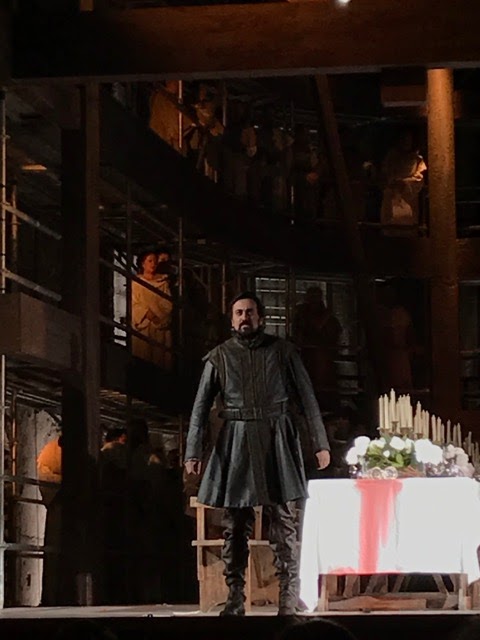
A encenação é interessante, parece um semicénico em que eles se mexem pouco, embora caracterizados, e tudo roda à volta de uma mesa. Um pormenor final - Rodolfo coloca veneno em todas as garrafas da mesa posta para talvez o suposto casamento de Rodolfo com Federica e em vez de matar Wurm, o Conde e Wurm acabam por beber do vinho a “celebrar” a morte de Luisa, o Conde indiferente à morte do filho, e acabam todos mortos pelo veneno.


LUISA MILLER, Church of San Francisco del Prato, Parma, October 2019

(review in English below)

Text by Wagner_fanatic

I am still in shock and not exaggerating. It has nothing to do with the fact that the opera was in a church. I didn't go with high expectations because the ticket they got me was in the 8th row, I had no idea how it was in terms of lines and arrangement, it was in a church and there was probably going to be echo or reverberation of sound (although I don't know anything about acoustics) and hoped for the worst ... I sat down in front of a gray-haired man - I thought, "Okay, you're gone" and then looking around all was scaffolding and I thought: "I'll be praying the whole opera for that one does not fall on my head ”. But I forgot about the scaffolding and the head was sinking into the chair, denying its lumbar support, resuming its normal position just to applaud. Before the opera began he still said to the woman next to him: "This was a good setting for a Tosca", and he was right (at least the 1st act).

You know that I like, correction, love Luisa Miller, but my comments today are not hyperbolized by this feeling. Roberto Abbado produced an impressive sound and drama from the orchestra, and the sound was at the level of what can be achieved in the best opera houses, without echo or reverberation, perhaps due to the church being completely covered with scaffolding.

The singers were stratospheric!!! Francesca Dotto a beautiful Luisa, same voice, same emotion, a bang!

Amadi Lagha an exuberant Rodolfo, with a beautiful tone, emotionality resembling Grigolo. Having been spectacular throughout the performance, the ending, with the emotional transition it requires, as at Otello (as Domingo told Beczala), was overwhelming !!!

Martina Belli was ill and the person who played the role of Federica was Veta Pilipenko, for what they announced - a mezzo of great quality and a pleasure to hear her,

Gabriele Sagona's Wurm is to be expected, also with a touching voice;

Riccardo Zanellato, the count, is a good bass with an excellent presence, but he was the one who least excited me about the timbre... as it unfolds we get used to it but it is not brilliant, sounding like it comes from the throat and not from the “depths of the soul below”.

Now, to the end, probably the man who will help me keep looking for more Verdi - Franco Vassallo! What a great Miller!!! He has everything! Full-bodied but high-pitched voice in apparent ease, fabulous legato, dramatic meaning in every sentence... What a great singer! I have to look well  youtube videos to get to know him even better.

The staging is interesting, it looks like a semicenic in which they move little, though characterized, and everything revolves around a table. A final detail - Rodolfo puts poison in every bottle on the table set for perhaps Rodolfo's supposed marriage to Federica and instead of killing Wurm, the Count and Wurm end up drinking from the wine to “celebrate” the death of Luisa, the Count indifferent to the death of the son, and all end up killed by the poison.