Mostrar mensagens com a etiqueta Craig Colclough. Mostrar todas as mensagens

quarta-feira, 4 de maio de 2022

LOHENGRIN, Royal Opera House, Londres / London, Abril / April 2022


(review in English below)

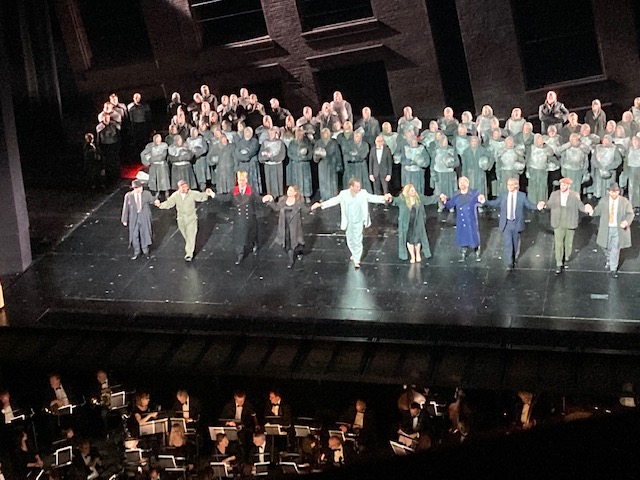
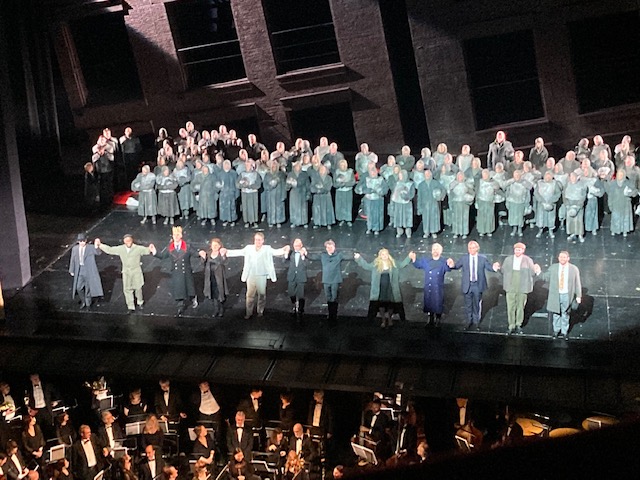
Há cerca de 4 anos tive o privilégio de assistir a esta produção do Lohengrin na Royal Opera House de Londres. Como escrevi no blogue, foi um dos espectáculos de ópera que mais me marcou pela sua excepcional qualidade. É certo que é uma das óperas de Wagner que mais gosto e a encenação de David Alden ajuda a que seja um espectáculo arrebatador, como voltou a acontecer. 

Coloca a acção no Séc. XX num país sob um regime militar. Os cenários, modulares, são constituídos por paredes de tijolos inclinadas, com grandes aberturas e corredores metálicos. Há militares armados em cena em grande parte do espectáculo. No início do 3º acto aparece uma grande estátua branca encimada por um cisne e, perto do final, muitas bandeiras vermelhas e brancas com o cisne, muito à imagem das bandeiras nazis. O Lohengrin é o salvador esperado pelo povo que, quando decide partir, instala-se o regime nazi-like.

O maestro Jakub Hursa foi óptimo. As luzes da sala são deixadas quase apagadas, aumentando progressivamente a iluminação à medida que a música se torna mais intensa, voltando a diminuir a intensidade até se apagarem totalmente no final. Um efeito magnífico, que se repetirá no último acto.


O Coro da Royal Opera foi perfeito em afinação, qualidade e conjugação de vozes. 

Os solistas formaram um conjunto de cantores excelentes. O Rei Heinrich foi interpretado pelo baixo Gábor Bretz que tem uma voz magnífica. O barítono Craig Colclough foi um Friedrich marcante em palco e vocalmente irrepreensível. A sua mulher Ortrud, a soprano Anna Smirnova, foi cínica e astuta e teve uma interpretação com uma potência vocal avassaladora. A soprano Jennifer Davis, que ouvi a primeira vez há 4 anos, voltou a oferecer-nos uma interpretação superlativa. Transmitiu vulnerabilidade e inocência marcantes e a voz é pura, limpa e com um poderio impressionante. O tenor Brandon Jovanovich foi um Lohengrin óptimo, tanto na interpretação cénica como vocal. Até o pequeno papel do arauto teve uma interpretação notável de Derek Welton.

Um espectáculo de ópera excepcional!


*****

LOHENGRIN, Royal Opera House, London, April 2022

About 4 years ago I had the privilege of watching this production of Lohengrin at the Royal Opera House in London. As I wrote on the blog, it was one of the opera performances that most impressed me due to its exceptional quality. It is true that it is one of Wagner's operas that I like the most and the staging by David Alden helps to make it a breathtaking show, as it happened again.T

The action in placed in the 20th century in a country under a military regime. The modular scenarios, are made up of sloping brick walls, with large openings and metallic corridors. There are armed soldiers on the scene in most of the performance. At the beginning of the 3rd act, there is a large white statue topped by a swan and, towards the end, many red and white flags with the swan, much like the Nazi flags. Lohengrin is the savior awaited by the people who, when he decides to leave, the Nazi-like regime is installed.

Maestro Jakub Hursa was great. The lights in the room are left almost off, progressively increasing the lighting as the music becomes more intense, then dimming again until they are completely off at the end. A magnificent effect, which will be repeated in the last act. The Royal Opera Choir was perfect in pitch, quality and voice conjugation.

The soloists formed an ensemble of excellent singers. King Heinrich was bass Gábor Bretz who has a magnificent voice. Baritone Craig Colclough was an outstanding Friedrich on stage and vocally irreproachable. His wife Ortrud, soprano Anna Smirnova, was cynical and shrewd and delivered a performance with overwhelming vocal power. Soprano Jennifer Davis, who I heard for the first time 4 years ago, has returned to offer us a superlative interpretation. She conveyed remarkable vulnerability and innocence and the voice is pure, clean and with impressive power. Tenor Brandon Jovanovich was a great Lohengrin, both on stage and vocally. Even the small role of the herald had a remarkable performance by Derek Welton.

An exceptional opera performance!

*****

terça-feira, 7 de fevereiro de 2017

TOSCA, English National Opera, December / Dezembro 2016


 (review in English below)

A Tosca, opera de G. Puccini, esteve em cena na English National Opera em Dezembro. A encenação de Catherine Malfitano é clássica e muito vistosa. Se no primeiro acto, passado na igreja de Sant’Andrea della Valle, e no segundo, nos aposentos de Scarpia no Palazzo Farneze, os cenários são convencionais, no terceiro, no Castel Sant’Angelo o palco é original, redondo, vendo-se ao fundo o céu, reforçando a sensação de aprisionamento.


A direcção musical foi excelente e esteve a cargo do maestro Martin Fitzpatrik. Os cantores solistas foram todos de grande qualidade.

O soprano americano Keri Alkema foi uma Tosca de voz potente e sempre bem colocada e afinada. Em palco faltou-lhe um pouco a demonstração da paixão pelo Cavaradossi.


Craig Colclough, barítono norte-americano, foi um Scarpia com uma excelente interpretações cénica, malévolo como se espera. O cantor tem uma voz respeitável embora com um timbre algo nasalado.


O pintor Mário Cavaradossi foi interpretado pelo tenor galês Gwyn Huges Jones. Foi uma interpretação superior, timbre belíssimo, voz sempre sobre a orquestra e de grande expressividade. Cenicamente esteve bem, mas também lhe faltou maior paixão no relacionamento com a Tosca.


Os papéis secundários foram interpretados por cantores menos impressionantes mas, ainda assim, bons. Andri Björn Róbertsson como Cesar Angelotti, Adrian Powter como o sacristão, Scott Davies como Spoletta, Graeme Danby como Sciarrone e Alessandro MacKinnon como o jovem pastor.

Uma Tosca de grande qualidade na ENO, que minorou o facto de ter sido cantada em inglês.


****

TOSCA, English National Opera, December 2016

Tosca, G. Puccini's opera, was on stage at the English National Opera in December. The production of Catherine Malfitano is classic and very showy. If in the first act, in the church of Sant'Andrea della Valle, and in the second, in the room of Scarpia in Palazzo Farneze, the scenarios are conventional, but in the third, in the Castel Sant'Angelo the stage is original, round, with the sky in the background, reinforcing the feeling of imprisonment.

The musical direction by maestro Martin Fitzpatrik was excellent. The soloist singers were all of great quality.

American soprano Keri Alkema was a Tosca with a powerful voice always well heard and tuned. On stage she lacked the demonstration of passion for Cavaradossi.

Craig Colclough, American baritone, was a Scarpia with an excellent scenic performance, malevolent as expected. The singer has a respectable voice although with a somewhat nasal tone.

The painter Mario Cavaradossi was interpreted by the Welsh tenor Gwyn Huges Jones. It was a superior performance, the voice has a beautiful timbre, always over the orchestra and of great expressiveness. On stage he was well, but also lacked more passion by Tosca.

The supporting roles were played by less impressive but still acceptable singers. Andri Björn Róbertsson as Cesar Angelotti, Adrian Powter as the sacristan, Scott Davies as Spoletta, Graeme Danby as Sciarrone and Alessandro MacKinnon as the boy shepherd.

A Tosca of great quality in the ENO, that reduced the disadvantage of being sung in English.


****

segunda-feira, 11 de julho de 2016

TRISTAN AND ISOLDE, English National Opera, Junho /June 2016


 (review in English below)

Cantada em inglês, assisti à opera de R. Wagner Tristão e Isolda na English National Opera.

A encenação de Daniel Kramer é estranha e confusa, apesar de alguns cenários vistosos de Anish Kapoor. No primeiro acto o palco está dividido por 3 painéis verticais formando uma pirâmide, apesar de a acção quase não se passar na zona central. No final aparecem os membros do coro que parecem figuras de um filme de ficção científica.
No segundo o palco está preenchido por uma caverna rochosa, onde decorre o dueto de amor, embora os protagonistas estejam quase sempre afastados um do outro. Aqui o efeito cénico é bom, mas continua a nada reflectir a acção da ópera. No final, Tristão e Isolda aparecem presos a camas de hospital e os membros do coro vestidos como se estivessem equipados para uma intervenção cirúrgica.
No terceiro acto o palco está vazio e tem apenas um buraco a meio. O sangue do Tristão escorre abundantemente e é este o efeito, desinteressante, que domina todo o acto.
O vestuário de Christina Cunningham é horrível e ridículo. O Kurwenal e a Bargäne parecem comediantes (ou travestis). O Tristão é vestido no primeiro acto como um samurai e a Isolda como uma dama antiga. Nos dois actos seguintes aparecem mais “normais”. Enfim, um disparate total.


A direcção musical foi excelente e esteve a cargo do maestro Edward Gradner. Optou por um tempo lento e sonoridade marcada e a orquestra esteve ao mais alto nível.

Stuart Skelton foi óptimo no desempenho do Tristão. Tem uma voz de tenor heróico muito bonita e cantou o papel de forma autoritária e emotiva, mantendo a qualidade vocal em toda a récita.


A Isolda do soprano Heidi Melton foi outra grande intérprete. Começou muito bem, teve alguma tendência para a estridência no registo mais agudo, mas foi sempre audível sobre a orquestra. No 3º acto o liebestod não teve a emoção que se espera.


Matthew Rose foi um rei Marke muito bom, de voz segura, sempre bem colocada e de assinalável beleza tímbrica. Pena a figura ridícula em que o colocaram e como o vestiram.

Também excelente esteve a mezzo Karen Cargill que fez uma Brangäne bem audível, emotiva e com boa presença cénica. Também ela foi ridicularizada no vestuário.


O Kurwenal de Craig Colclough cantou em grande estilo, com voz bem timbrada, sempre afinada e sobre a orquestra. Em palco, outro dos ridicularizados pela encenação.


Um excelente espectáculo musical, apesar do vestuário ridículo e da encenação que em nada traduziu o sentido da ópera.


****


TRISTAN AND ISOLDE, English National Opera, June 2016

Sung in English, I attended R. Wagner´s Tristan and Isolde at the English National Opera.

The staging of Daniel Kramer is strange and confusing, although some visually nice scenery of Anish Kapoor. In the first act the stage is divided by 3 vertical panels forming a pyramid, although the action hardly moves in the central zone. At the end the choir members appear dressed like figures of a fiction movie.
In the second act the stage is a big rocky cave, where the love duet takes part, though the protagonists are often far apart. Here the scenic effect is good, but still not reflecting the opera action. In the end of this act, Tristan and Isolde appear stuck in hospital beds and choir members dressed as if they were equipped for surgery.
In the third act the stage is empty and has only a hole in the middle. Tristan’s blood flows abundantly and this is the dull effect that dominates the entire act.
Christina Cunningham’s clothing is horrible and ridiculous. Kurvenal and Bargäne seem comedians (or transvestites). Tristan is dressed in the first act as a samurai and Isolde as an old lady. In the following two acts they appear more "normal" but, overall it is a total nonsense.

The musical direction was excellent and was in charge of conductor Edward Gradner. He opted for a slow time and marked sound, and the orchestra playied at the highest level.

Stuart Skelton was great as Tristan. He has a very good heroic tenor voice and sang the role with authoritative and emotional expression, keeping the vocal quality throughout the performance.

Isolde was soprano Heidi Melton, another great performer. She started at the highest level, had a tendency to shrillness in the high register, but she was good, always audible over the orchestra. In the 3rd act the Liebestod had not the excitement one expects.

Matthew Rose was a very good King Marke, strong voice, always well tuned and with beauty timbre. It was a pity the ridiculous figure that he was put and how he was dressed.

Also excellent was mezzo Karen Cargill who sang a very audible Brangäne, emotional and with good stage presence. She too was ridiculed in the way she was dressed.

Craig Colclough sang Kurvenal in style, with a nicely audible voice, always in tune and over the orchestra. On stage, another mocked by the staging.

An excellent musical performance, despite the ridiculous clothing and staging that in no way reflecteded the contents of opera.


****