Mostrar mensagens com a etiqueta Ludovic Tézier. Mostrar todas as mensagens

quinta-feira, 29 de setembro de 2022

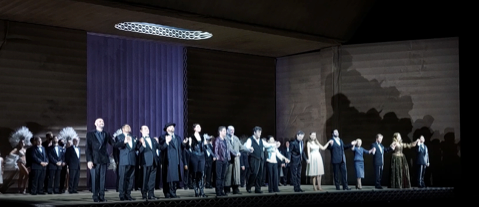
AIDA, Royal Opera House, Londres, Setembro / September 2022


(review in English below)

A nova produção da Royal Opera House da Aida de Verdi foi entregue a Robert Karsen. Não há qualquer semelhança com o enquadramento original. O Egipto e a Etiópia foram esquecidos e tudo se passa num bunker militar cinzento de um País sob uma ditadura militar. Embora a produção tenha sido concebida antes da pandemia e da guerra na Ucrânia, ganha alguma actualidade pois poderia passar-se na Coreia do Norte ou mesmo na Rússia. Toda a espectacularidade habitual da ópera não existe.

As cenas passam-se todas nesse cenário muito cinzento, onde apenas há as cores azul e vermelha (com a estrela comunista) de bandeiras do País imaginado. Os protagonistas são militares de variadas patentes e o coro são soldados. Numa das grandes cenas de bailado este é substituído por um conjunto de empregadas domésticas a pôr uma enorme mesa, sob supervisão militar e a outra é dançada pelos soldados que exibem as suas capacidades militares. 


A marcha triunfal do 2º acto começa com uma série de caixões cobertos pela bandeira, o 3º acto passa-se à volta do que seria um túmulo de um soldado desconhecido e a cena final num depósito de mísseis.

A direcção musical de Antonio Pappano foi excelente e a orquestra esteve ao mais alto nível. 

O Coro foi talvez o melhor de todo o espectáculo e, no primeiro acto, os elementos cantando em pianíssimo, armados de metralhadoras e sentados como se numa igreja estivessem, foi sublime!

A soprano Elena Stikhina foi uma Aida notável, voz bonita, emotiva, bem audível e excelente presença em palco.


Agnieszka Rehlis foi uma Amneris algo contida, o seu mezzo não tem o poderio habitual nas interpretações desta personagem, mas cantou em crescendo e no final esteve bastante bem, apesar de a encenação não ajudar.

O tenor Francesco Meli foi um Radames fantástico. Sempre afinado, embora cantando aparentemente no limite em algumas vezes, nunca desafinou e transmitiu todas as emoções que se esperam do personagem. 


O Amonastro do barítono Ludovic Tézier não me surpreendeu porque sempre que ouvi este cantou, fiquei muito bem impressionado. Foi marcante, sobretudo no diálogo com a Aida no 3º acto.


Fabuloso foi o baixo Solomon Howard, talvez o melhor solista da noite, com uma interpretação magistral do Sumo Sacerdote Ramfis. 


In Sung Sim foi um Rei do Egipto desinteressante, mas o papel é muito pequeno.


(equipa de produção)

Um espectáculo musicalmente superior numa encenação cinzenta e algo monótona.


****


AIDA, Royal Opera House, London, September 2022

The new Royal Opera House production of Verdi's Aida was handed over to Robert Karsen. There is no resemblance to the original opera. Egypt and Ethiopia have been forgotten and everything takes place in a gray military bunker in a country under a military dictatorship. Although the production was conceived before the pandemic and the war in Ukraine, it gains relevance as it could take place in North Korea or even Russia. All the usual spectacularity of opera does not exist.

The scenes all take place in this very gray setting, where there are only the blue and red colors (with the communist star) of flags of the imaginary country. The soloists are soldiers of different ranks and the choir are soldiers. In one of the great ballet scenes, this is replaced by a group of maids setting a huge table, under military supervision, and the other is danced by soldiers displaying their military skills. The 2nd act's triumphal march begins with a series of flag-draped coffins, the 3rd act takes place around what would have been a tomb of an unknown soldier and the final scene in a missile depot.

Antonio Pappano's musical direction was excellent and the orchestra was at the highest level. The Choir was perhaps the best of the whole show and, in the first act, the elements singing in pianissimi, armed with machine guns and seated as if they were in a church, was sublime!

Soprano Elena Stikhina was a remarkable Aida, with a beautiful, emotional, well-audible voice and excellent stage presence.

Agnieszka Rehlis was a somewhat restrained Amneris, her mezzo doesn't have the usual power in the interpretations of this character, but she sang in crescendo and in the end she was quite good, although the staging didn't help.

Tenor Francesco Meli was a fantastic Radames. Always in tune, although singing seemingly on edge at times, he never went out of tune and conveyed all the emotions one would expect from the character.

Baritone Ludovic Tézier's Amonastro did not surprise me because whenever I heard him sing, I was very impressed. He was remarkable, especially in the dialogue with Aida in the 3rd act.

Fabulous was the bass Solomon Howard, perhaps the best soloist of the night, with a masterful interpretation by High Priest Ramfis.

In Sung Sim was an uninteresting King of Egypt, but the role is very small.

A musically superior show in a gray and somewhat monotonous staging.

****

segunda-feira, 15 de novembro de 2021

RIGOLETTO, OPERA DA BASTILHA, PARIS, NOVEMBRO 2021


Texto de Francisco Casegas, colaborador do blogue

Tive oportunidade no passado dia 4 de Novembro de assistir a uma das minhas óperas favoritas, Rigoletto de Verdi na Ópera da Bastilha em Paris.

A orquestra da Opera Nacional de Paris foi dirigida por Giacomo Sagripanti de forma consistente, sempre em sintonia com os cantores.


Embora o número de intervenções do coro não seja muito elevado nesta ópera, o coro da Ópera Nacional de Paris esteve em muito bom nível nas suas intervenções.

Relativamente à produção confesso que não fiquei grande fã. O cenário consiste numa grande caixa de cartão cujas faces se vão abrindo e fechando conforme o desenvolvimento das cenas. No geral, tendeu para o aborrecido na minha opinião.


No papel de Rigolleto esteve o barítono Ludovic Tézier. É um cantor que que aprecio bastante e que nesta récita esteve ao mais alto nível. Dotado de um potente aparelho vocal, esteve irrepreensível, vocal e cenicamente sempre em sintonia com a sua Gilda.

No papel de Gilda esteve o soprano Nadine Sierra. Como já foi referido neste blog não é uma cantora com um enorme volume, mas tecnicamente é extraordinária e nesta récita foi também irrepreensível.


No papel de Duque de Mantova esteve o tenor Dmitry Korchak. Começou com um “Questa O’ Quella” algo apagado, mas depois arrancou para uma interpretação bastante sólida durante o resto da récita.

Nos restantes papéis os cantores também estiveram em bom nível. Destacaria talvez Justina Gringyté como Maddalena que tem um timbre de elevada beleza.

No geral foi uma récita de elevado nível de onde saí extremamente satisfeito assim como o restante público que aplaudiu fortemente os artistas, após ter saído desiludido das minhas 2 últimas récitas “fora de portas” (Tosca em Zurique e Faust em Londres). 

Uma palavra de apreço também às assistentes de sala que nos momentos anteriores ao início da récita tiveram o cuidado de se dirigir às pessoas que tinham bilhete nas laterais na zona mais recuada da plateia (como era o meu caso) para avançarem para lugares mais à frente que estivessem livres se assim o desejassem. Aproveitei o convite e acabei por assistir à recita em lugares fantásticos da plateia.


RIGOLETTO, Opera Bastille, Paris, November 2021

Review by Francisco Casegas

I had the opportunity on the 4th of November to watch one of my favorite operas, Rigoletto by Verdi at the Opéra Bastille in Paris.

The orchestra of the Opera National de Paris was conducted by Giacomo Sagripanti consistently, always in tune with the singers.

Although the number of interventions by the choir is not very high in this opera, the choir of the Opéra National de Paris was at a very good level in its interventions.

Regarding the production, I confess that I wasn't a big fan. The setting consists of a large cardboard box whose faces open and close as the scenes develop. Overall it tended to be boring in my opinion.

In the role of Rigolleto was the baritone Ludovic Tézier. He is a singer that I really appreciate and that in this recital he was at the highest level. Endowed with a powerful vocal apparatus, he was impeccable, vocally and scenically, always in tune with his Gilda.

In the role of Gilda was soprano Nadine Sierra. As mentioned in this blog, she is not a singer with a huge volume, but technically she is extraordinary and in this recital she was also impeccable.

In the role of Duke of Mantova was tenor Dmitry Korchak. He started with a “Questa O’ Quella” somewhat faded, but then it took off for a very solid performance during the rest of the recital.

In the remaining roles the singers were also at a good level. I would perhaps highlight Justina Gringyté as Maddalena, who has a highly beautiful timbre.

In general, it was a high level performance from which I left extremely satisfied as well as the rest of the audience who strongly applauded the artists, after leaving my last 2 performances “outside the country” disappointed (Tosca in Zurich and Faust in London).

A word of appreciation also to the room attendants who, in the moments prior to the beginning of the recital, were careful to address the people who had tickets on the sides in the back of the audience (as was my case) to advance to seats in the front that were free if they so wished. I took advantage of the invitation and ended up watching the performance in a fantastic seat in the audience.

segunda-feira, 19 de abril de 2021

PARSIFAL, Ópera de Viena, Wiener Staatsoper, transmissão / streaming Abril / April 2021

(review in English below)

A Ópera de Viena transmitiu recentemente a nova produção da ópera Parsifal de R. Wagner com encenação do russo Kirill Serebrennikov.

A Orquestra e o Coro da Ópera de Viena, sob a direcção de Philippe Jordan estiveram ao mais alto nível. O maestro foi excelente.

A acção foi trazida para a actualidade. O 1º e o 3º actos passam-se numa prisão russa. É retratada a forma desumana como os presos são tratados, a corrupção, as relações entre os reclusos e destes com os guardas. Parsifal recorda o passado e a acção é assim retratada, com o Parsifal actual (o cantor Jonas Kaufmann muitas vezes “à parte” da acção) e outro Parsifal (um actor), mais jovem e o principal sujeito da acção. No 1º acto a Kundry é uma jornalista que entrevista e fotografa os presos (os cavaleiros do Graal). As tatuagens são centrais na encenação e representam grande parte da simbologia da ópera. É uma encenação cativante e de grande intensidade psicológica.


O 2º acto passa-se numa redacção de uma revista de moda, Schloss, onde Parsifal é o modelo esperado. Klingsor é o dono da agência e Kundry uma executiva. A cena de sedução da Kundry sobre o Parsifal é excelente. No final, ela mata o Klingsor a tiro.


O 3º acto, novamente na prisão, é o menos interessante. Titurel foi cremado e em vez de caixão o Amfortas traz uma pequena urna com as cinzas, coloca-as na sua face e lança-as sobre os outros. No final Parsifal abre as celas e todos saem em liberdade.


É uma encenação de gosto discutível e que nada tem a ver com a ideia original de Wagner, mas é cativante, rica, psicologicamente intensa e está muito bem conseguida.

Quanto aos cantores, melhor seria impossível.

Georg Zeppenfeld foi um Gurnemanz muito competente, voz excelente e interpretação sempre eficaz.


Ludovic Tézier fez um Amfortas excepcional, tanto na interpretação vocal como cénica. Esteve sempre excelente mas, no 1º acto, foi memorável. 


Elina Garanca, para mim, foi a melhor da récita. Interpretou a Kundry com uma potência vocal assinalável, timbre magnífico, afinação perfeita e, em cena, foi uma actriz de topo. Excelente!!


 Jonas Kaufmann fez um Parsifal de qualidade, sobretudo no 2º acto, onde foi excelente. Como teve um “duplo” (actor Nikolay Sidorenko), por vezes as suas intervenções cénicas pareceram algo bizarras.


Finalmente Wolfgang Koch foi um Klingsor convincente. Este cantor é excelente para os papéis maléficos das óperas de Wagner.


O Parsifal não é uma ópera para principiantes mas este é um espectáculo de excelente qualidade que pode ser visto no site abaixo durante as próximas semanas:

 https://www.arte.tv/en/videos/102879-000-A/richard-wagner-parsifal/

*****


PARSIFAL, Wiener Staatsoper,  streaming April 2021

The Vienna State Opera recently broadcast the new production of R. Wagner's opera Parsifal staged by Russian director Kirill Serebrennikov.

The Vienna Opera Orchestra and Choir, under the direction of Philippe Jordan were at the highest level. The conductor was excellent.

The action was brought up to date. The 1st and 3rd acts take place in a Russian prison. It portrays the inhumane way prisoners are treated, corruption, the relationships between prisoners and between them and the guards. Parsifal remembers the past and the action is thus portrayed, with the current Parsifal (the singer Jonas Kaufmann often "apart" from the action) and another Parsifal (an actor), younger and the main subject of the action. In the first act, Kundry is a journalist who interviews and photographs prisoners (the Knights of the Grail). Tattoos are central to staging and represent a large part of opera symbology. It is a captivating staging and of great psychological intensity.

The 2nd act takes place in an editorial of a fashion magazine, Schloss, where Parsifal is the expected model. Klingsor is the owner of the agency and Kundry an executive. Kundry's seductive scene on Parsifal is excellent. In the end, she shoots Klingsor.

The 3rd act, again in prison, is the least interesting. Titurel was cremated and instead of a coffin, Amfortas brings a small urn with the ashes, places them on his face and throws them over the others. At the end Parsifal opens the cells and everyone leaves in freedom.

It is a staging of debatable interest that has nothing to do with Wagner's original idea, but it is very showy, psychologically intense and is very well done.

As for the singers, better would be impossible.

Georg Zeppenfeld was a very competent Gurnemanz, with an excellent voice and always efficient interpretation.

Ludovic Tézier did an exceptional Amfortas, both in vocal and scenic interpretation. He was always excellent, but in the first act, he was memorable.

Elina Garanca, for me, was the best of the night. She played Kundry with remarkable vocal power, magnificent timbre, perfect pitch and, on the stage, was a top actress. Fabuloust!!

Jonas Kaufmann was a quality Parsifal, especially in the 2nd act, where he was excellent. As he had a “double”, sometimes his scenic interventions seemed somewhat bizarre.

Finally Wolfgang Koch was a convincing Klingsor. This singer is excellent for the evil roles of Wagner's operas.

Parsifal is not an opera for beginners but this is a performance of excellent quality that can be seen on the website below for the next few weeks:

 https://www.arte.tv/en/videos/102879-000-A/richard-wagner-parsifal/

*****

sexta-feira, 31 de julho de 2020

Ludovic Tézier, um grande barítono na stage door da Royal Opera House A great baritone at the stage door of the Royal Opera House, Março / March 2019


Depois de ter assistido a uma das melhores óperas da temporada de 2018-2019 – La Forza del Destino – na Royal Opera House de Londres, juntei-me aos muitos que esperavam os cantores principais na stage door. Apenas um saiu por aqui, o grande barítono francês Ludovic Tézier.


Numa época de grande escassez de bons barítonos verdianos, Tézier é talvez o melhor da actualidade. A sua interpretação como Don Carlo foi fabulosa e, apesar da péssima qualidade das fotografias, foi simpático e deu autógrafos a todos os que o pediram.


Ludovic Tézier, a great baritone at the stage door of the Royal Opera House, March 2019


After attending one of the best operas of the 2018-2019 season - La Forza del Destino - at the Royal Opera House in London, I joined the many who were waiting for the main singers on the stage door. Only one came out, the great French baritone Ludovic Tézier.


In a time of great shortage of good verdian baritones, Tézier is perhaps the best of the present days. His interpretation as Don Carlo was fabulous and, despite the poor quality of the photographs, he was friendly and gave autographs to all who asked.

terça-feira, 26 de março de 2019

LA FORZA DEL DESTINO, Royal Opera House, Londres / London, Março / March 2019


(text in English below)

A Royal Opera House apresentou a ópera de Verdi La Forza del Destino, com libreto de Francesco Maria Piave, a principal e mais esperada nova produção da temporada londrina. É uma ópera que vive essencialmente da música e do canto, dado que o argumento é dos mais inverosímeis entre os usados nas óperas de Verdi.


Em Sevilha, o Marquês de Calatrava tem dois filhos (um terceiro morreu em criança), Carlo e Leonora. Ela apaixona-se e tenciona fugir com Álvaro, filho de um nobre espanhol e uma princesa inca. O pai opõe-se e, ao confrontar Alvaro, este devolve a arma mas esta dispara acidentalmente e mata o Marquês que lança uma maldição à filha. Os dois amantes separam-se. Leonora vai para um convento e vive uma vida de ermita. Carlo decide vingar a morte do pai, matando Alvaro e a irmã. Entretanto (Alvaro e Carlo) vão para a guerra em Itália. Sem conhecerem a identidade um do outro, Alvaro salva Carlo da morte e tornam-se amigos para sempre. Depois é Alvaro que é ferido com gravidade, deixando os seus pertences a Carlo, que descobre a sua verdadeira identidade. Desafia Alvaro para um duelo, ele recusa e vai também para um convento (o mesmo em que está Leonora). Anos mais tarde acaba por ser encontrado por Carlo, batem-se em duelo, Carlo é ferido mortalmente e, antes de morrer, fere também mortalmente a irmã Leonora, tudo na presença de Alvaro, quando os dois amantes se reencontram.


A encenação de Christof Loy traz a acção para o Séc XX. O início é muito interessante, durante a abertura vemos os 3 filhos do Marquês de Calatrava, inicialmente crianças, a morte de um deles, depois adolescentes e finalmente jovens adultos. O primeiro acto, a casa do Marquês de Calatrava, passa-se num cenário com uma grande porta a meio, um grande lustre, uma janela lateral e uma mesa central e várias cadeiras. Este mesmo cenário acaba por sofrer pequenas alterações para todas as restantes cenas dos 3 actos seguintes. A única mudança mais relevante é a substituição da janela lateral por uma arcada com um grande cristo cruxificado suspenso, nas cenas no mosteiro. Para além do cenário há projecções ocasionais da morte acidental do Conde de Calatrava e da maldição por ele lançada a Leonora (não vi grande mais valia nelas). No último acto o cenário é igual ao do primeiro, o que poderá querer transmitir alguma claustrofobia, sobretudo para a Leonora, mas o efeito não é fantástico.
Vê-se bem, mas foi uma encenação que começou por prometer muito mas acabou por desiludir.


A direcção musical do maestro titular Antonio Pappano foi óptima. A Orquestra da Royal Opera House esteve muito bem e o Coro foi excelente e os bailarinos também.


Quanto aos cantores solistas, o elenco de estrelas seguramente que contribuiu para que os bilhetes tenham esgotado muito poucos minutos após a abertura da bilheteira online e terem sido vendidos no mercado negro a milhares de libras! Corria o rumor (a condizer com a má fama desta ópera) que o Kaufmann poderia cancelar porque tinha faltado aos ensaios gerais… e como o menino é um dos que sofre regularmente de “cancelite”, temi que tal acontecesse,… mas não.

O Marquês de Calatrava foi interpretado pelo baixo Robert Lloyd. É um papel relativamente pequeno mas foi uma boa interpretação, cénica e vocal.


 Dona Leonora foi Anna Netrebko. Que dizer da melhor cantora da actualidade? A voz encorpou, está perfeitamente adaptada a este tipo de reportório, e mantém todas as qualidades de excepção, timbre lindíssimo, agudos luminosos, potência brutal, afinação perfeita. Foram momentos únicos vividos na Royal Opera House sempre que esteve em cena. No La Vergine Degli Angeli foi divinal, na cena mais feliz da opera, não só pela sua interpretação, como pela de Furlanetto e pelo momento mais conseguido da encenação, com velas acesas num efeito magnífico. Avassaladora!


O Don Alvaro interpretado pelo Jonas Kaufmann esteve também ao mais alto nível. É um cantor de que muito gosto, já não canta com a exuberância de outrora, mas tem um timbre baritonal muito bonito, uns pianissimi arrebatadores e, no registo agudo é notável, conseguindo um belo tom heróico. Foi muito expressivo em cena, o que contribuiu para a excelência da interpretação.


O barítono Ludovic Tézier não deixou os seus créditos por mãos alheias e fez um Don Carlo de voz poderosa, afinada e sempre audível sobre a orquestra. Foi muito convincente no papel malévolo que lhe coube. Em período de grande escassez qualitativa, é seguramente um dos melhores barítonos verdianos da actualidade. Os duetos com o Kaufmann foram sublimes e foi, sem dúvida, um dos melhores cantores em palco!


Outro cantor fabuloso foi o baixo Ferruccio Furlanetto como Padre Guardiano. É sempre um prazer ouvi-lo pois associa de forma perfeita capacidade interpretativa, voz gigante e belíssima, com um timbre grave de fazer tremer o chão. Fantástico.


O barítono Alessandro Corbelli interpretou o Fra Melitone com muita graça e correcção, sempre afinado e audível. E mais uma excelente em palco.


A mezzo Veronica Simeoni foi uma Preziosilla com bom desempenho cénico, mas não na interpretação vocal. Foi um erro de casting, o papel não se ajusta à sua voz, nem a qualidade esteve ao nível dos restantes.


Nos papéis secundários houve homogeneidade e óptimas interpretações, Roberta Alexander (Cura), Michael Mofidian (Alcaide), Carlo Bosi (Mastro Trabuco) e Jonathan Fisher (Cirurgião).


Um espectáculo fabuloso na Royal Opera House, a confirmar as mais elevadas expectativas que tinha gerado.


*****


LA FORZA DEL DESTINO, Royal Opera House, London, March 2019

The Royal Opera House presented Verdi's opera La Forza del Destino, with libretto by Francesco Maria Piave, the main and most anticipated new production of the London season. It is an opera that lives essentially on music and singing, since the argument is one of the most unlikely among those used in the operas of Verdi.

In Siviglia, Marquis di Calatrava has two children (a third died as a child), Carlo and Leonora. She falls in love and intends to run away with Alvaro, the son of a Spanish nobleman and an Inca princess. The father opposes and, in confronting Alvaro, this one returns the gun but it accidentally shoots and kills the Marquis that sends a curse to his daughter. The two lovers separate. Leonora goes to a convent and lives a hermitage life. Carlo decides to avenge the death of his father, killing Alvaro and his sister. Meanwhile (Alvaro and Carlo) go to war in Italy. Without knowing each other's identity, Alvaro saves Carlo from death and become friends forever. Then it is Alvaro who is seriously injured, leaving his belongings to Carlo, who discovers his true identity. He defies Alvaro for a duel, Alvaro refuses and also goes to a convent (the same one where Leonora is). Years later Carlo finally finds Alvaro, Carlo is mortally wounded and, before dying, he also stabs mortally his sister Leonora, all in the presence of Alvaro, when the two lovers meet again.

Christof Loy's staging brings action to the 20th century. The beginning is very interesting, during the opening we see the 3 children of the Marquis di Calatrava, initially children, the death of one of them, then adolescents and finally young adults. The first act, the house of the Marquis of Calatrava, passes in a scenario with a large half-door, a large chandelier, a side window and a central table and several chairs. This same scenario ends up undergoing minor changes for all the remaining scenes of the next 3 acts. The only more relevant change is the replacement of the side window by an arcade with a large cruxified Christ suspended in the scenes in the monastery. Beyond the setting there are occasional projections of the accidental death of the Marquis di Calatrava and the curse he cast Leonora (I did not see much added value in them). In the last act the scenario is the same as the first, which may want to convey some claustrophobia, especially for Leonora, but the effect is not fantastic.
It is a pleasant staging that started by promising a lot but ended up disappointing.

The musical direction of maestro Antonio Pappano was excellent. The Orchestra of the Royal Opera House was very well and the Choir was excellent.

As for soloist singers, the cast of stars surely contributed to the fact that the tickets sold out very few minutes after opening the online box office and were sold on the black market for thousands of pounds! A rumor was running (to match the bad reputation of this opera) that Kaufmann could cancel because he had missed the dress rehearsals ... and as he is one of those who regularly suffer from "cancellitis", I feared that would happen, ... but no.

The Marquis di Calatrava was performed by bass Robert Lloyd. It's a relatively small role but he was a good on stage and vocal performance.

 Dona Leonora was Anna Netrebko. What to say about the best singer of today? The voice is perfectly matched and adapted to this type of repertoire, and she maintains all the qualities of exception, beautiful timbre, luminous top notes, brutal power, perfect tuning. They were unique moments lived in the Royal Opera House whenever she was on stage. In La Vergine Degli Angeli she was divine, in the happiest scene of the opera, not only for her interpretation, but also for that of Furlanetto and for the most accomplished moment of the staging, with candles lit in a magnificent effect. Overwhelming!

Don Alvaro played by Jonas Kaufmann was also at the highest level. He is a singer that I like, he no longer sings with the exuberance of before, but he has a very beautiful baritonal tone, fine pianissimi, and in the top register he is remarkable, achieving a beautiful heroic tone. He was very expressive on the scene, which contributed to the excellence of the interpretation.

Baritone Ludovic Tézier did not leave his credits by the hands of others and made a Don Carlo of tuned powerful voice, always well audible over the orchestra. He was very convincing in his malevolent role. In a period of great qualitative scarcity, he is surely one of the best verdian baritones of the present time. The duets with Kaufmann were sublime and he was one of the best singers on stage!

Another fabulous singer was bass Ferruccio Furlanetto as Father Guardiano. It is always a pleasure to listen to him because he associates perfect interpretive ability, a giant and beautiful voice, with a bass tone to make the floor shake. Fantastic.

Baritone Alessandro Corbelli interpreted Fra Melitone with great grace and correction, always tuned and audible. He was another great artist on stage.

Mezzo Veronica Simeoni was a Preziosilla with good scenic performance, but not vocal interpretation. She was a miscasting, the role does not fit her voice, nor the quality was at the top level of the other soloists.

In the secondary roles there was homogeneity and great interpretations, Roberta Alexander (Cura), Michael Mofidian (Alcaide), Carlo Bosi (Mastro Trabuco) and Jonathan Fisher (Surgeon).

A fabulous performance at the Royal Opera House, confirming the highest expectations it had generated.

*****