Mostrar mensagens com a etiqueta Pretty Yende. Mostrar todas as mensagens

terça-feira, 10 de maio de 2022

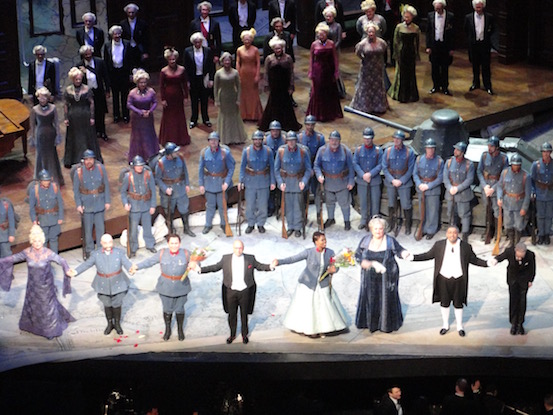
LA TRAVIATA – Royal Opera House, Londres / London, Abril / April 2022


(review in English below)

A Royal Opera de Londres mantém em cena a sumptuosa produção de Richard Eyre da ópera La Traviata de G. Verdi, talvez a minha preferida de entre as muitas que já vi.
Assisti a duas récitas no mesmo dia, com elencos distintos. Os maestros foram Giacomo Sagripanti, que imprimiu um ritmo por vezes excessivamente rápido e Renato Balsadonna, mais a meu gosto. 

Como Violetta duas sopranos verdadeiramente excepcionais. A sul-africana Pretty Yende, que já ouvi várias vezes. É uma das minhas cantoras favoritas da actualidade e voltou a demonstrá-lo. Tem uma voz magnífica, timbre de uma beleza invulgar e interpreta as personagens de forma irrepreensível. A arménia Hrachuhí Bassénz, que nunca tinha visto e ouvido, também me deslumbrou com as suas qualidades interpretativas, vocais e cénicas.


O Alfredo foi interpretado pelos tenores Stephen Costello e Egor Zhuravskii (do programa Jette Parker) que substituiu Dmytro Popov. Costello esteve aceitável, mas não impressionou, a voz fica aquém do que se esperaria para um espectáculo neste teatro. O jovem Zhuravskii cantou muito bem, mas esteve sempre muito estático e algo nervoso, o que se compreende, dado que foi uma substituição de última hora.

Dos barítonos que interpretaram Giorgio Germont, Dimitri Platanias foi excelente. O cantor tem uma voz expressiva, bonita e poderosa. Vladimir Stoyanov também esteve bem, mas a interpretação foi inferior ao Platanias.


Nas personagens secundarias tivemos Angela Simkin (Flora nas 2 récitas), Germán Alcantara e Yuriy Yurchuk (Barão Duphol), Davis Shipley e Blaise Malaba do programa Jette Parker (Dr Grenvil) e Kseniia Nikolaieva do programa Jette Parker e Gaynor Keeble (Annina). De todos eles, saliento a interpretação vocal fabulosa de Kseniia Nikolaieva, uma voz fabulosa que ouviremos no futuro em personagens mais relevantes.


****


LA TRAVIATA – Royal Opera House, London, April 2022

The Royal Opera in London keeps on stage Richard Eyre's sumptuous production of the opera La Traviata by G. Verdi, perhaps my favorite of the many I've seen.
I attended two performances on the same day, with different casts. The conductors were Giacomo Sagripanti, who set a sometimes excessively fast pace, and Renato Balsadonna, more to my liking.

As Violetta two truly exceptional sopranos. The South African Pretty Yende, which I've heard several times. She's one of my favorite singers right now and she's shown it again. She has a magnificent voice, an unusually beautiful timbre and plays the characters irreproachably. The Armenian Hrachuhí Bassénz, who I had never seen or heard, also dazzled me with her interpretive, vocal and scenic qualities.

Alfredo was played by tenors Stephen Costello and Egor Zhuravskii (from the Jette Parker program) who replaced Dmytro Popov. Costello was acceptable, but not impressed, the voice falls short of what one would expect for a show in this theater. The young Zhuravskii sang very well, but he was always very static and a little nervous, which is understandable given that he was a last-minute substitution.

Of the baritones who played Giorgio Germont, Dimitri Platanias was excellent. The singer has an expressive, beautiful and powerful voice. Vladimir Stoyanov was also well, but the interpretation was inferior to Platanias.

In the secondary characters we had Angela Simkin (Flora in the 2 performances), Germán Alcantara and Yuriy Yurchuk (Baron Duphol), Davis Shipley and Blaise Malaba from the Jette Parker program (Dr Grenvil) and Kseniia Nikolaieva from the Jette Parker program and Gaynor Keeble (Annina). Of all of them, I distinguish the fabulous vocal interpretation of Kseniia Nikolaieva, a fabulous voice that we will hear in the future in more relevant characters.

****

segunda-feira, 8 de março de 2021

LA TRAVIATA Wiener Staatsoper 7 Março 2021


(Review in English below)

A encenação de Simon Stone trouxe a acção para a actualidade. Recorreu a um palco rotativo e projectou muitas imagens que permitiram enquadras a acção. No 1º acto os participantes tiravam  selfies e trocavam mensagens nas redes sociais. A protagonista era a figura de um anuncio de um perfume, vestia e tinha adereços luxuosos. 


(Photo Wiener Staatsoper)

O 2º acto foi passado num ambiente rural em que o Alfredo pisou uvas para fazer vinho (mas sem arregaçar as calças) e a Violetta lidava com um tractor. 


(Photo Wiener Staatsoper)

O 3º acto foi o pior, de mau gosto, com referencias sexuais explícitas, máscaras ridículas e inconsequentes. O jogo foi feito num “tablet”. No último acto a Violetta aparece inicialmente num cadeirão de um hospital de dia, recebendo um soro que rejeita. Depois de deambular entre caixotes de lixo, acaba numa cama de hospital.


(Photo Wiener Staatsoper)

Se a encenação foi polémica e pouco interessante, o canto foi diferente. A soprano Pretty Yende não começou da melhor forma mas, a partir do 2º acto, teve uma interpretação excelente tanto cénica como vocal. O tenor Juan Diego Flórez também esteve ao melhor nível, tanto no canto como na representação. O barítono Igor Golovatenko cumpriu sem deslumbrar, esteve sempre estático, pouco emotivo e falhou algumas notas. Donna Ellen foi uma Annina muito competente.


(Photo Wiener Staatsoper)

O mais decepcionante e triste foi a ausência de público!

Um bom espectáculo de ópera, apesar de online.

****


La Traviata, Wiener Staatsoper, 7th March 2021

Simon Stone's staging brought the action to the present day. He used a rotating stage and projected many images that allowed the action to be framed. In the 1st act, participants took selfies and exchanged messages on social networks. The protagonist was the figure of an advertisement for a perfume, she wore and had luxurious props.

The 2nd act was spent in a rural environment in which Alfredo stepped grapes to make wine (but without rolling up his pants) and Violetta was dealing with a tractor.

The 3rd act was the worst, in bad taste, with explicit sexual references, ridiculous and inconsequential masks. The game was made on a “tablet”. In the last act, Violetta initially appears in a day hospital chair, receiving a serum that she rejects. After wandering among trash bins, she ends up in a hospital bed.

If the staging was controversial and uninteresting, the singing was different. The soprano Pretty Yende did not start in the best way but, from the 2nd act on, she had an excellent performance, both scenic and vocal. Tenor Juan Diego Flórez was also at the best level, both in singing and acting. Baritone Igor Golovatenko complied without being dazzled, he was always static, little emotional and missed some notes. Donna Ellen was a very competent Annina.

The most disappointing and sad thing was the absence of an audience!

A good opera show, although online.

****

terça-feira, 9 de julho de 2019

I PURITANI, Liceu, Barcelona, Outubro / October 2018


(review in English below)

Depois do camo_opera ter assistido à estreia deste espectáculo, como relatou aqui, tive também a oportunidade de o ver, umas semanas mais tarde, já depois de ter morrido a grande soprano catalã Montserrat Caballé. Tivemos, no início uma curta homenagem, onde ouvimos um pequeno excerto da Casta Diva, cantada no período áureo da Caballé.

Não vou repetir os comentários à encenação de Annilese Miskimmon reposta por Deborah Cohen feita pelo camo_opera, com os quais concordo. Vê-se bem e percebe-se claramente o enredo, apesar das transposições de 3 séculos.


I Puritani é mais uma ópera típica do belcanto, a última que Bellini compôs. Para ser apreciada na sua plenitude exige cantores de topo nos protagonistas e foi isso que tivemos no Liceu de Barcelona.

O maestro Christopher Franklin foi aceitável na direcção da Orquestra do Liceu.


Pretty Yende, soprano sul africana, foi sublime como Elvira. É uma cantora que muito gosto (foi ela que me fez vir a Barcelona) e, mais uma vez, esteve a nível superlativo. A voz é limpa, sempre afinada, timbre maravilhoso, agudos inacreditáveis, extensão e potência notáveis e nunca grita. Em cena é muito credível, representa também muito bem e a juventude faz o resto.


O Javier Camarena, tenor mexicano (o que terá a América Latina para “produzir” todos os grandes tenore di grazia das últimas décadas?), esteve ao nível da Yende no papel de Arturo. Voz de uma beleza invulgar, enchendo sempre o teatro, agudos estratosféricos e sem perderem a mínima qualidade são, entre outras, as características do seu desempenho vocal. A figura não ajuda muito mas logo que começa a cantar, deixamos de o ver. Fabuloso.
Também acho que são os dois melhores cantores de belcanto da actualidade.


O barítono Mariusz Kwiecien nunca falha e, mais uma vez, esteve em grande nível como Riccardo. Sólido na interpretação vocal, voz firme, bem timbrada e sempre afinado.


Também muito bem esteve o baixo barítono Marko Mimica como Giorgio. Tem várias intervenções, foi sempre muito sólido, a voz é forte, agradável e expressiva, apenas não tem graves profundos, como por vezes seriam necessários.


Dos restantes cantores, Gianfranco Montresor como Gualtiero esteve bem, Lidia Vinyes-Curtis aceitável como Enrichetta, e Emmanuel Faraldo mal se ouviu como Bruno.

Mas foi um espectáculo fabuloso, sobretudo devido à Pretty Yende e ao Javier Camarena.


*****


I PURITANI, Liceu, Barcelona, ​​ October 2018

After camo_opera watched the premiere of this performance, as he reported here, I also had the opportunity to see it a few weeks later, after the death of the great Catalan soprano Montserrat Caballé. At the beginning we had a short tribute, where we heard a small excerpt from Casta Diva, sung in the golden period of Caballé.

I will not repeat the comments to Annilese Miskimmon's (adapted by Deborah Cohen) production  written by camo_opera, with which I agree. It is pleasant and one clearly perceives the plot, despite transpositions of three centuries.

I Puritani is another opera typical of belcanto, the last one Bellini composed. To be appreciated in its fullness it requires top singers in the leading roles and that was what we had at the Liceu Barcelona.

Maestro Christopher Franklin was acceptable in the direction of the Liceu's Orchestra.

Pretty Yende, South African soprano, was sublime as Elvira. She is a singer that I like (she was the one who made me travel to Barcelona) and, once again, she was at a superlative level. The voice was clean, always tuned, wonderful timbre, unbelievable top notes, remarkable extension and power, and she never screamed. On stage she was very credible.

Javier Camarena, Mexican born tenor (what does Latin America have to "produce" all the great tenore di grazia of the last decades?), was at the level of Yende in the role of Arturo. The voice was of an unusual beauty, always well heard, stratospheric top notes and without losing the minimum quality were, among others, the characteristics of his vocal performance. The figure did not help much but once he began to sing, we stopped seeing him. Fabulous. I also think they are the two best belcanto singers of the present.

Baritone Mariusz Kwiecien never fails and, once again, was at top level as Riccardo. Solid in vocal interpretation, firm voice, always tuned.

Also very well was bass baritone Marko Mimica as Giorgio. He has several interventions, the voice is strong, very pleasant and expressive, he just has no deep bass, as it would sometimes be necessary.

Of the remaining singers, Gianfranco Montresor as Gualtiero was well, Lidia Vinyes-Curtis was acceptable as Enrichetta, and Emmanuel Faraldo was barely heard himself as Bruno.

But it was a fabulous performance, especially due to Pretty Yende and Javier Camarena.

*****

quinta-feira, 4 de abril de 2019

LA FILLE DU RÉGIMENT, METropolitan Opera, Fevereiro / February, 2019


(review in English below)


La Fille du Régiment de Donizetti é uma ópera verdadeiramente “da treta”, com uma história ridícula e sem interesse. Contudo, para os amantes de belcanto e do fogo de artifício vocal é um pitéu. A produção da Metropolitan Opera de Nova Iorque é em parceria com a Royal Opera de Londres e com a Ópera estatal de Viena e já foi comentada neste blogue várias vezes porque, para além destes teatros, também tem sido apresentada noutros, incluindo Barcelona e Paris.


A encenação de Laurent Pelly é muito bem conseguida, situa a acção na altura da primeira guerra mundial e é cheia de momentos cómicos que ajudam a relativzar o ridículo do argumento. O 1º acto passa-se nas montanhas do Tirol (feitas de uns mapas gigantes) e o 2º numa sala do castelo da Marquesa de Berkenfield. A Marie é a única rapariga, uma maria-rapaz que veste calças e marcha no meio de um grande regimento. É levada pela “tia” (que é a mãe) para o seu castelo para ser educada como uma verdadeira senhora e casar com o filho da Duquesa de Krakentorp, por conveniência familiar. Nada disto acontece e a ópera acaba com um elogio à França. Só visto se consegue avaliar um espectáculo a qualidade cénica do espectáculo.


Fui com as expectativas em alta e, apesar de vários condicionantes, não saí defraudado.
Os condicionantes:
- Já vi esta produção umas 3 vezes, por isso não haveria grande surpresa na componente visual e cénica.

- É cantada e falada em francês. Estava ao meu lado um casal de franceses a quem, no intervalo, perguntei se estavam a perceber o que se dizia ou cantava no palco. Disseram-me que não, que tinham que ler as legendas (!). Nenhum dos cantores era francês e até eu percebi que o que se falava não soava a francês decente.

- Vi duas récitas com o Juan Diego Florez (talvez o meu tenor ligeiro favorito de sempre) como Tonio e com a Natalie Dessay como Marie. Para mim, ela é a referência absoluta no papel de Marie, uma actriz que cantava e que terá sido a intérprete que Donizetti, quando escreveu a ópera, sabia que um dia surgiria. Nunca haverá melhor e, possivelmente, nem igual. É pena que já se tenha retirado.


Mas..., apesar disto, foi um espectáculo deslumbrante, graças aos dois cantores solistas e ao Laurent Pelly:

- O tenor mexicano Javier Camerana tem uma voz arrepiante, fabulosa, com um registo agudo maravilhoso em beleza, intensidade e afinação. Tivemos não 9 mas 18 dós de peito pois bisou o Pour mon ame… E se o público do Met é muito generoso para com todos os cantores, bons e maus, nesta récita a casa veio abaixo com os aplausos e outras manifestações de apreço! Reconheço que foi melhor que o Florez quando o vi no mesmo papel.


- A soprano sul-africana Pretty Yende. é actualmente a melhor cantora neste registo. Tem uma voz limpa e cristalina, com um timbre lindíssimo, e de qualidade homogénea no registo médio e agudo. A desafinação forçada na lição de canto do 2º acto foi do mais hilariante que tenho visto. E as áreas dramáticas são de um lirismo arrepiante. Mas tem que se ouvir, não se consegue descrever por palavras. Como referi, a Natalie Dessay é passado porque já não canta ópera, muito menos estas que são extremamente exigentes.


- Apesar de ser uma ópera cómica, tem árias de grande lirismo e intensidade dramática, primorosamente interpretadas pelos dois solistas, mas sobretudo pela Yende.


- Os momentos de comicidade são muito bem concebidos e têm realmente muita graça. Na parte falada do 2º acto atingem o expoente máximo com a mistura de algumas expressões inglesas no francês e até com a evocação da Flauta Mágica (zu hilfe, zu hilfe) num momento de apuros do Hortensius, o mordomo da Marquesa. Mas é preciso ver. A Yende nos ensaios do 2º acto é também brilhante neste aspecto e quando se abraça ao Tonio com a condecoração e se magoa nela, também os dois são espectaculares.

O maestro Enrique Mazzola esteve bem, a Orquestra da Metropolitan Opera óptima e o Coro fantástico.


A mezzo norte-americana Stephanie Blythe foi uma Marquesa de Berkenfield de peso (em todos os sentidos) 


o barítono italiano Alessandro Corbelli foi um óptimo Sulpice, o protector da Marie, 


o papel falado da Duquesa de Krakenthorp foi interpretado pela norte-americana Kathleen Turner de voz marcadamente grave, 


e o mordomo Hortensius (baixo norte-americano Paul Corona) não destoou.


Um espectáculo fantástico!


*****


LA FILLE DU RÉGIMENT, METropolitan Opera, February, 2019

La Fille du Régiment by Donizetti is a truly "trash" opera, with a ridiculous and uninteresting story. However, for lovers of belcanto and the vocal firework is a “must see”. The production of the Metropolitan Opera of New York is in partnership with the Royal Opera of London and with the State Opera of Vienna and has already commented previously and several times on this blog because it has also been seen in other cities such as Paris and Barcelona.

The staging by Laurent Pelly is very well concieved, situates the action at the time of the first world war and is full of humorous moments that help to relativize the ridiculous of the argument. The first act takes place in the mountains of Tyrol (made of giant maps) and the 2nd in a room of the castle of Marquise of Berkenfield. Marie is the only girl, a wearing trousers and marching girl in the middle of a great regiment. She is taken by her "aunt" (who is in fact her mother) to her castle to be brought up as a true lady and to marry the son of the Duchess of Krakentorp for family convenience. None of this happens and the opera ends with a compliment to France. To appreciate the real quality staging of the opera you have to see it.

I went with high expectations and, despite several conditions, I was not disappointed.
The conditions:
- I've seen this production about 3 times, so there would be no big surprise in the visual and scenic component.

- It is sung and spoken in French. I was standing next to a couple of French people who, at the interval, told me that they could not understand what was being said or sang on the stage, they had to read the subtitles in French (!). None of the singers was French and I even realized that what was being said did not sound decent French.

- I saw two performances with Juan Diego Flórez (perhaps my favorite light tenor ever) as Tonio, and with Natalie Dessay as Marie. For me, she is the absolute reference in the role of Marie, an actress who sang and who would have been the interpreter that Donizetti, when he wrote the opera, knew that one day would arise. There will never be better and possibly not even as good as. It's a shame she's already retired.

But ... despite these, it was a dazzling performance, thanks to the two soloist singers and to Laurent Pelly:

- Mexican tenor Javier Camerana has an amazing, fabulous voice, with a marvelous register of beauty, intensity and tuning. We had not 9 but 18 high Cs because he gave an encore of the most famous aria Pour mon ame ... And if the audience of the Met is very generous to all the singers, good and bad, in this performance the house came down with the applause and other manifestations of appreciation! I admit he was better tonight than Flórez when I saw him in the same role.

- South African soprano Pretty Yende is currently the best singer in this register (liric coloratura soprano). She has a clean and crystalline voice, with a beautiful timbre, and of homogeneous quality in the mid and top registers. The detuning in the second act's singing lesson was the most hilarious thing I've ever seen in the several performances of this opera. And the dramatic areas are of a touching lyricism. But you have to listen, I can not describe it in words. As I mentioned, Natalie Dessay is past because she no longer sings opera, in particular these extremely demanding roles.

- Although it is a comic opera, it has Arias of great lyricism and dramatic intensity, exquisitely interpreted by the two soloists, but mainly by Yende.

- The moments of comedy are very well designed and really have a lot of fun. In the spoken part of the 2nd act they reach the maximum with the mixture of some English expressions in tne French and even with the evocation of the Magic Flute (zu hilfe, zu hilfe) in a moment of trouble of Hortensius, the butler of the Marquise. But it has to be seen. Yende is also brilliant in the rehearsals of the second act, and when she embraces Tonio with the decoration that hurts her. Here the two are spectacular.

Maestro Enrique Mazzola was fine, the Orchestra and the Choir of the Metropolitan Opera were fantastic.

American mezzo Stephanie Blythe was a weight (in every sense) Marquise of Berkenfield, Italian baritone Alessandro Corbelli was a terrific Sulpice, Marie's protector, the spoken role of the Duchess of Krakenthorp was played by Kathleen Turner with a markedly bass voice, and the butler Hortensius (American bass Paul Corona) was also very good.

A fantastic performance!

*****