Mostrar mensagens com a etiqueta Petra Lang. Mostrar todas as mensagens

sexta-feira, 26 de agosto de 2022

LOHENGRIN, Festival de Bayreuth / Bayreuther Festspiele, Agosto / August 2022

(review in English below)

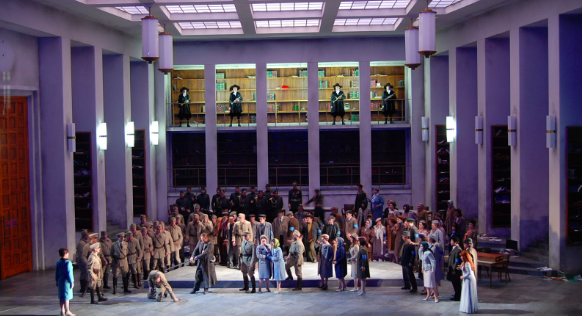
Este Lohengrin do Festival de Bayreuth, com encenação de Yuval Sharon, é muito bizarro, mas a encenação acaba por ser muito vistosa e agradável. A acção passa-se numa zona de postes eléctricos de alta tensão, todos os intervenientes principais vestem de azul, cor do cenário, o que se traduz num eleito visual muito agradável. A acção é intercalada por projecções de nuvens intensas. Quase todos têm asas de insectos. (Em Bayreuth, a última produção do Lohengrin era dominada por ratos; a actual é por insectos!). É uma comunidade sem líder que anseia por ele. Sempre que se fala no cisne (o irmão da Elsa e potencial líder) aparece a corrente eléctrica nos cabos.


No 3º acto, após o casamento, o quarto dos noivos e os seus trajos são numa cor mais quente, laranja avermelhado (maior segurança no casamento, amor e protecção do Lohengrin), contrastando com o azul de toda a restante cenografia. Mas passada esta cena volta-se ao ambiente azul habitual (excepto a Elsa) e assim tudo se passa até terminar. No final, a Ortrud, com os companheiros do Telramund prenderem todos com uma corda e ela lança fogo sobre os troncos de fogueira, uma vingança face à sabida derrota do duo maléfico da obra. O irmão de Elsa aparece de verde com um pequeno tronco de árvore na mão simbolizando o verde de esperança, de renovação, de renascimento, de uma nova realidade. E talvez por isso, todos tenham de morrer no final. Todos menos Elsa e o irmão, simbolizando essa renovação (e o Bem) e menos Ortrud, ficando a ideia de que o Mal está e estará sempre presente na Vida.


O maestro Christian Thielemann foi excepcional na direcção da Orquestra que esteve ao mais alto nível. O Coro foi magnífico! Mais uma vez, ouviu-se Wagner em todo o seu esplendor.

Também superlativas foras as interpretações vocais. O tenor Klaus Florian Vogt foi um Lohengrin perfeito. Tem um timbre leve inconfundível, de uma beleza e musicalidade ímpares e neste papel é exímio. O In fernem land no 3º acto foi muito bonito e expressivo, apoiado de forma sublime pela orquestra. Acho que quando Wagner escreveu o Lohengrin, teve uma premonição que um dia surgiria um cantor ideal para ele – Klaus Florian Vogt!


A soprano Camilla Nylund foi uma Elsa von Brabant genuína e com boa interpretação vocal, muito emotiva e bem audível sobre a orquestra.


O rei Heinrich foi o baixo Georg Zeppenfeld que, mais uma vez, não deixou os seus créditos por mãos alheias e ofereceu-nos uma interpretação sólida, inteligente, com voz grave potente e bonita. 

O barítono Martin Gantner foi o Friedrich von Telramund. Para mim o menos impressionante dos cantores, apesar de ter tido um bom desempenho. 


Finalmente a Ortrud foi interpretada de forma eficiente e malvada pela mezzo Petra Lang, que tem uma voz imensa. A encenação também a favorece. As suas asas são diferentes das dos restantes, personificando um insecto malévolo. A intervenção vocal final foi arrepiante.


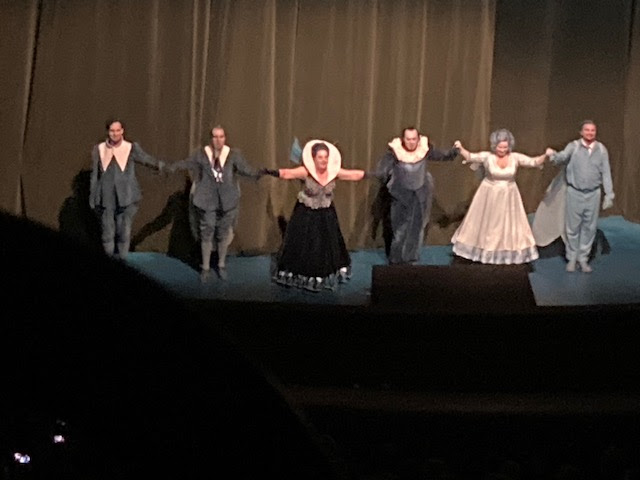
Terminado o espectáculo, o público explodiu em aplausos a todos, que foram obrigados a vir várias vezes ao palco. A maior ovação que ouvi em Bayreuth este ano. 


(Texto escrito com contribuições do wagner_fanatic e do Fanático_Um, que assistiram a récitas em dias diferentes)

*****

LOHENGRIN, Bayreuth Festival, August 2022

This Lohengrin from the Bayreuth Festival, staged by Yuval Sharon, is very bizarre, but the staging turns out to be very showy and pleasant. The action takes place in an area of ​​high voltage electric poles, all the main actors wear blue, the color of the scenery, which translates into a very pleasant visual choice. The action is interspersed with projections of intense clouds. Almost all have insect wings. (In Bayreuth, the last production of Lohengrin was dominated by rats; the current one is by insects!). It's a leaderless community that craves him. Whenever the swan (Elsa's brother and potential leader) is mentioned, the electrical current appears in the cables.

In the 3rd act, after the wedding, the bride and groom's room and their costumes are in a warmer color, reddish orange (greater security in the marriage, love and protection by Lohengrin), contrasting with the blue of the rest of the scenography. But after this scene, all returns to the usual blue environment (except for Elsa) and that's how everything goes until it's over. In the end, Ortrud, with Telramund's companions, bound everyone with a rope and she threw fire on the bonfire logs, a revenge in the face of the known defeat of the evil duo of the opera. Elsa's brother appears in green with a small tree trunk in his hand, symbolizing the green of hope, of renewal, of rebirth, of a new reality. And maybe that's why everyone has to die in the end. All die except Elsa and her brother, symbolizing this renewal (and the Good) and except Ortrud, leaving the idea that the Evil is and will always be present in Life.

Conductor Christian Thielemann was exceptional in the direction of the Orchestra that was at the highest level. The Choir was magnificent! Once again, Wagner was heard in all his splendor.

Also superlative were the vocal interpretations. Tenor Klaus Florian Vogt was a perfect Lohengrin. He has an unmistakable light timbre, of unparalleled beauty and musicality, and in this role he excels. In fernem land in the 3rd act was very beautiful and expressive, supported in a sublime way by the orchestra. I think that when Wagner wrote Lohengrin, he had a premonition that one day an ideal singer would appear for him – Klaus Florian Vogt!

Soprano Camilla Nylund was a genuine Elsa von Brabant with a good vocal interpretation, very emotional and very audible over the orchestra.

King Heinrich was bass Georg Zeppenfeld who, once again, did not leave his credits in the hands of others and offered us a solid, intelligent interpretation, with a powerful and beautiful bass voice.

Baritone Martin Gantner was Friedrich von Telramund. For me the least impressive of the singers, despite having a good performance.

Finally, Ortrud was played efficiently and evilly by mezzo Petra Lang, who has a huge voice. The staging also favors her. Her wings are different from the rest, personifying a malevolent insect. Her final vocal intervention was chilling.

At the end of the performance the audience burst into applause to all, who were forced to come to the stage several times. This was the biggest ovation I've heard in Bayreuth this year.

*****

quarta-feira, 3 de fevereiro de 2021

LOHENGRIN, San Francisco Opera, transmissão / streaming


Mais uma oportunidade de assistirmos a uma transmissão diferida de um espectáculo muito elogiado pela crítica.

Trata-se da ópera Lohengrin de R. Wagner, levada à cena recentemente pela Ópera de San Francisco e que será transmitida durante uma semana, a partir do próximo dia 6 de Fevereiro às 10h00 em San Francisco (18h00 em Lisboa).

(Fotografia / Photo: Cory Weaver, San Francisco Opera)


A encenação é de Frank Zamacona e a direcção musical de Nicola Luisotti.

(Fotografia / Photo: Cory Weaver, San Francisco Opera)

Tem como solistas principais Brandon Jovanovich (Lohengrin), Camilla Nylund (Elsa), Petra Lang (Ortrud), Gerd Grochowski (Friedrich von Telramund), Kristinn Sigmundsson (Heinrich) e Brian Mulligam (Arauto).

https://sfopera.com/opera-is-on/streaming/


LOHENGRIN, San Francisco Opera streaming

Another opportunity to watch a broadcast of a show highly praised by critics.

It is the opera Lohengrin by R. Wagner, recently performed by the  San Francisco Opera and which will be broadcast for a week, starting on the 6th of February at 10 am in San Francisco (6 pm in Lisbon).

Frank Zamacona directed and Nicola Luisotti was the maestro.

Main soloists are Brandon Jovanovich (Lohengrin), Camilla Nylund (Elsa), Petra Lang (Ortrud), Gerd Grochowski (Friedrich von Telramund), Kristinn Sigmundsson (Heinrich) and Brian Mulligam (Herald).

https://sfopera.com/opera-is-on/streaming/


domingo, 13 de janeiro de 2019

LOHENGRIN, Wiener Staatsoper, Novembro / November 2018


(review in English below)

Assistir a um bom Lohengrin é sempre um privilégio e foi o que aconteceu esta noite em Viena. A encenação de Andreas Homoki já comentada neste blogue é pouco interessante. Tudo se passa numa taberna, com as personagens vestidas de tirolesas e muitas mesas e cadeiras em palco, constantemente a serem mudadas de posição, mas praticamente nada mais.


A Orquestra esteve ao mais alto nível e a Simone Young (que saudades na Gulbenkian) foi fantástica. Foi a melhor abertura do Lohengrin que ouvi, imprimiu um ritmo lento e a orquestra em fortíssimo naquela parte mágica, foi fantástica. E em toda a ópera foi sempre fabulosa e sem qualquer falha por parte dos instrumentistas.


O Coro também foi excelente, sobretudo o masculino.


O Kwangchul Youn foi excelente como rei Heinrich. Já o ouvi muitas vezes e nunca falha.


A Elza van den Heever (uma estreia para mim) foi uma Elsa fantástica, consistente, ingénua e insegura, de voz poderosa, afinada e boa presença em palco.


O Evgeny Nikitin (Friedrich von Telramund) tem uma voz bonita mas muito pequena, foi frequentemente abafado pela orquestra, o pior da noite.


A Ortrud da Petra Lang foi cenicamente muito boa, malévola e cínica, vocalmente quase sempre muito bem mas, por vezes, pareceu que quebrou um pouco. Apesar de ter uma voz forte e afinada, acho que não é a ideal para a personagem.


O arauto do Clemens Unterreiner foi uma agradável surpresa pela qualidade da interpretação.


Deixo para o fim o Andreas Schager que ouvi ao vivo pela primeira vez. Foi o mais aplaudido da noite, estando em casa. Cantou sempre afinado, não falhou nenhuma nota, ouviu-se sempre sobre a orquestra, esteve bem em palco, mas... soube-me a pouco. Não sei se é o timbre vocal, mas ficou aquém de outros intérpretes que tenho visto, nomeadamente o Klaus Florian Vogt que é para mim o melhor Lohengrin no activo.


Mas foi uma récita muito boa.


****


LOHENGRIN, Wiener Staatsoper, November 2018

Watching a good Lohengrin is always a privilege and that was what happened tonight in Vienna. Andreas Homoki's production was already commented on this blog and is not very interesting. Everything happens in a tavern, with the characters dressed in typical Tirol costumes and many tables and chairs on stage, constantly changing positions, but practically nothing more.

The Orchestra was at the highest level and Simone Young (hoe I mess her in Gulbenkian) was fantastic. It was the best opening of the Lohengrin that I heard, she imposed a slow pace and the orchestra in forte in that magical part, was fantastic. And throughout the opera was always fabulous and without any fault on the part of the musicians.
The Choir was also excellent, especially the male.

Kwangchul Youn was excellent as King Heinrich. I've heard him many times and he never fails.

Elza van den Heever (a first time for me) was a fantastic, consistent, naive and insecure Elsa with a powerful, well-tuned voice and good stage presence.

Evgeny Nikitin (Friedrich von Telramund) has a nicebut very small voice, he was often drowned by the orchestra, the worst of the night.

Petra Lang's Ortrud was very good, evil, and cynical, vocally almost always very well, but at times she seemed to break a little. Although she has a strong and well-tuned voice, I do not think it's ideal for the character.

The herald of Clemens Unterreiner was a pleasant surprise for the quality of the interpretation.

I leave to the end the Andreas Schager who I heard live for the first time. He was the most applauded of the night, being at home. He always sang in tune, did not miss a note, was always heard above the orchestra, was well on stage, but ... I was expecting more. I do not know if it is the vocal timbre, but he was not as good as other interpreters I have seen, namely Klaus Florian Vogt who is for me the best Lohengrin of our days.

But it was a very good performance.

****

segunda-feira, 27 de agosto de 2018

TRISTÃO E ISOLDA / TRISTAN UND ISOLDE, Bayreuth, Agosto / August 2018


(Review in English below)

Direcção musical – Christian Thielemann
Encenação – Katharina Wagner
Tristan – Stephen Gould
Marke –Georg Zeppenfeld
Isolde – Petra Lang
Kurwenal – Iain Paterson
Melot – Raimund Nolte
Brangäne – Christa Mayer

O Tristão e Isolda encerrou este meu ano em Bayreuth. A abertura foi algo rápida de mais e um pouco agressiva para o meu gosto mas o que se seguiu é trabalho de um verdadeiro génio da batuta como o Thielemann... uma intensidade dramática e uma precisão impressionantes!!!

Vocalmente estiveram todos a um nível estratosférico! A grande surpresa foi a Brangane da Christa Mayer (uma Magdalene excelente nos Mestres Cantores de Nuremberga) que fez um papel poderosíssimo. Que voz de mezzo brilhante!

A Petra Lang e o Stephen Gould estão incríveis. No 1º acto, a cena do Tristan... Isolde... (aqui não bebem mas jorram de mão dada o filtro sobre as outras) foi de uma intensidade e beleza vocal ímpar... a suavidade com que cada nome saiu da laringe de cada um deles derrete qualquer um!

No 2º acto o mais perfeito O sink hernieder... que eu já ouvi ao vivo ou em gravação. E com a óbvia grande contribuição de Thielemann. Zeppenfeld colossal (como já tenho dito, ele e o Groissbock são os melhores baixos wagnerianos da actualidade)!

Gould foi incansável e imparável no 3º acto, titânico, aliviando o quão pesaroso pode ser ouvir este acto por alguém que não cante e interprete como ele! Lang com um final estrondoso! Zeppenfeld parecia pouco emotivo mas compreendi porquê... Katharina Wagner coloca-o não simpático com a razão da traição de Tristão e com a sua morte, mas mantém-no marcado por essa mesma traição, em completo escárnio em relação a Tristão. Isolda “morre” para aquela relação com Tristão mas vive, arrastada do palco, em mão, por Marke.


No global foi excelente, apenas diminuído pelo meu encarar da obra (não é a minha favorita…) e pelo lugar pouco convidativo na galeria (onde qualquer som “acessório” é amplificado) para uma encenação não necessariamente minimalista.

Mesmo da estação de comboios ainda é possível um adeus (quiçá até para o ano...) à “Colina Verde”...


Texto de wagner_fanatic


TRISTAN UND ISOLDE, Bayreuth, August 2018

Musical direction - Christian Thielemann
Production - Katharina Wagner
Tristan - Stephen Gould
Marke - Georg Zeppenfeld
Isolde - Petra Lang
Kurwenal - Iain Paterson
Melot - Raimund Nolte
Brangäne - Christa Mayer

Tristan and Isolde ended my year in Bayreuth. The opening was a bit too fast and a bit aggressive for me but what followed is the work of a true genius of the baton like Thielemann ... dramatic intensity and stunning precision!!!

Vocally all have been on a stratospheric level! The big surprise was Christa Mayer's Brangane (an excellent Magdalene in Die Meistersinger von Nurnberg) who performed a very powerful role. What a brilliant mezzo voice!

Petra Lang and Stephen Gould were amazing. In the 1st act, the scene of Tristan ... Isolde ... (here they do not drink but hand jets given the filter over the others) was of an unique intensity and vocal beauty... the softness with which each name left the larynx of each of them melts either!

In the 2nd act the most perfect O sink hernieder ... I've heard live or in recording. And with the obvious great contribution of Thielemann. Colossal Zeppenfeld (as I have said, he and Groissbock are the best Wagnerian basses today)!

Gould was tireless and unstoppable in the 3rd act, titanic, relieving how sorry it can be to hear this act by someone who does not sing and interpret like him! Lang with a booming end! Zeppenfeld seemed unemotional but I understood why ... Katharina Wagner makes him unfriendly with the reason for Tristan's betrayal and his death, but keeps him scarred by this same betrayal, in complete derision of Tristan. Isolde "dies" for that relationship with Tristan but lives, dragged from the stage, in hand, by Marke.

Overall it was excellent, only diminished by my view of the work (not my favorite ...) and by the uninviting place in the gallery (where any "accessory" sound is amplified) for a non-minimalist staging.

To say goodbye, the railway station.

Text by wagner_fanatic.