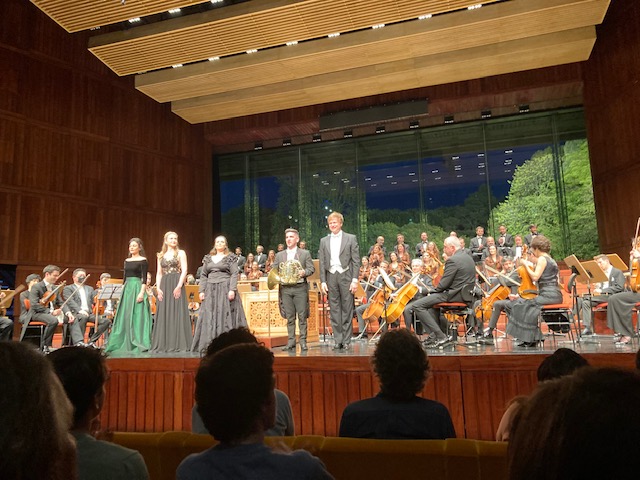
Numa das melhores temporadas dos últimos anos, a Fundação Gulbenkian ofereceu-nos mais um grande concerto, desta vez a belíssima Missa em Si menor de Johann Sebastian Bach.
Dirigiu superiormente o maestro Leonardo García Alarcon que nem usou partitura. O Coro Gulbenkian e a Orquestra Gulbenkian tiveram óptimos desempenhos, como é habitual.
Nos solistas a soprano Ana Quintans destacou-se mais uma vez pela excelência da sua interpretação. A mezzo Cátia Moreso e o baixo-barítono Andreas Wolf estiveram muito bem. Mais discretos foram a contralto Dara Savinova, o tenor Fabio Trümpy e o contratenor Owen Willetts.
****
Mass in B minor, Bach, Calouste Gulbenkian Foundation, April 2022
In one of the best seasons of recent years, the Gulbenkian Foundation offered us another great concert, this time the beautiful Mass in B minor by Johann Sebastian Bach.
Maestro Leonardo García Alarcon superiorly directed the concert. The Gulbenkian Choir and the Gulbenkian Orchestra had excellent performances, as usual.
Concerning the soloists, soprano Ana Quintans stood out once again for the excellence of her interpretation. Mezzo Cátia Moreso and bass-baritone Andreas Wolf were very good. More discreet were alto Dara Savinova, tenor Fabio Trümpy and countertenor Owen Willetts.
(texto de
wagner_fanatic e fanatico_um. Fotografias de wagner_fanatic)
Uma Flauta Mágica espectacular! Muito diferente do habitual, sempre especial. A
encenação de Suzanne Andrade,
Barrie Kosky
presta uma homenagem ao cinema mudo do início do século passado e está muito
bem conseguida. É verdadeiramente original, exige uma precisão enorme dos
cantores para aparecerem nos momentos certos, a fazerem os gestos certos para
que tudo o que é constantemente projectado se enquadre na perfeição, o que
aconteceu. É um daqueles espectáculos que tem que ser visto, não se consegue
descrever.
Assistimos
a duas récitas com artistas diferentes.
O maestro Ivo Bolton na sua
tradição e qualidade irrepreensível esteve muito bem numa das récitas e menos
bem na outra, onde imprimiu um ritmo excessivamente lento na abertura. A
Orquestra sublime ou nem tanto, numa das récitas com várias entradas tardias de
vários instrumentos, sobretudo no início.
O Tamino foi
excepcional nas duas récitas, interpretado por dois cantores diferentes.
Stanislas de Barbeyracfoi brutal! Paul
Appleby foi excelente, dicção perfeita, voz muito bonita e um volume
assinalável.
Andreas Wolf foi o
Papageno nas 2 récitas. Foi excelente, mas com ligeiro vibrato.
A Raínha da Noite foi cantada de forma superior pelas duas intérpretes,
Aleksandra Olczyk com um vozeirão brutal e
afinação sublime, e Rocío Pérez que, tenho mostrado
alguma fragilidade na coloratujra da primeira intervenção, foi irrepreensível
na sua áeria de referência.
A Pamina da Olga Peretyatko esteve fantástica, com
os ataques agudos límpidos, e a da Anett Fritsch foi espectacular, de voz
sempre afinada, timbre bonito e uma interpretação sólida, sempre sobre a
orquestra.
O Monostatos do Mikeldi Atxalandabaso foi correcto e interessante nas
duas récitas.
Foi na
interpretaçãoo do Sarastro que as diferenças foram acentuadas. Um dos cantores
(Andrea
Mastroni)foi excelente, de voz cavernosa e bem audível, como se deseja neste papel,
enquanto o outro (Rafal Siwek) foi fraco, com francas dificuldades no
registo mais grave e uma voz frequentemente afogada pela orquestra.
Nos papéis secundários
houve uniformidade na qualidade elevada de todos: Ruth Rosique como Papagena,
Elena
Copons, Gemma Coma-Alabert e Marie-Luise
Dressen nas três damas,
e os três rapazes (que eram raparigas).
****
THE MAGIC
FLUTE / DIE ZAUBERFLÖTE, Teatro Real, Madrid, February 2020
(text by
wagner_fanatic and fanatic_um. Photographs by wagner_fanatic)
A
spectacular Magic Flute! Very different from the usual, always special. The
staging by Suzanne Andrade, Barrie Kosky pays homage to the silent cinema of
the beginning of the last century and is very well. It is truly original, it
requires an enormous precision of the singers to appear at the right moments,
to make the right gestures so that everything that is constantly projected fits
perfectly, what happened. It is one of those shows that has to be seen, it
cannot be described.
We watched
two performances with different artists.
Maestro Ivo Bolton in his tradition and
impeccable quality did very well in one of the shlows and less well in the
other, where he imposed an excessively slow pace in the opening. The Orchestra was
sublime or not so, in one of the recitals with several late entries of various
instruments, especially at the beginning.
Tamino was
exceptional in both performances, performed by two different singers.
Stanislas de Barbeyrac was brutal! Paul Appleby was excellent, perfect diction, very beautiful voice
and a remarkable volume.
Andreas Wolf was Papageno in the 2 performances. He was
excellent, but with a slight vibrato.
The Queen
of the Night was sung in a superior way by the two interpreters,
Aleksandra Olczyk with a brutal loud voice and sublime tuning,
and Rocío Pérez who, after having
shown some fragility in the coloratura on the first intervention, was irreproachable
in her reference area.
Olga Peretyatko's Pamina was fantastic, with clear, high-pitched
attacks, and Anett Fritsch was
spectacular, her voice was always in tune, beautiful timbre and a solid
interpretation, always over the orchestra.
Monostatos
by Mikeldi Atxalandabaso was correct
and interesting in both shows.
It was in
the interpretation of Sarastro that the differences were accentuated. One of
the singers (Andrea Mastroni) was excellent,
with a cavernous and very audible, voice as is desired in this role, while the
other (Rafal Siwek) was weak, with difficulties
in the most low register and a voice often drowned by the orchestra.
In the
supporting roles there was uniformity in the high quality of all: Ruth Rosique as Papagena, Elena Copons, Gemma Coma-Alabert and Marie-Luise Dressen in the three ladies,
and the three boys (who were girls).
O Teatro Real de Madrid estreou a sua nova temporada 2014/2015 com a emblemática ópera Le Nozze di Figaro de Wolfgang Amadeus Mozart.
Trata-se da primeira das três óperas da triologia da Ponte. Estreada em 1786 no Burgtheater em Viena, o texto que o próprio Mozart escolheu para que Lorenzo da Ponte adaptasse era de Beaumarchais — tratava-se da peça teatral Le marriage de Figaro ou La folle journée escrita em 1784 cujos contornos políticos eram marcantes. Este texto é antecedido da também famosa peça O Barbeiro de Sevilha, adaptada para ópera por Giovanni Pasielo e, mais tarde, por Giacomo Rossini. Em pleno período pré-revolucionário, questionava-se a diferença de classes e o poder hereditário da nobreza. Tal conteúdo não intimidou Mozart e da Ponte que juntos fizeram uma das peças operáticas mais perfeitas de sempre em apenas 6 semanas.
O sucesso foi imediato com 9 representações em Viena e dezenas em Praga. Deste sucesso, resultou a encomenda para a não menos magnífica ópera Don Giovanni.
O enredo — complexo e ao estilo de Molière — é bem conhecido e poderão encontrar uma sinopse, por exemplo, neste link da Wikipedia.
Deixo-vos, igualmente, um vídeo em que o musicólogo espanhol José Luis Téllez faz uma excelente introdução à ópera. Trata-se de um orador nato, de extrema simpatia e com que tive o prazer de trocar breves palavras. Vale a pena ir ouvi-lo nos 30 minutos que antecedem cada récita.
Assisti à estreia absoluta no dia 15.09 e, depois, à estreia do elenco secundário a 18.09.
A encenação de Emilio Sagi já tinha sido estreada precisamente em Madrid em 2011. Agora foi novamente reposta e com todo o mérito. Trata-se de uma encenação clássica que segue fielmente todos os detalhes do libretto e não deixa lugar a segundas e terceiras interpretações. Permite o desenrolar da acção de modo muito eficaz, favorece a comédia e tem, inclusive, momentos muito bem conseguidos como, por exemplo, a ária de Marcellina ou a de Figaro (quando pede aos homens que observem as mulheres ligam-se as luzes da sala...) do quarto acto que se passa à frente do pano que vêem abaixo mas que, com diferentes incidências de luz, ganha transparências que permitem ver cenas por trás. E o cenário do último acto é belíssimo. É, de facto, uma encenação exemplar.
A Orquestra Titular do Teatro Real dirigida por Ivor Bolton esteve em muito bom nível, oferecendo uma grande qualidade interpretativa, favorencendo os cantores e sem falhas importantes. A orquestra do Teatro Real está, actualmente, num nível muito elevado.
Quanto aos elencos.
Começando pelo de dia 15.09.
O Conde de Almaviva foi o famoso barítono italiano Luca Pisaroni. Cenicamente esteve muito bem e foi aquele que melhor interpretou Mozart. Fraseado perfeito, belíssimo timbre, muito seguro na interpretação vocal. Pena que o "giubilare mi fa" da sua ária do 3.º acto lhe tenha saído muito mal, embora tenha tentado disfarçar.
A Condessa de Almaviva foi o soprano Sofia Soloviy. Se é verdade que entrou com uns agudos ligeiramente ásperos, a sua interpretação foi em crescendo e teve uma ária "E Susanna non vien" de elevadíssimo nível.
Susanna foi Sylvia Schwartz. Vocalmente uns furos abaixo do restante elenco. Teve muita dificuldade de projecção vocal, ficando quase sempre difícil de ouvir quer quando acompanhada pela orquestra, quer nos tutti vários em que participa. Cenicamente esteve bem, mas não teve a jovialidade que se espera desta personagem.
Figaro foi Andreas Wolf. A sua voz fez-me lembrar, pelo modo de entoação e pelo timbre, o de Peter Matei. Foi um Figaro seguro vocalmente, mas sem ser muito cómico, o que transpareceu na sua interpretação cénica que me pareceu, por vezes, um pouco estática.
Cherubino foi Elena Tsallagova que esteve em bom plano vocal e cenicamente. As suas duas árias principais correram-lhe muito bem.
Já no dia 18.09 estes cinco solistas foram interpretados por outros cantores.
O Conde foi Andrey Bondarenko. Na minha opinião sofreu do mesmo problema de Sylvia Schwartz, mas mais grave. Era mesmo difícil de ouvir. De resto, quando se ouvia, não tinha falhas e fez um Conde convincente do ponto de vista cénico.
A Condessa foi Anett Fritsch. Esteve em bom plano vocal e cenicamente. A sua voz não tem a potência ou a beleza da de Sofia Soloviy, mas não apresentou falhas e tem uma postura e figura óptimas para o papel.
A Susanna de Elenora Buratto foi excelente. Voz límpida, jovial e com agudos fáceis e seguros, teve uma prestação vocal de elevadíssimo nível. Cenicamente esteve perfeita, encarnando a personagem com toda a jovialidade e comicidade que se espera. A melhor da noite.
Figaro foi o italiano Davide Luciano. Tem um timbre muito bonito, esteve sempre muito seguro vocalmente e coordenado com a orquestra. Pode afirmar-se que foi um excelente Figaro e que se pode aventurar facilmente em muitos outros papéis mozartianos. Também cenicamente esteve perfeito. Um Figaro audaz, másculo, decido e jovial.
Cherubino foi Lena Belkina. Esteve em bom plano vocal e cénico sem, contudo, ter uma interpretação marcante.
Aqui o vídeo do aplauso da segunda récita.
Se tivesse de escolher ficaria com: Pisaroni como Conde, Soloviy como Condessa, Buratto como Susanna, Luciano como Figaro e Tsallagova como Cherubino.
O restante elenco foi constante nas duas récitas. Marcellina foi Helene Schneiderman que nos ofereceu uma interpretação muito cómica e vocalmente de elevado nível. A sua ária Il capro e la capretta foi magnífica. Doctor Bartolo foi Christophoros Stamboglis que esteve bem sem encantar, mesmo na sua La vendetta. Don Basilio (José Manuel Zapata), Don Curzio (Gerardo López) e Antonio (Miguel Sola) tiveram um bom desempenho. Finalmente, uma nota para a óptima Barbarina de Khatouna Gadelia.
No fim de contas, gostei mais da segunda récita e foi uma excelente forma de iniciar a temporada 2014/2015.
-------------------------
(Review in Elglish)
The Teatro Real of Madrid opened its new 2014/2015 season with the emblematic Mozart's Le Nozze di Figaro.
This is the first of three operas of da Ponte's trilogy. Premiered in 1786 at the Burgtheater in Vienna, the text that Mozart himself chose for Lorenzo da Ponte to adapt was Beaumarchais's play Le marriage de Figaro or La folle journée written in 1784 and whose political boundaries were marked. This text is also prefaced the famous play The Barber of Seville, adapted for opera by Giovanni Pasielo and later by Giacomo Rossini. In a fully pre-revolutionary period, it questioned the place of the different social classes and the hereditary power of the nobility. Such content did not intimidated Mozart and da Ponte who together made one of the finest operatic pieces ever and in just six weeks.
The opera got immediate success with 9 representations in Vienna and dozens in Prague. This success resulted in the order for no less magnificent opera Don Giovanni.
The plot - complex and with the style of Molière - is well known and you can find a synopsis, for example, this Wikipedia link.
I leave you also a video in which the Spanish musicologist José Luis Téllez made an excellent introduction to this opera. He is a born orator, extreme kind and I had the pleasure of exchanging a few words with him. It worth going hear him in the 30 minutes before each recitation.
http://youtu.be/NhDpW6eegB8
I attended the premiere on 15.09 and then the premiere of the supporting cast on 18.09.
The staging of Emilio Sagi had already been premiered in Madrid in 2011. This is a classic staging that follows faithfully all libretto'sdetails and leaves no room for second and third interpretations. It allows very effectively the comedy and even has moments very well done, for example, Marcellina's aria or the one of Figaro (when asking men to watch women teh opera hall lights turned on...) in the fourth act that goes ahead of cloth you see below. This curtain, with different incidences of light, wins transparencies that allows you to see behind scenes. And the scenario of the last act is gorgeous. It is indeed an exemplary staging.
The Teatro Real Orchestra conducted by Ivor Bolton was in very good level, offering a high interpretive quality, underlying singers and with no flawless. The orchestra of the Teatro Real is currently at very high level.
As for the two recitations.
Starting from the day 15.09.
The Count of Almaviva was the famous Italian baritone Luca Pisaroni. Scenically he did very well and was the one who best portrayed Mozart. Perfect phrasing, beautiful timbre, very safe in vocal interpretation. Too bad the he had a terrible finale "giudicare mi fa" of the 3rd act aria, although he has tried to disguise.
The Countess Almaviva was the soprano Sofia Soloviy. If it is true that she came with a slightly harsh treble, her interpretation was growing and had an aria "E Susanna non vien" of the highest level.
Susanna was Sylvia Schwartz. She was vocally below the rest of the cast. She had great difficulty in vocal projection, getting almost always difficult to hear when accompanied by the orchestra, but also the several tutti of he opera. Scenically she was good, but lacked the playfulness that is expected of this character.
Figaro was Andreas Wolf. Her voice reminds me, by way of intonation and timbre, the one of Peter Matei. Figaro was vocally secure, but without being too comical, what transpired in his scenic interpretation that seemed sometimes a bit static.
Cherubino was Elena Tsallagova who was in good level voical and scenically. She was very well in her two main arias.
Already on 18.09, these five soloists were interpreted by other singers.
The Count was Andrey Bondarenko. In my opinion, he suffered from the same problem of Sylvia Schwartz, but more severe. He was really hard to hear. Moreover, when heard, had no faults and made a convincing Count in the scenic viewpoint.
The Countess was Anett Fritsch. She was in good level vocal and scenically. Her voice does not have the power or beauty of Sofia Soloviy's, but showed no faults and has a great figure and posture for the role.
The Susanna Elenora Buratto was excellent. Clear, youthful and with easy and secure treble voice had a very high level vocal performance. Scenically she was perfect, embodying the character with all the jollity and drollery we could expect. The best of the night!
Figaro was the Italian Davide Luciano. He has a beautiful timbre, has always been very secure vocally and coordinated with the orchestra. It can be said that he was an excellent Figaro and he can easily venture into many other Mozart roles. He was also scenically perfect. A bold, manly, and jovial Figaro.
Cherubino was Lena Belkina. She was in good vocal and scenic level without, however, have a striking interpretation.
Here the video of applause the second recitation.
If I had to choose a cast it would be: Pisaroni as Count, Soloviy as Countess, Buratto as Susanna, Luciano as Figaro and Tsallagova as Cherubino.
The rest of the cast was in a constant level in both recitals. Marcellina was Helene Schneiderman who offered us a very humorous and vocally perfect interpretiation. Her aria Il Capro e la capretta was magnificent. Doctor Bartolo was Christophoros Stamboglis that was good without charm even in his famous aria La vendetta. Don Basilio (José Manuel Zapata), Don Curzio (Gerardo López) and Antonio (Miguel Sola) performed well. Finally, a note to the amazing Barbarina of Khatouna Gadelia.
In the end, I liked more the second recitation. This Le Nozze di Figaro was a great way to start the season 2014/2015.