Mostrar mensagens com a etiqueta Royal Opera House (Londres). Mostrar todas as mensagens

segunda-feira, 7 de novembro de 2022

SALOME, Royal Opera House, Londres, Setembro / September 2022

(review in English below)

Voltei a ter a oportunidade de rever na Royal Opera House a Salome de Richard Strauss na produção marcante de David McVicar. A encenação é violenta e chocante mas nesta reposição as cenas de nudez foram retiradas, aparecendo despido apenas o carrasco, no final da ópera.

Como referi em texto anterior, a acção é transportada para o Séc. XX e decorre no palácio de Herodes. No primeiro andar vê-se (mal) um jantar elegante, à luz de velas. O cenário principal é a cave imunda do palácio, umas casas de banho com paredes com azulejos brancos muito sujos, a condizer com tudo o resto. O profeta João Baptista (Jokanaan) está preso numa cisterna, donde é retirado por algum tempo, a pedido da Salomé. Com o decorrer da acção, todos descem para a cave.

As doentias cenas de assédio da Salomé sobre Jokanaan e de Herodes sobre Salomé são explícitas. Na dança dos sete véus o palco transforma-se radicalmente, aparecendo sucessivamente sete portas em movimento, entre as quais e com a ajuda de curtos filmes, Salomé recorda sete episódios traumáticos passados entre ela e o padrasto (Herodes), terminando com a concretização da relação sexual. A cena final de necrofilia em que a Salomé acaricia e beija a cabeça do Jokanaan totalmente ensanguentada (trazida a escorrer sangue pelo carrasco nu) é ainda mais impressionante. Uma encenação bem conseguida e chocante.


A música de Strauss é poderosa. A sonoridade é grandiosa e rica, o cromatismo sonoro impressionante, há utilização de leitmotive e alternância de consonância com dissonância. A orquestra é a parte maior desta obra. Sob a direcção do maestro Alexander Soddi, a orquestra da Royal Opera House, esteve ao seu melhor nível e proporcionou-nos uma interpretação superior, viva e dramática, dando-nos toda a sumptuosidade tímbrica que faz justiça à música de Strauss. 


Os cantores solistas foram todos de topo. A soprano Malin Byström foi uma Salomé de timbre suave e muito bonito, mantendo elevada qualidade vocal ao longo de toda a récita, sempre sobre a orquestra e com um final avassalador. A cantora é magra, alta e aparenta a juventude que a personagem exige, o que ajudou muito a sua óptima interpretação cénica.


O barítono Jordan Shanahan foi um Jokanaan óptimo, de voz marcante e poderosa, com um desempenho cénico perfeito.


Herodes foi interpretado pelo tenor John Daszak que esteve num nível superior. Foi sempre bem audível, o timbre é adequado à personagem e esteve sempre bem na componente cénica.
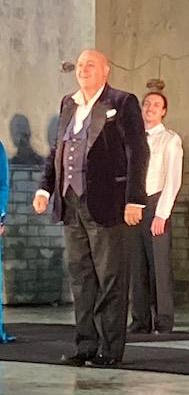

A mezzo Katarina Dalayman foi muito convincente no encorajamento da filha a pedir a cabeça do João Baptista e, no canto, foi óptima.

O Narraboth do tenor Thomas Atkins teve uma interpretação muito emotiva e até comovente, tanto na excelente componente vocal como na interpretação cénica.


Os muitos cantores secundários, apesar de terem interpretações curtas, estiveram ao nível deste excelente espectáculo de ópera.


*****


SALOME, Royal Opera House, London, September / September 2022

I once again had the opportunity to see Salome by Richard Strauss in the remarkable production of David McVicar at the Royal Opera House. The staging is violent and shocking, but in this performance the nude scenes were removed, leaving only the executioner naked at the end of the opera.

As I mentioned in a previous text, the action is transported to the XXth century  and takes place in Herod's palace. On the first floor you can see (barely) an elegant dinner, by candlelight. The main setting is the filthy basement of the palace, some bathrooms with walls with very dirty white tiles, in keeping with everything else. The prophet John the Baptist (Jokanaan) is imprisoned in a cistern, from which he is removed for some time, at the request of Salome. As the action progresses, everyone descends to the basement.

The sickening scenes of Salome's harassment of Jokanaan and Herod of Salome are explicit. In the dance of the seven veils, the stage is radically transformed, with seven moving doors appearing successively, between which and with the help of short films, Salomé recalls seven traumatic episodes between her and her stepfather (Herodes), ending with their sexual relationship. The final necrophilia scene in which Salomé caresses and kisses the bloodied Jokanaan's head (brought out by the naked executioner) is even more impressive. A well done and shocking staging.

Strauss' music is powerful. The sound is grandiose and rich, the sound chromaticism is impressive, there are leitmotive and alternation of consonance with dissonance. The orchestra is the biggest part of this work. Under the direction of conductor Alexander Soddi, the  was at its best and provided us with a superior, lively and dramatic interpretation, giving us all the timbral sumptuousness that does justice to Strauss' music.

The soloist singers were all of top quality. Soprano Malin Byström was a Salome with a smooth and very beautiful timbre, maintaining high vocal quality throughout the performance, always over the orchestra and with an overwhelming ending. The singer is thin, tall and seems to have the youth that the character demands, which helped a lot in her great scenic performance.

Baritone Jordan Shanahan was a great Jokanaan, with a strong and powerful voice, with a perfect scenic performance.

Herod was interpreted by tenor John Daszak who was at a higher level. He was always very audible, the timbre is suited to the character and he was always good in the scenic component.

Mezzo Katarina Dalayman was very convincing in encouraging her daughter to ask for the head of João Baptista and, in the corner, she was great.

The Narraboth of tenor Thomas Atkins had a very emotional and even moving interpretation, both in the excellent vocal component and in the scenic interpretation.

The many support singers, despite having short interpretations, were at the level of this excellent opera show.

*****

terça-feira, 1 de novembro de 2022

DON GIOVANNI, Royal Opera House, Londres / London, Setembro / September 2022

(review in English below)

A produção da Royal Opera House de Don Giovanni de Mozart a cargo de Kasper Holten foi uma das últimas óperas a que assisti ao vivo antes do terrível período da pandemia. Tive a sorte de estar novamente em cena 3 anos depois, numa altura em que voltei a Londres por razões profissionais.


Como já referi, a encenação é moderna e sofisticada, muito bem conseguida. Um complexo cubo central está em permanente rotação no palco, sobre o qual se projectam diversas imagens e há aberturas constantes de múltiplas portas que dão acesso a diversas salas em dois andares, ligados por escadas interiores. Logo na abertura vão aparecendo projectados os milhares de nomes das conquistas do Don Giovanni, uma imagem que aparecerá frequentemente ao longo da récita em momentos adequados. A movimentação cénica dos cantores é também óptima. 

A direcção musical de Constantin Trinks foi muito boa e respeitou os cantores.

Christopher Maltman que me habituei a ver como Don Giovanni, foi um Leoporello muito bom, com voz marcante, belo timbre e bem no desempenho cénico.


Don Giovanni foi Luca Micheletti, um excelente actor com boa figura, muito ágil em parco também graças à sua juventude. Mas o mais importante foi a interpretação vocal de qualidade superior, sempre afinado e bem audível.


A soprano Maria Bengtsson foi uma Donna Anna marcante, com óptima presença em palco e uma interpretação vocal superior, de grande emotividade.

Charles Castronovo foi fantástico como Dom Ottavio. O tenor tem um timbre bonito, bem audível e esteve sempre ao melhor nível na interpretação vocal e cénica.

A mezzo Paula Murrihy foi uma magnífica Dona Elvira na interpretação cénica como vocal. 


O barítono Thomas Faulkner foi um Masetto notável e de voz segura e bem audível, 

e Christina Gansch foi uma Zerlina atrevida, com voz excelente e óptima presença em palco.

O Comendador, Adam Palka, não destoou e contribuiu para este magnífico espectáculo de ópera. 

Um excelente espectáculo!


*****


DON GIOVANNI, Royal Opera House, London, September 2022

The production of the Royal Opera House of Mozart´s Don Giovanni by Kasper Holten was one of the last operas I saw live before the terrible period of the pandemic. I was lucky enough to be back on the scene 3 years later, at a time when I returned to London for professional reasons.

As I mentioned, the staging is modern and sophisticated, very well done. A complex central cube is in permanent rotation on the stage, on which several images are projected and there are constant openings of multiple doors that give access to different rooms on two floors, connected by interior stairs. Right at the opening, thousands of names of Don Giovanni's conquests are projected, an image that will often appear throughout the performance at appropriate times. The scenic movement of the singers is also great.

Constantin Trinks' musical direction was very good and respected the singers.

Christopher Maltman, who I got used to seeing as Don Giovanni, was a very good Leoporello, with a remarkable voice, beautiful timbre and a good stage performance.

Don Giovanni was Luca Micheletti, an excellent actor with a good figure, very agile but also thanks to his youth. But the most important thing was the superior quality vocal interpretation, always in tune and very audible.

Soprano Maria Bengtsson was a remarkable Donna Anna, with great presence on stage and a superior vocal interpretation, with great emotion.

Charles Castronovo was fantastic as Dom Ottavio. The tenor has a beautiful timbre, very audible and has always been at the best level in vocal and scenic interpretation.

Mezzo Paula Murrihy was a magnificent Dona Elvira in the scenic interpretation as vocal.

Baritone Thomas Faulkner was a remarkable Masetto with a confident, well-audible voice, and Christina Gansch was a cheeky Zerlina, with an excellent voice and great stage presence.

The Comendatore Adam Palka, did not stand out and contributed to this magnificent opera presentation.


An excellent performance.

*****

quarta-feira, 5 de outubro de 2022

MADAMA BUTTERFLY, Royal Opera House, Setembro / September 2022

(Review in English below)

Já várias vezes escrevi neste blogue sobre a Madama Butterfly, uma das minhas operas favoritas de Puccini. E algumas delas sobre a excelente produção, clássica, da Royal Opera House, que é frequentemente levada à cena nos últimos anos.

Ao contrário do que é a regra nesta excelente catedral da ópera, nos últimos anos os elencos escolhidos têm sido maus, o que não faz justiça à magnífica obra do compositor.

Infelizmente desta vez voltou a ser assim, exceptuando a interpretação da protagonista, que salvou a récita porque a ópera vive sobretudo dela.

O maestro Nicola Luisotti, com créditos afirmados, teve uma direcção nada empolgante ou emotiva.

O tenor Joshua Guerrero, de boa figura, foi vocalmente débil, deixou-se afogar frequentemente pela orquestra e cantou com idêntica expressão quer os momentos de felicidade, quer os de tristeza e remorso.


O barítono Carlos Alvarez parecia que estava a cantar em mono e a ensaiar. Mal se ouviu e também sem transparecer qualquer sensibilidade.


A mezzo Christine Rice cumpriu o papel de Suzuki sem deslumbrar, tal como Carlo Bosi como Goro. Em papéis curtos estiveram 2 artistas do Jette Parker, Josef Jeongmeen Ahn como Princepe Yamadori e Gabriele Kupsyte como Kate Pinkerton


A protagonista, soprano Maria Agresta não começou da melhor maneira mas, após o primeiro acto, teve uma interpretação magnífica, irrepreensível do ponto de vista vocal e em palco foi muito convincente, transbordando as emoções próprias de cada momento. É uma interpretação enorme e de grande exigência cénica e vocal e esteve à altura. Salvou a récita.


**

MADAMA BUTTERFLY, Royal Opera House, September 2022

I have written several times on this blog about Madama Butterfly, one of my favorite operas by Puccini. And some of them about the excellent, classic production of the Royal Opera House, which has been frequently brought to the scene in recent years.

Contrary to what is the rule in this excellent cathedral of opera, in recent years the chosen casts have been bad, which does not do justice to the magnificent work of the composer.

Unfortunately this time it was like that again, with the exception of the protagonist's interpretation, who saved the performance because the opera lives mainly on her.

Conductor Nicola Luisotti, with his credits affirmed, had an unexciting or emotional direction.

Tenor Joshua Guerrero, of good figure, was vocally weak, often let himself be drowned by the orchestra and sang with the same expression both the moments of happiness and those of sadness and remorse.

Baritone Carlos Alvarez looked like he was singing in mono and rehearsing. He was barely heard and also without showing any emotions.

Mezzo Christine Rice sung the role of Suzuki without dazzling, as did Carlo Bosi as Goro. In short roles were 2 artists from Jette Parker, programme Josef Jeongmeen Ahn as Princepe Yamadori and Gabriele Kupsyte as Kate Pinkerton

The protagonist, soprano Maria Agresta, did not start off in the best way, but after the first act, she had a magnificent interpretation, irreproachable from a vocal point of view and on stage she was very convincing, overflowing with the emotions of each moment. It's a huge interpretation of great scenic and vocal demand and it lived up to it. She saved the performance.

**

quinta-feira, 29 de setembro de 2022

AIDA, Royal Opera House, Londres, Setembro / September 2022


(review in English below)

A nova produção da Royal Opera House da Aida de Verdi foi entregue a Robert Karsen. Não há qualquer semelhança com o enquadramento original. O Egipto e a Etiópia foram esquecidos e tudo se passa num bunker militar cinzento de um País sob uma ditadura militar. Embora a produção tenha sido concebida antes da pandemia e da guerra na Ucrânia, ganha alguma actualidade pois poderia passar-se na Coreia do Norte ou mesmo na Rússia. Toda a espectacularidade habitual da ópera não existe.

As cenas passam-se todas nesse cenário muito cinzento, onde apenas há as cores azul e vermelha (com a estrela comunista) de bandeiras do País imaginado. Os protagonistas são militares de variadas patentes e o coro são soldados. Numa das grandes cenas de bailado este é substituído por um conjunto de empregadas domésticas a pôr uma enorme mesa, sob supervisão militar e a outra é dançada pelos soldados que exibem as suas capacidades militares. 


A marcha triunfal do 2º acto começa com uma série de caixões cobertos pela bandeira, o 3º acto passa-se à volta do que seria um túmulo de um soldado desconhecido e a cena final num depósito de mísseis.

A direcção musical de Antonio Pappano foi excelente e a orquestra esteve ao mais alto nível. 

O Coro foi talvez o melhor de todo o espectáculo e, no primeiro acto, os elementos cantando em pianíssimo, armados de metralhadoras e sentados como se numa igreja estivessem, foi sublime!

A soprano Elena Stikhina foi uma Aida notável, voz bonita, emotiva, bem audível e excelente presença em palco.


Agnieszka Rehlis foi uma Amneris algo contida, o seu mezzo não tem o poderio habitual nas interpretações desta personagem, mas cantou em crescendo e no final esteve bastante bem, apesar de a encenação não ajudar.

O tenor Francesco Meli foi um Radames fantástico. Sempre afinado, embora cantando aparentemente no limite em algumas vezes, nunca desafinou e transmitiu todas as emoções que se esperam do personagem. 


O Amonastro do barítono Ludovic Tézier não me surpreendeu porque sempre que ouvi este cantou, fiquei muito bem impressionado. Foi marcante, sobretudo no diálogo com a Aida no 3º acto.


Fabuloso foi o baixo Solomon Howard, talvez o melhor solista da noite, com uma interpretação magistral do Sumo Sacerdote Ramfis. 


In Sung Sim foi um Rei do Egipto desinteressante, mas o papel é muito pequeno.


(equipa de produção)

Um espectáculo musicalmente superior numa encenação cinzenta e algo monótona.


****


AIDA, Royal Opera House, London, September 2022

The new Royal Opera House production of Verdi's Aida was handed over to Robert Karsen. There is no resemblance to the original opera. Egypt and Ethiopia have been forgotten and everything takes place in a gray military bunker in a country under a military dictatorship. Although the production was conceived before the pandemic and the war in Ukraine, it gains relevance as it could take place in North Korea or even Russia. All the usual spectacularity of opera does not exist.

The scenes all take place in this very gray setting, where there are only the blue and red colors (with the communist star) of flags of the imaginary country. The soloists are soldiers of different ranks and the choir are soldiers. In one of the great ballet scenes, this is replaced by a group of maids setting a huge table, under military supervision, and the other is danced by soldiers displaying their military skills. The 2nd act's triumphal march begins with a series of flag-draped coffins, the 3rd act takes place around what would have been a tomb of an unknown soldier and the final scene in a missile depot.

Antonio Pappano's musical direction was excellent and the orchestra was at the highest level. The Choir was perhaps the best of the whole show and, in the first act, the elements singing in pianissimi, armed with machine guns and seated as if they were in a church, was sublime!

Soprano Elena Stikhina was a remarkable Aida, with a beautiful, emotional, well-audible voice and excellent stage presence.

Agnieszka Rehlis was a somewhat restrained Amneris, her mezzo doesn't have the usual power in the interpretations of this character, but she sang in crescendo and in the end she was quite good, although the staging didn't help.

Tenor Francesco Meli was a fantastic Radames. Always in tune, although singing seemingly on edge at times, he never went out of tune and conveyed all the emotions one would expect from the character.

Baritone Ludovic Tézier's Amonastro did not surprise me because whenever I heard him sing, I was very impressed. He was remarkable, especially in the dialogue with Aida in the 3rd act.

Fabulous was the bass Solomon Howard, perhaps the best soloist of the night, with a masterful interpretation by High Priest Ramfis.

In Sung Sim was an uninteresting King of Egypt, but the role is very small.

A musically superior show in a gray and somewhat monotonous staging.

****