Mostrar mensagens com a etiqueta Teatro Nacional de São Carlos. Mostrar todas as mensagens

domingo, 9 de outubro de 2022

L’ELISIR D’AMORE, Teatro de São Carlos, Outubro / October 2022

(review in English below)

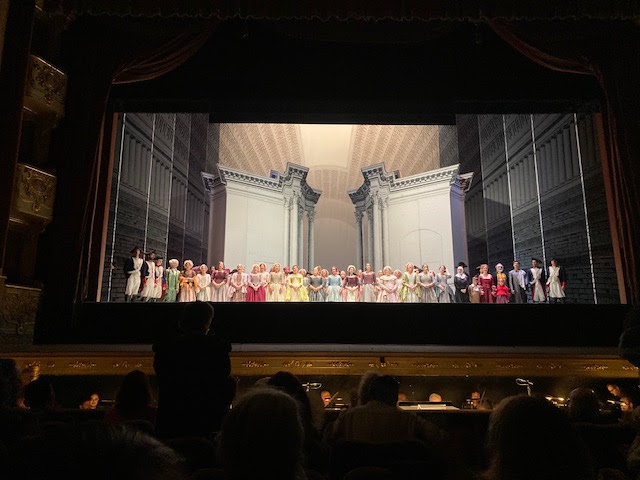
A ópera L’Elisir d’Amore de G Donizetti abriu a temporada lírica do Teatro de São Carlos. Uma produção nova com encenação e cenografia de Mário João Alves.


Duas escadas, umas mesas, cestos e caixas com (muitas) laranjas e pouco mais foram os adereços usados. A encenação foi simples mas com várias partes interessantes e de bom efeito visual, tendo tonado o espectáculo agradável de ver. 


Passa-se num ambiente rural, numa quinta de produção de laranjas ou similar. Antes da sua chegada (de pára-quedas) o Dr. Dulcamara lança panfletos sobre a plateia a anunciar as suas façanhas. 

No final são também lançados sobre a plateia enormes balões simulando laranjas.


O maestro Antonio Pirolli ofereceu-nos uma boa orquestração, mas por vezes pouco viva. A Orquestra Sinfónica Portuguesa esteve muito bem. Destaco o fagote (David Harrison) e a harpa (Carmen Cardeal) na famosíssima aria Una furtiva lagrima. 


O Coro do Teatro de São Carlos, sob a direcção de Giampaolo Vesselia teve uma prestação excelente.

Os solistas eram todos jovens, o que é óptimo, mas as interpretações não foram ao mesmo nível. O Nemorino foi interpretado pelo tenor espanhol Antonio Garés. Tem uma boa figura mas a emissão foi irregular, alternando períodos em que era bem audível com outros que mal se ouvia. O timbre é peculiar e, no registo mais agudo, parece cantar em falsete. 


A soprano Rita Marques foi a Adina, que não começou bem mas melhorou ao longo da récita e no final do 2º acto teve um desempenho marcante, com um registo agudo seguro e afinado. Em palco, não transmitiu qualquer atracção nem pelo Belcore nem pelo Nemorino, situação idêntica da parte deles.


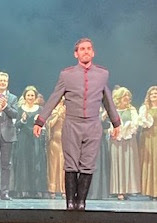
O barítono Ricardo Panela, cantor que muito aprecio, foi um Belcore vocalmente correcto, mas a figura não se ajusta à personagem. É demasiado jovem e franzino para o papel do sargento. A encenação e o guarda-roupa também não ajudaram.


O melhor da tarde foi o o baixo chileno Ricardo Seguel como Dulcamara. Tem uma voz poderosa, sempre bem audível, timbre muito bonito e em cena  foi o mais credível.


A Giannetta cantada por Joana Seara foi uma presença agradável.


***


L'ELISIR D'AMORE, Teatro de São Carlos, October 2022

The opera L'Elisir d'Amore by G Donizetti opened the lyrical season at Teatro de São Carlos. A new production with production and staging by Mário João Alves.

Two ladders, some tables, and baskets and boxes with (many) oranges were the props used. The staging was pleasant, had several interesting parts and good visual effect, making the performance pleasant to watch. It takes place in a rural setting, on an orange farm or similar. Before his arrival (by parachute) Dr. Dulcamara throws pamphlets over the audience announcing her achievements. At the end, huge balloons simulating oranges are also thrown over the audience.

Maestro Antonio Pirolli offered us a good orchestration, but sometimes not very lively, and the Orquestra Sinfónica Portuguesa played very well. I highlight the bassoon (David Harrison) and the harp (Carmen Cardeal) in the very famous aria Una furtiva lagrima. The São Carlos Theater Choir, under the direction of Giampaolo Vesselia, had an excellent performance.

The soloists were all young, which is great, but the performances weren't on the same level. Nemorino was interpreted by Spanish tenor Antonio Garés. He has a good figure but the vocal emission was irregular, alternating periods in which he was very audible with others that were barely audible. The timbre is peculiar and, in the highest register, he seems to sing in falsetto.

Soprano Rita Marques was Adina, who did not start well but improved throughout the performance and at the end of the 2nd act she had a remarkable performance, with a secure and in tune high register. On stage, she didn't show any attraction for either Belcore or Nemorino, a similar situation on their part as well.

Baritone Ricardo Panela, a singer I really appreciate, was a vocally correct Belcore, but the figure of the singer doesn't fit the character. He's too young and skinny for the role of sergeant. The staging and clothes didn't help either.

The best singer of the afternoon was the Chilean bass Ricardo Seguil as Dulcamara. He has a powerful voice, always very audible, very beautiful timbre and scenically he was the most credible.

Giannetta sung by Joana Seara was a pleasant presence.

***


segunda-feira, 27 de junho de 2022

ANDREA CHÉNIER, Teatro de São Carlos, Lisboa / Lisbon, Junho / June 2022

(Text in English below)

A ópera que muito gosto Andrea Chénier de U Giordano com libreto de Luigi Illica retrata o período da Revolução Francesa, suas esperanças e horrores. Numa festa no castelo da família, a jovem aristocrata Maddalena de Coigny, filha da condessa, é presenteada com um poema pelo generoso poeta Andrea Chénier, que defende a liberdade, amor e poesia. O mordomo Gérard queixa-se do luxo em que a família vive e demite-se. Em Paris começa a revolução mas os convidados ignoram-no. Anos mais tarde, o antigo mordomo, agora um revolucionário que quer vingar-se da opressão e injustiça, luta com Chénier por Maddalena, por quem estão ambos apaixonados. Gérard, contudo, avisa o poeta que é procurado como contra-revolucionário. Num tribunal revolucionário Chénier é condenado e Gérard é obrigado a assinar a condenação. Maddalena oferece-se em troca da vida de Chénier e comove Gérard quando relata a crueldade do povo francês no terror da revolução, ao assistir à morte da sua mãe, queimada viva. Aceita o amor de Chénier e são ambos condenados à morte pela guilhotina.

A encenação de Sarah Schinasi foi convencional, simples e eficaz. 

A Orquestra Sinfónica Portuguesa, sob a direcção de Antonio Pirolli, cumpriu com qualidade, merecendo realce a harpista Carolina Coimbra que tocou maravilhosamente nesta partitura em que a harpa é instrumento essencial e tem alguma da mais bela música.


Um protagonista importante é o povo francês (representado pelo coro) com um papel decisivo na evolução dos acontecimentos revolucionários. O Coro do Teatro de São Carlos esteve bem.


Em relação aos solistas, infelizmente, a récita deixou muito a desejar.

O barítono Claudio Sgura foi Gérard e o único com um desempenho capaz. Tem uma voz bem audível e de timbre agradável. Na ária do 3º acto Nemico della patria foi emotivo e convincente.

O tenor Marco Berti foi um Andrea Chénier com má presença em palco. A voz está muito desgastada, o timbre é agradável mas, em esforço, perde qualidade porque ou não aguenta ou grita. E emotividade foi algo que nunca transpareceu.

A soprano Svetla Vassileva, em substituição de Elisabete Matos, foi uma Maddalena pouco dada a representações cénicas e com uma prestação vocal muito aquém do desejável. Ou não se ouvia ou, no registo mais agudo, a estridência incomodava. A belíssima aria La mamma morta foi decepcionante. (Sei que ter Maria Callas como referência para esta ária é impiedoso para as outras cantoras, mas... non troppo). E emoção foi algo inexistente, viver ou morrer foi idêntico em palco. 


Nos papéis secundários estiveram Maria Luísa de Freitas (Bersi), Cátia Moreso (Condessa de Coigny / Madelon), José Corvelo (Roucher), Christian Luján (Mordomo / Fouquier Tinville) sempre bem, Luis Rodrigues (Mathieu) também bem, Sérgio Martins (Abade) e João Oliveira ( Dumas / Schmidt).

Uma última nota sobre as biografias apresentadas nos programas de sala. Os cantores solistas são sempre os mais aclamados em todo o mundo, sempre requisitados para os grandes teatros de ópera mundiais, etc. etc.  Haja algum pudor no que se escreve!! Nem todo o público que ainda resiste e vai ao São Carlos é desconhecedor do mundo da ópera...


*


ANDREA CHÉNIER, Teatro de São Carlos, Lisbon, June 2022

The opera I really like Andrea Chénier by U Giordano with a libretto by Luigi Illica portrays the period of the French Revolution, its hopes and horrors. At a party in the family castle, the young aristocrat Maddalena de Coigny, daughter of the countess, is presented with a poem by the generous poet Andrea Chénier, who defends freedom, love and poetry. The butler Gérard complains about the luxury in which the family lives and resigns. In Paris the revolution begins but the guests ignore him. Years later, the former butler, now a revolutionary who wants revenge for oppression and injustice, fights with Chénier for Maddalena, with whom they are both in love. Gérard, however, warns the poet that he is wanted as a counter-revolutionary. In a revolutionary court Chénier is condemned and Gérard is forced to sign the sentence. Maddalena offers herself in exchange for Chénier's life and moves Gérard when he recounts the cruelty of the French people in the terror of the revolution, when he witnessed the death of his mother, burned alive. She accepts Chénier's love and they are both sentenced to death by the guillotine.

Sarah Schinasi's staging was conventional, simple and effective. The Orquestra Sinfónica Portuguesa, under the direction of Antonio Pirolli, performed with quality, with emphasis on the harpist Carolina Coimbra who played wonderfully in this score in which the harp is an essential instrument and has some of the most beautiful music.

An important protagonist is the French people (represented by the choir) with a decisive role in the evolution of revolutionary events. The Coro do Teatro de São Carlos did well.

Concerning the soloists, unfortunately, the performance left a lot to be desired.

Baritone Claudio Sgura was Gérard and the only one with a capable performance. He has a very audible voice and a pleasant timbre. In the aria of the 3rd act Nemico della patria was emotional and convincing.

Tenor Marco Berti was an Andrea Chénier with poor stage presence. The voice is very worn, the timbre is pleasant but, with effort, it loses quality because it either can't stand it or screams. And emotionality was something that never transpired.

Soprano Svetla Vassileva, replacing Elisabete Matos, was a Maddalena little given to scenic representations and with a vocal performance that was far from desirable. Either you couldn't hear it or, in the highest register, the shrill was annoying. The beautiful aria La mamma morta was disappointing. (I know that having Maria Callas as a reference for this aria is ruthless for the other singers, but... non troppo). And emotion was non-existent, living or dying was identical on stage.

In the supporting roles were Maria Luísa de Freitas (Bersi), Cátia Moreso (Countess de Coigny / Madelon), José Corvelo (Roucher), Christian Luján (Butler / Fouquier Tinville) always well, Luis Rodrigues (Mathieu) also well, Sérgio Martins ( Priest) and João Oliveira (Dumas / Schmidt).

A final note about the biographies presented in the programs. Soloist singers are always the most acclaimed all over the world, always in demand for the world's great opera houses, etc. etc. Some modesty in what is written should exist!! Not all the public that still resists and goes to Teatro São Carlos is unaware of the opera world...

*


segunda-feira, 23 de maio de 2022

FAUST, Teatro Nacional de São Carlos, Lisboa / Lisbon, Maio / May 2022


(review in English below)

No Teatro Nacional de São Carlos pudemos assistir à ópera Faust de Charles Gounod numa produção originária da Ópera de Las Palmas, encenada por Alfonso Romero Mora, sob a direcção do maestro Antonio Pirolli. 

Foi o melhor espectáculo de ópera desta temporada, ao nível dos grandes espectáculos de ópera internacionais. Tanto o Coro do Teatro de São Carlos como a Orquestra Sinfónica Portuguesa estiveram muito bem.


A encenação foi fantástica! Foi a prova que, com imaginação e competência, conseguem criar-se espectáculos de grande qualidade cénica com poucos recursos. Saliento alguns aspectos: Logo no início, um pêndulo enorme marca o ritmo da vida, que é parado pelo Mefistófeles quando chega a acordo com o velho Faust e o transforma num jovem. No final da ópera, quando tudo termina, o pêndulo volta a aparecer e a retomar o seu curso. 

Há também logo no início uma banheira antiga, (objecto purificador?), onde o velho Faust é lavado por uma enfermeira no lar onde está. A banheira voltará a aparecer quando Marguerite surge com o filho abandonado por Faust. Mais tarde, será aí que a criança morrerá afogada pela mãe, enlouquecida. 

Para mim a cena de maior impacto é a cena da igreja do IV acto, quando Marguerite reza a Deus em frente a uma estátua da Pietá e rodeada de um grupo de religiosos. O diálogo é estabelecido com Mefistófeles que manipula um padre (morto) que canta e faz os gestos condenatórios. Mais tarde Mefistófeles coloca-se sobre a estátua e, nesse momento, vê-se que as figuras são vivas porque se movimentam. O efeito é magnífico e de uma beleza invulgar.

Muito mais se poderia destacar. Também houve pequenos apontamentos que não gostei como, logo no início, a lavagem do velho Faust. Não teria sido necessário um nu integral do figurante. Felizmente que, mais tarde, com a criança, esta ficou de cuecas. 

Mas foi uma encenação excelente, a melhor de todas as que vi desta ópera!


Quanto aos cantores solistas, também estiveram muito bem. Faust foi o tenor Mario Bahg de voz com timbre agradável e bem audível. Foi pouco emotivo na componente cénica, mas esteve bem.

Anunciaram antes do início do espectáculo que o barítono Rubén Amoretti não estaria fisicamente bem. Mas foi um Méfistófeles excelente com voz bonita, potente e sempre afinada, aliada a uma excelente presença cénica, muito ajudada pela caracterização.


A soprano Irina Lungu fez uma Marguerite de qualidade superior, tanto na vertente cénica como na vocal, onde mantém um voz de qualidade assinalável, afinada e muito bem colocada.


O barítono André Baleiro foi um Valentin de excepção. Para mim o melhor cantor da noite. É jovem, a figura ajuda muito, e tem uma voz enorme e sabe utilizá-la na perfeição. Foi um privilégio assistir à sua interpretação. E o público reconheceu-o no final.


A Mezzo Cátia Moreso este ano já nos ofereceu interpretações de topo. Não foi o caso hoje. Esteve bem mas, frequentemente, as notas saíram mais gritadas que cantadas, o que prejudicou a actuação.

A terminar, Luís Rodrigues (Wagner) e Patrícia Quinta (Marthe) cumpriram sem destoar.

Um excelente espectáculo de ópera!


****


FAUST, Teatro Nacional de São Carlos, Lisbon May 2022

At the Teatro Nacional de São Carlos we were able to watch the opera Faust by Charles Gounod in a production originally from the Opera de Las Palmas, directed by Alfonso Romero Mora, under the direction of conductor Antonio Pirolli.

It was the best opera performance this season, at the level of the great international opera shows. Both the São Carlos Theater Choir and the Portuguese Symphony Orchestra performed very well.

The staging was fantastic! It was a proof that, with imagination and competence, it is possible to create shows of great scenic quality with few resources. I emphasize some aspects: Right at the beginning, a huge pendulum marks the rhythm of life, which is stopped by Mephistopheles when he comes to terms with the old Faust and transforms him into a young man. At the end of the opera, when everything is over, the pendulum reappears and resumes its course.
There is also at the very beginning an old bathtub, (purifying object?), where old Faust is washed by a nurse in the nursing home where he is. The bathtub will reappear when Marguerite appears with her son abandoned by Faust. Later, it will be there that the child will be drowned by the mother, maddened.
For me, the scene with the greatest impact was the scene in the church of the IV act, when Marguerite prays to God in front of a statue of the Pietá and surrounded by a group of religious. The dialogue is established with Mephistopheles who manipulates a (dead) priest who sings and makes the condemning gestures. Later Mephistopheles places himself on top of the statue and, at that moment, it is seen that the figures are alive because they move. The effect is magnificent and of an unusual beauty.
Much more could be highlighted. There were also minor points that I didn't like, such as, right at the beginning, the washing of the old Faust. A full nude of the extra would not have been necessary. Fortunately, later on, with the child, he was left in his underwear. But it was an excellent staging, the best I've ever seen of this opera!

As for the soloist singers, they were also very good. Faust was the tenor Mario Bahg with a pleasant and audible voice. He was less emotional in the scenic component, but he was fine.

They announced before the start of the show that baritone Rubén Amoretti would not be physically well. But he was an excellent Mephistopheles with a beautiful, powerful and always in tune voice, combined with an excellent stage presence, greatly helped by the figure.

Soprano Irina Lungu was a Marguerite of superior quality, both in the scenic and vocal aspects, where she maintains a voice of remarkable quality, in tune and very well placed.

Baritone André Baleiro was an exceptional Valentin. For me the best singer of the night. He is young, the figure helps a lot, and he has a huge voice and knows how to use it perfectly. It was a privilege to watch his performance. And the audience recognized him in the end.

Mezzo Cátia Moreso this year has already offered us top interpretations. That was not the case today. She was ok, but often the notes were more shouted than sung, which hampered the performance.

Luís Rodrigues (Wagner) and Patrícia Quinta (Marthe) were ok in their short roles.

An excellent opera show!

****


domingo, 17 de abril de 2022

MESSA DA REQUIEM, Verdi, Teatro de São Carlos, Abril / April 2022

(review in English below)

A Messa da Requiem de G. Verdi, uma das obras do compositor que mais gosto, foi apresentada no Teatro de São Carlos. O maestro Antonio Pirolli dirigiu a Orquestra Sinfónica Portuguesa que, tendo estado globalmente bem, teve várias falhas, sobretudo nos metais. 

O Coro impôs-se nas partes mais sonantes, Dies irae, Rex tremendae majestatis.

Os solistas formaram um conjunto equilibrado de bons cantores. 

A mezzo Cátia Moreso foi a melhor da noite. Muito expressiva na interpretação, voz afinada e poderosa, mal olhou para a partitura. Esteve sempre bem, mas o Liber scriptus proferetur foi marcante.

A soprano Roberta Mantegna tem uma potência vocal assinalável e teve uma interpretação em crescendo. No início as notas agudas saíram estridentes, mas melhorou ao longo da récita e quer o Agnus dei, quer o Libera me foram muito bons.

O tenor Luciano Ganci tem um timbre agradável e uma óptima projecção vocal. Foi pena não transparecer emotividade na interpretação.

O baixo Rubén Amoretti cumpriu sem deslumbrar. A voz é notável mas não conseguiu transmitir toda a imponência de que a partitura está imbuída.

Verdi compôs uma obra de uma força e beleza ímpares. No Teatro de São Carlos assistimos a um bom espectáculo.


***


REQUIEM, Verdi, Teatro de São Carlos, April 2022

Messa da Requiem by G. Verdi, one of my favorite works by the composer, was presented at the Teatro de São Carlos. Maestro Antonio Pirolli directed the Orquestra Sinfónica Portuguesa which, having performed well overall, had several flaws, especially in the brass.

The Choir did well and dominated the strongest parts, Dies irae, Rex tremendouse majestatis.

The soloists formed a balanced set of good singers.

Mezzo Cátia Moreso was the best of the night. Very expressive in interpretation, in tune, powerful voice and barely looked at the score. IShewas always good, but the Liber scriptus proferetur was remarkable.

Soprano Roberta Mantegna has a remarkable vocal power and had a crescendo interpretation. In the beginning the top notes were shrill, but she improved throughout the performance and both Agnus dei and Libera me were very good.

Tenor Luciano Ganci has a pleasant timbre and remarkable vocal projection. It was a pity not to show emotion in the interpretation.

Bass Rubén Amoretti sung without being stunning. The voice is remarkable but has not managed to convey all the force that the score is imbued.

Verdi composed a work of unparalleled strength and beauty. At Teatro de São Carlos we attended a good performance.

***