Mostrar mensagens com a etiqueta Plamen Kartaloff. Mostrar todas as mensagens

segunda-feira, 19 de outubro de 2015

GÖTTERDÄMMERUNG – O Crepúsculo dos Deuses – Sófia, 9 de Julho de 2015


(review in English below)

“Götterdämmerung” é a derradeira ópera da tetralogia “Der Ring des Nibelungen”, encerrando assim esse ciclo ímpar na história da ópera.
Para além de ser uma ópera longa (cerca de quatro horas e meia de música, sem contar com os intervalos), tem uma estrutura narrativa complexa. Todavia, assistir ao vivo à mesma, como culminar da tetralogia, é uma experiência avassaladora.

Prosseguindo o percurso lógico iniciado nas óperas anteriores, a encenação de Plamen Kartaloff encontrou um bom ponto de equilíbrio entre a fidelidade à história do libretto e o recurso a simbolismos que abrem novos pontos de vista sobre a acção e seu significado ou que exploram associações de ideias menos óbvias.
Com recurso a figuras geométricas e a formas simbólicas – o cone, o arco, a mandorla, o tríscelo – o encenador vai ilustrando a acção e descodificando algumas das ideias subjacentes à música e às palavras cantadas.

(Prólogo - Foto do site da Ópera de Sófia / Prologue - Photo by Sofia Opera House site)

Veja-se, por exemplo, que o “Götterdämmerung” começou aqui com o exacto cenário do final do “Siegfried”, uma espécie de ninho de amor entre Brünnhilde e Siegfried no interior da mandorla, forma que simboliza, entre outras coisas, o embrião humano.

(Prólogo - Foto do site da Ópera de Sófia / Prologue - Photo by Sofia Opera House site)

Mais tarde surge o símbolo celta do tríscele (ou triskelion), como que um óvulo contendo a sabedoria do mundo, do interior do qual aparecem as Nornas.

(Jornada pelo Reno / Rhein Journey - Photo by Sofia Opera House site)

Durante a “Jornada pelo Reno”, a penetração da mandorla pelo cone que serve de barco a Siegfried acentua a ideia da humanidade de Brünnhilde e de  que a junção de ambos é carnal e não apenas espiritual.

(Acto I - Foto do site da Ópera de Sófia / Act I - Photo by Sofia Opera House site)

No palácio dos Gibichungs, Gunther surge como um astrónomo, observando os planetas ou a passagem de estrelas cadentes, tipicamente anunciadores do fim do mundo. Paralelamente, cubos com os desenhos das crianças de “Os Sete Planetas e os Zodíacos”, de Hans Sebald Beham (1500-1550), que seriam aquelas em cuja vida a influência de um planeta é dominante e que, por isso, se acreditava possuírem as qualidades dos deuses antigos.


(Morte de Siegfried - Foto do site da Ópera de Sófia / Siegfried's Death - Photo by Sofia Opera House site)

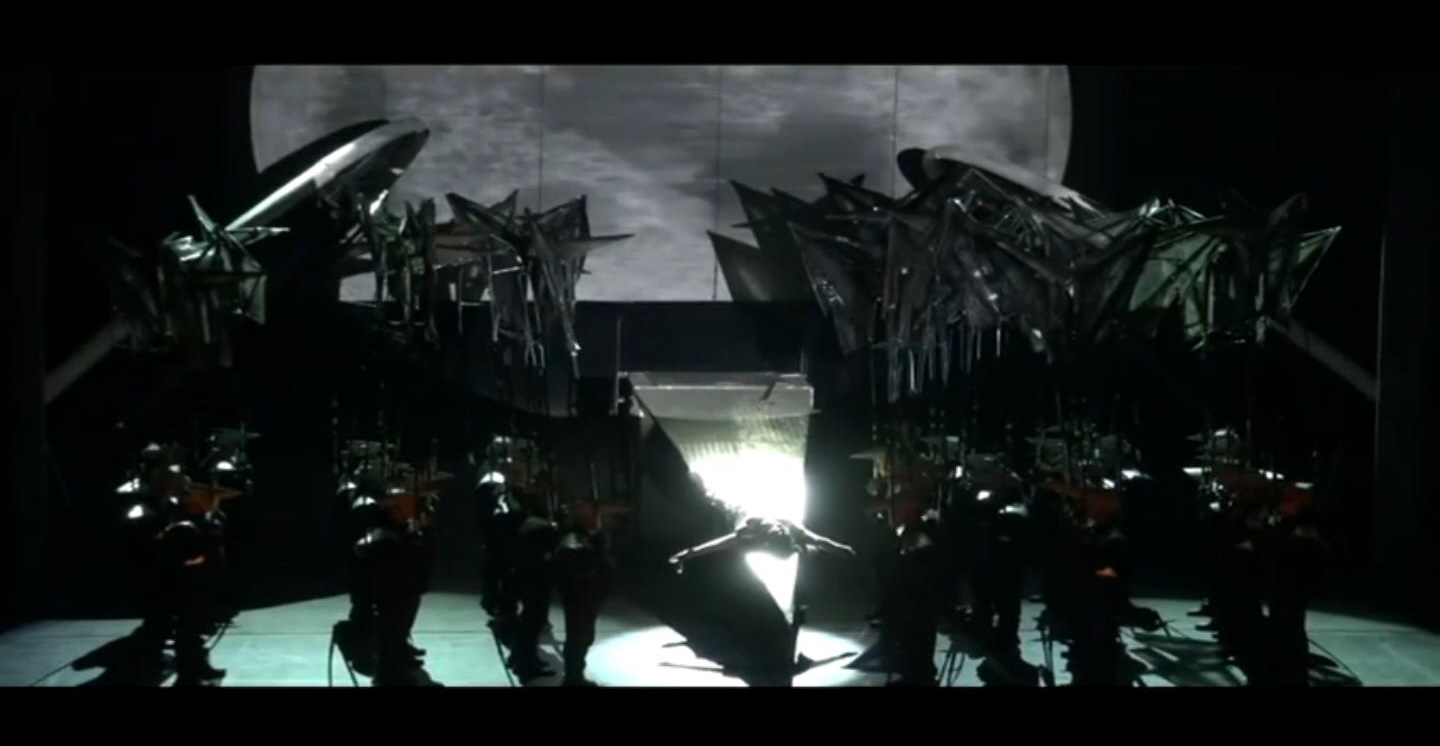
A cena da morte de Siegfried foi impressionante, com o herói morto caído sobre uma plataforma que simboliza a sua espada, acompanhada de projecções lunares, que funcionaram muito bem.

(Imolação- Foto do site da Ópera de Sófia / Immolation - Photo by Sofia Opera House site)

Na cena da imolação de Brünnhilde vemos mesma à garupa de Grane e acoplada à plataforma onde continua Siegfried morto, quebrando o grande anel, ao mesmo tempo que imagens de chamas vão tomando conta do cenário.

(Acto III - Foto do site da Ópera de Sófia / Act III - Photo by Sofia Opera House site)

No final, na derrocada do Walhalla, os cones estão em fogo e vemos os deuses caminhando em direcção às chamas, cambaleantes, para tudo dar lugar ao azul do Reno. Uma visão clássica, mas dramaticamente eficaz.


A direcção musical de Erich Wächter conseguiu imprimir mais intensidade à progressão musical e, em certos momentos, foi electrizante. Recordo-me, por exemplo, da segunda parte do Prólogo, em que o dueto entre Brünnhilde e Siegfried arrancou uma espontânea salva de palmas do público, que foi caso único durante toda a tetralogia.
Infelizmente, todavia, a orquestra continuou a exibir algumas falhas técnicas.


O coro esteve bastante bem, quer ao nível vocal, quer ao nível de presença em palco.


No papel de Siegfried voltámos a ter o excelente Martin Iliev, que confirmou a magnífica imagem que já tinha dado ao cantar Siegmund, exibindo uma voz brilhante, potente e com um timbre radioso, a par de um temperamento dramático apurado. Mais uma vez ficou a sensação de que se trata de um cantor que qualquer casa de ópera mundial não desdenharia ter nos seus elencos.


(Yordanka Derilova- Foto do site da Ópera de Sófia /  Photo by Sofia Opera House site)

Em Yordanka Derilova tivemos a terceira Brünnhilde da tetralogia e, sem margem para dúvidas, a melhor de todas. Voz potente e bonita, de carácter dramático mas de timbre não pesado, exibindo excelente projecção vocal. A par destas qualidades vocais, a evidente capacidade de traduzir vocalmente uma ampla gama de emoções,  uma presença em palco cheia de dramatismo e bons dotes de actriz, aliadas a uma bela figura física, fizeram de Yordanka Derilova uma Brünnhilde convincente e de grande qualidade.


Hagen foi interpretado pelo baixo Petar Buchkov, que cantou de forma eficaz, conseguindo conjugar a raiva que anima a personagem com a subtileza e dissimulação com que actua.


A soprano Tsvetana Bandalovska cantou a dividida Gutrune. Como já se havia notado, a sua voz bonita e dotada de um timbre claro, aliada a uma excelente figura, permitiram criar uma personagem credível.


Gunther ficou a cargo de Atanas Mladenov, que cantou com correcção e afinação, fazendo transparecer a personalidade apagada e passiva do meio-irmão de Hagen.


A Waltraute coube a Tsveta Sarambelieva, que exibiu uma boa potência vocal e uma personalidade vocal assertiva, o que tornou o seu diálogo com Brünnhilde bastante bem conseguido.


Alberich foi novamente Biser Georgiev, que não desiludiu.


As Nornas foram cantadas por Lyubov Metodieva, Ina Pertova e Tsveta Sarambelieva, tendo cumprido vocalmente com eficácia, para além de boas presenças em palco.


As Filha do Reno foram cantadas por Irina Zhekova, Silvia Teneva e Elena Marinova.

Podemos ver aqui um vídeo com o resumo da produção.

Terminou assim a primeira tetralogia a que tive o privilégio de assistir, num teatro de ópera menos em evidência e que não é um destino evidente, mas que apresentou um espectáculo de excelente qualidade, que rivaliza com as melhores produções mundiais da actualidade.
Em suma, uma experiência operática que não irei esquecer.

(Foto do site da Ópera de Sófia /  Photo by Sofia Opera House site)

*
*

Götterdämmerung - The Twilight of the Gods - Sofia, July 9, 2015


“Götterdämmerung” is the last opera of the tetralogy “Der Ring des Nibelungen”, ending this unique cycle in the history of opera.
In addition to being a long opera (about four and a half hours of music, plus intermissions), it has a complex narrative plot. However, attending to a live performance of this culmination of the tetralogy, is an overwhelming experience.

Continuing the logic present in previous operas, the staging of Plamen Kartaloff found a good balance between fidelity to the history of the libretto and the use of symbolism that opens up new views on the action and its meaning or explores less obvious associations of ideas.
Using geometric solids and symbolic forms - the cone, the bow, the mandorla, the triskelion - the director ilustrates the action and decodes some of the ideas behind the music and the words sung.
As an example, “Götterdämmerung” began with the same setting that ended “Siegfried", a kind of love nest between Brünnhilde and Siegfried locked within the mandorla, a symbol, among other things, of the human embryo. Later, the Celtic triskelion symbol appears as an egg cell containing the wisdom of the world, from the interior of which appear the Norns.

During the "Rhin Journey" the penetration of the mandorla by the cone that serves as a boat to Siegfried accentuates the idea of Brünnhilde’s humanity and that their junction is carnal and not just spiritual.

In Gibichungs’ Palace, Gunther emerges as an astronomer, observing the planets or the approaching of blazing stars, typically seen as signs of the end of the world. At the same time, cubes with drawings of the children of "The Seven Planets and the Zodiacs" by Hans Sebald Beham (1500-1550), which would be those on whose life the influence of a planet is dominant and who, therefore, were believed to possess the qualities of the ancient gods.

The Siegfried's death scene was impressive with the dead hero fallen on a platform that symbolizes his sword, accompanied by lunar projections, which worked very well.

In the immolation of Brünnhilde scene we see her on the back of Grane and coupled to the platform where is dead Siegfried, breaking the big ring, while flames start to take over the whole scene. In the end, when Walhalla collapses, the cones are on fire and we see the gods walking towards the flames, after what all gives way to the blue Rhine. A classical view, but dramatically effective.

The musical direction of Erich Wächter imprinted more intensity to the musical progression and, at times, was electrifying. I remember, for example, the second part of the Prologue, in which the duet between Brünnhilde and Siegfried snatched a spontaneous round of applause from the audience, which happened only once during the entire tetralogy.
Unfortunately, however, the orchestra continued to show some technical failures.
The choir was quite good, both in vocal level, as in terms of stage presence.

In the role of Siegfried we had again the excellent Martin Iliev, who confirmed the magnificent image that had already been given when he sang Siegmund, displaying a bright and powerful voice, with a bright timbre, along with a sharp dramatic temperament. Again I got the feeling that this is a singer that can have place in any world opera house.

In Yordanka Derilova we had the third Brünnhilde of tetralogy and, beyond any doubt, the best of all. Powerful and beautiful voice, dramatic character but not heavy timbre, with excellent vocal projection. Alongside these vocal qualities, the evident ability to translate vocally a wide range of emotions, a presence full of stage drama and good actress skills, combined with a beautiful physical figure, made of Yordanka Derilova a convincing and high quality Brünnhilde.

Hagen was interpreted by the bass Petar Buchkov, who sang effectively, managing to combine the anger that animates the character with the subtlety and stealth with which it operates.

The soprano Tsvetana Bandalovska sang the divided Gutrune. As had already been noted, her beautiful and clear timbre voice, combined with a great figure, helped to create a credible character.

Gunther was played by Atanas Mladenov, who sang with correction and pitch, translating the erased and passive personality of Hagen's half-brother.

Waltraute was incarnated by Tsveta Sarambelieva, who displayed a good vocal power and an assertive vocal style, which made the dialogue between her and Brünnhilde quite well done.

Alberich was again Biser Georgiev, and he did not disappoint.

The Norns were sung by Lyubov Metodieva, Ina Pertova and Tsveta Sarambelieva, having fulfilled vocally effectively, in addition to good presence on stage.

The Rhinemaidens were sung by Irina Zhekova, Silvia Teneva and Elena Marinova.

We can see here a video with the summary of this production.

Thus ended the first tetralogy that I was privileged to attend, in an opera house less in evidence and that it is not an obvious destination, but that presented a high quality spectacle that rivals the world's best present productions.
In short, an operatic experience that I will not forget.

domingo, 20 de setembro de 2015

Der Ring des Nibelungen - Sófia, 4 a 9 de Julho de 2015


(review in English below)

O ciclo “Der Ring des Nibelungen”, de Richard Wagner é, seguramente, uma das mais extraordinárias realizações artísticas da Humanidade e um marco incontornável na história da música, em particular da ópera.
Quer pela sua extensão, quer pela extraordinária riqueza da sua invenção musical, quer ainda pela multiplicidade das suas dimensões simbólicas e filosóficas, a sua apresentação constitui um desafio que nenhuma companhia ou casa de ópera pode encarar de ânimo leve. A sua levada a cena exige não só um alargado naipe de cantores com características difíceis de reunir, como também uma orquestra de dimensões acima do comum (Wagner previu 124 músicos) e infra-estruturas cénicas muito exigentes.
Todo o ciclo representa também um elevado desafio para o encenador e para o director musical, dos quais depende, em grande medida, a capacidade de lhe conferir unidade e significado.

(Fosso da orquestra em Bayreuth / Orchestra Pit at Bayreuth)

Uma breve introdução a esta monumental obra de Richard Wagner pode ler-se aqui.

Embora conheça muito bem o “Ring” em termos discográficos – na minha discoteca está representado com treze gravações integrais em CD e uma em DVD (Boulez) – nunca tinha tido a oportunidade de assistir a uma sua representação ao vivo.
Essa oportunidade surgiu agora, em Sófia, na sua Ópera Estatal e foi, de facto, uma experiência marcante.
Para comemorar os 200 anos do nascimento de Richard Wagner, a Ópera de Sófia decidiu encenar o primeiro “Ring” integral a ser apresentado na Bulgária. E decidiu fazê-lo recorrendo exclusivamente a cantores búlgaros (mais de 200), à Orquestra, Coro e Corpo de Bailado da Ópera de Sófia, o que não deixa de ser um feito notável. Suponho que poucas casas de ópera pelo mundo fora se possam orgulhar de um tal empreendimento e com o grau de sucesso que tem obtido.
Por outro lado, o recurso exclusivo a cantores búlgaros constitui uma demonstração de grande pujança de uma escola de vozes que legou muitos nomes célebres à arte lírica, embora poucos deles se tenham destacado no repertório wagneriano.

(Ópera de Sófia / Sofia Opera House)

O “Ring” de Sófia é o culminar de um processo longo, pois começou com a apresentação de cada uma das quatro óperas ao longo das temporadas 2009/2010 até 2012/2013. Em Julho de 2013, pela primeira vez, foram apresentadas nos termos preconizados por Wagner, ou seja, como um Bühnenfestspiel composto por um Vorabend e três dias, ao longo de uma semana.
O sucesso do projecto levou a novas apresentações em 2014 e 2015, em Sófia, e em Setembro de 2015, no Festspielhaus de Füssen, na Alemanha.

A encenação ficou a cargo de Plamen Kartaloff, membro da Academia de Ciências da Bulgária e director da Ópera de Sófia e a direcção musical a cargo do maestro alemão Erich Wächter.

(Plamen Kartaloff)

Nos textos que dedicarei a cada uma das quatro óperas que compõem o ciclo falarei de modo mais pormenorizado sobre os cantores intervenientes, a prestação da orquestra e abordarei as questões relativas à encenação de forma mais específica.
Neste primeiro texto introdutório gostaria apenas de tecer algumas considerações mais genéricas, suscitadas pela impressão geral que me ficou do ciclo como um todo.

A actual Ópera de Sófia abriu portas em 1953 e constitui um edifício de cariz neoclássico, de dimensões médias, encontrando-se integrado em plena malha urbana, com a fachada principal virada para uma pequena e estreita rua secundária.

(Ópera de Sófia / Sofia Opera House)

O seu interior é tradicional, de dimensões médias, dispondo de plateia e dois balcões, sem camarotes.
Uma vez que os bilhetes eram vendidos separadamente para cada ópera, acabei por me sentar em quase todas as zonas da sala. A plateia apresenta claramente as melhores condições acústicas e de visibilidade, sendo que nos balcões a acústica e a visibilidade ficam um pouco prejudicadas.

(Foto do site da Ópera de Sófia / Photo by Sofia Opera House site)

O fosso orquestral é pequeno e não permite acomodar uma orquestra com a dimensão ideal para tocar Wagner. Dessa forma, os naipes de cordas acabaram por ser os mais prejudicados, especialmente os violoncelos e contrabaixos, em pequeno número.


(Orquestra da Ópera de Sófia / Sofia Opera Orchestra)

No cômputo global, posso dizer que a prestação orquestral foi o ponto mais fraco do “Ring” de Sófia. De facto, para além da dimensão reduzida da orquestra se reflectir sobre o volume sonoro que é expectável em alguns momentos da obra, penso que a Orquestra da Ópera de Sófia não possui ainda o nível qualitativo das suas congéneres do centro da Europa ou Estados Unidos. As falhas foram frequentes e incidiram especialmente sobre as madeiras e os metais, sabendo-se que este último é um dos naipes cuja intervenção é mais exigente. Mas também as cordas demonstraram alguma inconsistência, com desafinações frequentes e desacertos nos ataques.
Todavia, no final a orquestra foi muito aplaudida e importa salientar o enorme esforço físico e intelectual que representa tocar cerca de 15 horas de música em quatro dias.

(Orquestra da Ópera de Sófia / Sofia Opera Orchestra)

A direcção musical de Erich Wächter foi correcta e sóbria. Imprimiu, no geral, tempos moderados, notando-se sempre a preocupação de suportar as vozes dos cantores, que nunca abafou. Conseguiu sempre manter texturas orquestrais transparentes, o que permitiu uma escuta mais analítica da música. Dessa forma, embora por vezes tenha faltado alguma poesia ou empolgamento, tal foi contrabalançado pela grande facilidade em ouvir os leitmotive em todas as suas vertentes e transformações.

(Erich Wächter - Foto de Barbara Bönsch)

A encenação ficou a cargo de Plamen Kartaloff. Confesso que as primeiras imagens que vi na net me deixaram algo apreensivo, pois os cantores pareciam personagens de filmes de ficção científica dos anos 80. Contudo, penso que a encenação apresentou aspectos bastante positivos e, no essencial, serviu bem a obra.
Embora os cenários e os figurinos nos transportem para um universo difícil de identificar, num misto de figuras monstruosas e fatos prateados que lembram os cantores pop dos anos 80, a encenação como um todo é bastante tradicional, na medida em que ilustra de forma literal a acção da ópera, tal como está escrita. Em cena as personagens executam precisamente aquilo que o libreto indica e o desenvolvimento da acção acompanha a história. Não há reinterpretações e muito menos contradição entre o que se passa no palco e o que é cantado e consta da partitura.

Trata-se de uma opção perfeitamente válida e que faz sentido se pensarmos que esta é a primeira apresentação do “Der Ring des Nibelungen” na Bulgária, pensada em primeiro lugar para a audiência nacional. Todavia, penso que em alguns aspectos a encenação foi demasiado explícita, mostrando no palco aquilo que cabe à música representar, especialmente quando o uso dos leitmotive desempenha, em grande medida, essa função.
Como se sabe, o “Ring”, pelas vicissitudes e ordem da composição, está cheio de relatos e alusões que resumem aquilo que já sucedeu nas óperas anteriores. Ora, cada vez que uma personagem aludia a qualquer acontecimento ou a orquestra fazia ouvir o leitmotiv de qualquer outra personagem, o encenador fazia-a entrar em cena sob uma forma fantasmagórica, como que tornando visualmente explícito aquilo que a música já sugeria de forma cabal.
Penso que por vezes se exagerou nesta prática, o que, de certo modo, se traduziu numa certa de desvalorização da música de Wagner, designadamente do papel que nela desempenham os leitmotive.

Um ponto bastante bem conseguido foi o facto de a encenação e do trabalho de palco ter sido coerente com a continuidade do fluxo musical. As cortinas nunca foram fechadas e/ou a música interrompida para alteração de cenário, pois este ia-se modificando continuamente, adaptando-se à música e à acção.

O encenador recorreu a um conjunto de figuras simbólicas que se iam transmutando consoante a acção dramática. Neste aspecto, importa destacar a presença permanente em palco de um gigantesco anel, que tanto se apresentava na sua forma circular e completa, como se ia separando em dois semi-círculos, formando arcos, mandorlas ou outras figurações.
Para além desse enorme anel de 12 metros de diâmetro, outro objecto bastante presente foi o cone, que tanto assumiu o papel de castelo (Walhalla), como de cavalo (das Valquírias) e que simboliza, de acordo com o texto do encenador no programa de sala, a ligação entre o céu e a terra.

(Foto do site da Ópera de Sófia / Photo by Sofia Opera House site)

Um aspecto muito agradável foi a existência de dupla legendagem, em búlgaro e em inglês, o que é demonstrativo do excelente acolhimento dado ao público estrangeiro.

(Foto do site da Ópera de Sófia / Photo by Sofia Opera House site)

A este propósito, não posso deixar de dirigir publicamente uma palavra de grande apreço para com o Director de Relações Públicas da Ópera de Sófia, Dimitar Sotirov, com quem travámos conhecimento aquando do levantamento dos ingressos na bilheteira da Ópera e que nos acolheu com grande gentileza, interessando-se pela nossa opinião relativamente a todos os aspectos das récitas a que íamos assistindo, pedindo-nos para falar à televisão búlgara e convidando-nos para um cocktail dado pela Ópera de Sófia no final do “Götterdammerung”, com a presença de alguns cantores e do maestro, o que foi muito agradável.

Outro aspecto muito interessante foi o facto de, à semelhança da tradição de Bayreuth, o início de cada récita ser precedido por uma fanfarra tocada pelos metais, com temas extraídos da ópera respectiva. Fanfarra essa que, como em Bayreuth, era repetida por três vezes, 30, 20 e 10 minutos antes do início da ópera.

(Fanfarra antes do início da ópera / Fanfare before opera)

Foi também a oportunidade para conhecer outros melómanos wagnerianos de todo o mundo, para trocar experiências e impressões e para discutir as récitas.

Em suma, foi uma experiência musical muito gratificante e que seguramente nunca irei esquecer.


Der Ring des Nibelungen – Sofia, 4th – 9th July 2015


The “Der Ring des Nibelungen” cycle, by Richard Wagner, is surely one of the most extraordinary artistic achievements of mankind and an essential milestone in the history of music, particularly opera.
Either by its extension, or the extraordinary richness of its musical invention, or even the multiplicity of its symbolic and philosophical dimensions, its presentation is a challenge that no company or opera house can face lightly. Making it happen requires not only gathering singers with features which are hard to find, but also a larger than normal orchestra (Wagner asked for 124 players) and very demanding scenic infrastructures.
The whole cycle also represents a high challenge to the director and the music director, on whom depends to a large extent, the ability to confer it unity and meaning.

A brief introduction to this monumental work of Richard Wagner can be read here.

Although I know the “Ring” very well in discographic terms - in my record collection it is represented with thirtheen complete CD cycles and a DVD cycle (Boulez) – I had never had the opportunity to attend a live performance.
That opportunity has now arisen, in Sofia, in his State Opera and was in fact a remarkable experience.
To celebrate the 200th anniversary of the birth of Richard Wagner, the Sofia Opera decided to stage the first complete “Ring” in Bulgaria. They decided to do it using only Bulgarian singers (over 200), the Orchestra, Chorus and Opera Ballet Corps of Sofia Opera, which is nonetheless a remarkable achievement. I suppose that few opera houses around the world can be proud of such a project and the degree of success it has achieved.
On the other hand, the exclusive use of Bulgarian singers shows te great strength of a school of voices that has given many famous names to the lyrical art, although few of them have stood out in the Wagnerian repertoire.

The “Ring” of Sofia is the culmination of a long process because it started with the presentation of each of the four operas throughout the seasons 2009/2010 to 2012/2013. In July 2013 it was presented for the first time as Wagner thought: a Bühnenfestspiel  structured in three days preceded by a Vorabend, performed over one week.
The success of the project led to new presentations in 2014 and 2015, in Sofia, and in September 2015 in the Festspielhaus in Füssen, Germany.

The staging was done by Plamen Kartaloff, member of the Bulgarian Academy of Sciences and Director of the Sofia Opera and the musical direction was in the hands of the German conductor Erich Wächter.

In the forthcoming texts devoted to each of the four operas that make up the cycle I will speak in more detail about the singers, the performance of the orchestra and will discuss the issues of staging more specifically.
In this first introductory text, I would just like to make a few more general considerations raised by the general impression I got of the cycle as a whole.

The current Sofia Opera House was opened in 1953 and is a neoclassic building, medium-sized, lying fully integrated into the urban fabric, with the main facade facing a small, narrow side street.
The interior is traditional, medium-sized, offering parterre and two balconies without boxes.
As the tickets were sold separately for each opera, I ended up sitting down in almost all areas of the hall. The parterre clearly has the best acoustics and visibility conditions; in the balconies acoustics and visibility are slightly less impressive.

The orchestra pit is small and can not accommodate an orchestra with the ideal size to play Wagner. Thus, the strings section was the most affected, especially the cellos and double-basses, which were insufficient in number.
In the overall context, I can say that the orchestral performance was the weakest point of the Sofia “Ring”. In fact, apart from the small size of the orchestra reflect on the sound volume that is expected in some of the work moments, I think the Orchestra of the Sofia Opera does not yet have the qualitative level of their counterparts in central Europe or in the United States. The failures were frequent and occurred, especially on woodwinds and brass, given that the latter is one of the sections whose role is more demanding. But also the strings showed some inconsistency with frequent out of tune playing and imprecisions in the attacks.
However, in the end the orchestra was greatly applauded and it should be noted the enormous physical and intellectual effort that is playing about 15 hours of music in four days.

The musical direction of Erich Wächter was correct and sober. He favore, on the whole, moderate times, always with the concern of supporting the voices of the singers, who were never muffled by the orchestra. He always managed to maintain transparent orchestral textures, allowing a more analytical listening to the music. Thus, although sometimes has missed some poetry or thrill, this was conterbalanced by the ease in listening the leitmotivs in all its forms and transformations.

The staging was done by Plamen Kartaloff. I confess that the first images I saw on the net left me somewhat apprehensive, for the singers looked like characters from science fiction movies of the 80s However, I think the staging presented very positive aspects and essentially served well the opera.
Although the sets and costumes transport us to difficult to identify universe, in a mixture of monstrous figures and silver costumes reminiscent of the pop singers of the 80s, the staging as a whole is quite traditional in that it illustrates literally the Opera action, as it is written. On stage, the characters perform precisely what the libretto states and the development of action follows the story. There are no reinterpretations let alone contradiction between what is happening on stage and what is being sung or written in the score.
This is a perfectly valid option and it makes sense if we think that this is the first presentation of “Der Ring des Nibelungen” in Bulgaria, designed primarily for a Bulgarian audience. However, I think that in some respects, the staging was too explicit, showing on stage what it is to be represented by music, especially when the use of leitmotivs plays, to a large extent, this function.
As we know, because of its specificities and order of composition, the “Ring” is full of narrations that summarize what has happened in earlier operas. The problem is that, each time a character alludes to any past event or the orchestra plays the leitmotiv of any other character or event, the director puts it on the stage, like a “phantom”, making visually explicit what the music already suggested adequately enough.
I think this practice was exaggerated, which somehow translates into a kind of devaluation of Wagner's music, particularly of the role played by leitmotivs.

A point quite well done was the fact that the staging and stage work have been consistent with the continuity of the musical flow. The curtains were never closed and / or the music stopped for change of scenery. The scenarios changed continuously, adapting to music and action.
The director used a set of symbolic figures that were transmuting according to dramatic action. In this respect, it is worth mentioning the permanent presence on stage of a gigantic ring, which both presented itself in its circular and in full, as it was separating into two semi-circles, arcing, mandorlas or other figurations.
In addition to this enormous 12 meters wide ring, another very present object was the cone, which both assumed the role of a castle (Walhalla), as horse (of the Valkyries) and symbolizing, according to the text of the Director in the program, a link between heaven and earth.

A very nice aspect was the existence of dual subtitling in Bulgarian and English, which is demonstrative of the excellent reception given to foreign audiences.
In this regard, I must publicly address a word of great appreciation to the Sofia Opera Public Relations Manager, Dimitar Sotirov, who met us when picking up the tickets at the box office and welcomed us with great kindness, always asking for our opinion on all aspects of the performances that we were watching, asking us to speak to the Bulgarian TV and inviting us for a cocktail given by the Sofia Opera after “Götterdammerung”, with the presence of some singers and conductor, which was very pleasant.

Another very interesting aspect was the fact that, like the Bayreuth tradition, the beginning of each performance was preceded by a fanfare played by brass players, with motives taken from the opera that is about to start. As in Bayreuth, the fanfares were repeated three times, 30, 20 and 10 minutes before the start of the performance.

It was also the opportunity to meet other wagnerites from around the world, to exchange experiences and impressions and to discuss the performances.

In a whole, it was a very rewarding musical experience and surely I will never forget it.