domingo, 15 de setembro de 2013

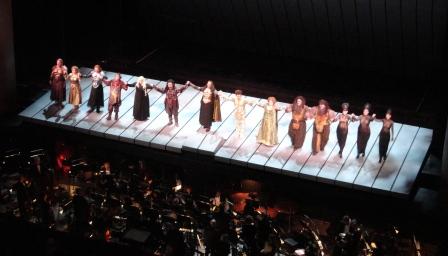
SIEGFRIED, METropolitan OPERA, Nova Iorque, Maio de 2013


 A ópera do Anel em que a natureza está sempre presente beneficia muito da abordagem cénica de Lepage. O primeiro acto tem um efeito visual marcante, com a cabana de Mime de um lado do palco e, do outro, a floresta com um riacho em que a água corre pelo palco e onde as folhas das árvores esvoaçam ao sabor do vento.
No segundo acto o dragão é o objecto menos conseguido, parece uma bóia de criança. Mas tudo o resto é de belo efeito, nomeadamente as várias intervenções da ave que Siegfried ouve.
O terceiro acto também começa com imagens de forte impacto visual e quer o diálogo de Wotan com Erda, quer com Siegfried são muito bem conseguidos. Já a cena final do despertar de Brünhilde é muito estática, apesar de eficaz.


O tenor norte americano Robert Brubaker foi um Mime excepcional. Tem um timbre peculiar que se adapta perfeitamente à personagem. Nunca cantando em forte, foi sempre claramente audível pois a técnica de projecção vocal é exímia. Cenicamente foi irrepreensível. Um dos melhores da noite.


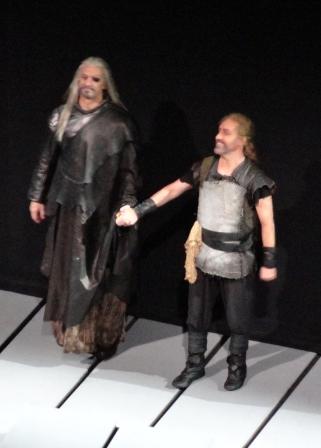
Siegfried foi interpretado pelo tenor sueco Lars Cleveman. Este deve ser um dos papéis wagnerianos em que mais difícil é, na actualidade, encontrar cantores à altura da elevada exigência interpretativa. Cleveman fez o que pôde mas não é o Siegfried ideal. Tem uma figura frágil e a voz, embora agradável, por vezes fica abafada pela orquestra. Ainda assim aguentou-se, sem quebrar, até ao final.
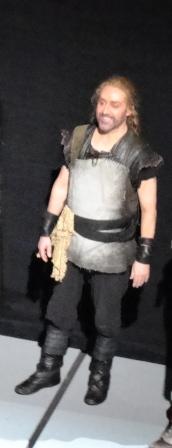

O Wanderer do baixo barítono norte americano Greer Grimsey foi muito bom, na continuação da excelente interpretação que o cantor já tinha tido como Wotan na Valquíria. Voz também de timbre peculiar mas bem domada pelo cantor e sempre audível e afinada. A interpretação cénica foi irrepreensível.


O baixo-barítono norte americano Richard Paul Fink confirmou que está aquém dos restantes solistas na interpretação que fez de Alberich. Foi o menos impressionante dos cantores da noite. Frequentemente não se ouvia e a voz não tem qualquer qualidade atractiva.

Excepcional foi o baixo alemão Hans-Peter König que, nesta ópera, foi Fafner. É um cantor de elite que está no auge das suas fabulosas potencialidades. A voz é de uma beleza invulgar e de uma potência avassaladora.


O soprano americano Lisette Oropesa foi um pássaro da floresta muito competente, de voz cristalina e muito agradável.


Repetiu uma boa actuação como Erda o mezzo americano Meredith Arwady. É detentora de uma voz potente e com um registo grave impressionante.


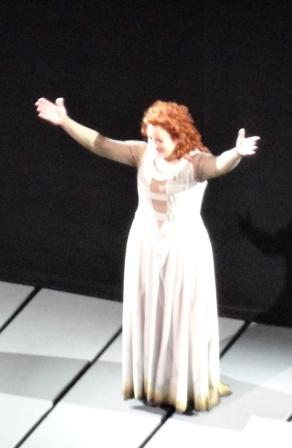
 Finalmente o soprano norte americano Deborah Voight voltou a interpretar a Brünhilde. Apesar de, nesta ópera, só cantar no final, achei que transpareceu algum cansaço vocal e foi ocasionalmente agreste, sobretudo nas notas mais agudas, que não soaram agradáveis.


****


SIEGFRIED, Metropolitan Opera, New York, May 2013

The Ring’s opera where nature is always present benefits a lot from the scenic approach of Lepage.
The first act has a remarkable visual effect with Mime's hut on one side of the stage and on the other, the forest with a stream where the water runs across the stage and where the leaves flutter in the wind.
In the second act the dragon is ridiculous but everything else is of fine effect, namely the various parts when Siegfried hears the bird.
The third act also begins with images of strong visual impact and both the dialogue between Erda and Wotan, and between Siegfried and Wotan wants are very good. The final scene of the awakening of Brunhilde is very static, although effective.

North American tenor Robert Brubaker was an exceptional Mime. He has a peculiar tone that fits the character. Never singing in forte, he was always clearly audible as the technique of vocal projection excels. Artistically he was blameless. One of the best of the night.

Siegfried was played by Swedish tenor Lars Cleveman. This must be one of the most difficult Wagnerian roles and, today, to find singers up to the high standards of interpretation is very difficult. Cleveman did his best but he is not the ideal Siegfried. He has a fragile figure and the voice, though pleasant, sometimes gets drowned out by the orchestra. Still, he held up without breaking until the end.

The Wanderer by North American bass baritone Greer Grimsey was very good, in the continuation of the excellent interpretation that the singer had had as Wotan in Valkyrie. His voice has a peculiar timbre but well controlled by the singer and always audible and tuned. The artistic performance was very good.

North American bass-baritone Richard Paul Fink confirmed that he lags behind other soloists in his interpretation of Alberich. He was the least impressive of the singers of the night. Often he was not heard and the voice does not have any attractive quality.

Exceptional was the German bass-baritone Hans-Peter König that in this opera was Fafner. He is an elite singer at the height of his fabulous potential. The voice is of an unusual beauty and an overwhelming power.


American soprano Lisette Oropesa was a very competent bird of the forest, with  a crystal clear and very nice voice.

American mezzo Meredith Arwady repeated her good performance as Erda. She has a powerful voice and impressive low record.

Finally, North American soprano Deborah Voight was Brunhilde again. Although, in this opera, she sings only in the end, I thought she revealed some vocal fatigue and was occasionally harsh, especially in the high notes, which did not sound pleasant.

****

segunda-feira, 9 de setembro de 2013

DIE WALKÜRE / A VALQUÍRIA, METropolitan OPERA, Nova Iorque, Maio de 2013


A encenação tem como momentos originais os troncos de árvores, logo no início, entre os quais se vê a perseguição a Siegmund. Mais tarde, quando conta a sua história, vêem-se sombras no tecto da casa de Hunding ilustrando a acção.
No 2º acto o monólogo de Wotan é acompanhado por um conjunto diversificado de imagens projectadas num grande olho, colocado no centro do palco, rodeado por montanhas com lava a escorrer. O final da ópera, com o aprisionamento da Brünhilde entre o fogo sagrado, é também de efeito visual marcante.


 O primeiro acto foi arrasador! O tenor neozelandês Simon O´Neill fez um Siegmund excepcional. É um papel que canta com frequência, e bem. Tem um timbre de invulgar beleza e perfeitamente adequado à personagem. Ouve-se sempre em todos os registos, mantendo a mesma qualidade interpretativa. É pena o cantor estar cada vez mais gordo, o que prejudica o aspecto físico que a personagem exige. Mas, vocalmente, está melhor que nunca.


 A Sieglinde do soprano austríaco Martina Serafin foi também fantástica. A cantora projecta a voz com grande eficácia, ouve-se sobre a orquestra e a afinação é perfeita. Tem uma figura óptima para o papel e é muito convincente na actuação cénica.


 Também insuperável foi o Hunding do baixo-barítono alemão Hans-Peter König. É um cantor fantástico, com um vozeirão brutal que é sempre uma garantia de qualidade no seu máximo esplendor. Foi o que aconteceu mais uma vez.


 O baixo-barítono norte americano Greer Grimsley, que desconhecia, surpreendeu-me muito positivamente como Wotan. Tem um timbre peculiar que serve muito bem a personagem. Também projecta a voz de forma muito eficiente e foi notável ao longo de toda a récita. A actuação em palco foi das melhores a que assisti, muito credível, em que os momentos mais altos foram a morte de Hunding e o diálogo final com a filha.


 A Brünhilde do soprano norte americano Deborah Voight não destoou dos restantes cantores. Foi a mais aplaudida em palco, talvez por “jogar em casa” e pelo que já ofereceu ao público do Met, mas não se destacou. Esteve muito bem, mas há melhores.


 Deixo para último aquela que continuo a considerar a melhor Fricka da actualidade, o mezzo norte americano Stephanie Blythe. Foi arrasadora. A voz é brutal em tamanho e potência e a cantora interpreta o papel com uma emotividade assinalável. Um privilégio ouvi-la. Quando veio agradecer, no final do 2º acto, percebi por que razão faltara na véspera. Está muito incapacitada fisicamente, desloca-se com enorme dificuldade e com a ajuda de uma bengala. Esta noite tivemos a sorte de a ouvir porque, nesta encenação, canta sempre sentada.


 Uma Valquíria excelente!


*****

Die Walküre, Metropolitan Opera, New York, May 2013

The staging has original parts such as as tree trunks, early on, among which we see the persecution of Siegmund. Later, when he tells his story, one sees shadows on the ceiling of Hunding’s house illustrating the action. In the 2nd act Wotan's monologue is accompanied by a diverse set of images projected on a large eye, placed at center stage, surrounded by mountains with lava dripping. The end of the opera, with the Brunhilde between the sacred fire, is also a striking visual effect.

The first act was astonishing! New Zealand tenor Simon O'Neill was an exceptional Siegmund. This is a role that he sings often and well. He has a tone of unusual beauty and perfectly suited to the character. He is always head in all registers, maintaining the same vocal quality. It is a pity that the singer is becoming increasingly fat, which impairs the physical aspect that the character requires. But vocally, he is better than ever.

Austrian soprano Martina Serafin’s Sieglinde was also fantastic. The singer projects her voice with great efficiency, she is always heard above the orchestra and the tuning is perfect. She has a perfect figure for the role and is very convincing onstage.

Also unsurpassed was german bass-baritone Hans-Peter König as Hunding. He is a fantastic singer with a booming voice that  is always a guarantee of quality in full splendor. It happened again.

North American bass-baritone Greer Grimsley, who I did not know, surprised me very positively as Wotan. He has a peculiar tone that serves very well the character. He also projects his voice very efficiently and he was remarkable throughout the performance. The stage performance was among the best I attended, very credible, the highlights were the death of Hunding and the final dialogue with his daughter.

North American soprano Deborah Voight was Brunhilde, at the same high level of the other singers. She was the most applauded on stage, perhaps because she "was at home" and because of what she has already offered to the public at the Met. She was very good, but there are better singers of this role.


I leave it to the end the singer I consider the best Fricka of present times, North American mezzo Stephanie Blythe. She was overwhelming. The voice is brutal in size and power and she sings the role with a remarkable emotionality. A privilege to hear her. When she came to thank at the end of the 2nd act, I realized why she had failed the night before. She was physically very incapacitated, walking with great difficulty and with the help of a cane. Tonight we were lucky to hear because, in this staging, she always sings sitting.

An excellent Valkyrie


*****

terça-feira, 3 de setembro de 2013

O OURO DO RENO / DAS RHEINGOLD, METropolitan OPERA, Maio de 2013


 O Ouro do Reno é o prólogo em quatro cenas do Anel do Nibelungo de R. Wagner.

Na encenação de Robert Lepage os aspectos de efeito mais espectacular nesta primeira ópera são, logo na primeira cena, as filhas do Reno suspensas, a nadar e, quando assentam no fundo do rio e sempre que se movem, provocam a queda de grande quantidade de pequenas pedras. A terceira cena é também muito bem conseguida, não só a descida ao Nibelheim como a actuação de Mime e dos Nibelungos a fundirem o ouro. A transformação de Alberich numa gigantesca serpente e, depois, num sapo, são vistosas. Finalmente, depois da tempestade, a subida dos deuses ao Walhalla que aparece como um arco-íris que vai passando no fundo do palco tem grande impacto visual.


 Os solistas foram, na maioria, de grande qualidade.

O melhor da noite foi o tenor eslovaco Stefan Margita que interpretou o semideus do fogo Loge. Tem uma voz sempre audível e afinada, muito melodiosa e agradável. Aparecia envolvido em luzes que simulavam o fogo e teve um excelente desempenho cénico. Já quando o vi no Anel de Munique, no mesmo papel, foi igualmente notável. Na actualidade não deve haver melhor Loge.


 Fricka foi interpretada pelo mezzo americano Elizabeth Bishop, em substituição de Stephanie Blythe. Esteve à altura do papel e ofereceu-nos uma bela interpretação. Foi vocalmente forte e cenicamente convincente. A voz é bonita, penetrante e sempre bem colocada.


 O baixo-barítono americano Richard Paul Fink foi o elo fraco da noite. Interpretou Alberich de forma deficiente. Ouviu-se mal, a voz é pequena e feia. Não é um cantor com qualidade que justifique a sua actuação num papel solista no Met.


 Wotan foi interpretado pelo baixo-barítono americano Greer Grimsley. Esteve bem, a voz é muito respeitável, ouviu-se sempre sobre a orquestra e foi credível em cena.


 Também de qualidade assinalável foi a interpretação de Freia pelo soprano americano Wendy Bryn Harmer que, no registo mais agudo, foi segura e não gritou.


 Os dois gigantes, Fasolt e Fafner, foram interpretados pelos baixos alemães Franz-Josef Selig e Hans-Peter König e foram dois dos melhores cantores da noite. Vozes potentes, registos graves imponentes e boa presença em palco.


 Se o Froh de Richard Cox foi muito fraco, merecem nota positiva o mezzo americano Meredith Arwady que foi uma Erda poderosa,


 o tenor americano Robert Brubaker que deixou uma óptima impressão como Mime


  e o barítono americano Dwayne Croft como Donner.


 Foram também impecáveis as três filhas do Reno Dísella Làrusdóttir (Woglinde), Jennifer Johnson Cano (Wellgunde) e  Renee Tatum (Flossilde).


Começou bem o Anel de Nova Iorque.

**** 


DAS RHEINGOLD, Metropolitan Opera, May 2013

Das Rheingold is the prologue in four scenes from the Ring of the Nibelung by R. Wagner.

In Robert Lepage´s staging the most spectacular aspects of this first opera are in the very first scene, the daughters of the Rhine suspended, swimming, and when they settle on the river bottom and whenever they move, they cause the fall of large amounts of small stones. The third scene is also very well done, not only the descent to Nibelheim as well as Mime and the Nibelungs merging of the gold. Alberich's transformation into a giant snake and then into a frog are showy. Finally, after the storm, the rising of the gods to Walhalla that appears as a rainbow on the back of the stage has great visual impact.

The soloists were mostly very good.

The best of the night was Slovakian tenor Stefan Margita who played the semi god of fire, Loge. His very melodious and pleasant voice was always audible and tuned, He appeared wrapped in lights that simulated fire and performed excellently. When I saw him in the Munich´s Ring in the same role, he was equally remarkable. At present there should be no better Loge.

Fricka was interpreted by American mezzo Elizabeth Bishop, replacing Stephanie Blythe. She was OK in the role and offered us a beautiful interpretation. She was strong vocally and artistically  compelling. The voice is beautiful, deep and always well projected.

American bass-baritone Richard Paul Fink was the weak link in the night. He interpreted Alberich in a deficient way. We could not hear him well, the voice is small and not nice. He is not a top quality singer to justify a solo role at the Met.

Wotan was interpreted by American bass-baritone Greer Grimsley. He was good, the voice is very respectable, ever heard above the orchestra and he was credible onstage.

Also remarkable was the quality of interpretation of Freia by American soprano Wendy Bryn Harmer that in the top notes, was secure and did not shout.

The two giants, Fasolt and Fafner, were interpreted by German basses Franz-Josef Selig and Hans-Peter König and they were two of the best singers of the night. Powerful voices, imposing bass notes and good stage presence.

If Richard Cox´s Froh was very weak, deserve positive remarks the American mezzo Meredith Arwady that was a powerful Erda, the American tenor Robert Brubaker who left an excellent impression as Mime and American baritone Dwayne Croft as Donner. The three daughters of the Rhine were also very good, Dísella Lárusdóttir (Woglinde), Jennifer Johnson Cano (Wellgunde) and Renée Tatum (Flossilde).

The Met’s Ring had a good start.


****