(review in English below)
A ópera Parsifal
de R. Wagner esteve em cena na Metropolitan Opera, na encenação de François Girard. É um espectáculo de grande impacto visual, embora
sujeito a várias interpretações.
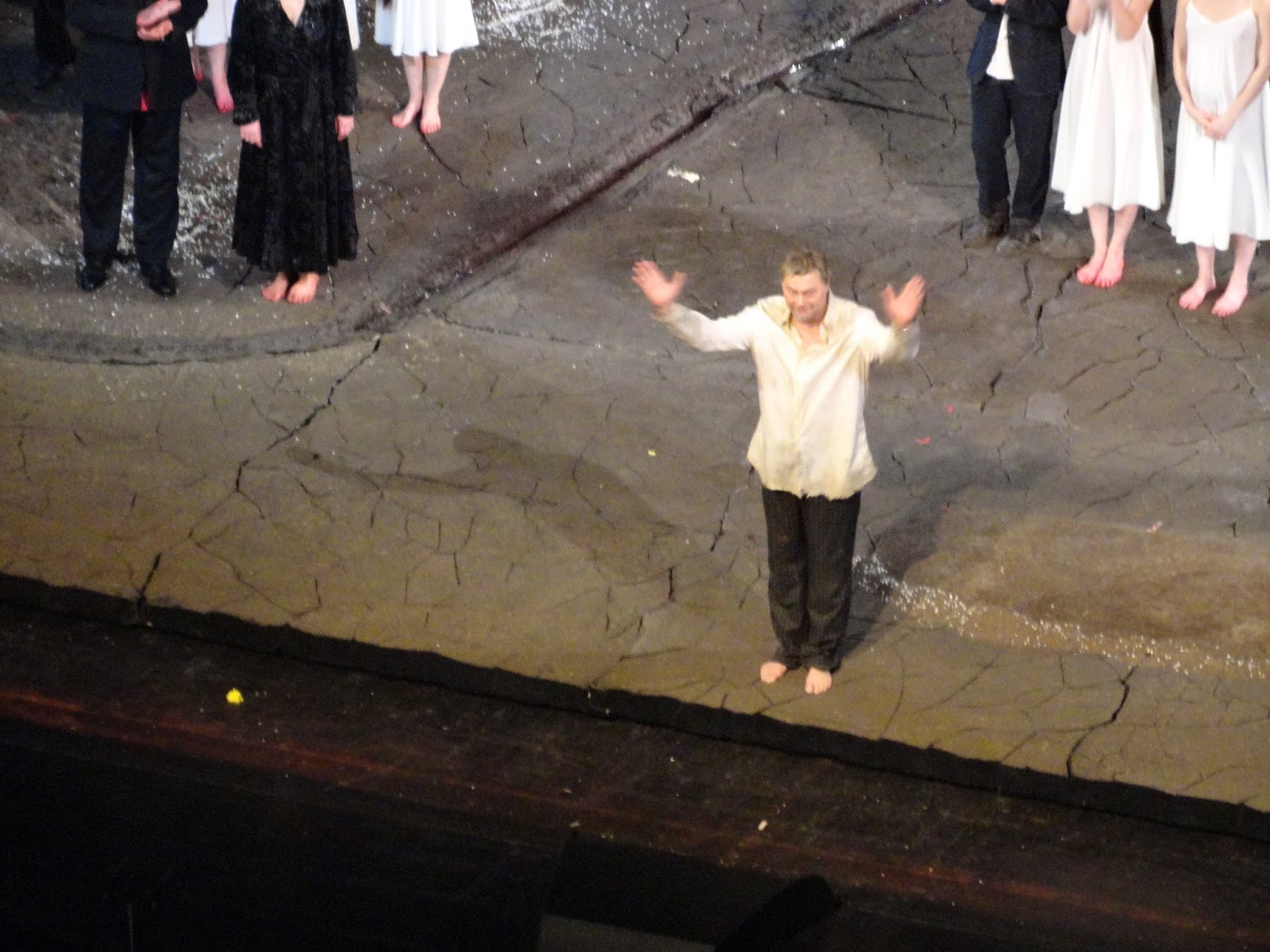
No primeiro acto o palco está despido,
escuro, agreste e é atravessado a meio por um curso de água que, no final, se
transforma em sangue. Ao fundo há projecção constante de imagens de nuvens,
superfícies arenosas ou grandes esferas, aspecto que se manterá até ao final da
ópera. Os cavaleiros do Graal aparecem de fato moderno, despem o casaco e
descalçam-se, assim permanecendo todo o acto, ora em pé ou sentados em círculo,
na metade esquerda do palco. A direita é ocupada pelas mulheres, de negro. É lá
que está sempre a Kundry. A lança, o cálice e o cisne morto pelo Parsifal
aparecem.
No segundo acto, no castelo enfeitiçado
do Klingsor, tudo se passa numa piscina de sangue, para grande desconforto dos
cantores, imagino. As mulheres-flor, com as lanças, estão vestidas com uma
túnica branca que vai ficando ensanguentada. A meio entra uma cama, onde a
Kundry também tenta, em vão, seduzir o Parsifal.

No terceiro acto
o cenário e idêntico ao primeiro, mas a paisagem ainda está mais devastada, num
período pós-apocalíptico. Começa com um enterro e há várias sepulturas recentes
espalhadas pelo cenário. O Parsifal chega vergado e coberto com um pano negro,
apenas empunhando a lança. Todos estão muito envelhecidos. Gurnemanz e a Kundry
lavam os pés ao Parsifal, ele cura a ferida de Amfortas com a lança e é a
própria Kundry que retira o cálice sagrado antes de morrer. Enquanto o Parsifal
levanta o cálice, quase desaparece a marca que divide o palco a meio desde o
início. Homens e mulheres misturam-se vestidos de branco e de igual e pela
primeira vez. Mesmo ao cair do pano, levantam-se duas personagens, o Amfortas e
uma mulher vestida de negro. É uma encenação visualmente marcante que deixa
muitas interpretações em aberto.

O canadiano e
futuro maestro titular da Metropolitan Opera Yannick Nézet-Séguin ofereceu-nos uma interpretação magnífica da obra, maioritariamente
com tempos longos e suaves, alternados com sonoridades violentas e a orquestra no
seu máximo esplendor, sobretudo no 2º acto. Os coros extra palco
foram outra mais valia marcante.
Mas muito mais
importante que a encenação, é a interpretação musical e vocal que garantem o
sucesso do Parsifal e ele foi totalmente conseguido com os solistas escolhidos.
O baixo alemão René Pape é o Gurnemanz de referencia, tantas vezes já interpretou o papel. É o narrador
da peça, tem uma voz imponente, profunda e bonita, e manteve a qualidade
interpretativa ao longo de toda a ópera, tendo sido fabuloso no 3º acto.
O Amfortas foi
magistralmente interpretado pelo barítono sueco Peter Mattei. Foi a imagem do sofrimento dilacerante (muito ajudado pela encenação),
transmitiu em pleno na potentíssima interpretação vocal o desespero e dor que
sofria pela ferida incurável que lhe foi infringida pela lança sagrada que
deveria proteger quando, seduzido pela Kundry, entrou no reino do Klingsor.
Absolutamente fantástico.
A Kundry da soprano
alemã Evelyn Herlitzius foi cenicamente
perfeita. A voz é grande, sempre sobre a orquestra, mas agreste no registo mais
agudo e, ocasionalmente, tem um vibrato excessivo.
O tenor alemão Klaus Florian Vogt foi um Parsifal
irrepreensível. Tem uma voz de timbre muito claro, perfeitamente adaptado à
personagem de jovem tolo. Sei que esta minha opinião não é partilhada por
muitos, nomeadamente alguns amigos que escrevem neste blogue. Para além da
beleza tímbrica e da clareza da emissão, o que mais me impressiona é a
delicadeza vocal e facilidade com que Vogt canta, nunca aparentando o mínimo
esforço, sendo sempre audível sobre a orquestra, mesmo nos momentos mais
introspectivos, imprimindo-lhes uma emoção arrepiante. Mas também usa a voz em forte sempre que necessário e o seu Amfortas! Die Wunde! foi exemplar. Um espanto!
O Klingsor foi
também interpretado ao mais alto nível pelo baixo barítono russo Evgeny
Nikiyin. O cantor tem uma voz muito bonita e bem colocada, que se ouviu sempre
sobre a orquestra. Vestiu na perfeição a personagem malévola da ópera e a
confrontação com a Kundry foi marcante.
Um espectáculo de
invulgar qualidade.
*****
PARSIFAL,
METropolitan Opera, February 2018
The opera Parsifal by R. Wagner was on stage at the Metropolitan
Opera, in the staging of François
Girard. It is a show of great visual impact, although subject to several
interpretations.
In the
first act the stage is empty, dark, and is crossed in the middle by a course of
water that, in the end, turns into blood. In the background there is a constant
projection of images of clouds, sandy surfaces or large spheres, an aspect that
will remain until the end of the opera. The Knights of the Grail appear in
modern dresses, strip off their cloaks and take off their shoes, thus remaining
the whole act, standing or sitting in a circle on the left half of the stage.
The right half is occupied by women in black. It is there that is Kundry. The
spear, the chalice and the swan killed by the Parsifal appear.
In the
second act, in the bewitched castle of Klingsor, everything happens in a pool
of blood, to the great discomfort of the singers, I imagine. The flower women,
with the spears, are dressed in white tunics that get bloody. In the middle
enters a bed, where Kundry also tries, in vain, to seduce Parsifal.
In the
third act the scene is identical to the first, but the landscape is still more
devastated in a post-apocalyptic like period. It begins with a funeral and
there are several recent graves scattered around the scene. Parsifal arrives
bent and covered with a black cloth, just holding the spear. Everyone is much
older. Gurnemanz and Kundry wash the feet of Parsifal, he heals the wound of Amfortas
with the spear, and it is Kundry herself who handles the sacred chalice before
dying. As Parsifal raises the chalice, the mark that divides the stage in half
from the beginning almost disappears. Men and women mix up dressed both in
white for the first time. Just at the fall of the curtain, two characters stand
up, Amfortas and a woman dressed in black. It is a visually striking staging
that leaves many interpretations open.
Canadian
and future director maestro of the Metropolitan Opera Yannick Nézet-Séguin offered us a magnificent interpretation of the
work, mostly with long and smooth tempi
alternated with violent sounds and the orchestra in its maximum splendor,
especially in the 2nd act. The extra stage choirs were another remarkable
asset.
But much
more important than the staging, it is the musical and vocal interpretation that
guarantee the success of Parsifal and it was totally achieved with the chosen
soloists.
German bass
René Pape is the reference
Gurnemanz, so many times has played the role. He is the narrator of the opera,
maintains an imposing voice, deep and beautiful, and maintained the interpretive
quality throughout the performance, having been fabulous in the 3rd act.
Amfortas
was masterfully performed by Swedish baritone Peter Mattei. He was the image of the painful suffering (much aided
by the staging), transmitted in full in the most powerful vocal interpretation of
the despair and pain that he suffered from the incurable wound that was
inflicted on him by the sacred spear he was to protect when, seduced by Kundry,
he entered the kingdom of Klingsor. Absolutely fantastic.
Kundry by
the German soprano Evelyn Herlitzius
was blissfully perfect. The voice is large, always over the orchestra, but
rough in the highest pitched and occasionally has an excessive vibrato.
German
tenor Klaus Florian Vogt was an
irreproachable Parsifal. He has a very clear tone voice, perfectly adapted to
the character of a young fool. I know that my opinion is not shared by others,
especially some friends who write on this blog. Beyond the timbre's beauty and
the clarity of the singing, what strikes me most is the vocal delicacy and ease
with which Vogt sings, never seeming the least effort, being always audible
over the orchestra, even in the most introspective moments, giving them a
creepy emotion. But he also uses the strong voice whenever necessary and his Amfortas! Die Wunde! was paradigmatic.
An astonishment!
Klingsor
was also performed at the highest level by Russian bass baritone Evgeny Nikiyin. The singer has a very
beautiful and powerful voice, which has always been heard over the orchestra.
He interpreted perfectly the malevolent character of the opera and the dialogue
with Kundry was remarkable.
A
performance of unusual quality.
*****