segunda-feira, 9 de abril de 2018

MACBETH de Giuseppe Verdi na Royal Opera House, London, 7.04.2018

(review in English below)

A ópera Macbeth foi estreada em 1847 em Florença depois de mais uma colaboração entre Francesco Maria Piave e Giuseppe Verdi. Mais tarde, em 1865, a ópera foi extensamente revista para a Ópera de Paris. Actualmente, é esta última versão aquela que é regularmente apresentada nos teatros.

A história é baseada no drama homónimo de William Shakespeare, dramaturgo de referência para Verdi e que lhe inspirou outras óperas: Otello e Falstaff. É uma história de ambição, poder, crime e da culpa levada ao extremo da loucura. O libreto segue o drama inglês de forma muito próxima, sendo a alteração principal a transformação das três bruxas num conjunto de 3 coros femininos que, ainda assim, cantam cada um deles como uma personagem.

A encenação de Phyllida Lloyd é muito rica e interessante, tendo sido estreada na ROH em 2002. Aqui foi retomada por Daniel Dooner.

Imagens da ROH

A acção não é situada num século particular e a encenadora pretende dar relevo à atribuição de significados simbólicos a diversos elementos cénicos. Desde logo pela caracterização das bruxas. Sendo estas encaradas ao longo de séculos como símbolo demoníaco e maléfico, Lloyd caracteriza-as ao estilo de Frida Kahlo, quer na maquilhagem, quer no guarda roupa preto com turbante vermelho vivo. Se habitualmente a mulher em Macbeth é um ser maléfico nas suas acções, nesta encenação a mulher não é entendida exclusivamente como um símbolo do mal, demoníaco ou mágico. É-lhe, antes, atribuído um papel activo, um cunho irreverente, funcionando com um símbolo da emancipação da mulher que deve poder decidir as suas acções, sejam elas boas ou más. Para tal contribui o papel que é dado a uma bruxa que, como figurante, ajuda ao desenrolar da acção: por exemplo, é ela quem entrega a coroa de Duncan a Macbeth, é ela quem ajuda o pequeno Fleance a fugir de ser assassinado. 

Imagens da ROH

Igualmente interessante é o uso da água: há uma espécie de lavatório no canto direito do palco que é usado com frequência para a lavagem das mãos, como se a necessidade de purificação das mãos manchadas pelo crime fosse permanente. Apesar dessa limpeza ser, como sabemos, ineficaz, a verdade é que há essa procura de purificação ou, antes, de ocultação do mal pela água.

Imagens da ROH

O uso de uma caixa em forma de gradeamento dourado também é interessante. É como se o poder estivesse sempre simbolicamente aprisionado: nessa caixa aparece Duncan a cavalo e é nela que  é, posteriormente, assassinado. A caixa funciona também como a sala do trono, sala onde Macbeth é coroado e assassinado, e onde Malcolm retoma o poder.

Imagens da ROH

Para vincar essa ideia, a coroa de Macbeth surge encerrada numa pequena réplica dessa caixa quando, depois de coroado, Macbeth procura descansar no seu quarto. 

 Imagens da ROH

Do ponto de vista visual a encenação é impactante, apesar de escura, como aliás é habitual nas encenações de Macbeth. O cenário global é uma estrutura em madeira aos quadrados (como uma tablete de chocolate) pintada a negro matte. Esta estrutura vai aparecendo e desaparecendo, colocando os cantores num cenário sombrio e de algum modo claustrofóbico, como que a limitar no espaço a ambição pelo poder. A cama dos Macbeth é uma réplica dessa estrutura, cuja colcha reproduz esse padrão, mas com quadrados negros brilhantes. A forma como as alucinações e visões  de Macbeth são apresentadas é convencional, mas muito eficaz. E não faltam os pormenores cénicos especificados no libreto: Duncan banhado em sangue, as diferentes visões, a lanterna de Lady Macbeth, os ramos da floresta de Birman.

O ponto negativo, a realçar algum, é a direção de actores que é, mais do que monótona, algo artificial, não impedindo, contudo, o desenrolar da acção de forma fluída.


A Orquestra da ROH apresentou-se ao mais alto nível sob a direção de Antonio Pappano, cuja capacidade para explorar as dinâmicas musicais da partitura foi magistral, assim como a expressividade que consegue nos diferentes momentos da ópera: é dramático, lírico, religioso ou pungente sempre que tal é exigido. 


O Coro da ROH teve igualmente uma prestação de elevada qualidade, quer os três conjuntos das bruxas — sempre com um tempo e intensidade magníficos —, quer todo o coro nas suas diversas intervenções com destaque natural para o coro dos refugiados Patria oppressa.
 Imagens da ROH

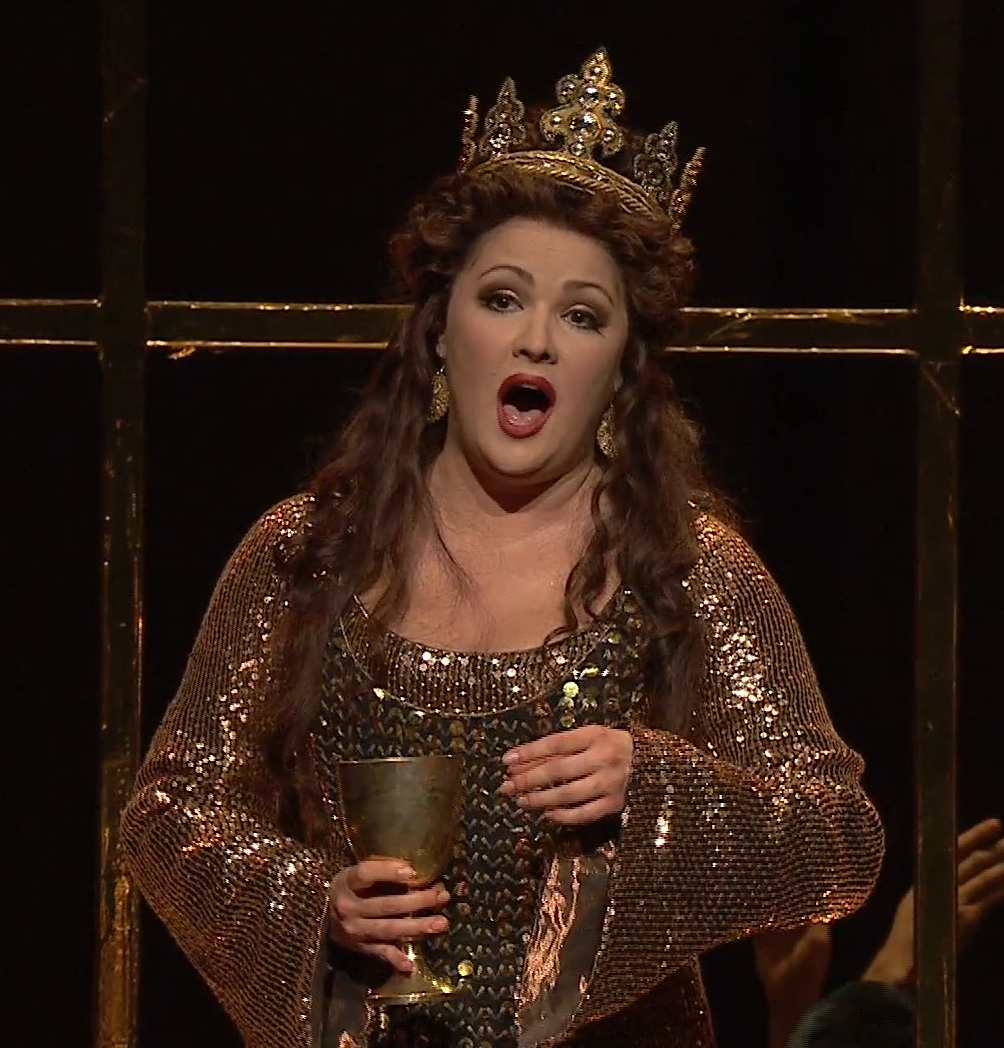
Quanto aos cantores, o elenco era dominado pela presença de Anna Netrebko. A sua presença magnética, carisma e voz sem paralelo no mundo lírico actual catapultaram-na para uma prestação de absoluta excelência. A voz está enorme e Netrebko sabe usá-la em toda a sua extensão: os agudos são estratosféricos, os graves sublimes, as passagens em piano ou as entradas em forte inatacáveis, e apresentou uma coloratura impecável. A sua Lady é maléfica e manipuladora e cambia a forma como faz e diz em perfeita consonância com a acção. A leitura da carta, passagem de grande dificuldade na atribuição de um cunho dramático e anunciador da trama trágica que se vai seguir, foi perfeita, assim como todas as intervenções seguintes, podendo destacar a ária La luce langue cujo A loro um requiem, l’eternita foi arrepiante. Netrebko é um espanto e, no meu entender, ninguém canta ou cantou o papel de Lady Macbeth melhor. Que privilégio!

Imagens da ROH

Željko Lučić, como Macbeth, foi a figura central do elenco masculino. A sua voz é, indubitavelmente, bonita e grande e, creio, ter tudo para ser a de um verdadeiro barítono verdiano. Todavia, sucede que está a milhas de o ser. A sua interpretação cénica é estática, coisa que perdoaria não fosse a sua interpretação vocal de uma monotonia exasperante. É incapaz de transmitir emoções: por isso canta Iago tal como canta Rigoletto ou Macbeth. Por exemplo, quando a alucinar  diz Ma fuggi, deh, fuggi, fantasma tremendo! parece tão desesperado quanto eu estaria a relaxar num esteira de uma piscina com um mojito na mão. Em jeito de comparação, é como um computador a tocar piano: tem voz, mas não tem vida! Uma frustração porque vocalmente não falha uma.

Imagens da ROH

Ildebrando D’Arcangelo foi um Banquo de grande categoria, apresentando uma excelente forma vocal e uma projeção irrepreensível. O papel é pequeno, mas bonito, e D’Arcangelo, como habitualmente, engrandeceu-o com uma magnífica interpretação de Come dal ciel precipita.

David Junghoon Kim foi um Macduff de voz cheia e com excelente projeção, tendo cantado a famosa ária O figli, o figli miei! de forma expressiva e elegante.

Konu Kim foi um Malcolm de qualidade. Foi engraçado que quer Macduff, quer Malcolm tivessem sido cantores asiáticos: parecia que a Escócia ia ser tomada de assalto pela Coreia do Sul.

As restantes personagens, nos seus pequenos papéis, estiveram em muito bom nível, destacando Francesca Chiejina como aia de Macbeth pela beleza do timbre.


A deslocação a Londres ficou totalmente justificada. Assistiu-se a uma récita de elevadíssimo nível qualitativo, a começar pela encenação que se destaca pela riqueza simbólica, passando pela orquestra de musicalidade sumptuosa e terminando nos cantores de nível global muito alto. E faço duas menções: uma negativa para Lučić, pela frustração que causa a sua monotonia; uma tremendamente positiva para Netrebko, pela incomparável qualidade como intérprete. Diria mesmo que quando Netrebko participa em récitas de Macbeth a ópera dever-se-ia chamar Lady Macbeth!


————————
(Review in English)
The opera Macbeth was premiered in 1847 in Florence resulting from another collaboration between Francesco Maria Piave and Giuseppe Verdi. Later, in 1865, the opera was extensively reviewed for the Paris Ópera. Nowadays, it is this last version that is regularly presented in the theatres.

The story is based on the homonymous William Shakespeare’s drama, playwright of reference for Verdi and that inspired to him other operas: as Otello or Falstaff. It is a story of ambition, power, crime and guilt taken to the extreme of madness. The libretto follows the English drama closely, the main alteration being the transformation of the three witches into a set of three female choirs that still sing each of them as a solo character.

Phyllida Lloyd's staging is very rich and interesting, having premiered at ROH in 2002. This time, it’s revisited by Daniel Dooner.

The setting is not situated in a particular century and the stage director intends to attribute symbolic meanings to various scenic elements. First of all, the characterisation of witches. Witches has been regarded for centuries as a demonic and malefic symbol. Lloyd characterises them in the style of Frida Kahlo, both in their make-up and in the black wardrobe with a bright red turban. If usually the woman in Macbeth is an evil being in her actions, in this scenario the woman is not understood as a symbol of evil, demonic or magical powers. Rather, she is given an active role, an irreverent character, functioning as a symbol of the emancipation of the woman who must be able to decide her actions, being they good or bad. For this, the role that is given to a witch who, as an assistant, helps in the unfolding of the action: for example, it is she who delivers the crown of Duncan to Macbeth, it is she who helps little Malcolm to escape being assassinated.

Equally interesting is the use of water: there is a kind of lavatory on the right-hand corner of the stage that is often used for hand-washing, as if the need to cleanse the hands stained by crime was permanent. Although this cleansing is, as we know, ineffective, the truth is that there is this quest for purification or, rather, for hiding evil through the water.

The use of a box in the shape of a golden cage is also interesting. It is as if the power were always symbolically imprisoned: in this cage Duncan appears on his horseback and is in that cage he will be assassinated. The box also functions as the throne room, where Macbeth is crowned and murdered, and where Malcolm regains power. To emphasise this, Macbeth's crown is enclosed in a small replica of this cage when, after crowning, Macbeth seeks to rest in his room.

The staging is visually striking, although a bit too dark, as is usual in Macbeth's stagings. The overall setting is a wooden frame with squares (like a chocolate bar) painted in matte black. This structure appears and disappears, creating a dark and claustrophobic scenario, as if it was to limit in space the ambition for power. The Macbeth bed is a replica of this structure, whose quilt reproduces this pattern, but with shiny black squares. The way Macbeth's hallucinations and visions are presented is conventional, but very effective. And the scenic details specified in the script are all present: Duncan bathed in blood, the different visions, the lantern of Lady Macbeth, the branches of the Birman forest.

The negative point, to mention one, is the direction of actors that is, more than monotonous, a bit artificial. Despite this, it does not prevent the unfolding of the action in a fluid way.

The ROH Orchestra performed at the highest level under the Antonio Pappano’s baton, whose ability to explore the musical dynamics of the score was masterful, as well as the expressiveness it achieves in the different moments of the opera: it is dramatic, lyrical, religious or pungent where  required.

The ROH Choir also had a high quality performance, both the three sets of witches - always with a magnificent time and intensity - and the whole choir in its various interventions with a natural highlight for the refugees’ chorus Patria oppressa.

As for the singers, the cast was dominated by the presence of Anna Netrebko. Her magnetic presence, charisma, and unparalleled voice in today's lyrical world have catapulted her into a performance of absolute excellence. The voice is enormous and Netrebko knows how to use it in all its length: the highs are stratospheric, the basses sublime, the passages in piano or the fortes unassailable, and presented an impeccable coloratura. Your Lady is evil and manipulative and changes the way she does and says everything in perfect harmony with the action. The reading of the letter, a passage of great difficulty in the attribution of a dramatic and announcing tragic trait that is to follow, was perfect, as well as all the following interventions. I could emphasise the aria La luce langue whose A loro un requiem, l’eternita was amazing. Netrebko is an astonishment and, in my opinion, no one sings or sang the role of Lady Macbeth any better. What a privilege!

Željko Lučić, as Macbeth, was the central figure of the male cast. His voice is undoubtedly beautiful and great and, I believe, have everything to be that of a true Verdian baritone. However, it happens that it is miles away from being so. His scenic interpretation is static, which I would forgive, but his vocal interpretation is of exasperating vocal monotony. He is incapable of transmitting emotions: he sings Iago as he sings Rigoletto or Macbeth. For example, when hallucinating he says Ma fuggi, deh, fuggi, fantasma tremendo! it seems as desperate as if I would be to relax on a pool with a mojito in my hand. In comparison, he's like a computer playing the piano: he has the voice, but no life, which is a huge frustration because he does not fail a note vocally speaking.

Ildebrando D'Arcangelo was a Banquo of great category, presenting an excellent vocal form and an impeccable projection. The role is short but beautiful, and D'Arcangelo, as usual, magnified it with a magnificent interpretation of Come dal ciel precipita.

David Junghoon Kim was a Macduff with huge voice and with excellent projection, having sung the famous aria O figli, o figli miei! in an expressive and elegant way.

Konu Kim was a Malcolm of good quality. It was funny that either Macduff or Malcolm were Asian singers: it seemed that Scotland was going to be taken by South Korea.

The remaining characters, in their short roles, were at a very good level, highlighting Francesca Chiejina as Macbeth's lady-in-waiting for the beauty of the timbre.


The trip to London was totally justified. There was a recital of very high quality, starting with the staging that stands out for the symbolic richness, passing by the sumptuous orchestra of great musicality and ending up with the singers of a very high global level. And I must make two special mentions: a negative one to Lučić, by the frustration that causes his monotony; a tremendously positive for Netrebko, for her incomparable quality as an interpreter. I would even say that when Netrebko participates in recitals of Macbeth the opera should be called Lady Macbeth!

quinta-feira, 5 de abril de 2018

BRYN TERFEL, Fundação Calouste Gulbenkian, Abril / April 2018


(review in English below)

O baixo-barítono galês Bryn Terfel esteve ontem na FCG para um recital em conjunto com o Coro e Orquestra Gulbenkian sob direção do também galês Gareth Jones.


O programa foi variado e interessante, tendo começado pela Abertura da ópera Nabucco de Verdi. De seguida, Terfel cantou de forma soberba a ária Son lo sipirito che nega sempre da ópera Mefistófeles de Arrigo Boito, compositor e libretista italiano conhecido pelos libretos de Otello e Falstaff de Verdi. Seguiu-se L’onori! Ladri! da ópera Falstaff de Verdi: Terfel fez uma introdução bastante cómica à ária e cantou-a com o estilo burlesco necessário, caracterizando muito bem a personagem que é um dos seus papéis de referência. Depois, o Coro da FCG cantou o famoso Va pensiero da ópera Nabucco de Verdi: no final, um senhor, aos gritos, pedia “outra! outra! Fazem sempre isso em Verona!”, levantando algum sururu na sala, mas o seu pedido não foi atendido… E bem! 


Mudou-se depois para o alemão Richard Wagner. Começou-se com o Coro dos peregrinos da ópera Tannhäuser e seguiu-se a Música do fogo mágico e Despedida de Wotan, parte emblemática e de grande intensidade dramática da ópera Die Walküre que Terfel cantou com intensidade, embora por vezes a voz soasse um pouco “arranhada”. É difícil “cair” de repente na pele de Wotan. Deixou saudades das Valquírias que vimos ao vivo em Londres e Nova Iorque, onde teve interpretações superiores.

A segunda parte começou com a muito dramática cena da Morte de Boris da ópera Boris Godunov de Mussorgsky, uma das minhas óperas preferidas de língua russa. Terfel estreou o papel na Royal Opera House em 2016, tendo recebido críticas muito positivas, mas não me convenceu. Ontem fez, de facto, uma excelente interpretação da ária, com todas as subtilezas interpretativas que esta necessita e com um uso da voz excelente. A ária encaixa-se muito bem no intervalo da tessitura do Terfel, onde se sente mais à vontade nesta fase da carreira. Falta-lhe uma certa doçura e lirismo para se poder comparar ao Boris perfeito: Nicolau Ghiaurov. Mas poderá valer a pena vê-lo de novo na próxima temporada de Londres…


Regressou-se, depois, a Verdi com a Abertura da La Traviata e o Coro dos Ciganos de Il Trovatore, muito bem interpretado pelo Coro da FCG que esteve sempre em muito bom nível.

Seguiu-se um registo mais ligeiro. Primeiro com a canção Homeward Bound de Marta Keen que conta com uma angelical intervenção do coro, naquele que foi dos momentos mais bonitos da noite, pela simplicidade e pelo apelo à vida. De seguida, ouviu-se a Abertura e Some Enchanted Evening da obra South Pacific da dupla Richard Rogers e Oscar Hammerstein II. Para terminar, Terfel ofereceu uma muito divertida interpretação da canção cómica If I was a rich man da obra The Fiddler on the Roof.

Como encore Terfel cantou a canção tradicional de embalar galesa Suo Gan, recordando que esta fez parte da banda sonora do filme O império do sol (1987) de Steven Spielberg.

No cômputo geral, assistiu-se a um concerto de grande qualidade mas faltou-lhe aquela aura especial que se viveu sentiu no passado recente com outros solistas como a Joyce DiDonato ou a Patricia Petibon. Senti falta de algo da Tosca, talvez um dos monólogos do Hans Sachs ou o monólogo do Holandês. Coro e Orquestra da FCG ao mais alto nível. Terfel demonstrou ser um artista dotado de grande capacidade vocal e, sobretudo, de um enorme capacidade interpretativa a que associa uma figura carismática.


Texto de camo_opera e wagner_fanatic.


BRYN TERFEL at the Calouste Gulbenkian Foundation, April 2018

Welsh bass-baritone Bryn Terfel was at the FCG yesterday for a recital together with the Gulbenkian Choir and Orchestra under the direction of the Gareth Jones.

The program was varied and interesting, having begun by the opening of Verdi's opera Nabucco. Then, Terfel sang a superb aria
Son lo sipirito che nega sempre from the opera Mephistopheles by Arrigo Boito, Italian composer and librettist known by the libretti of Otello and Falstaff by Verdi. After this aria came L'Onori! Ladri! of Verdi's opera Falstaff: Terfel made a rather comic introduction to the aria and sang it with the necessary burlesque style, characterizing very well the character that is one of his reference roles. Then the FCG Choir sang the famous Va pensiero of Verdi's opera Nabucco: in the end, a man, shouting, asked "again! again! They always do this in Verona! ", raising some noise in the room, but his request was not followed ... and well!

Richard Wagner was the next composer. The Choir of the pilgrims of the opera Tannhäuser was first, and followed the music of the magic fire and Farewell of Wotan, the emblematic part of great dramatic intensity of the opera Die Walküre that Terfel sang with intensity, although ocasionaly the voice sounded a little "scratched". It is difficult to "fall" suddenly into Wotan's skin. I missed the Valkyries we saw live in London and New York, where he had superior performances.

The second part began with the very dramatic Death of Boris scene from Mussorgsky's opera Boris Godunov, one of my favorite Russian-language operas. Terfel debuted the role at the Royal Opera House in 2016 and received very positive reviews, but he did not convince me. Yesterday he offered, in fact, an excellent interpretation of the aria, with all the interpretive subtleties it needs and with an excellent voice usage. The aria fits very well in the range of Terfel's tessitura, where he feels more comfortable at this stage of his career. He lacked a certain sweetness and lyricism to be able to compare to the perfect Boris: Nicolau Ghiaurov. But it might be worth seeing him again next season in London ...

Then returned Verdi with the Opening of La Traviata and the Choir of the Gypsies of Il Trovatore, very well interpreted by the FCG Choir that was always at top level.
This was followed by lighter music. First with the song Homeward Bound of Marta Keen that counts on an angelical intervention of the choir, in one of the most beautiful moments of the night, for the simplicity and the call to life. Then there was the Opening and Some Enchanted Evening from the South Pacific work of the duo Richard Rogers and Oscar Hammerstein II. To conclude, Terfel offered a very amusing interpretation of the comic song If I was a rich man of the The Fiddler on the Roof.

As an encore Terfel sang the traditional Welsh wrapping song Suo Gan, remembering that this was part of the soundtrack of the film The empire of the sun (1987) of Steven Spielberg.

On the whole, it was a high-quality concert but it lacked that special aura that was experienced in the recent past with other soloists such as Joyce DiDonato or Patricia Petibon. I missed some part from Tosca, perhaps one of Hans Sachs's monologues or the Holländer monologue. FCG Choir and Orchestra were at the highest level.
Terfel proved to be an artist endowed with great vocal ability and, above all, an enormous interpretative capacity to which a charismatic figure associates.

Text by camo_opera and wagner_fanatic.

domingo, 1 de abril de 2018

A VALQUÍRIA / DIE WALKÜRE – Deutsche Oper am Rhein, Düsseldorf, Março / March 2018


(review in English below)

A Valquíria, de Richard Wagner, esteve em cena na Deutsche Oper am Rhein no Sábado de Páscoa.


O teatro tem uma acústica peculiar, a orquestra era “normal”, não excessivamente wagneriana, mas ouvia-se quase sempre em forte, embora alguns trechos soassem baixo.


A encenação foi de Dietrich Hilsdorf, guarda roupa de Renate Schmitzer, luzes de Volker Weinhart e dramaturgia de Bernhard Lobes. Apesar de ter os componentes clássicos (a espada era uma espada, a lança uma lança, o Wotan tinha o olho vendado) foi peculiar mas não pindérica. A acção passa-se numa guerra (um tema muito do agrado dos encenadores da Valquíria). O cenário é sempre o mesmo nos 3 actos, mas com modificações.

O 1º acto começa com a chegada do Hagen a casa, tentando acariciar a Siegliende, mas é por ela repelido. A casa tem uma grande mesa à esquerda do palco, com garrafas de vinho e copos (ficarão até ao final da ópera), por trás dela o tronco grande de uma árvore onde está cravada a espada Nothung. À direita há um fogão antigo e uma porta, deduz-se para o quarto, e nada mais, para além de umas cadeiras dispersas. Tudo o resto é convencional, embora a Sieglinde tem uma postura muito insinuante para com o Siegmund logo desde o início. No final, quando revelam as suas identidades de irmãos gémeos, vestem a roupa um do outro, numa cena que não resulta.


O 2º acto começa no mesmo local e estão sentados à mesa o Hunding, o Siegmund e a Sieglinde já grávida de 6 meses, que ouvem a oposição da Fricka à sua união adúltera e incestuosa. Também todo este acto decorre no mesmo cenário e é convencional. O Wotan toma uma atitude muito submissa e quase “derrotada” depois do pedido da Fricka, deita-se no chão quando fala com a Brünhilde, numa atitude muito pouco de acordo com a sua condição de deus. Quando ordena retirar o poder mágico da espada (que está sobre a mesa), cai a lança em cima dela, partindo-a, e fica espetada na vertical, talvez o efeito mais original e mais conseguido da encenação. É aqui que a lança aparece pela primeira vez e continuará nas mãos do Wotan.


O 3º acto começa ouvindo-se ruidosamente um helicóptero e ele aprece destruído no mesmo cenário com a mesa de um lado e o fogão do outro. Dele saem os heróis mortos, em tronco nu, tipo zombies, com as feridas mortais na cabeça, pescoço, tórax ou abdómen. As valquírias estão de vestido comprido escarlate e cavalos, nem na melhor imaginação. Oferecem vinho aos heróis, há muitos copos e muitas velas acesas na mesa. Depois tudo é convencional até ao fim (excepto o Hagen morto que permanece sentado num sofá que está na tal mesa até ao fim - é um boneco). A Brünhilde fica sentada numa cadeira perto da mesa e o fogo sagrado vê-se fora dessa sala, numa janela grande. Ainda pensei que as velas serviriam para o fogo mas não, grande parte delas são apagadas com vinho pelo Wotan.


A direcção musical, regular, da Düsseldorfer Symphoniker foi do maestro Axel Kober.


Em relação aos cantores principais, todos de grande categoria.
A Sieglinde, soprano sueca Elisabet Strid, foi a melhor da noite. Tem uma voz muito bonita, expressiva e interpretou a personagem de forma soberba, incluindo o desempenho cénico.


O Siegmund, tenor norte americano Corby Welch, foi o elo mais fraco. Pouco emotivo, os Wälse! saíram frouxos, no Winterstürme foi desinteressante e ocasionalmente deixou-se afogar pela orquestra.


O Hunding, baixo finlandês Sami Luttinen, tem uma voz cavernosa poderosíssima e teve uma interpretação correcta.


A Fricka, mezzo alemã Renée Morloc, cantou bem, ouviu-se sempre sobre a orquestra e ofereceu-nos uma interpretação convincente.


O Wotan, baixo barítono inglês Simon Neal, tem um timbre vocal muito bonito, audível sempre a orquestra e perfeitamente adequado à personagem. Se fez um papel excessivamente submisso e “derrotado”, terá sido por indicação do encenador.


A Brünhilde, soprano norte americana Linda Watson, ofereceu-nos também uma interpretação marcante, de qualidade superior. Cenicamente não foi muito criativa mas a voz destacou-se como uma das melhores, sempre sobre a orquestra e de grande expressão emotiva.


As valquírias: Helmige (Josefine Weber), Gerhilde (Jessica Stavros), Ortlinde (Katja Levin), Waltraute (Katarzyna Kuncio), Siegrune (Zuzana Sveda), Rossweisse (Maria Hilmes), Grimgerde (Katharina von Bülow) e Schertleite (Evelyn Krahe) estiveram globalmente bem, embora não tenha havido equilíbrio qualitativo entre todas.


****


DIE WALKÜRE - Deutsche Oper am Rhein, Düsseldorf, March 2018

Richard Wagner's Die Walküre was on stage at the Deutsche Oper am Rhein on Easter Saturday.

The theater has a peculiar acoustics, the orchestra was "normal", not excessively Wagnerian, but it was almost always heard in forte, although some parts sounded piano.

The staging was by Dietrich Hilsdorf, Renate Schmitzer's costumes, Volker Weinhart lights. Despite having the classic components (the sword was a sword, the spear a spear, Wotan had the eye blindfold) the staging was peculiar. The action takes place in a war (a theme much to the liking of the directors of Valkyrie). The scenario was always the same in the 3 acts, but with modifications.

The first act begins with the arrival of Hagen in his house, trying to kiss Siegliende, but is repelled by her. The house has a large table to the left of the stage, with bottles of wine and glasses (that will remain until the end of the opera), behind it the large trunk of a tree where the sword Nothung is nailed. To the right there is an old stove and a door, it leads to the bedroom, and nothing else, besides scattered chairs. All the rest is conventional, although Sieglinde has a very insinuating behavior towards Siegmund right from the start. In the end, when they reveal their identities as twin brothers, they dress each other's clothes in a scene that does not work out.

The second act begins in the same place and at the table the are seated Hunding, Siegmund and Sieglinde already 6 months pregnant, who hear the opposition of Fricka to their adulterous and incestuous union. Also this whole act takes place in the same scenario and is conventional. Wotan takes a very submissive and almost "defeated" attitude after Fricka's request, lying on the floor when speaking to Brünhilde, in an attitude that is very little in accordance with his god condition. When he orders to remove the magical power of the sword (which is on the table), the spear drops on top of it, breaking the sword, and stuck vertically, perhaps the most original and most accomplished effect of the staging. This is where the spear appears for the first time and will remain in Wotan's hands.

The third act begins with a loud noisy helicopter and we see it destroyed in the same scenario with the table on one side and the stove on the other. From the elicopter exit the dead heroes, like zombies, with mortal wounds on the head, neck, thorax, or abdomen. The valkyries are in scarlet dark dress and without horses. They offer wine to the heroes, there are many glasses and many candles lit on the table. Then everything is conventional until the end (except for the dead Hagen who is sitting on a couch until the end - it's a doll). Brünhilde sits in a chair by the table and the sacred fire is seen outside this room, through a large window. I still thought the candles would serve the fire but no, most of them are wiped with wine by Wotan.

The musical direction of the Düsseldorfer Symphoniker was regular, by maestro Axel Kober.

Concerning the main singers, all were of great category.
Sieglinde, Swedish soprano Elisabet Strid, was the best of the night. She has a very beautiful and expressive voice, and interpreted the character in a superb way, including the stage performance.

Siegmund, North American tenor Corby Welch, was the weakest link. Unemotional, the Wälse! were loose, and in the Wintersturme was uninteresting and occasionally drowned by the orchestra.

Hunding, Finnish bassist Sami Luttinen, has a very powerful cavernous voice and had a correct interpretation.

Fricka, German mezzo Renée Morloc, sang well, she was always heard about the orchestra and offered us a convincing interpretation.

Wotan, English bass baritone Simon Neal, has a very beautiful vocal tone, always audible over the orchestra and perfectly suited to the character. If he has played an excessively submissive and "defeated" role, it will have been by appointment of the director.

Brünhilde, North American soprano Linda Watson, also offered us a remarkable interpretation, of superior quality. On stage she was not very creative but the voice stood out as one of the best, always over the orchestra and of great emotional expression.

The Valkyres: Helmige (Josefine Weber), Gerhilde (Jessica Stavros), Ortlinde (Katja Levin), Waltraute (Katarzyna Kuncio), Siegrune (Zuzana Sveda), Rossweisse (Maria Hilmes), Grimgerde (Katharina von Bülow) and Schertleite ) were globally well, although there was no qualitative balance among all.

****