sábado, 19 de outubro de 2019

LA TRAVIATA, Arena di Verona, Agosto / August 2019


(text in English below)

Texto de wagner_fanatic

Leo Nucci volta a trazer-me à Arena de Verona. No ano passado, com o seu Barbeiro de Sevilha, a noite foi especial, não só pela mais que provável derradeira vez de o ouvir neste papel, mas também porque era a minha estreia na Arena.


Este ano, foi diferente e acho que até mais especial. No ano da morte de Franco Zeffirelli, a sua última encenação, esta La Traviata, era motivo que chegasse para a honra de a ela assistir ao vivo. Mas a isto juntava-se Leo Nucci, superlativamente acompanhado por Lisette Oropesa e Vittorio Grigolo.


Leo Nucci continua a ser um fenómeno de longevidade, uma lenda viva, um Senhor da Ópera italiana. A voz precisa de uns minutos para abrir mas é só isso. Depois, mantém-se igual no tempo, agora, principalmente quando o ambiente lhe é propício (e o da Arena assim o é), a elevar-se ainda mais, a modular as frases numa interpretação que já confunde a personagem com o homem e cantor.  Um dueto de Senhor com Violetta, um Di Provenza lírico e sentido, e um final de segundo acto marcante!




De Vittorio Grigolo já todos conhecemos o seu histerionismo quer físico quer vocal... embora por vezes a exceder-se e a roçar um pouco o ridículo interpretativo, o que é certo é que, tirando estes poucos momentos, não deve haver cantor que consiga exprimir-se de forma tão apaixonante. E é pena que tão poucos o consigam a este nível. O início do segundo acto foi um desses momentos em que Grigolo, ao cantar/interpretar, quase que parece estar a ter uma relação de índole sexual com a partitura. O Ogni suo aver tal femmina foi brutal, contrastando emotivamente com o arrependimento que se segue. Um dos maiores momentos da noite, claramente!


Lisette Oropesa é um fenómeno! A voz é linda, boa projeção, agudos impecáveis e uma evolução interpretativa da Violetta de qualidade muito rara!


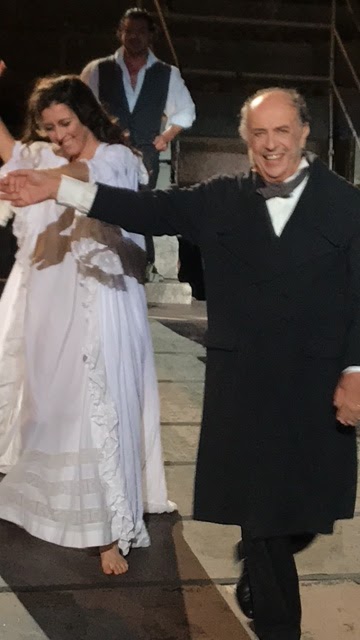
Daniel Oren é um maestro incrível! As caras que faz como que demenciado ou em estado pós-AVC, os gestos emotivos que vão muito além da mera agitação de batuta, os grunhidos de paixão, o falar com a orquestra no meio da ópera (gritou bem alto stacatto para as cordas porque não estavam a fazer devidamente) e o agradecer com a imagem de marca dos braços este estendidos são um espetáculo fora da ópera mas... dentro dela.


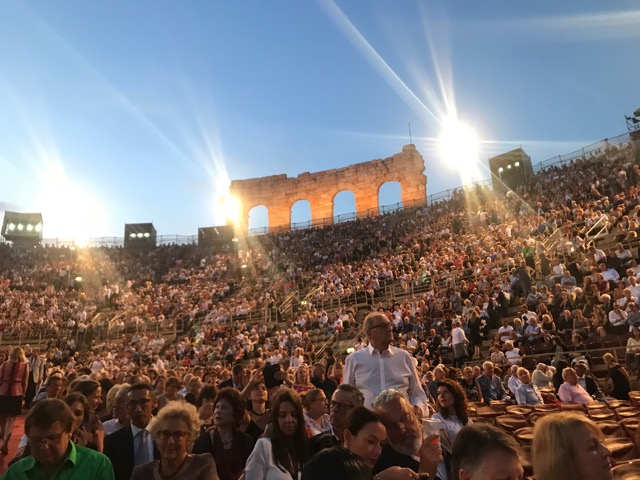
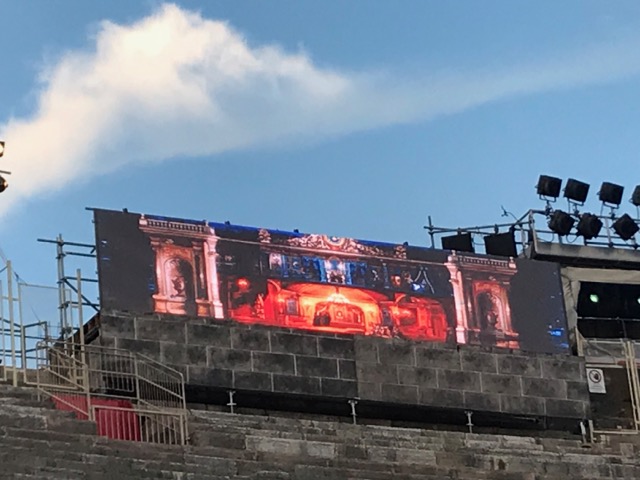
Zeffirelli foi recordado no final com foto nos écrans das legendas, seguido de repetição do Libiamo ne’lieti calici em ambiente de festa e Oren a dirigir do palco e a interagir com os cantores. No final, o agradecer especial junto das bancadas, com um efusivo Grigolo a puxar por todos e um muito bem merecido apoio motivacional de Nucci a Oropesa. São assim os grandes artistas. A Arena é um espaço diferente, mágico, e sempre que nela se entra, na sua magnitude e imponência, faz-nos sentir aconchegados, por incrível que possa parecer. É o aconchego da ópera, o calor de quem a preenche e o espírito da sua história.


LA TRAVIATA, Arena of Verona, August 2019

Text by Wagner_fanatic.

Leo Nucci brings me back to the Arena di Verona. Last year with his Barber of Seville, the evening was special, not only for the most likely last time to hear him in this role, but also because it was my Arena debut.

This year was different and I think even more special. In the year of Franco Zeffirelli's death, his last performance, this La Traviata, was reason enough for the honor of watching it live. But to this was added Leo Nucci, superlatively accompanied by Lisette Oropesa and Vittorio Grigolo.

Leo Nucci remains a phenomenon of longevity, a living legend, an Italian Opera Lord. The voice needs a few minutes to open but that's all. Then he stays the same in time now, especially when the atmosphere is right for him (and the Arena's is), to rise even higher, to modulate the phrases into an interpretation that confuses the character with the man and singer. A duet with Violetta, a lyrical and meaningful Di Provenza, and a remarkable second act ending!

From Vittorio Grigolo we all know his hysterionism, both physical and vocal... although sometimes he goes overboard and touches a little the ridiculous interpretation, which is certain that, apart from these few moments, there should be no singer who can express himself so passionately. And it is a pity that so few get it on this level. The beginning of the second act was one of those moments when Grigolo singing / performing, almost seemed to be having a sexual relationship with the score. The Ogni suo aver tal femmina was brutal, contrasting emotionally with the ensuing regret. One of the biggest moments of the night, clearly!

Lisette Oropesa is a phenomenon! The voice is beautiful, good projection, impeccable top notes and a very rare quality interpretative evolution of Violetta!

Daniel Oren is an amazing conductor! The faces he makes as if demented or post-stroke, the emotional gestures that go far beyond mere baton shaking, the passionate grunts, the talking to the orchestra in the middle of the opera (shouted loudly stacatto to the strings because they weren't doing it properly) and thanking him with the brand image of his outstretched arms is a sight outside the opera but ... inside it.

Zeffirelli was remembered at the end with a photo on the screen of the subtitles, followed by a repeat of Libiamo ne'lieti calici in a party atmosphere and Oren directing the stage and interacting with the singers. In the end, special thanks to the stands, with an effusive Grigolo pulling everyone and a well-deserved motivational support from Nucci to Oropesa. These are the great artists. The Arena is a different, magical space, and whenever you enter it, in its magnitude and grandeur, it makes us feel cozy, incredible as it may seem. It is the warmth of the opera, the warmth of its filler and the spirit of its history.

sexta-feira, 18 de outubro de 2019

TURANDOT, Liceu Barcelona, Outubro 2019


A primeira “banhada” (e espero que a última!) da temporada. Tinha bilhetes para ver duas récitas (dois elencos) da Turandot de Puccini no Liceu de Barcelona. Infelizmente, as datas coincidiram com os grandes distúrbios na Catalunha em geral e em Barcelona em particular.


Com as perturbações no aeroporto e nas principais avenidas da cidade, fiquei impossibilitado de lá me deslocar. Imperou o bom senso e recuperei os valores pagos pelos voos, hotel e Liceu.


TURANDOT, Liceu Barcelona, October 2019

The first “draw back” (and hopefully the last!) of the season. I had tickets to see two performances (two casts) of Turandot by Puccini at the Liceu in Barcelona. Unfortunately, the dates coincided with the major disturbances in Catalonia in general and Barcelona in particular.

With the disturbances at the airport and the main avenues of the city, I was unable to travel there. The common sence prevailed and I got back the money paid by the flights, hotel and opera theater.

terça-feira, 15 de outubro de 2019

LA FORZA DEL DESTINO, Teatro Nacional de São Carlos, Lisboa, Outubro 2019


(review in English below)

O Teatro de São Carlos abriu a temporada com a opera de Verdi La Forza del Destino, numa encenação de David Pountney. Há projecções numa tela translúcida à frente do palco. Abre com a palavra Paz, vê-se uma borboleta e uma roda (da sorte?) e a pistola a disparar uma bala aparece várias vezes ao longo do espectáculo. No início da segunda parte é a palavra Guerra que surge. No palco há dois grandes painéis móveis que permitem criar os diversos cenários, um deles com uma cortina e os figurantes trazem e levam frequentemente mesas. No primeiro acto dominam imagens de cruzes de grandes dimensões e pouco mais, com um efeito cénico interessante no início mas depois muito repetitivo. Há situações bem conseguidas mas a encenação, para além de escura como a história da ópera, é estranha em várias partes. Há padres com enormes mitras trajados de branco mas todos ensanguentados (final do 2º acto), a morte aparece frequentemente retratada nos elementos do coro e há um “Piccolo Teatro di Guerra” no 3º acto de efeito algo bizarro.

O maestro Antonio Pirolli fez um óptimo trabalho, a Orquestra Sinfónica Portuguesa esteve bem e o Coro também muito bem.


O baixo barítono Miklós Sebestyén foi o Marquês de Calatrava e o Padre Guardiano. Esteve bem, algo discreto, mas com um timbre agradável e boa presença em palco.

Leonora foi a soprano Julianna Di Giacomo que tem uma voz potente, com vibrato acentuado e, no registo mais agudo, perde qualidade e sai mais gritado que cantado. Contudo, teve partes muito boas, nomeadamente  “Madre, pietosa Vergine” no 2º acto e o “Pace pace mio Dio...” no último.

O barítono Damiano Salerno foi um Don Carlo de qualidade superior. Voz poderosa, timbre muito agradável e sempre afinado. Para mim o melhor cantor da récita.

No extremo oposto esteve o tenor Rafael Alvarez como Don Alvaro. Voz agreste, desafinou frequentemente e com enormes dificuldades nos agudos. Em cena também não foi interessante.

De entre os cantores portugueses, Cátia Moreso foi uma Preziosilla muito vistosa mas a voz resvala frequentemente para a estridência, Luís Rodrigues foi um Melitone excelente, tanto na interpretação vocal como cénica, João Merino um Alcaide e um Cirurgião digno e Carlos Guilherme um Trabuco algo apagado.


**


LA FORZA DEL DESTINO, Teatro Nacional de São Carlos, Lisbon, October 2019

The Teatro Nacional de São Carlos opened the season with the opera by Verdi La Forza del Destino, produced by David Pountney. There are projections on a translucent screen in front of the stage. It opens with the word Peace, you see a butterfly and a wheel (lucky?) and the pistol firing a bullet is appearing several times throughout the show. At the beginning of the second part is the word War that appears. On the stage there are two large moving panels that create the various scenarios, one with a curtain and the extras often bring and carry tables. In the first act dominate large crosses and little more, with an interesting scenic effect at first but later very repetitive and unimaginative. There are interesting scenic situations but the staging, as dark as the history of the opera, is strange in many parts. There are priests with huge white-clothed miter but all bloody (end of 2nd act), death often appears in the choir elements and there is a “Piccolo Teatro di Guerra” in the 3rd act of somewhat bizarre effect.

Conductor Antonio Pirolli did a good job, the Portuguese Symphony Orchestra was well and the Choir was very good.

Bass baritone Miklós Sebestyén was Marquis of Calatrava and Padre Guardiano He was fine, somehow discreet, but a nice timbre and good presence on stage.

Leonora was soprano Julianna Di Giacomo who has a powerful voice, but with strong vibrato and, in the top register, loses quality and the voice is more shouted than sung. However, she had very good parts, namely “Madre, pietosa Vergine” in the second act and "Pace pace mio Dio..." in the last.

Baritone Damiano Salerno was a top quality Don Carlo. Powerful voice, very pleasant tone and always tuned. For me the best singer of the night.

At the opposite extreme of the interpretation was tenor Rafael Alvarez as Don Alvaro. Wild voice, often detuned and with great difficulties in the top register. On stage he was not interesting either.

Among Portuguese singers, Cátia Moreso was a very showy Preziosilla but her voice often slips to stridency, Luís Rodrigues was an excellent Melitone, both in vocal and scenic interpretation, João Merino was a correct Mayor and Surgeon and Carlos Guilherme made a  weak Trabuco.

**