Mostrar mensagens com a etiqueta Michael Boder. Mostrar todas as mensagens

quinta-feira, 26 de junho de 2014

Gershwins' PORGY AND BESS - Danish Royal Opera House, Copenhaga - 26.03.2014

(Review in English below)


A ópera Porgy and Bess de George Gershwin foi composta e estreada em 1935. O libreto é de George e Ira Gershwin, DuBose e Dorothy Heyward.


Estreou com bastante polémica, não só por ser uma história cujos protagonistas são pessoas de raça negra, como pela inovação musical que introduzia, numa aproximação clara ao jazz e com uma muito marcada influência folclore. Gershwin, um compositor judeu, foi acusado (e ainda hoje o é) de racismo e de uma visão sectária e demasiado preconceituosa. Mas o que é facto é que, independentemente das críticas que se possam consubstanciar em algo (?), a ópera de Gershwin tem múltiplas melodias extremamente famosas de onde se destaca Summertime que, hoje em dia, é mais famosa através do jazz.


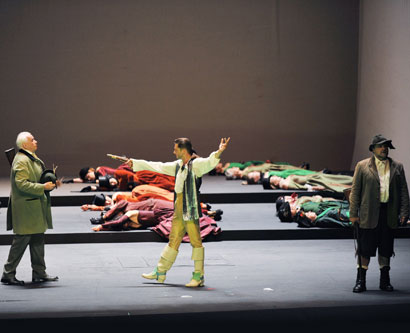
A nova encenação da escocesa Liz Ascroft é, do ponto de vista visual, muito interessante. Baseia-se numa enorme estrutura em madeira com aspecto deteriorado, mas que representa a comunidade muito familiar em que aquele povo vivia. O cenário existe em 3 planos: uma espécie de pátio e um rés-do-chão e primeiro andar. A acção passa-se nesses 3 planos, sem nenhuma ordem especial e sem qualquer incoerência com o libreto. Pode dizer-se que em todos os aspectos a encenação é clássica: cenário, guarda-roupa, iluminação, direcção de actores. A única coisa que não percebi e que me intrigou foi a presença de Clara com o bebé nos braços do início até que parte em busca de salvar Jake do temporal. Mas foi uma encenação muito bem feita e agradável de seguir.


A orquestra da Royal Danish Opera dirigida por Michael Boder apresentou um bom nível de entrosamento e de interpretação, sem qualquer falha importante e tendo em conta os cantores. Excelente!

No que respeita aos cantores, há a destacar uma óbvia diferença de qualidade entre os elementos dos elencos feminino e masculino: a vantagem foi, claramente, para o primeiro.

Bess foi interpretada pelo soprano americano Lisa Daltrius. A voz é pujante, sobretudo no registo agudo, fazendo ecoar as notas mais altas com facilidade, mas mantendo o timbre agradável. Não podemos dizer o mesmo do registo mais grave onde não esteve tão forte. Mas teve uma boa interpretação vocal. Quanto às capacidades cénicas foi uma intérprete que conseguiu transmitir a densidade da personagem.

Clara foi interpretada pelo soprano Jeanine de Bique. O timbre da voz é bonito, a técnica eficaz e as capacidades expressivas de qualidade. Ofereceu-nos um excelente Summertime e em termos cénicos esteve muito bem.


Sabrina Carten, Serena mulher de assassinado Robins, foi a voz que mais me impressionou. É um mezzo de voz com ampla tessitura que sabe moldar bem. Os seus agudos são brilhantes e vívidos e os graves cheios. As suas capacidades cénicas são também assinaláveis. Talvez, a par da orquestra, a melhor da noite.

Judith Skinner foi Maria tem uma voz de mezzo-soprano muito adequada, com uma postura e sotaque da Carolina do Sul muito interessante e que muito contribuiu pra a construção da personagem.


Porgy foi o baixo-barítono Kenneth Overton. A voz tem um timbre agradável, mas não é um cantor particularmente dotado em qualquer registo: grave, médio ou agudo. Cenicamente, cumpriu com destreza as exigências de andar com uma canadiana improvisada. Foi, pois, melhor actor do que cantor. Teria preferido ao contrário.

Também Sporting Life, aqui interpretado pelo tenor Robert Mack, esteve, vocalmente, muito abaixo do que a personagem exige. O seu problema era que, muitas vezes, se tornava praticamente inaudível, uma vez que a projeção não é o seu forte. Poder-se-ia pensar que foi da orquestra, mas não. Outros cantores conseguiam ouvir-se perfeitamente. Já cenicamente foi o mais empenhado e capaz de todo o elenco. Desse ponto de vista, foi um Sporting Life perfeito.

Crown foi o baixo Ntobeko Rwanga. A voz não tem um timbre particularmente agradável, mas foi sempre audível. Em termos cénicos cumpriu bem, sem entusiasmar.

O Coro esteve em excelente nível, mostrando-se muito entrosado entre si e também com a orquestra.


Foi uma noite muito agradável passada num dos mais cativantes e modernos edifícios de ópera mundiais. É um edifício lindíssimo situado junto ao rio e que faz lembrar um enorme barco. Está decorado com extremo bom gosto e a sala interior tem excelente visibilidade de qualquer ponto. No intervalo fiz um tour pelos vários pisos e até os lugares de pé permitem uma visão completa do palco. Pena que a acústica não seja espectacular. Esse foi o maior defeito que senti. Dias depois, um italiano perguntou-me qual a minha opinião sobre a acústica: também ele vê aí o único defeito da sala. Será, pois, uma experiência a repetir, até porque, apesar de a Dinamarca ser um país muito caro, tem um povo muito simpático, educado e prestável, além de uma gastronomia que, para mim, foi inesperadamente surpreendente.

Deixo-vos fotos e vídeos do edifício.


------
(Review in English)

Porgy and Bess by George Gershwin is an opera that was composed and premiered in 1935. The libretto is by George and Ira Gershwin, DuBose and Dorothy Heyward.

Debuted quite controversial, not only because it is a story whose protagonists are black people, but also because of the musical innovation introduced, in a clear approach to jazz and with a very marked influence of folklore. Gershwin, a Jewish composer, was accused (and still is) of racism and of a sectarian and too biased view. But the fact is that regardless of the criticisms that may constitute something (?), Gershwin's opera has many extremely famous melodies, which highlights Summertime that nowadays is more famous by jazz.

A new staging of the Scottish Liz Ascroft is, in the visual point of view, very interesting. It builds on a huge wooden structure with deteriorated aspect, but that is very familiar to the community in which these people lived. The scenario exists in 3 planes: a kind of courtyard and ground floor and first floor. The action takes place in these 3 plans with no particular order and without any inconsistency with the libretto. You could say that in all respects the scenario is classic: scenery, wardrobe, lighting, actors directing. The only thing I did not understand and that intrigued me was the presence of Clara with the baby in her arms until the start of searching to save Jake from the temporal. But it was a performance well done and enjoyable to follow.

The Orchestra of the Royal Danish Opera conducted by Michael Boder showed a good level of rapport and interpretation without any major failure and taking into account the singers. Excellent!

Regarding singers, we can highlight an obvious difference in quality between the elements of female and male casts: the advantage was clearly for the first.

Bess was interpreted by American soprano Lisa Daltrius. The voice is booming, especially in the high register, echoing the high notes with ease, while maintaining the pleasant timbre. We cannot say the same of most low register, which was not as strong. But had a good vocal performance. As for scenic capabilities she was a performer who managed to convey the density of the character.

Clara was played by a soprano Jeanine Peck. The timbre of the voice is beautiful, and of quality and effective technical and expressive capacities. She was excellent in scenic terms and offered us a beautiful Summertime.

Sabrina Carten as Serena, Robins’ widow, was the voice that impressed me most. She has a mezzo voice with wide tessitura she knows well how to mold. Her treble is bright and vivid and bass is full. Her scenic capabilities are also notable. Perhaps, along with the orchestra, she was the best of the night.

Judith Skinner was Maria has a voice of mezzo-soprano quite adequate, with an attitude and accent of South Carolina very interesting that contributed largely to the building of character.

Porgy was the bass-baritone Kenneth Overton. The voice has a nice tone, but he is not a particularly gifted singer in any register: low, medium or high pitch. Scenically, he complied well with the disability Porgy has. He was therefore better actor than singer. We would have preferred the opposite.

Sporting Life here played by tenor Robert Mack was vocally far below what the character requires. His problem was that often became almost inaudible, since the projection is not his best characteristic. It might be because of the orchestra, but it was not. Other singers could be heard perfectly. Scenically he was the most committed and capable of the entire cast. From this point of view, he was a perfect Sporting Life.

Crown was the bass Ntobeko Rwanga. The voice does not have a particularly pleasant timbre, but he was always audible. In scenic terms he fulfilled without enthusiasm.

The choir was in excellent level, being highly regarded among themselves and with the orchestra.

It was a very nice evening in one of the most captivating and modern buildings of opera world. It is a beautiful building situated next to the river and resembles a huge boat. It is decorated with exquisite taste and the interior room has excellent visibility from any point. At halftime I made a tour of several floors and even the standing room allow a full view of the stage. Too bad the sound is not spectacular. That was the greatest flaw I felt. Days later, an Italian asked me about my opinion on the acoustics: he also feels it as the only defect of the hall. It will therefore be an experience to repeat, because even though Denmark is a very expensive country, has a very friendly, polite and helpful people, and a cuisine that, for me, was unexpectedly amazing.


I leave you photos and videos of the building.

terça-feira, 31 de maio de 2011

Der Freischütz (O Franco Atirador) - Liceu, Barcelona - 12 Maio 2011


(review in english below)

Der Freischütz, ou o Franco Atirador, é a ópera mais famosa de Carl Maria von Weber. Não é tão frequentemente encenada quando comparada com outras óperas mas encerra da música mais bonita alguma vez composta no romantismo alemão. Sem ela, a música de Wagner não seria sem dúvida como a conhecemos hoje em dia, dado que foi uma das suas grandes inspirações.

A história passa-se à volta de um concurso de tiro onde o vencedor poderá casar com a filha do Guarda Florestal. Semelhanças posteriores em Wagner? Mestres Cantores? Tannhäuser? :)


Max, apaixonado por Agathe, presentemente em maré de azar em tiro, cede ao diabo ao forjar com a ajuda de Kaspar, na Toca do Lobo, balas mágicas que atingem tudo o que desejar.


Mas a sétima, a última, atinge não o que o atirador quiser mas sim o que Samiel (o diabo) o entender. Kaspar tenta assim comprar mais uns anos entre os vivos, ao oferecer a vida de Agathe no dia do concurso de tiro. Contudo, no dia da prova, a última bala disparada por Max não atinge Agathe mas sim Kaspar, traído pelo diabo. Ao confessar a origem das balas, Max é proibido de casar com Agathe pelo Príncipe Ottokar.


O aparecimento do Ermitão da aldeia, tido como representante de Deus por todos os membros da aldeia, revela-se essencial para a felicidade de Max e Agathe. O ermitão diz que dois corações não podem depender de um tiro para serem felizes. O concurso de tiro (tradição antiga da aldeia) é suspendido para sempre e os amantes poder-se-ão unir, embora apenas após um período de redenção de Max porque, embora por amor e
não maldade, cedeu às tentações do diabo.


Mais uma vez nesta Temporada, o Teatro do Liceu de Barcelona trouxe um elenco sublime para esta produção. Ao contrário do Parsifal em que pude assistir aos dois elencos, aqui apenas assisti ao elenco principal, na noite da estreia.

A encenação é antiga, estando já imortalizada em DVD da casa de Ópera de Hamburgo. É assinada por Peter Konwitschny e, embora seja peculiar nos elementos de palco, num perfil moderno, acaba por permitir visualizar todos os locais onde se passa a acção. Só para dar alguns pormenores, encontramos um elevador vermelho na parte lateral esquerda do palco; quando Agathe canta a célebre ária “Wie nahte mir der Schlumm” uma plataforma com parapeito fica à frente do palco, com diversas luzes simulando um céu estrelado; a pomba branca que Max deve atingir no concurso de tiro é uma lâmpada; a ópera parece acabar, com o encerramento do pano e tudo, até o Ermita, que fica como que assistir à ópera a partir da primeira fila da plateia, e vai intervindo gestualmente até este momento final, fazendo com que a ópera não termine até ele dizer o que tem a dizer; no final todos brindam em festa com champanhe, incluindo o Ermita e Samiel.

Vejam, neste vídeo, a cena da Toca do Lobo...


A estreia foi um sucesso, de uma qualidade vocal e orquestral muito boa, algo a que o Teatro do Liceu já nos habituou.

A orquestra, sob a direcção de Michael Boder, o mesmo maestro que dirigiu o Parsifal, esteve sublime, honrando a música de Weber ao nível celestial que merece.

A única ligação com a produção presente em DVD, além da encenação, foi Albert Dohmen como Kaspar. Com cerca de 10 anos de diferença entre o DVD e esta récita, a sua qualidade vocal e interpretativa manteve-se ao mais alto nível.


Christopher Ventris tem sido a salvação do Liceu nesta Temporada. Depois de substituir, de forma exímia, Simon O’Neill como Parsifal, substituiu agora Peter Seiffert como Max, afastado por doença. O que dizer? Mais uma vez marcou uma récita pela positiva. Em excelente momento vocal, confirmou a sensação que tenho ao ter vindo a assistir aos seus Parsifais desde há alguns anos, o de evoluir francamente na sua capacidade como actor. Fantástico!


Como já tinha visto o DVD antes de comprar os bilhetes, já sabia que o Ermita sentar-se-ia na primeira fila da plateia à esquerda. Comprei então bilhetes na 3ª fila do mesmo lado... Resultado?


Tive Matti Salminen a cantar à distância de 50cm a sua primeira passagem antes de se dirigir ao palco. Que momento! De arrepiar! Apesar da idade, a sua voz ainda é dotada de uma profundidade incrível. Aguardo com antecipação a possibilidade de o ver, finalmente, como Gurnemanz em Zurique, na encenação de Guth que, depois de Barcelona, se estreia na cidade Suiça em Junho-Julho e repete em Outubro deste ano.


Petra-Maria Schnitzer esteve excelente como Agathe. O único defeito a colocar é que, na ária “ Und ob die Wolken sie verhüllen”, os seus pianos no início das frases foram tão piano que praticamente não se ouviram. Mas em nada diminuiu a sua interpretação.


Ofelia Sala foi Ännchen. Extremamente viva e dinâmica, como se pede à personagem, complementou com uma interpretação vocal muito boa.


Os restantes cantores, em papéis menores, e o Coro não desiludiram, equilibrando um conjunto de estrelas que estiveram em sintonia plena nesta noite quente de Barcelona.


Der Freischütz - Liceu, Barcelona - 12 May 2011


Der Freischütz is the most famous opera by Carl Maria von Weber. Not so often staged when compared with other operas, it has the most beautiful music ever composed in German Romanticism. Without it, the music of Wagner would certainly not be as we know it today since it was one of his greatest inspirations.

The story is set around a shooting contest where the winner will marry the daughter of the Ranger. Similarities later in Wagner? Die Meistersinger? Tannhäuser? :)


Max, in love with Agathe, presently on bad luck in shooting, makes an agreement with the the devil forging, with the help of Kaspar, at the Wolf's Lair, magic bullets that hit everything he wants.


But the seventh bullethits what Samiel (the devil) wants. Kaspar tries to buy a few more years among the living, by offering the life of Agathe on the shooting contest. However, on the contest day, the last bullet fired by Max does not reach Agathe but Kaspar, betrayed by the devil. By confessing the origin of the bullets, Max is forbidden to marry Agathe by Prince Ottokar.


The appearance of the Hermit of the village, taken as representative of God for all members of the village, it is essential to the happiness of Max and Agathe. The Hermit says that two hearts can not depend on a shot to be happy. The shooting contest (the ancient tradition of the village) is suspended forever and lovers will be able to join, but only after a period of redemption of Max, who for love and not malice, yielded to the temptations of the devil.


Again this season, the Teatro del Liceu in Barcelona brought a sublime cast for this production. Unlike Parsifal where I could watch the two casts, here I only saw the main cast at the premiere.

The staging is ancient, having been immortalized in DVD by the Opera House in Hamburg. It is signed by Peter Konwitschny and although with peculiar elements on stage, in a modern way, it lets you imagine all the locations where the action is happening. Just to give some details, we find a red lift on the left side of the stage; when Agathe sings the famous aria "Wie mir der naht Schlumm", a platform is set with a window and several lights simulating a starry sky; the white dove that Max tries to shoot at the contest is a lamp; the opera seems to end with the closure of the cloth and all, but is resumed when the Hermit, who watches the opera from the first row of the audience, and intervenes with gestures along the opera, sings his opinion; in the end everyone toasts with champagne in celebration, including the Hermitage and Samiel.

Look at this video with the scene of the Wolf's Lair ...


The premiere was a success, a very good orchestral and vocal quality, something the Teatro del Liceu already accustomed us.

The orchestra, under the direction of Michael Boder, the same conductor who directed the Parsifal, was sublime, honoring the music of Weber to the celestial level it deserves.

The only connection with the production of this DVD, in addition to staging, was Albert Dohmen as Kaspar. With about 10 years difference between the DVD and this performance, his vocal quality and interpretation remained at the highest level.


Christopher Ventris has been the salvation of the Teatro del Liceu this season. After replacing, so excels, Simon O'Neill as Parsifal, now replaced Peter Seiffert as Max away by disease. What to say? Once again he marked positively the performance. In excellent vocal moment, he confirmed what I have been feeling by watching his Parsifals from some years now – he is becomming a much better actor. Fantastic!


Since I had seen the DVD before buying the tickets, I already knew that the Hermit would sit in the front row of the audience, on the left. Then I bought tickets on the 3rd row on the same side ... And the result was?...


Matti Salminen sang his first line at a distance of 50cm, before heading on stage. What a moment! Creepy! Despite his age, his voice still possesses an incredible depth. I look forward to the opportunity to see him, finally, as Gurnemanz in Zurich, Guth's staging which, after Barcelona, will debut in the swiss city in June-July and repeats in October this year.


Petra-Maria Schnitzer was excellent as Agathe. The only shortcoming is that, in the aria "Und ob die Wolken sie verhüllen", her pianos at the beginning of the sentences were so piano that were hardly heard. But in no way diminished her interpretation.


Ofelia Sala was Annchen. Extremely lively and dynamic, as the character askes, complemented this with a very good vocal performance.


The other singers in minor roles and the chorus did not disappointed, balancing a cluster of stars that were in full harmony on this warm night in Barcelona.


domingo, 6 de março de 2011

PARSIFAL – Gran Teatre del Liceu, Barcelona, Fevereiro de 2011

(review in English below)

Apesar de o meu amigo e colega de blogue wagner_fanatic ser o grande especialista em Wagner, ter também visto este Parsifal e ter escrito uma crítica soberba no blogue, o impacto que o espectáculo me causou leva-me a também escrever sobre ele. Os nossos caros leitores terão, assim, duas opiniões, a do sapateiro e a do remendão.

Se as obras de Wagner não são de encenação fácil, Parsifal é das que coloca maiores desafios aos encenadores. A opção é frequentemente pelo minimalismo simbólico e metafórico, deixando para a orquestra e cantores todo o foco da atenção.


O encenador Claus Guth concebeu um espectáculo deslumbrante, num palco rotativo com os cenários em dois andares, em mudança e evolução constantes.

A acção foi situada no início do Século XX, num hospital onde se tratam feridos da grande guerra. Tudo roça o insuperável na encenação onde as mudanças cénicas são constantes, numa sequência coerente, requintada e explícita. Entre muitos outros focos de interesse, merecem relevo o sofrimento atroz de Amfortas com a ferida que não sara, Gurnemanz como guardião do Graal e de outras relíquias, a entrada de Kundry quando portadora do bálsamo para Amfortas, a simplicidade inocente de Parsifal após ter morto do cisne, a postura intimidadora de Klingsor de lança sagrada em punho, a sedução (não conseguida) de Parsifal pelas Flores trajadas a rigor num cenário festivo requintado da época, o beijo de Kundry a Parsifal e seu despertar posterior, o ritual de purificação de Parsifal, a morte de Titurel e o final redentor. Enfim, um espectáculo perfeito, deslumbrante, arrebatador e, verdadeiramente, uma revolução na difícil arte de encenar Wagner.


as Flores

Continuando em tom laudatório, passo aos cantores:

Gurnemanz foi interpretado pelo baixo alemão Hans-Peter König. A voz é de uma beleza e potência arrepiantes, sempre afinada e mantendo uma qualidade tanto no registo mais grave como no mais agudo como raramente tenho ouvido.


Anja Kampe foi uma Kundry arrebatadora. Perfeita cenicamente, ofereceu-nos um soprano de grande qualidade. Voz cheia, forte, capaz de transmitir todas as emoções da personagem. Fantástica!


Amfortas, interpretado pelo baixo-barítono americano Alan Held, foi a encarnação perfeita do homem em sofrimento dilacerante. Vocalmente firme e emotivo, sempre bem audível, foi outro grande intérprete da noite.


Parsifal foi o tenor alemão Klaus Florian Vogt. Foi a primeira vez que vi este cantor ao vivo e tive uma surpresa considerável. A figura, sem a agilidade requerida, adapta-se bem ao papel. Mas o mais importante é a voz. O timbre é claro e a voz é fresca, de uma beleza e lirismo invulgares. Contudo, como referiu o wagner_fanatic, cantava de forma não apropriada para o papel e eu achei que, ocasionalmente, lhe faltava potência porque era afogado pela orquestra quando soava forte. Com o progredir da récita foi crescendo, mais em “jeito que em força”, denotando uma técnica de qualidade e sem nunca recorrer à estridência. Mas confesso que esperava mais, sobretudo no 2º acto.


Klingsor foi John Wegner, barítono alemão. Esteve também muito bem, a um nível qualitativo elevado mas, de entre os protagonistas, foi o menos marcante.


Ante Jerkunica, baixo croata, foi um Titurel de excepcional qualidade vocal e imponente presença em palco.


Finalmente a orquestra (Orquestra Sinfónica do Gran Teatre del Liceu) e os coros (Coro do Gran Teatre del Liceu e Coro de Câmara do Palau de la Música Catalana) tiveram também desempenhos exemplares. Ouviu-se Wagner de grande qualidade no Liceu de Barcelona e o maestro Michael Boder teve uma responsabilidade major.


Após cair o pano o público explodiu num estrondoso aplauso que se manteve por largos minutos, apesar do adiantado da hora, obrigando a várias chamadas ao palco dos cantores e maestro.


Uma obra prima no Liceu a colocar a fasquia da qualidade de tal forma elevada que dificilmente será superada em qualquer outro teatro de ópera. Um espectáculo perfeito e completo, para encher os ouvidos, os olhos e a alma!
*****


Parsifal - Gran Teatre del Liceu, Barcelona, February 2011


My friend and colleague in this blog wagner_fanatic is the big expert on Wagner, he has also seen this Parsifal and he wrote a superb review on in in this blog. However, the impact that the performance caused me leads me to also write about it. Our dear readers will thus have two reviews, one form the expert and another from the amateur.

If Wagner's works are not easy to stage, Parsifal is one that poses the greatest challenges for directors. The option is often symbolic and metaphorical by a minimalistic approach, leaving to the orchestra and singers all the focus of attention.

Stage director Claus Guth conceived a dazzling staging on rotary scenarios at two levels in height, in constant change and evolution. The action was situated at the beginning of the twentieth century, in a hospital treating wounded people from the great war.

All events were unsurpassed in the scenic option where changes were constant in a coherent, refined and explicit sequence. Among many other points of interest I highlight the appalling suffering of Amfortas with the wound that will not heal, Gurnemanz as guardian of the Grail and other relics, the entry of Kundry with the balsam for Amfortas, the innocent simplicity of Parsifal having killed the swan, the steady posture of Klingsor with the holy spear in hand, the (not achieved) seduction of Parsifal by the Flowers dressed in an exquisite setting of a sophisticated party, the kiss of Kundry and the awakening of Parsifal, the purification ritual for Parsifal, the death of Titurel, and the redeeming end. In summary, a perfect, gorgeous and stunning performance. Truly a revolution in the difficult art of staging Wagner operas.

Continuing laudatory in tone, a few words about the singers:

Gurnemanz was interpreted by the German bass Hans-Peter König. The voice is of an exquisite beauty and power, always in tune and maintaining a high quality both in the lower and in the top notes, as I have rarely heard.

Anja Kampe was a fabulous Kundry. Artistically perfect, she offered us a soprano of great quality. The voice if full, strong, and is able to convey all the emotions of the character. Fantastic!

Amfortas, interpreted by American bass-baritone Alan Held, was the perfect image of heartbreaking human suffering. Vocally he was strong and emotional, always very audible. He was another great performer of the night.

Parsifal was sung by the German tenor Klaus Florian Vogt. It was the first time I saw him live and I had a considerable surprise. The figure adapts well to character, although without the agility required. But the most important is the voice. The timbre is light and the voice is fresh and of an unusual lyrical beauty. However, as wagner_fanatic mentioned, he does not sing in the most appropriate way for the character, and I found that occasionally he lacked power because he was drowned by the orchestra when it sounded louder. While the performance progressed he sounded better, denoting a high technical quality, never resorting to stridency. Anyway I was expecting better, mainly in Act 2.

Klingsor was German baritone John Wegner. He was also very good, but the less impressive among the soloists.

Ante Jerkunica, Croat bass, was an exceptional Titurel showing an astonishing voice quality and stage presence.

Finally the orchestra (Symphony Orchestra of the Gran Teatre del Liceu) and choirs (Chorus of the Gran Teatre del Liceu and the Chamber Choir of the Palau de la Musica Catalana) were also fabulous. We had the privilege of listening to Wagner's great musical quality at the Liceu in Barcelona and maestro Michael Boder had a great responsibility on that.

After the curtain fall, the audience burst into a thunderous applause that continued for several minutes, despite the late hour, forcing several curtain calls of the singers and conductor.

A masterpiece in the Liceu set the level of quality so high that it can hardly be surpassed in any other opera house. A perfect and complete performance, to fill your ears, eyes and soul!
*****