Mostrar mensagens com a etiqueta Artur Rucinski. Mostrar todas as mensagens

quinta-feira, 31 de outubro de 2019

MANON, METropolitan Opera, Outubro / October 2019


(review in English below)


A Metropolitan Opera de Nova Iorque voltou a levar à cena a Manon de Jules Massenet, uma ópera baseada no romance de Antoine-François Prévost L´Histoire du Chevalier Des Grieux et de Manon Lescaut, novela que também serviu de base à ópera Manon Lescaut de Puccini. Esta produção já foi comentada no blogue anteriormente.

A encenação de Laurent Pelly, simples e vazia, mas eficaz, traz a acção para o período da Belle Époque, cerca de século e meio após o romance ter sido escrito. No primeiro acto o cenário está encimado de casas em miniatura e uma escadaria que dá acesso à zona central do placo, sem adereços, onde grande parte da acção decorre. Na cena seguinte o quarto simples de Manon e Des Grieux está também colocado ao cimo de vários troços de escadas. Na primeira parte, Manon é uma jovem vestida de forma muito humilde e inocente. No 3º acto, nas margens do Sena, a encenação lembra um quadro de um pintor impressionista. Manon aparece na máxima exuberância (vestido, jóias e postura). Na cena seguinte, em Saint Sulpice, talvez a mais notável de toda a produção, dá-se o reencontro com Des Grieux, agora padre. Depois de uma rejeição inicial, Des Grieux não resiste e  Manon deita-se na cama austera do amante e despindo-lhe o hábito. Segue-se a cena do jogo, onde apenas há as mesas como objectos no palco, com as interpretações vocais a superarem as cénicas, mas o glamour mantém-se. Finalmente, o último quadro, é um contraste total com os anteriores. Manon, desfigurada, é arrastada pelo chão, pontapeada e ultrajada pelos guardas. Apenas uns candeeiros sóbrios de rua estão no palco. Morre nos braços de Des Grieux.


A direcção musical, desinteressante, foi do maestro Maurizio Benini.

A Manon foi interpretada pela soprano americana Lisette Oropesa, já vencedora este ano de dois prémios musicais. Teve uma interpretação de qualidade mas pouco emotiva. A voz é ágil, agradável, sobre a orquestra e com uma amplitude apreciável. Em cena esteve bem.


Des Grieux foi interpretado pelo tenor americano Michael Fabiano. Foi a melhor interpretação vocal em que o ouvi, porque foi constante na emissão e sempre audível. O problema é que a voz não tem cor, é “a preto e branco” e, por isso, não transmite emoção. É sempre entoada da mesma forma, quer nos momentos de alegria, quer nos de tristeza, quer nos de angustia. Nos duetos com a Oropesa não houve transmissão de qualquer sentimento de atracção ou paixão pela Manon, o que “matou” o espectáculo, que teve o momento mais confrangedor na cena em Saint Sulpice, (N'est-ce plus ma main).


Nos papéis secundários Guillot de Morfontaine foi interpretado de forma agradável pelo tenor italiano Carlo Bosi


o barítono canadiano Brett Polegato foi um De Brétigni de forma regular, 


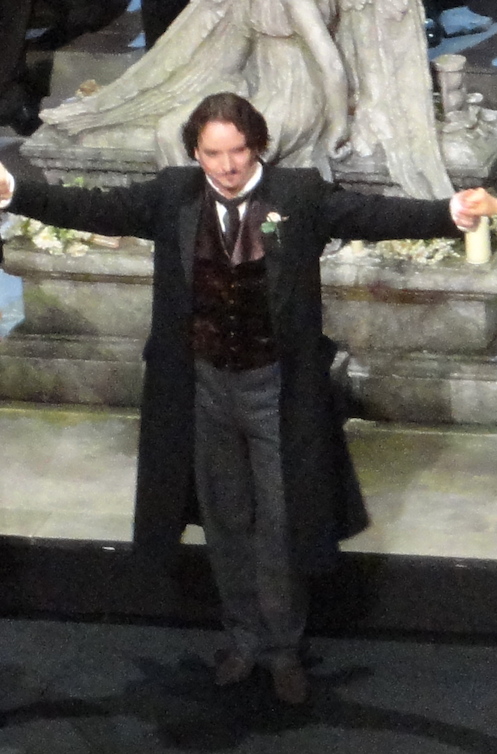
mas o Lescaut foi interpretado ao mais alto nível  pelo barítono polaco Artur Rucinski, o melhor da noite,


e o Conde Des Grieux, também óptimo, pelo baixo sul coreano Kwangchul Youn.


As três”meninas”,  Jacqueline Echols (Poussette),  Laura Krumm (Javotte) e Maya Lahyani (Rosette) cumpriram também sem destoar.


***


MANON, METropolitan Opera, October 2019

The Metropolitan Opera of New York has once again presented Manon by Jules Massenet, an opera based on the novel by Antoine-François Prévost L'Histoire du Chevalier Des Grieux and Manon Lescaut, a novel that also served as the basis for the opera Manon Lescaut by Puccini. This production has been commented on the blog before.

Laurent Pelly's production, simple but effective, brings action to the Belle Époque period, about a century and a half after the novel was written. In the first act the scenery is topped with miniature houses and a staircase that gives access to the central area, without props, where much of the action takes place. In the next scene the simple bedroom of Manon and Des Grieux is also placed at the top of several sections of stairs. In the first part, Manon is a young girl dressed in a very humble and innocent way. In the third act, on the banks of the Seine, the performance resembles a painting by an impressionist painter. Manon appears in the most exuberance (dress, jewelry and posture). In the next scene in Saint Sulpice, perhaps the most remarkable of all the production, is the reunion with Des Grieux, now priest. After an initial rejection, Des Grieux does not resist and reconciliation takes place, laying Manon on his lover's austere bed and undressing his habit. This is followed by the game scene, where there are only tables as objects on stage, with vocal interpretations surpassing the scenic ones, but the glamor remains. Finally, the last scene is a total contrast to the previous ones. Manon, disfigured, is dragged across the floor, kicked and outraged by the guards. Only a few sober street lamps are on stage. She dies in Des Grieux's arms.

The musical direction, without interest, was by conductor Maurizio Benini.
Manon was performed by American soprano Lisette Oropesa, already this year's winner of two music awards. She had a quality interpretation but with few emotion. The voice is agile, pleasant, over the orchestra and of appreciable amplitude. On stage she was always fine.
Des Grieux was interpreted by American tenor Michael Fabiano. It was the best vocal interpretation in which I heard him, because he was constant in vocal emission and always audible. The problem is that the voice has no color, it is "in black and white" and therefore does not convey emotion. He always sings in the same way, whether in moments of joy or in sadness or in anguish. In the duets with Oropesa there was no transmission of any feeling of attraction or passion for Manon, which "killed" the show, which had the worst moment on the scene in Saint Sulpice, (N'est-ce plus ma main).

In supportiny roles Guillot de Morfontaine was played pleasantly by Italian tenor Carlo Bosi, Canadian baritone Brett Polegato played De Brétigni on a regular basis, but Lescaut was interpreted at the highest level by Polish baritone Artur Rucinski, the best of the night, and Count Des Grieux was also great by South Korean bass Kwangchul Youn.
The three 'girls', Jacqueline Echols (Poussette), Laura Krumm (Javotte) and Maya Lahyani (Rosette) were correct in their roles.

***

sábado, 4 de junho de 2016

LUCIA DI LAMMERMOOR, Royal Opera House, Londres, Maio de 2016

(review in English below)

A encenação de Katie Mitchell desta Lucia di Lammermoor coloca a acção na época victoriana, quando emerge o feminismo. Lucia é uma personagem determinada, nada submissa, mas esmagada pelo conservadorismo masculino dominante.
No palco, dividido a meio, vêem-se sempre dois momentos distintos em simultâneo.


No 1º acto é o cemitério com a fonte de um lado e o quarto de Lucia no outro. Lucia veste roupas masculinas para se encontrar com Edgardo e, no encontro, têm relações sexuais (a cena é decente). Os fantasmas (da mãe e da rapariga) aparecem e serão presença frequente em toda a récita. O dueto de amor final entre Lucia e Edgardo termina com o fantasma entre os dois.

No início do 2º acto, Lucia está no quarto mas corre subitamente para vomitar na casa de banho (magníficos os cenários de Vicki Mortimer). Está grávida e partilha o segredo com a dama de companhia Alisa.
Sempre com obstinada negação, reage às ordens do irmão para se casar com Arturo, apesar das cartas forjadas de Edgardo que lhe mostram. O casamento acaba por acontecer, em ambiente festivo, quando Edgardo reaparece.

No 3º acto, quando Arturo entra no leito nupcial onde está Lucia, é assassinado por Alisia que está escondida atrás da cama. As duas mulheres esfaqueiam-no e estrangulam-no, num assassínio premeditado. Na cena paralela há festa, num grande salão de caça com uma mesa de bilhar ao centro.
Na sequência do assassinato de Arturo, Lucia aborta e fica totalmente coberta de sangue na região abdominal e pernas, o que a leva à loucura. A “cena da loucura” é interpretada em cima da mesa de bilhar, onde Lucia, coberta do seu próprio sangue, vê os fantasmas (incluindo o de Edgardo). A ópera termina com a Lucia morta na banheira, a transbordar água e sangue, onde é encontrada por Edgardo, que se degola.


Apesar de nenhum dos cantores solistas ter sido perfeito, sob a direcção musical de Daniel Oren assistiu-se a um espectáculo de grande categoria, independentemente da polémica sobre a encenação. Coro e orquestra ao mais alto nível, com a grande mais valia da harmónica de vidro na cena da loucura.


Aleksandra Kurzak interpretou com grande dignidade o difícil papel de Lucia. Cenicamente esteve ao mais alto nível e vocalmente também foi muito boa, faltando-lhe apenas alguma doçura vocal em certos momentos. A cena da loucura foi marcante, embora tenha sido parca na coloratura, que outras oferecem generosamente.


O tenor Stephen Costello foi um Edgardo de grande categoria, timbre bonito, voz sempre bem audível e afinada. Uma agradável surpresa, depois da última vez que o tinha ouvido, em que ficou muito aquém do desejável.


O melhor da noite foi o Enrico do barítono Artur Rucinski, que não conhecia. Voz poderosíssima, muito bonita e expressiva, sobre o coro e a orquestra. Muito credível em cena, foi fantástico.


O tenor David Junghoon Kim foi um Arturo vocalmente bem, mas a figura do cantor, muito obesa, não ajudou nada nesta encenação e até provocou muitos risos na dramática cena em que é assassinado.


Também muito bem foram o cínico Raimondo de Metthew Rose, com uma grande interpretação vocal, o Normanno de Peter Hoare e a fiel Alisa numa bela interpretação de Rachel Lloyd.


Um espectáculo marcante.


****


Lucia di Lammermoor, Royal Opera House, London, May 2016

Katie Mitchell's staging of this Lucia di Lammermoor places the action in the Victorian era, when feminism was emerging. Lucia is a woman with a character, not submissive, but overwhelmed by the dominant male conservatism. The stage was divided in the middle and we could always see two distinct actions simultaneously.

In the 1st act the cemetery with the fountain is on one side and Lucia’s room on the other. Lucia dresses men's clothing to meet Edgardo and, at the meeting, they have sex (the scene is decent). Ghosts (of her mother and of the girl) appear and are frequently presence throughout the performance. The final love duet between Lucia and Edgardo ends with the girl’s ghost between the two.

At the beginning of the 2nd act, Lucia is on the bed but suddenly runs to vomit in the bathroom (the scenery by Vicki Mortimer is magnificent). She is pregnant and sharing the secret with Alisa. Always obstinate in denial, she reacts to her brother's orders to marry Arturo, despite the forged letters of Edgardo showing to her. The marriage ends up happening in a festive environment when Edgardo reappears.

In the 3rd act, when Arturo enters the bedroom to meet Lucia on the bed, he is murdered by Alisia that is hidden behind the bed. The two women stab him and strangle him in a premeditated murder. In parallel we see a party in a large hall hunting with a pool table in the centre.
Following the murder of Arturo, Lucia has a miscarriage and is completely covered in blood in the abdominal area and legs, which leads her to madness. The "mad scene" is interpreted on the pool table where Lucia, covered with her own blood, sees the ghosts (including Edgardo’s). The opera ends with Lucia dead in the bath overflowing water and blood, which is found by Edgardo, who kills himself.

Regardless of the controversy about the staging and although none of the soloists had a perfect performance, it was a very good night of opera. Musical direction of Daniel Oren was excellent. Choir and orchestra were at the highest level, with great added value of the glass harmonica in the madness scene.

Aleksandra Kurzak played with great dignity the difficult role of Lucia. Scenically she was at the highest level and vocally she was also very good, but lacking some vocal sweetness at times. The scene of madness was remarkable, although she was sparse in some vocal coloratura that others offer generously.

Tenor Stephen Costello was a good class Edgardo, beautiful timbre, audible voice and almost always in tune. It was a pleasant surprise after the last time I had heard hem, when he performed far from the desirable.

The best of the night was baritone Artur Rucinski, whom I did not heard before. Powerful voice, very beautiful and expressive and always over the choir and the orchestra. Very credible on stage, he was fantastic.

Tenor David Junghoon Kim was a vocally acceptable Arturo, but the figure of the singer, very obese, did not help in this staging and even caused some laughter during the dramatic scene in which he is murdered.

Also very good were the cynical Raimondo by Metthew Rose, with a great vocal interpretation, Normanno by Peter Hoare and faithful Alisa, a beautiful interpretation of Rachel Lloyd.

An impressive perfromance.


****