(Review in English below)
Assistimos na Fundação Gulbenkian
à terceira transmissão em directo integrada no ciclo "The Metropolitan
Opera HD". Em cena esteve a ópera "The
Tempest", escrita pelo compositor inglês Thomas Adès (hoje com 41 anos), a partir do libreto de Meredith Oakes, que se baseou na peça
homónima de William Shakespeare, que tem inspirado inúmeras produções
artísticas, entre as quais o poema sinfónico, op. 18, “A Tempestade”, composto
em 1873 por Pyotr Ilyich Tchaikovsky.
Estreada com grande sucesso em 10 de Fevereiro de 2004 na Royal Opera
House, em Londres, esta ópera tem merecido grande aceitação no panorama
internacional, tendo sido estreada em Copenhaga logo em 2005 e nos Estados
Unidos em 2006, e estreando-se no Metropolitan de Nova Iorque na presente
temporada de 2012/2013 com uma espectacular produção do encenador canadiano Robert
Lepage, recentemente recordado a propósito da sua espantosa produção do Ciclo
do Anel de Richard Wagner, igualmente no Metropolitan.
A ópera desenvolve-se em 3 actos. A história, apesar de não manter a
fraseologia de Shakespeare, mantém todos os ingredientes da peça original e foi
excelentemente concebido pela libretista Oakes. Poderão ler uma sinopse, por
exemplo, no programa de sala da FCG.
A encenação a cargo de Robert Lepage
é — indubitavelmente — de uma qualidade excepcional. Começa, aludindo à guerra
de poder da cidade-estado Milão, por nos transportar ao Teatro la Scala como
pano de fundo.
A cena da tempestade é conseguida de forma brilhante com Ariel a
rodopiar no candeeiro que faz o mar revolto e tempestuoso. Aliás, como espírito
que é, Ariel é caracterizada de um modo quase sem forma e que nunca toca o
solo, antes o sobrevoa. A caracterização das personagens é também excelente,
aludindo aos poderes mágicos de personagens como Próspero e Ariel e à negritude
das profundezas da terra de Caliban. Em suma, é uma encenação com enorme
impacto visual, que cumpre inteiramente com o encadeamento da história e que a
desenvolve. Robert Lepage é um dos melhores encenadores da actualidade!

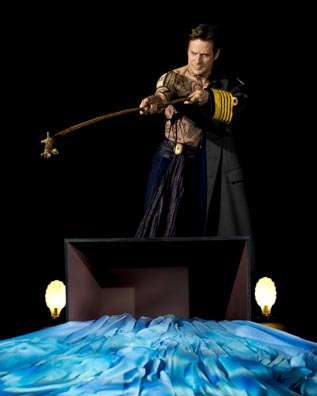
O papel de Própero foi escrito por Adès para o barítono Simon Keenlyside. É um papel de muita
intensidade dramática e quase omnipresente na ópera. Musicalmente é de uma
enorme dificuldade pois exige mudanças de registo vocal e interpretativo quase
constantes. O próprio, quando questionado acerca do seu primeiro contacto com a
partitura, refere que a sua reacção foi “panic!”. Keenlyside foi perfeito! Tem
um timbre muito bonito, uma presença excelente e impositiva (para o que também
contribuiu uma caracterização muito vistosa cheia de tatuagens que
representavam os seus feitiços), desempenhando o “seu” Próspero de forma
imaculada.
Miranda foi o mezzo-soprano americano de
ascendência argentina Isabel Leonard.
Faz parte do par romântico da ópera, tem uma presença física muito adequada ao
papel e interpreta cenicamente muito bem. Vocalmente tem um timbre claro e
melodioso, fraseou com uma boa dicção o seu difícil papel.
Ferdinand foi o tenor Alek Shrader. Fazia o par romântico com Miranda, apresentando uma presença física e expressividade muito adequada a um jovem apaixonado. Apresentou-se vocalmente em bom plano, destacando-se — como o próprio papel exige — no segundo acto.
Audrey
Luna foi o soprano coloratura que desempenhou o papel do espírito Ariel. O
seu papel é de uma dificuldade extrema, uma vez que Adès lhe exige o seu
registo agudo máximo quase constantemente. A sua interpretação foi excelente:
tem um agudo muito bonito, que lhe sai com aparente facilidade e sem o gritar.
Por exemplo, a sua primeira entrada na ópera é com uns agudos arrepiantes a
levar quase à agonia. Cenicamente foi-lhe atribuído um papel muito envolvente e
fisicamente difícil de desempenhar, mas fê-lo optimamente.
O negro Caliban foi o tenor Alan Oke. A sua caracterização era
absolutamente condizente com a personagem. Tem um timbre adequado e cumpriu
muito bem sob todos os pontos de vista.
O baixo-barítono Kevin Burdette foi Stefano, enquanto o contratenor Iestyn Davies foi Trinculo. Ambos cumpriram bem com as demandas cénicas que lhes foram exigidas e estiveram vocalmente em bom plano.
Antonio, o irmão de Próspero, foi interpretado
pelo tenor Toby Spence. Sebastian, o
irmão do Rei de Nápoles, foi o barítono Christopher
Feigum. Apresentaram-se ambos em bom plano, cumprindo bem o seu pouco
extenso papel.
Gonzalo foi o baixo John del Carlo que esteve muito bem. Tem um grave forte e desempenhou
a sua personagem de forma muito convincente.
O tenor William
Burden foi o Rei de Nápoles. Tem um dos papéis mais melodiosos desta ópera
e é uma personagem desesperada pelo sentimento de perda do seu filho e herdeiro
Ferdinand que julga morto após o naufrágio inicial. Gostei muito do seu timbre
vocal e considero que fez uma excelente interpretação do ponto de vista
dramático: expressivo vocal e corporalmente.
A interpretação da obra esteve a cargo do
próprio compositor — Thomas Adès —
que dirigiu, uma vez mais, um coro e orquestra do MET perfeitos. A sua música
soou sublimemente.
Quero deixar uma nota de particular agrado
relativamente a esta The Tempest. A música foi excelentemente concebida: é
dramática, intensa, é capaz de nos levar da agonia à harmonia romântica, releva
a personalidade individual das personagens permitindo a sua evolução cénica,
expõe os sentimentos humanos e não é exibicionista. Adès prova — e deixa-o
claro! — que a música contemporânea tem óptimos valores e que a ópera é um
género vivo! Foi uma das óperas que mais prazer me deu assistir nos últimos
tempos. Um grande Bravo a
Thomas Adès!
----
(Review in English)
We have witnessed the third live transmission
integrated in the cycle "The Metropolitan Opera HD" at Gulbenkian Foundation. On stage was the
opera "The Tempest," written by English composer Thomas Adès (now 41 years old), from the librett by Meredith Oakes, which was based on the
homonymous play by William Shakespeare, which has inspired numerous artistic
productions, among which are, for example, the Symphonic poem, op. 18, The
Tempest, composed in 1873 by Pyotr Ilyich Tchaikovsky.
Premiered with great success on February 10,
2004 at the Royal Opera House in London, this opera has received wide
acceptance in the international scene, having been premiered in Copenhagen in
2005 and soon in the United States in 2006, and it was premiered at the
Metropolitan New York this season of 2012/2013 with a spectacular production of
Canadian director Robert Lepage,
recently recalled the purpose of his astonishing production of Wagner’s Ring
Cycle, also at the Metropolitan.
The opera unfolds in three acts. The story,
though not keep the phraseology of Shakespeare, has all the ingredients of the
original piece and was excellently designed by librettist Oakes. You can read a
synopsis, for example, in the room program of the FCG.
The staging was of Robert Lepage and it was - undoubtedly - of exceptional quality.
Begins, alluding to the war by power of the city-state Milan, carrying us to
Teatro la Scala as a backdrop. The storm scene is brilliantly achieved with Ariel
in a spinning lamp that makes sea be rough and stormy. Incidentally, Ariel, who
is a spirit, is characterized in a way that almost has any body form and never
touches the ground — Ariel flies above the ground every time. The
characterization of the characters is also excellent, alluding to the magical
powers of characters such as Prospero and Ariel and Caliban, as black as the
depths of the earth. In short, it is a stage with enormous visual impact, which
complies fully with the thread of the story and develops it. Robert Lepage is
one of the best directors of our time!
Adès wrote Prospero character to the baritone Simon Keenlyside. It is a role of great
dramatic intensity and almost ubiquitous in opera. Musically it is of huge
difficulty because it requires a change of vocal and interpretive registers
almost constant. Keenlyside, when asked about his first contact impact with the
score, notes that his reaction was "panic." But Keenlyside was
perfect! He has a beautiful timbre, an excellent and compelling presence (to which
also contributed a very eye-catching characterization full of tattoos that
represent his spells), playing "his" Prospero unblemished.
Miranda was the American mezzo-soprano Isabel Leonard. She is part of the
romantic duo of this opera, and she has a very appropriate physical presence to
the role and interprets scenically very well. Vocally she has a clear and
melodious timbre, phrasing with good diction her difficult role.
Audrey
Luna was a coloratura soprano who played the role of the spirit Ariel. Her
role is of extreme difficulty, since Adès requires her higher register almost
constantly. Her performance was excellent: she has a pretty acute, which is of
apparent ease and without screaming. For example, the first entry in the opera
is disturbing with high-pitched notes that almost bring us agony. Scenically she
was given a very engaging role, physically difficult to play, but she did it
optimally.
The black Caliban was the tenor Alan Oke. His characterization was
absolutely consistent with the character. He has a proper timbre and served
very well from all points of view.
Ferdinand was tenor Alek Shrader. He formed the romantic couple with Miranda,
presenting a physical presence and expressiveness well suited to a young man in
love. He introduced himself vocally in good plan, especially - as the role
requires - in the second act.
Antonio, Prospero's brother, was interpreted by
tenor Toby Spence. Sebastian, the
King of Naples’s brother, was the baritone Christopher
Feigum. They both showed themselves in good plan, well fulfilling their
roles not too demanding.
Gonzalo was the bass John del Carlo that was fine. He has a strong bass tone and played his
character very convincingly.
Tenor William
Burden was the King of Naples. He has one of the most melodic roles of this
opera and is a desperate character filled with the sense of loss of his son and
heir Ferdinand who he judges dead after the initial wreck. I really enjoyed his
vocal timbre and I think he did an excellent interpretation of the dramatic
point of view: expressive vocal and bodily.
The bass-baritone Kevin Burdette was Stefano and countertenor Iestyn Davies was Trinculo. They both complied well with the scenic
demands scenic they were required and were vocally in good plan.
It was the composer himself - Thomas Adès - who directed, once again,
a perfect MET chorus and orchestra. His music sounded sublimely.
I want to leave a note on this The Tempest. The music was excellently
conceived: it's dramatic, intense, it is able to lead us from the agony to romantic
harmony, reveals the personality of the individual characters allowing their
scenic evolution, exposes human feelings and is not flamboyant. Adès proof -
and makes it clear! - that contemporary music has great values and that opera
is a genre that is alive! It was one of the operas that gave me more pleasure
to watch lately. A big Bravo to
Thomas Adès!