Como tem sido hábito nas grandes casas de espectáculos, no início interpretou-se o hino da Ucrânia, em solidariedade com o genocídio que o País está a sofrer.
Começou depois o Rigoletto de G. Verdi. A encenação de Oliver Mears começa com uma figuração inspirada no “Martírio de São Mateus” de Caravaggio, um belo efeito visual, mas depois torna-se estática, algo minimalista e muito pouco inovadora.
O Rigoletto do barítono Luca Salsi foi extraordinário. É um verdadeiro barítono verdiano, espécie quase extinta nos dias que correm. Esteve muito bem em palco, a voz é magnífica, ampla, potente e muito expressiva.
Também ao mais alto nível esteve a soprano Rosa Feola. Sempre afinada, timbre bonito, voz cheia e grande expressividade em palco.
Já o tenor Francesco Demuro foi decepcionante. A voz é pequena, tem um timbre excessivamente agudo de que não gosto e canta quase sempre em esforço.
Notáveis foram também o baixo Evgeny Stavinsky como Sparafucile e a mezzo Aigul Akhmetshina como Maddalena. Os cantores secundários não destuaram, Phillip Rhodes (Monterone), Kseniia Nikolaieva (Giovanna) e German Alcantara (Marullo).
Apesar do tenor, um espectáculo de grande qualidade.
****
RIGOLETTO Royal Opera House, March 2022
As has been the custom in the great concert halls, at the beginning the anthem of Ukraine was played, in solidarity with the genocide that the country is suffering.
Then began Rigoletto by G. Verdi. Oliver Mears' staging begins with a figuration inspired by Caravaggio's “Martyrdom of St. Matthew”, a beautiful visual effect, but the staging was static, somewhat minimalist and not very innovative.
Baritone Luca Salsi's Rigoletto was extraordinary. He is a good verdian baritone, a species almost extinct these days. He was very well on stage, his voice is magnificent, wide, powerful and very expressive.
Also at the highest level was soprano Rosa Feola. She was always in tune, beautiful timbre, full voice and great expressiveness on stage.
Tenor Francesco Demuro was disappointing. The voice is small, has an excessively high timbre, which I don't like, and sings more in effort than in softness.
Also notable were bass Evgeny Stavinsky as Sparafucile and mezzo Aigul Akhmetshina as Maddalena. The support singers did not destroy,
Phillip Rhodes (Monterone), Kseniia Nikolaieva (Giovanna) and German Alcantara (Marullo).
Despite the tenor, it was a performance of great quality.
Falstaff de G. Verdi esteve em cena na Staatsoper unter den Linden de Berlim,
numa encenação de Mario Martone.
A ópera foi brutalíssima!!! Uma encenação que lhe chamaria mais “adaptada
aos tempos modernos” do que propriamente “moderna”. Falstaff é um habitante de
bairro social, calça de ganga e t-shirt e a taberna é transformada na rua do
bairro social, com paredes cheias de graffitis, aspecto velho dos prédios... o
contraste da casa de Alice é uma mansão da qual só chegamos a ver o jardim com
uma piscina e relvado. A cena final é no meio de uma espécie de centro
comercial abandonado com duas escadas rolantes em cada lateral.
Após combinar as coisas com Ford, e a passagem deste É sogno? O realtà? Falstaff vem vestido com uma camisa magenta
brilhante, blazer azul e chapéu fazendo parecer um bocado aciganado. A Mrs.
Quickly quando lhe vai dar a informação de que Alice o espera entre as 2 e as
3, sai do cenário numa mota a sério :)
Os pormenores cénicos são fantásticos e os cantores simplesmente magníficos
não só nas vozes mas também como actores altamente credíveis. Tudo pareceu
natural e eficaz, fluente sem excessos ou ausências. Que trabalho espectacular!
Só visto! A concepção da ópera é simplesmente genial. Não é a ária “x” ou a
ária “y” mas sim “o Falstaff” no seu todo. É versão Cavaleiro da Rosa verdiana
:) mas com muito mais piada. Acredito que não deve ter havido nos últimos
tempos encenação tão bem feita para esta ópera.
Dirigiu a
Orquestra Staatskapelle Berlin o
maestro Daniel Baremboim.
Os solistas foram
Michael Volle (Sir John Falstaff),
Simone Piazzola (Ford),
Francesco Demuro (Fenton),
Barbara Frittoli (Mrs. Alice Ford),
Nadine Sierra (Nannetta) e
Daniela Barcellona (Mrs. Quickly).
Todos descomunais e a Orquestra belíssima, com uma celestilialidade nas
passagens em que só temos as cordas, absolutamente arrepiante. A direcção do
Barenboim excelente, pace ideal,
intensidade e precisão irrepreensíveis.
Texto de wagner_fanatic.
FALSTAFF - Staatsoper unter den Linden, Berlin, April 2018
G. Verdi's Falstaff was on stage at
Berlin's Staatsoper unter den Linden,
staged by Mario Martone.
The opera was brutal!!! A staging that I would call it more
"adapted to modern times" than properly "modern". Falstaff
is an inhabitant of a social neighborhood, on jeans and t-shirt, and the tavern
is transformed into the street of the social district, with walls full of
graffiti, the old look of the buildings ... in contrast, Alice's house is a
mansion of which we only got to see the garden with a swimming pool and lawn.
The final scene is in the middle of a kind of abandoned shopping center with
two escalators on each side.
After combining things with Ford, and the passage of this É sogno? O realtà?Falstaff comes dressed in a
bright magenta shirt, blue blazer and hat making him look a bit gypsy. Mrs.
Quickly when gives him the information that Alice is waiting for him between 2
and 3 o’clock, she gets out of the stage on a real motorcycle :)
The scenic details are fantastic and the singers simply magnificent not
only in voices but also as highly credible actors. Everything seemed natural
and effective, fluent without excesses or absences. What a spectacular job!
Just seen! The design of the opera is simply brilliant. It is not the aria
"x" or the aria "y" but "the Falstaff" as a
whole. It is Verdi's version of the Rosencavalier
:) but much more fun. I believe that there should not have been in recent times
such well-done staging for this opera.
The Staatskapelle Berlin
Orchestra was directed by Daniel
Baremboim. The soloists included Michael
Volle (Sir John Falstaff), Simone
Piazzola (Ford), Francesco Demuro
(Fenton), Maria Agresta (Mrs. Alice
Ford), Nadine Sierra (Nannetta) and Daniela Barcellona (Mrs. Quickly).
All of them huge and the Orchestra was beautiful, with a heavenly touch
in the parts where we only have the strings, absolutely chilling. Barenboim's
excellent direction, ideal pace, intensity and precision were impeccable.
Foi quase de
certeza a pior noite de Ópera que eu já tive!!!
Comecemos: O
nosso São Carlos está a cair de podre por dentro, este está a cair de podre por
fora…
O Teatro cheirava a canos no interior da sala.
O público é do pior
que se pode imaginar!!! Pior do que no nosso São Carlos!
Tive uma velha ao
lado sempre a bater o pé com o ritmo da música, a mexer na correia da mala, a
falar uma ou outra vez com a do lado e a cantar / murmurar as árias... mas as
dos homens!
À esquerda um
rapaz até calmo mas que olhou para o telemóvel 5 ou 6 vezes para ver as horas.
Atrás à esquerda
uma tipa com aquelas pulseiras de argolas que chocalham cada vez que se mexe o
braço e que, no primeiro acto, estava quase sempre a falar com a do lado e só se
calaram quando eu as chamei à atenção com o olhar e as mãos!
Mas o melhor foi
uma velha da 2ª fila do outro lado da plateia que esperou o intervalo todo da
mudança de cena do 2º para o 3º acto e justamente quando começa o prelúdio do
3º acto decide desembrulhar durante 30 segundos o seu rebuçadinho... e mais!!!
A Violeta a morrer em palco (mal, mas já lá vamos...) e toca o telemóvel da
mesma velha, com um toque de sininhos de renas de Natal mais uns 20 ou 30 segundos!!!
E a velha atende e começa a falar até um senhor a mandar calar!!! Brutal!!!
Este público bate o nosso da Gulbenkian e São Carlos!!!
Vim pelo Nucci mas nem o Nucci foi brutal... voz
excelente mas a olhar muito para o maestro e, globalmente, transmitindo aquilo
que se sentiu na récita toda: pareceu uma manta de retalhos.
Francesco Demuro (que fez um Fenton muito bom em Berlim na Páscoa)
com expressividade inconstante, voz muito fininha e aparência franzina,
em
contraste com o vozeirão e mulherão que é a Nino Machaidze.
Nino bem mas não
caracterizou a Violeta. No 3º acto caracterização zero. Entra numa cadeira de
rodas antiga, quase sem forças, mas depois mexe-se melhor do que eu. Tem um ar
de que, se tem tuberculose, apanhou o bacilo no máximo há uma semana... nunca
tosse, não dando indícios de que tem tuberculose e depois foi cantar tudo quase
sempre em vozeirão. Quando canta os agudos inclina a cabeça para a direita,
parecendo que tem um torcicolo...
O Nucci nem o Di Provenza repetiu... e este público
não merecia. Só se salvou a
orquestra mas, mesmo assim, talvez por tudo isto não se sentiu o espírito da
Traviata.
Não acho que o
Teatro seja muito parecido com o São Carlos de Lisboa. As cadeiras da plateia,
pelo menos, são mais confortáveis que as do nosso.
A cidade é muito
suja e muito poluída. Ver ópera aqui? Acho que não consigo dar uma segunda
oportunidade...
Texto de wagner_fanatic
LA
TRAVIATA, Teatro di San Carlo, Napoli, May 2018
I came now
from São Carlos Theater, but from this one:
It was
almost certainly the worst opera night I've ever had !!!
Let's
start: Our São Carlos Theater is falling from rotten inside, this one is
falling of rotten outside ...
The public
is the worst imaginable!!! Worse than in our Sao Carlos!
I had an
old woman next to me, always clapping her foot with the rhythm of the music,
fiddling with the belt of the suitcase, talking again and again with the next
one and singing / muttering the arias ... but the men’s arias!
On the left
a boy even calm but who looked at the phone 5 or 6 times to see the time.
Behind on
the left was a woman with those rings that rattle every time she moves her arm
and that in the first act she was almost always talking to the one on the side
and they only fell silent when I called them to the attention with the look and
the hands!
But the
best was an old woman from the 2nd row on the other side of the audience who
waited the entire interval from the scene change from the 2nd to the 3rd act
and just when the prelude to the 3rd act began she decided to unwrap for 30
seconds her little candy ... and more!!! Violetta was to die on stage (badly,
but I will come to it later...) when the same old woman’s cell phone rang, with
a sound of bells of Christmas for another 20 or 30 seconds !!! And the old
woman answered and began to speak on the telephone until a gentleman ordered
her to shut up !!! Brutal!!! This audience beats ours from Gulbenkian and São
Carlos!!!
I came because
of LeoNucci but not even him was brutal ... excellent voice but looking a
lot at the maestro and, overall, conveying what we felt in the whole recital:
it looked like a patchwork of blankets.
Francesco Demuro (who made a very good Fenton in Berlin at
Easter) with fickle expressiveness, very thin voice and slim appearance, in
contrast to the voice and womanhood that is Nino Machaidze.
Nino sang well
but did not characterize Violetta. In the 3rd act zero characterization. She
enters on an old wheelchair, almost without strength, but then she moves better
than I do. She looked as if she has tuberculosis, she got the bacillus at most
a week before... She never coughs, giving no indication that she has
tuberculosis and then went to sing everything almost in a loud voice. When she
sings the top notes she tilts her head to the right, looking like she has a
torticoll ...
Nucci did
not even repeated the aria Di Provenza
... and this public did not deserved it.
The theater
smelled of pipes inside the room. Only the orchestra was ok, but even so,
perhaps for all this the Traviata spirit was not felt.
I do not
think the Theater is much similar to the São Carlos of Lisbon. The audience
seats, at least, are more comfortable than ours.
The city is
very dirty and very polluted. See opera here? I do not think I can give a
second chance...
A última ópera de Verdi foi composta em grande secretismo: Verdi tinha receio de que as agruras da sua idade avançada não lhe permitissem terminar o projecto. Foi congeminada juntamente com Arrigo Boito, o seu libretista de Otello, homem que desafiara Verdi para um último esforço e que tão bem lhe escreveu um texto em torno da personagem shakespeariana Sir John Falstaff, presente nas As Alegres Comadres de Windsor e nas partes I e II de Henrique IV.
A história gira em torno do enorme Falstaff, aristocrata decaído, muito obeso e que vivia dos prazeres da comida e das mulheres. Ele tenta seduzir as damas finas de Windsor e fia-se no seu charme e sebenta posição. Estas, muito alegres e sabidas, aproveitam para o ridicularizar.
A ópera, nem sempre devidamente apreciada por ser um Verdi diferente daquele a que habituara o seu público, é de uma enorme genialidade musical, impactando pelo seu todo. Lá está: o todo não é igual à soma das partes.
Foto: Matthias Baus
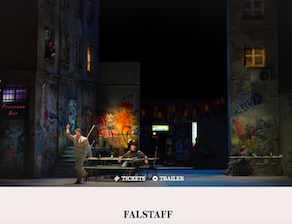
A encenação do realizador de cinema italiano Mario Martone é muito interessante. Passa-se num bairro degradado cheio de graffitis onde Falstaff está sentado nuns bancos num pátio à entrada de um estabelecimento de divertimento noturno — «Panorama Bar» — onde umas profissionais do sexo se exibem à janela. Ao fundo, um portão ao meio do pátio parece revelar uma rua. É neste ambiente escuro e sombrio, que decorre toda a primeira cena. Falstaff está vestido de calças de ganga e t-shirt preta e, a bem da verdade, falta-lhe a gordura imensa. Pistola e Bardolfo vestem-se de forma andrajosa e têm bastante mau aspecto. Aqui há, ao fundo, uns figurantes que com latas de tinta de spray desenham as frases «Welcome refugees» e «No War» em panos brancos colocados no chão: duvido que da plateia fossem legíveis e nunca chegam a ser exibidos, pelo que não se compreende o propósito.
Foto: Matthias Baus
A segunda cena passa-se num elegante jardim com piscina e casa de apoio. Aí, as alegres comadres, vestidas de modo mais requintado, ou apenas de fato de banho ou biquíni e enroladas num robe, congeminam toda a trama contra Falstaff. Fenton namora Nannetta que se exibe em biquíni e o provoca, atirando-o para a piscina.
Na terceira cena, voltamos ao primeiro cenário. Mrs. Quickly aparece de vermelho e de moto retro. Ao despedir-se, sai de moto, ouvindo-se o roncar do motor da moto que é verdadeira.
A quarta cena, retoma o segundo cenário. E os pormenores estão lá todos. Falstaff, vestido de camisa rosa brilhante e de motivos florais e umas botas de cowboy, tenta seduzir Alice, chegando a mostrar-lhe uma tatuagem de muito mau gosto estampado no peito largo que descobrea. Acaba por ser atirado para trás do muro do jardim, ouvindo-se um enorme splash.
Foto: Matthias Baus
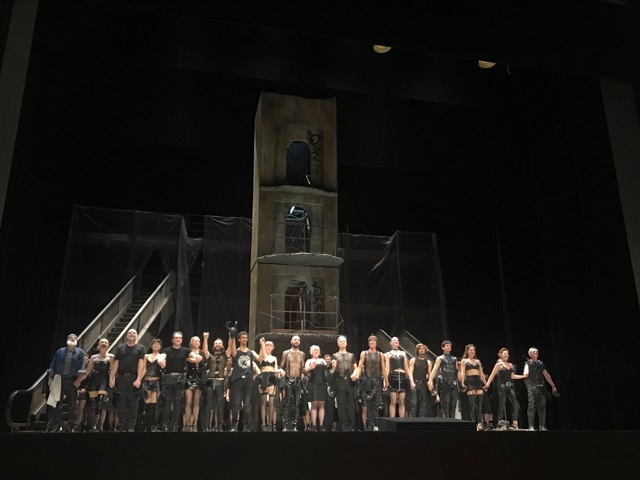
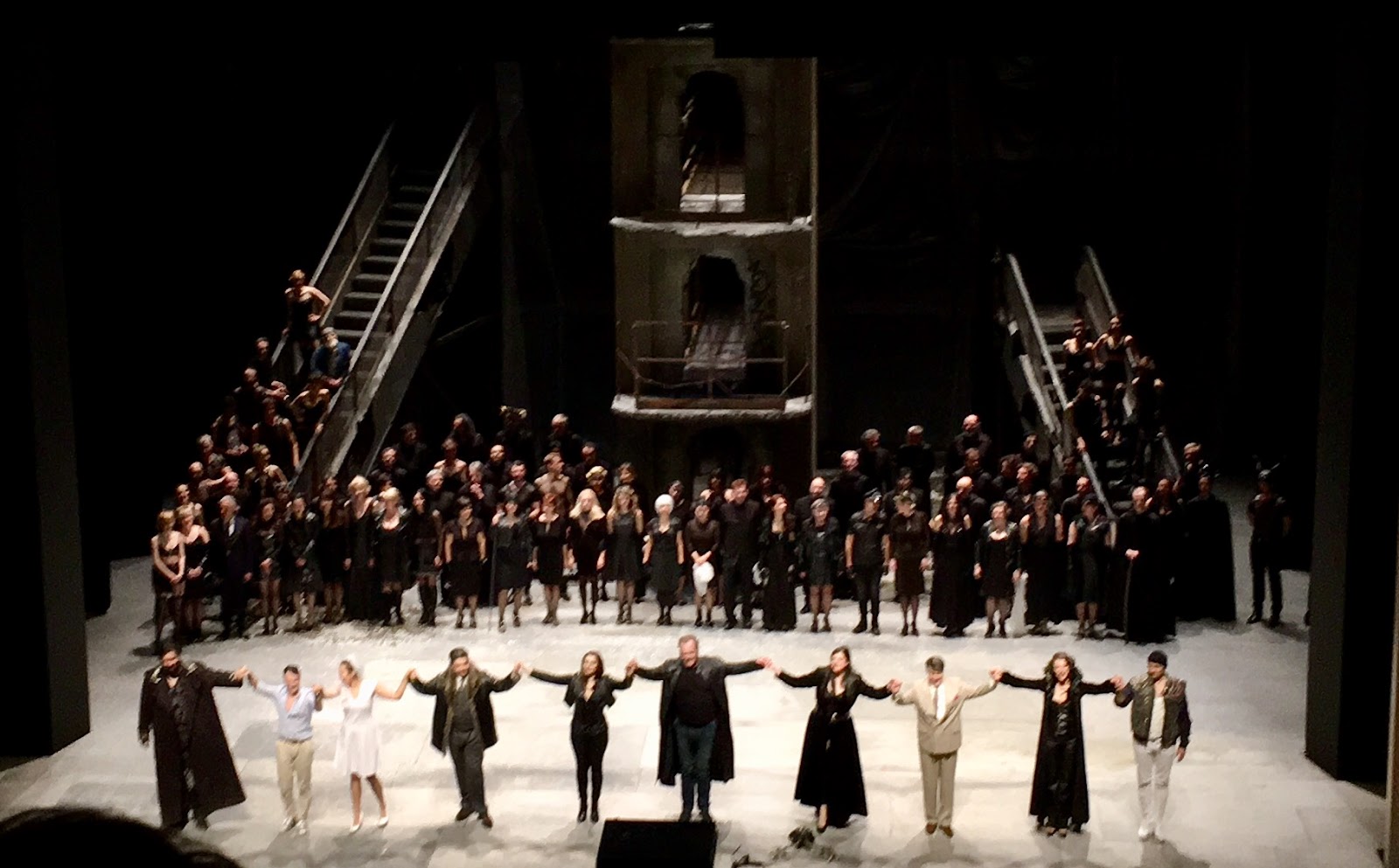
A quinta cena decorre no primeiro cenário, com um Falstaff muito andrajoso e a pedir vinho a um pouco amigável dono do bar. Logo de seguida, passa-se para a última cena: parece um edifício abandonado com escadas nas laterais e um torre no centro com varandas. Muitos figurantes surgem, naquele que é um pormenor distrator e pouco contextualizável no todo da encenação, vestidos de negro e com máscara, simulando atos sexuais, enquanto as personagens expõem ao ridículo Falstaff.
A encenação modernizada foi um dos pontos fortes da récita: é muito dinâmica, facilita a comédia, acompanha muito bem a música e a acção, e é ainda visualmente interessante.
A Staatskapellle Berlin foi muito bem dirigida por Daniel Barenboim.
Os solistas apresentaram uma qualidade global muito homogénea.
Michael Volle foi um Sir John Falstaff imponente na desenvoltura cénica e pela enorme voz que tem. Faltou-lhe a interpretação burlesca que a personagem necessita para ser verdadeiramente cómica, ou o fraseado típico italiano que teriam dado outro colorido a uma, ainda assim, excelente prestação. Destaco a interpretação de Mondo ladro, mondo rubaldo do terceiro acto.
Ford foi o barítono Alfredo Daza que, tendo uma voz bonita e sempre audível, compôs uma personagem credível e cantou bem o seu È sogno o realtà?
Fenton foi o tenor Francesco Demuro que tem uma voz bonita, mas a que me pareceu faltarem os agudos fáceis que se pedem no seu curto papel. Cenicamente foi muito convincente.
O Dr Cajus de Jurgen Sacher, Bardolfo de Stephan Rugamer e Pistola de Jan Martiník estiveram em bom plano, destacando a prestação vocal de Martiník.
Alice Ford foi Barbara Fritolli que compôs uma personagem credível e cenicamente irrepreensível. Vocalmente apresentou-se em bom nível, mas já não tem os agudos cristalinos de outros tempos.
Nadine Sierra como Nannetta foi a melhor das senhoras. A voz é muito bonita e tem os agudos cristalinos que tornam os seus Anzi rinnova come fa la luna perfeitos e elegantes. A sua jovialidade em palco e bonita figura ajudaram a torná-la uma Nannetta perfeita.
Daniella Barcellona, com a sua voz cheia e escura, foi uma excelente Mrs. Quickly, tendo-lhe faltado alguma comicidade para catapultar a sua interpretação para a excelência.
A Meg Page de Katharina Kammerloher esteve em bom nível no seu curto papel.
Assim, globalmente assistimos a uma excelente récita, com destaque para uma encenação de muita qualidade e com nota muito positiva para um conjunto de cantores de qualidade elevada a quem ficou apenas a faltar um pouco mais de capacidade para a comédia.
—————-
(Review in English)
Verdi's last opera was composed in great secrecy: Verdi was afraid that the hardships of his old age would not allow him to finish the project. He worked with Arrigo Boito, his librettist of Otello, a man who had challenged Verdi for one last effort, and who so well wrote a text to him about the Shakespearean character Sir John Falstaff, present in the Merry Wives of Windsor and parts I and II of Henry IV.
The story revolves around the huge Falstaff, a fallen aristocrat, very obese and living off the pleasures of food and women. He tries to seduce high-rank ladies of Windsor being confident that with his beauty and social position will grant him success. The joyful and wise ladies will expose him to ridiculousness.
The opera, not always properly appreciated for being not a typical Verdi opera, is of a great musical genius, impacting for his beauty and when heard as a whole. There it is: the whole is not equal to the sum of the parts.
The staging of the Italian film director Mario Martone is very interesting. The action is set in a dilapidated neighbourhood full of graffitied walls where Falstaff sits on benches in a courtyard at the entrance to a nightlife establishment - Panorama Bar - where sex workers hang out at the window. In the background, a gate in the middle of the courtyard seems to reveal a street. It is in this dark and gloomy environment that the entire first scene takes place. Falstaff is dressed in jeans and black t-shirt and, to be honest, he lacks immense fat. Pistol and Bardolfo dress in a ragged form and look quite bad guys. Here, in the background, there are figurines with cans of spray paint drawing the phrases "Welcome refugees" and "No War" in white cloths placed on the floor: I doubt that the audience would be able to read the statements or even see them, so that I think that it is not understandable.
The second scene takes place in an elegant garden with a swimming pool and house. There, the merry wives, dressed in a fashionable way, or just in bikini and wrapped in a robe, plot against Falstaff. Fenton dates Nannetta who shows up in a bikini and provokes him by throwing him into the pool.
In the third scene, we return to the first scenario. Mrs. Quickly appears in red and retro motorcycle. When they say goodbye, she leaves in her motorcycle, and we listened to the snoring of the real motorcycle she is in.
The fourth scene, resumes the second scenario. And the details are all there. Falstaff, dressed in bright pink shirt with floral motifs and cowboy boots, tries to seduce Alice, even showing him a bad taste tattoo stamped on the wide chest he reveals. At the end, he is thrown behind the garden wall as we listen to a huge splash.
The fifth scene takes place on the first scenario, with a very tattered Falstaff who is asking for wine to a somewhat not so friendly bar owner. Soon afterwards, we are transported to the last scene: it looks like an abandoned building with stairs on the sides and a tower with balconies in the centre. Many characters appear, in a distracting detail of the staging, dressed in black and masked, simulating sexual acts, while the characters expose Falstaff to ridiculous.
The modernized staging was one of the highlights of the recital: it is very dynamic, easily following the music and the action. And it is visually interesting.
The Staatskapellle Berlin was very well directed by Daniel Barenboim.
The soloists singers presented a very homogeneous overall quality.
Michael Volle was an imposing Sir John Falstaff, either scenically an vocally. He failed only on the burlesque aspect of his interpretation to be truly comical, and the typical Italian phrasing. If he managed it better he would have given us a more rich and coloured performance. I emphasize the interpretation of Mondo ladro, mondo rubaldo of the third act.
Ford was the baritone Alfredo Daza who, having a beautiful and always audible voice, composed a credible character and sang well his È sogno o realtà?
Fenton was the tenor Francesco Demuro who has a beautiful voice, but which seemed to lack the easy treble that are asked in his short paper. Cenically he was very convincing.
Jurgen Sacher’s Dr Cajus, Stephan Rugamer’s Bardolfo and Jan Martiník’s Pistol were all in good plan, highlighting the vocal performance of Martiník.
Alice Ford was Barbara Fritolli who composed a credible and radically irreproachable character. Vocally she has presented herself in good level, but she no longer has the crystalline highs of other times.
Nadine Sierra as Nannetta was the best of the ladies. Her voice is very beautiful and has the crystalline trebles that make hers Anzi rinnova come fa la luna perfect and elegant. Her playfulness on stage and beautiful figure helped make her a perfect Nannetta.
Daniella Barcellona, in her full, dark voice, was an excellent Mrs. Quickly, having lacked some comedy abilities to catapult her interpretation into excellence.
Despite her short role, Katharina Kammerloher performed well as Meg Page.
Thus, globally we have seen an excellent performance, with emphasis on a very high quality Martone’s staging and with a very positive note for a group of singers of high quality who just lacked a little more capacity to do comedy.