

(review in English below)
A nova produção do Festival de Bayreuth do ciclo do Anel do Nibelungo de R Wagner foi encenada pelo jovem austríaco Valentin Schwartz. É uma encenação moderna, muito afastada da concepção de Wagner. Apenas assisti ainda à primeira ópera, o Ouro do Reno, que me deixou perplexidade e muitas dúvidas, que espero ver clarificadas com o decorrer do ciclo.
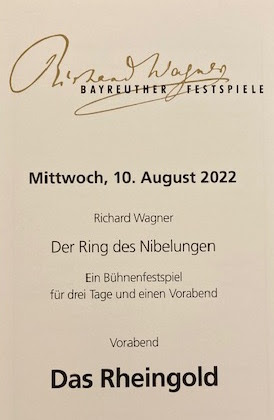
A ópera abre não nas águas do Reno mas com um filme de um liquido amniótico onde dois gémeos em gestação (Wotan e Alberich?) se agridem. A primeira cena passa-se numa pequena piscina onde Alberich é gozado pelas 3 filhas do Reno (empregadas de uma creche?) e por um grupo de 6 meninas loiras. Há uma 7ª criança, um rapaz de cabelos pretos e um boné amarelo e preto, com comportamento agressivo, que não se mistura com as restantes. No final é raptado pelo Alberich. Não há ouro, como não há nenhum dos outros adereços tradicionais da obra.
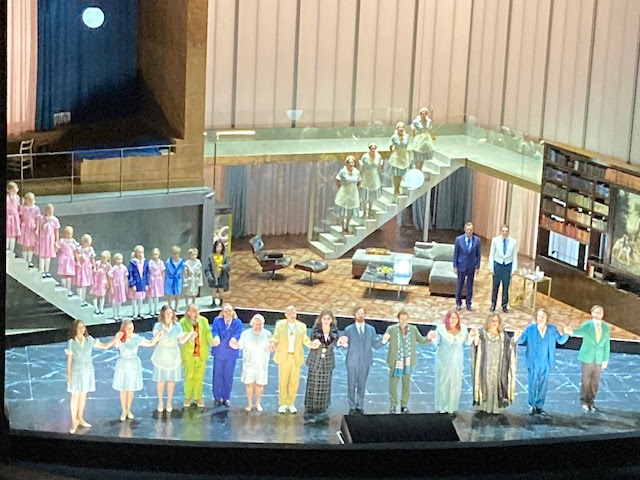
A 2ª e a 4ª cenas passam-se numa sala moderna, na garagem e num quarto anexo. Todos são personagens familiares muito abastados que interagem uns com os outros, há muitos criados e criadas mas não fazem nada. O Wotan é loiro, de calções. O Donner é jogador de golfe. Os gigantes, cabelos pretos, são os ocupantes do carro e parecem 2 mafiosos. É tudo muito estático. Claro que não há fogo nem elmo nem espada, apenas pistolas, muitas.
A 3ª cena é a mais bizarra para mim. O Nibelheim é uma creche envidraçada onde há 8 meninas loiras (serão as Valquírias?) a desenhar umas máscaras vermelhas aladas. São mal tratadas pelo rapaz de boné, que destrói os desenhos e grande parte do cenário, mas que aqui até parece ser filho de Alberich (será o Hagen em criança?). Enfim, muito difícil de entender, aparentemente sobre violência infantil, e qualquer semelhança com o original é mera coincidência. Veremos o que acontece nas próximas óperas...
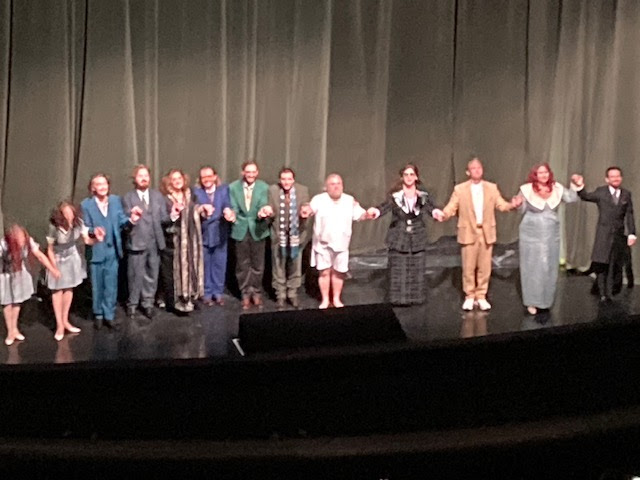
A orquestra excelente e o maestro Cornelius Meister também teve uma direcção muito boa, mas muita gente não gostou. No final foi muito vaiado, no meio dos aplausos.
Os cantores muito bons, como seria de esperar. Admirei especialmente a soprano Elisabeth Teige (Freia) com uma voz brutal e bem timbrada, a mezzo Christa Mayer foi uma Fricka muito correcta e expressiva, e a mezzo Okka von der Damerau (Erda) também se impôs pela qualidade.
O baixo Egils Silins foi um Wotan correcto mas de voz algo desgastada, o barítono Ólafur Sigurdarson foi um Alberich muito expressivo tanto no desempenho cénico (e a sua parte é exigente) como no vocal e o tenor Arnold Bezuyen fez um Mime excelente. O baixo Wilhelm Schwinghammer esteve bem como Fafner, qualitativamente acima do outro gigante, o baixo Jens-Erik Aasbo (Fasolt).
Num patamar inferior esteve o baixo-barítono Raimund Nolte (Donner), o tenor Attilio Glaser (Froh) e, sobretudo, o tenor Daniel Kirch (Loge) que por vezes quase se não ouvia. Finalmente as 3 Filhas do Reno Lea-ann Dunbar (Woglinde), Stephanie Houtzeel (Wellunde) e Katie Stevenson (Flossilde) foram óptimas.

****
DAS RHEINGOLD / THE RHEIN GOLD– Bayreuth Festival, August 2022
The new Bayreuth Festival production of the Ring of the Nibelung cycle was staged by the young Austrian Valentin Schwartz. It is a modern staging, far away from Wagner's conception. I only watched the first opera, Das Rheingold, which left me with perplexity and many doubts, which I hope to see clarified as the cycle progresses.
The opera opens not on the waters of the Rhine but within an amniotic fluid film in which two unborn twins (Wotan and Alberich?) attack each other. The first scene takes place in a small swimming pool where Alberich is teased by 3 daughters of the Rhein (employees at a daycare centre?) and by a group of 6 blonde girls. There is a 7th child, a boy with black hair and a yellow and black cap, with aggressive behavior, which does not mix with the others. In the end he is kidnapped by Alberich. There is no gold, as there are none of the work's other traditional props.
The 2nd and 4th scenes take place in a modern room, in the garage and in an annex bedroom. All are rich familiar characters that interact with each other, there are many maids but they do nothing. Wotan is blond, in shorts. Donner is a golfer. The giants, black hair, are the occupants of the car and look like 2 mobsters. It's all very static. Of course there is no fire or helmet or sword, only pistols, lots of them.
The 3rd scene is the most bizarre for me. The Nibelheim is a glassed-in daycare where there are 8 blonde girls (the Valkyries?) designing winged red masks. They are badly treated by the boy in the cap, who destroys the drawings and a large part of the scenery, but who here even seems to be Alberich's son (Hagen as a child?). Anyway, very difficult to understand, apparently about child violence, and any resemblance to the original is purely coincidental. We'll see what happens in the next operas...
The excellent orchestra and conductor Cornelius Meister also had a very good direction, but a lot of people didn't like it. In the end there was a lot of booing, amidst the applause.
The singers very good, as you would expect. I especially admired the soprano Elisabeth Teige (Freia) with a fabulous and well-timbred voice, mezzo Christa Mayer was a very correct and expressive Fricka, and mezzo Okka von der Damerau (Erda) also stood out for her quality.
Bass Egils Silins was a correct Wotan but with a slightly worn voice, baritone Ólafur Sigurdarson was a very expressive Alberich both in the scenic performance (and his part is demanding) and in the vocal and tenor Arnold Bezuyen was an excellent Mime. Bass Wilhelm Schwinghammer was fine as Fafner, qualitatively above the other giant, bass Jens-Erik Aasbo (Fasolt).
On a lower level of quality were bass-baritone Raimund Nolte (Donner), tenor Attilio Glaser (Froh) and, above all, tenor Daniel Kirch (Loge), who was sometimes barely heard.
Finally the 3 Daughters of the Rhein Lea-ann Dunbar (Woglinde), Stephanie Houtzeel (Wellunde) and Katie Stevenson (Flossilde) were great.
****


