Mostrar mensagens com a etiqueta Aleksandra Kurzak. Mostrar todas as mensagens

quinta-feira, 24 de novembro de 2022

TOSCA, METropolitan OPERA, New York, Outubro / October 2022

(review in English below)

A Tosca de G Puccini voltou a ser posta em cena na Metropolitan Opera de Nova Iorque, na magnífica e sumptuosa produção de David McVicar que, depois da curta e muito má recepção da anterior encenação desta ópera (da autoria de Luc Bondy, muito feia e um perfeito exemplo do eurotrash que, por estes lados, não é nada apreciado) mostrou ser capaz de fazer uma abordagem clássica com a mesma qualidade de outras mais modernas que tem assinado.


Dirigiu a Orquestra (que, surpreendentemente, não esteve isenta de falhas, sobretudo nos metais) o maestro Carlo Rizzi. O Coro foi excelente.


A soprano Aleksandra Kurzak foi uma Tosca magnífica, tanto na representação cénica como vocal. Tem uma voz muito bonita, agudos seguros e não forçados e ouve-se sempre sobre a orquestra. Foi, de longe, a melhor da noite.

O tenor Michael Fabiano cumpriu o papel de Cavaradossi sem grande brilho vocal. Em cena esteve bem, mas a emissão foi por vezes irregular e tem um timbre algo agreste.

O Scarpia do barítono George Gagnidze foi muito ajudado pela encenação mas o cantor foi muito estático, algo monocórdico, pouco emotivo e sempre que a orquestra tocava mais alto, deixava de se ouvir. 

Nos papéis secundários, com interpretações correctas mas sem impressionar, estiveram Kevin Short (Cesare Angelotti), Patrick Carfizzi (Sacristão), Rodell Rosel (Spoletta), Christopher Job (Sciarrone) e Paul Corona (carcereiro). O pastor jovem foi Davida Dayle.


***

TOSCA, METROpolitan OPERA, New York, October / October 2022

G Puccini's Tosca was revived at the Metropolitan Opera in New York, in the magnificent and sumptuous production of David McVicar who, after the short and very bad reception of the previous staging of this opera (by Luc Bondy, very ugly and a perfect example of the eurotrash that, in these geographic areas, is not appreciated at all) has shown to be able to make a classic approach with the same quality as the more modern ones he has signed.

Conductor Carlo Rizzi directed the Orchestra (which, surprisingly, was not without faults, especially in the metals). The Choir was excellent.

Soprano Aleksandra Kurzak was a magnificent Tosca, both on stage and vocal representation. She has a very beautiful voice, steady and unforced highs and we always hear her over the orchestra. She was by far the best of the night.

Tenor Michael Fabiano interpreted the role of Cavaradossi without great vocal brilliance. On stage he was fine, but the singing was sometimes irregular and has a somewhat harsh tone.

Baritone George Gagnidze's Scarpia was greatly helped by the staging, but the singer was very static, somewhat monotonous, not very emotional and whenever the orchestra played louder, he stopped being heard.

In the supporting roles, with correct but unimpressive performances, were Kevin Short (Cesare Angelotti), Patrick Carfizzi (Sacristan), Rodell Rosel (Spoletta), Christopher Job (Sciarrone) and Paul Corona (gaoler). The young sheppard was Davida Dayle.

***

sábado, 9 de julho de 2022

CAVALLERIA RUSTICANA / PAGLIACCI, Royal Opera House, Julho / July 2022

(review in English below)

As operas Cavalleria Rusticana de P Mascagni e Pagliacci de R Leoncavallo estiveram novamente em cena na Royal Opera House de Londres.


 A encenação de Damiano Michieletto é excelente! A acção decorre maioritariamente numa padaria (Cavalleria Rusticana) e no ambiente que a circunda, e num salão de festas (Pagliacci), numa Itália rural e atrasada da segunda metade do século passado. Em cada uma das óperas há uma ligação cénica clara à outra, um aspecto muito bem conseguido. Na Cavalleria Rusticana, o empregado mais novo da padaria é o Silvio da ópera Paglacci e nesta, no interlúdio, aparece a Santuzza a comunicar, por gestos, que está grávida, à mãe do Turiddu.

O palco rotativo mostra vários componentes dos cenários, tudo o que se passa na padaria é de excelente efeito cénico mas o momento mais conseguido é a recriminação da Santuzza pela imagem da Santa durante a procissão.

A direcção musical, excelente, foi do maestro titular Antonio Pappano e a orquestra esteve em grande forma.


Em relação aos cantores solistas, houve 3 cancelamentos “major”: Anita Rachvelishvili, Ermonela Jaho e Jonas Kaufmann. Num naipe de excelentes cantores, a que mais se destacou foi Aleksandra Kurzak que interpretou a Santuzza e a Nedda. Foi óptima em todos os aspectos, voz grande, bonita, colorida e expressiva, associada a interpretações cénicas fantásticas. Excelente! Melhor seria impossível.


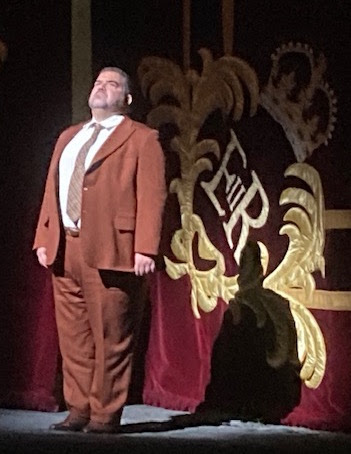
O barítono Dimitri Platanias também cantou nas 2 óperas. Foi Alfio e Tonio. Outro cantor muito bom, com um registo vocal médio assinalável. Interpretação correcta em cena, mas menos dinâmica que os restantes.


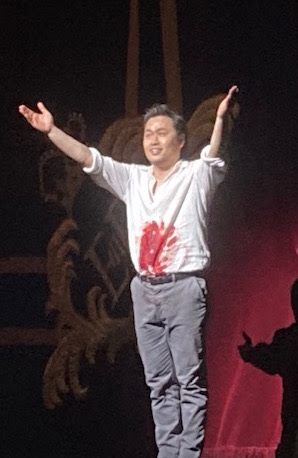
O tenor Seokjong Baek foi um intérprete superior do Turiddu, sobretudo estando a substituir o Kaufmann. Voz potente, de timbre bonito e sempre afinada. Dificilmente teríamos uma melhor interpretação vocal.

Elena Zilio repetiu a Mamma Lucia com a qualidade que já tínhamos apreciado quando vimos esta produção a primeira vez na ROH.

O Canio de Roberto Alagna, outra substituição do Kaufmann, foi bom. O cantor denota já algum desgaste vocal mas proporcionou-nos uma interpretação marcante num conjunto homogéneo de cantores de topo.

Deixo para o fim os cantores mais jovens que foram fantásticos! A Aigul Akhmetshina como Lola, o Egor Zhuravskii como Beppe, e, sobretudo, o Mattia Olivieri como Silvio.


Um espectáculo fantástico!


*****


CAVALLERIA RUSTICANA / PAGLIACCI, Royal Opera House, July 2022


The operas Cavalleria Rusticana by P Mascagni and Pagliacci by R Leoncavallo were once again on the scene at the Royal Opera House, London.

Damiano Michieletto's staging is excellent! The action takes place mainly in a bakery (Cavalleria Rusticana) and in the environment that surrounds it, and in a ballroom (Pagliacci), in rural and backward Italy in the second half of the last century. In each of the operas there is a clear scenic connection to the other, an aspect very well achieved. At Cavalleria Rusticana, the bakery's youngest employee is Silvio from the opera Paglacci and in this, in the interlude, Santuzza appears to communicate, by gestures, that she is pregnant, to Turiddu's mother. The rotating stage shows various components of the scenarios, everything that takes place in the bakery has an excellent scenic effect, but the most successful moment is Santuzza's recrimination for the image of the Saint during the procession.

The musical direction, excellent, was by the principal conductor Antonio Pappano and the orchestra was great.

Regarding soloist singers, there were 3 major cancellations: Anita Rachvelishvili, Ermonela Jaho and Jonas Kaufmann. In a group of excellent singers, the one who stood out the most was Aleksandra Kurzak who interpreted Santuzza and Nedda. She was great in all aspects, great, beautiful, colorful and expressive voice, associated with fantastic scenic interpretations. Fantastic! Better would be impossible.

Baritone Dimitri Platanias also sang in both operas. He was Alfio and Tonio. Another very good singer, with a remarkable vocal register. Correct interpretation on stage, but less dynamic than the others.

Tenor Seokjong Baek was a superior interpreter of Turiddu, especially as he replaced Kaufmann. Powerful voice, with a beautiful timbre and always in tune. We would hardly have a better vocal interpretation.

Elena Zilio repeated Mamma Lucia with the quality that we had already appreciated when we saw this production for the first time at ROH.

Roberto Alagna's Canio, another replacement for Kaufmann, was good. The singer already shows some vocal wear, but he provided us with a good interpretation in a homogeneous group of top singers.

I'll keep the younger singers who were fantastic for last! Aigul Akhmetshina as Lola, Egor Zhuravskii as Beppe, and, above all, Mattia Olivieri as Silvio.

A fantastic performance!

*****

terça-feira, 14 de agosto de 2018

TURANDOT, Staatsoper, Viena, Abril de 2018 / April 2018


 (review in English below)

Assistimos a uma encenação muito fora do habitual da Turandot, a última ópera (inacabada) de Puccini. O encenador Marco Arturo Marelli coloca a acção no início do século passado e retrata a elaboração da opera pelo próprio Puccini que é o Calaf. A ópera abre no seu quarto onde, ao piano, trabalha na composição. O palco modifica-se e transforma-se num teatro onde o coro são os espectadores sentados em frente ao público e a acção passa-se ao centro. O cenário vai mudando ao longo da ópera mas o quarto do compositor e o palco do teatro vão aparecendo periodicamente.
A China e os chineses são retratados com descrição, sem a exuberância habitual de outras encenações, mas não deixou de ser um espectáculo muito interessante e vistoso.


A Liu é uma criada do Calaf / Puccini e o imperador Altoum vem de cadeira de rodas. Depois de decapitado o príncipe da Pérsia, a sua cabeça fica em palco e, no início do 2º acto, os ministros Ping, Pang e Pong preparam-na dentro de um recipiente de vidro e colocam-na numa colecção de todas as cabeças dos pretendentes da Turandot decapitados anteriormente. Quando começa a cantar, a Turandot, vestida sem grande exuberância, vem acompanhada do corpo embalsamado da antecessora Lo-u-Ling e retira-lhe a tiara e usa-a.
Perto do final, quando se pretende descobrir o nome do Calaf, aparecem prostitutas a tentar obter dele a informação, toda o seu quarto é minuciosamente revistado e algumas folhas da partitura são rasgadas.
A ópera termina com o casamento do Calaf com a Turandot, estando todas as mulheres do coro / plateia com véu e os homens com fraque e cartola.


A direcção musical foi do maestro Frédéric Chaslin e Orquestra e Coro da Staatsoper de Viena tiveram prestações excelentes.

O Calaf foi cantado pelo tenor Roberto Alagna. É um personagem que, actualmente, interpreta frequentemente e quer a voz quer o seu desempenho cénico são bastante bons. Ouviu-se sempre bem e só não gostei de se ter feito aos aplausos no final da ária Nessun dorma, com a conivência do maestro, que parou a música.


A Liú da sua mulher Aleksandra Kurzak é excelente, foi a melhor da noite, tem uma voz de timbre muito agradável, agudos bonitos e estratosféricos e assinalável doçura.


Outra cantora que praticamente só canta este papel é a soprano Lise Lindstrom como Turandot. A voz tem um registo agudo impressionante, sempre sobre a orquestra, é o que mais a caracteriza, embora perca alguma qualidade nos registos médio e baixo.


Ping foi soberbamente interpretado por Boaz Daniel (um luxo vienense ter um cantor desta categoria num papel secundário), Pang (Jinxu Xiahou) e Pong (Leonardo Navarro) estiveram também bem.


Paolo Rumetz foi um mandarim apagado, Wolfram Igor Derntl um Altoum decente


 e Ryan Speedo Green um óptimo Timur de voz grande e belo timbre.


****


TURANDOT, Wiener Staatsoper, April 2018

We saw a very unusual staging of Turandot, Puccini's last (unfinished) opera. The director Marco Arturo Marelli puts the action in the beginning of the last century and portrays the elaboration of the opera by Puccini himself that is Calaf. The opera opens in his room where, at the piano, he works in the opera. The stage changes and becomes a theater where the choir are the audience seated in front of the public and the action happens in the centre. The setting is changing throughout the opera but the composer's room and the stage of the theater appear periodically.
China and the Chinese are portrayed with description, without the usual exuberance of other scenarios, but it was a very interesting and pleasant performance.

Liu is a maid of Calaf / Puccini and Emperor Altoum appears on a wheelchair. After beheaded the prince of Persia, his head is on stage and, at the beginning of the second act, the ministers Ping, Pang and Pong prepare it in a glass container and put it in a collection of all the heads of princes beheaded previously by Turandot. When Turandot begins to sing she is dressed in no great exuberance, and arrives with the embalmed body of her predecessor Lo-u-Ling, and removes her tiara and uses it.
Near the end, when everyone try to discover the name of Calaf, prostitutes appear to try to get information from him, his entire room is thoroughly searched and some sheets of the score are torn.
The opera ends with the marriage of the Calaf and Turandot, all the women in the choir / audience being veiled, and the men in a formal coat.

The musical direction was by the conductor Frédéric Chaslin and Orchestra and Choir of the Vienna Staatsoper had excellent performances.

Calaf was sung by tenor Roberto Alagna. It is a character he often plays in the actuality and both the voice and his scenic performance are quite good. He was always well heard and I just did not like his demand of the applause at the end of the aria Nessun dorma, with the connivance of the maestro, who stopped the music.

His wife Aleksandra Kurzak was an excellent Liu. shewas the best of the night, has a very beautiful timbre, impressive top notes and remarkable sweetness.

Another singer who practically only sings this role is soprano Lise Lindstrom as Turandot. The voice has an impressive high record, always over the orchestra, which is her main characteristic, although she loses some quality in the medium and low registers.

Ping was superbly interpreted by Boaz Daniel (a Viennese luxury to have a singer of this category in a secondary role), Pang (Jinxu Xiahou) and Pong (Leonardo Navarro) were also well.

Paolo Rumetz was an discrete mandarin, Wolfram Igor Derntl a decent Altoum and Ryan Speedo Green a great Timur with a big voice and beautiful timbre.

****

domingo, 22 de abril de 2018

Roberto Alagna e Aleksandra Kurzak, Viena, Abril / April 2018


Para os admiradores vão algumas fotografias do casal Alagna & Kurzak que, depois de uma bela récita da Turandot em Viena, se dispuseram a falar com admiradores e a autografar programas e fotografias na stage door da Wiener Staatsoper.


For the admirers here are some photographs of the couple Alagna & Kurzak who, after a great performance of the Turandot in Vienna, were willing to talk to admirers and autograph programs and photographs at the stage door of the Wiener Staatsoper.