Mostrar mensagens com a etiqueta Daniel Barenboim. Mostrar todas as mensagens

quarta-feira, 25 de abril de 2018

FALSTAFF de Giuseppe Verdi no FESTTAGE da Staatsoper Unter den Linden, Berlim, 1.04.2018


(review in English below)

A última ópera de Verdi foi composta em grande secretismo: Verdi tinha receio de que as agruras da sua idade avançada não lhe permitissem terminar o projecto. Foi congeminada juntamente com Arrigo Boito, o seu libretista de Otello, homem que desafiara Verdi para um último esforço e que tão bem lhe escreveu um texto em torno da personagem shakespeariana Sir John Falstaff, presente nas As Alegres Comadres de Windsor e nas partes I e II de Henrique IV.

A história gira em torno do enorme Falstaff, aristocrata decaído, muito obeso e que vivia dos prazeres da comida e das mulheres. Ele tenta seduzir as damas finas de Windsor e fia-se no seu charme e sebenta posição. Estas, muito alegres e sabidas, aproveitam para o ridicularizar.

A ópera, nem sempre devidamente apreciada por ser um Verdi diferente daquele a que habituara o seu público, é de uma enorme genialidade musical, impactando pelo seu todo. Lá está: o todo não é igual à soma das partes.

Foto: Matthias Baus

A encenação do realizador de cinema italiano Mario Martone é muito interessante. Passa-se num bairro degradado cheio de graffitis onde Falstaff está sentado nuns bancos num pátio à entrada de um estabelecimento de divertimento noturno — «Panorama Bar» — onde umas profissionais do sexo se exibem à janela. Ao fundo, um portão ao meio do pátio parece revelar uma rua. É neste ambiente escuro e sombrio, que decorre toda a primeira cena. Falstaff está vestido de calças de ganga e t-shirt preta e, a bem da verdade, falta-lhe a gordura imensa. Pistola e Bardolfo vestem-se de forma andrajosa e têm bastante mau aspecto. Aqui há, ao fundo, uns figurantes que com latas de tinta de spray desenham as frases «Welcome refugees» e «No War» em panos brancos colocados no chão: duvido que da plateia fossem legíveis e nunca chegam a ser exibidos, pelo que não se compreende o propósito.

Foto: Matthias Baus

A segunda cena passa-se num elegante jardim com piscina e casa de apoio. Aí, as alegres comadres, vestidas de modo mais requintado, ou apenas de fato de banho ou biquíni e enroladas num robe, congeminam toda a trama contra Falstaff. Fenton namora Nannetta que se exibe em biquíni e o provoca, atirando-o para a piscina.

Na terceira cena, voltamos ao primeiro cenário. Mrs. Quickly aparece de vermelho e de moto retro. Ao despedir-se, sai de moto, ouvindo-se o roncar do motor da moto que é verdadeira.

A quarta cena, retoma o segundo cenário. E os pormenores estão lá todos. Falstaff, vestido de camisa rosa brilhante e de motivos florais e umas botas de cowboy, tenta seduzir Alice, chegando a mostrar-lhe uma tatuagem de muito mau gosto estampado no peito largo que descobrea. Acaba por ser atirado para trás do muro do jardim, ouvindo-se um enorme splash.

Foto: Matthias Baus

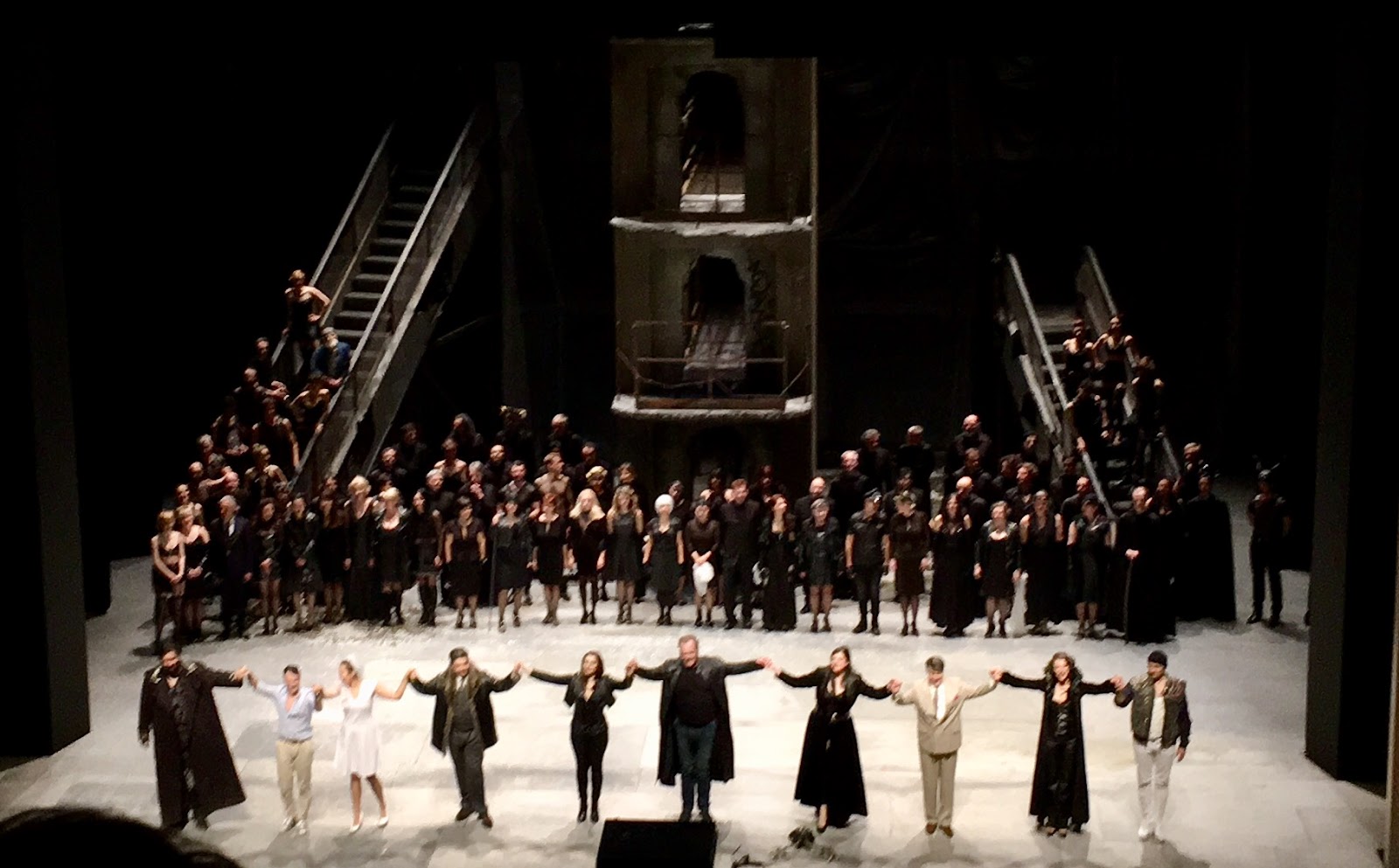
A quinta cena decorre no primeiro cenário, com um Falstaff muito andrajoso e a pedir vinho a um pouco amigável dono do bar. Logo de seguida, passa-se para a última cena: parece um edifício abandonado com escadas nas laterais e um torre no centro com varandas. Muitos figurantes surgem, naquele que é um pormenor distrator e pouco contextualizável no todo da encenação, vestidos de negro e com máscara, simulando atos sexuais, enquanto as personagens expõem ao ridículo Falstaff. 

A encenação modernizada foi um dos pontos fortes da récita: é muito dinâmica, facilita a comédia, acompanha muito bem a música e a acção, e é ainda visualmente interessante.


A Staatskapellle Berlin foi muito bem dirigida por Daniel Barenboim.

Os solistas apresentaram uma qualidade global muito homogénea.

Michael Volle foi um Sir John Falstaff imponente na desenvoltura cénica e pela enorme voz que tem. Faltou-lhe a interpretação burlesca que a personagem necessita para ser verdadeiramente cómica, ou o fraseado típico italiano que teriam dado outro colorido a uma, ainda assim, excelente prestação. Destaco a interpretação de Mondo ladro, mondo rubaldo do terceiro acto.

Ford foi o barítono Alfredo Daza que, tendo uma voz bonita e sempre audível, compôs uma personagem credível e cantou bem o seu È sogno o realtà?

Fenton foi o tenor Francesco Demuro que tem uma voz bonita, mas a que me pareceu faltarem os agudos fáceis que se pedem no seu curto papel. Cenicamente foi muito convincente.

O Dr Cajus de Jurgen Sacher, Bardolfo de Stephan Rugamer e Pistola de Jan Martiník estiveram em bom plano, destacando a prestação vocal de Martiník. 

Alice Ford foi Barbara Fritolli que compôs uma personagem credível e cenicamente irrepreensível. Vocalmente apresentou-se em bom nível, mas já não tem os agudos cristalinos de outros tempos.

Nadine Sierra como Nannetta foi a melhor das senhoras. A voz é muito bonita e tem os agudos cristalinos que tornam os seus Anzi rinnova come fa la luna perfeitos e elegantes. A sua jovialidade em palco e bonita figura ajudaram a torná-la uma Nannetta perfeita.

Daniella Barcellona, com a sua voz cheia e escura, foi uma excelente Mrs. Quickly, tendo-lhe faltado alguma comicidade para catapultar a sua interpretação para a excelência.

A Meg Page de Katharina Kammerloher esteve em bom nível no seu curto papel.


Assim, globalmente assistimos a uma excelente récita, com destaque para uma encenação de muita qualidade e com nota muito positiva para um conjunto de cantores de qualidade elevada a quem ficou apenas a faltar um pouco mais de capacidade para a comédia.

—————-
(Review in English)

Verdi's last opera was composed in great secrecy: Verdi was afraid that the hardships of his old age would not allow him to finish the project. He worked with Arrigo Boito, his librettist of Otello, a man who had challenged Verdi for one last effort, and who so well wrote a text to him about the Shakespearean character Sir John Falstaff, present in the Merry Wives of Windsor and parts I and II of Henry IV.

The story revolves around the huge Falstaff, a fallen aristocrat, very obese and living off the pleasures of food and women. He tries to seduce high-rank ladies of Windsor being confident that with his beauty and social position will grant him success. The joyful and wise ladies will expose him to ridiculousness.

The opera, not always properly appreciated for being not a typical Verdi opera, is of a great musical genius, impacting for his beauty and when heard as a whole. There it is: the whole is not equal to the sum of the parts.

The staging of the Italian film director Mario Martone is very interesting. The action is set in a dilapidated neighbourhood full of graffitied walls where Falstaff sits on benches in a courtyard at the entrance to a nightlife establishment - Panorama Bar - where sex workers hang out at the window. In the background, a gate in the middle of the courtyard seems to reveal a street. It is in this dark and gloomy environment that the entire first scene takes place. Falstaff is dressed in jeans and black t-shirt and, to be honest, he lacks immense fat. Pistol and Bardolfo dress in a ragged form and look quite bad guys. Here, in the background, there are figurines with cans of spray paint drawing the phrases "Welcome refugees" and "No War" in white cloths placed on the floor: I doubt that the audience would be able to read the statements or even see them, so that I think that it is not understandable.

The second scene takes place in an elegant garden with a swimming pool and house. There, the merry wives, dressed in a fashionable way, or just in bikini and wrapped in a robe, plot against Falstaff. Fenton dates Nannetta who shows up in a bikini and provokes him by throwing him into the pool.

In the third scene, we return to the first scenario. Mrs. Quickly appears in red and retro motorcycle. When they say goodbye, she leaves in her motorcycle, and we listened to the snoring of the real motorcycle she is in.

The fourth scene, resumes the second scenario. And the details are all there. Falstaff, dressed in bright pink shirt with floral motifs and cowboy boots, tries to seduce Alice, even showing him a bad taste tattoo stamped on the wide chest he reveals. At the end, he is thrown behind the garden wall as we listen to a huge splash.

The fifth scene takes place on the first scenario, with a very tattered Falstaff who is asking for wine to a somewhat not so friendly bar owner. Soon afterwards, we are transported to the last scene: it looks like an abandoned building with stairs on the sides and a tower with balconies in the centre. Many characters appear, in a distracting detail of the staging, dressed in black and masked, simulating sexual acts, while the characters expose Falstaff to ridiculous.

The modernized staging was one of the highlights of the recital: it is very dynamic, easily  following the music and the action. And it is visually interesting.

The Staatskapellle Berlin was very well directed by Daniel Barenboim.

The soloists singers presented a very homogeneous overall quality.

Michael Volle was an imposing Sir John Falstaff, either scenically an vocally. He failed only on the  burlesque aspect of his interpretation to be truly comical, and the typical Italian phrasing. If he managed it better he would have given us a more rich and coloured performance. I emphasize the interpretation of Mondo ladro, mondo rubaldo of the third act.

Ford was the baritone Alfredo Daza who, having a beautiful and always audible voice, composed a credible character and sang well his È sogno o realtà?

Fenton was the tenor Francesco Demuro who has a beautiful voice, but which seemed to lack the easy treble that are asked in his short paper. Cenically he was very convincing.

Jurgen Sacher’s Dr Cajus, Stephan Rugamer’s Bardolfo and Jan Martiník’s Pistol were all in good plan, highlighting the vocal performance of Martiník.

Alice Ford was Barbara Fritolli who composed a credible and radically irreproachable character. Vocally she has presented herself in good level, but she no longer has the crystalline highs of other times.

Nadine Sierra as Nannetta was the best of the ladies. Her voice is very beautiful and has the crystalline trebles that make hers Anzi rinnova come fa la luna perfect and elegant. Her playfulness on stage and beautiful figure helped make her a perfect Nannetta.

Daniella Barcellona, ​​in her full, dark voice, was an excellent Mrs. Quickly, having lacked some comedy abilities to catapult her interpretation into excellence.

Despite her short role, Katharina Kammerloher performed well as Meg Page.


Thus, globally we have seen an excellent performance, with emphasis on a very high quality Martone’s staging and with a very positive note for a group of singers of high quality who just lacked a little more capacity to do comedy.

quarta-feira, 27 de abril de 2016

“PARSIFAL”, Staatsoper unter den Linden no Schiller Theater, Berlim, Março 25, 2016/ March 25, 2016

Capa do Programa : Cavaleiros do Graal e Escudeiros. Foto: Ruth Walz (17 de Março de 2015), distribuído 2016.

(English version below)

Autor: De Moura MC, Lisboa

O “Fanáticos da Ópera” agradece a De Moura MC mais um texto de qualidade superlativa que muito enriquece o blogue e os seus leitores.

Assisti ao PARSIFAL no Schiller Theater, em 25 de Março de 2016. Parsifal, “uma peça de festival para a consagração de um palco “ (“ein Bühnenweihfestspiel “) como intitulado por Wagner, foi criada para o seu teatro de Bayreuth onde estreou em 26  Julho de 1882. É a ultima opera de Wagner. Sabe-se que Wagner encontrou a história de Parsifal (Parzivâl) num poema épico de Wolfram von Eschenbach, do século XIII, que leu em 1845. A opera teve uma longa gestação, Wagner estudou outros textos medievais e a “Estoire du Graal” de  Chréthien de Troyes. Em 1877 completa a versão final. Praticamente todos os aspectos da opera tem sido objecto de controvérsia. Para uns uma obra sublime,  essencialmente religiosa, para outros uma opera sacrílega, de erotismo religioso. Ainda hoje Parsifal é apresentada em teatros de opera de todo o mundo como um evento incluído na Páscoa. Como este Parsifal que vi na Sexta-Feira Santa integrado no Berlin Festtage 2016.

A acção decorre no que parece ser uma região remota no norte da Espanha num tempo medieval, ou talvez mítico. Aqui se encontra o Castelo de Montsalvat onde vivem os Cavaleiros do Graal. Amfortas é o guardião dos Cavaleiros mas está tão abalado pelos seus pecados e as suas limitações espirituais, que se considera indigno de celebrar o culto do Graal. Os Cavaleiros desiludidos transportam Amfortas para o tratamento de uma ferida que não cura. Parsifal, um jovem ignorante de tudo (nem sabe o nome), chega ao reino do Graal. O que sabe desta comunidade   conta-lhe um Cavaleiro mais idoso, Gurnemanz, que suspeita que ele pode ser o “tolo inocente” da profecia , o que vai aprender a compaixão, ser capaz de curar Amfortas e salvar a comunidade.


Palco do Teatro Schiller, Berlim, antes do início da opera Parsifal , Março 25, 2016

Wagner introduz na história uma personagem crucial. Kundry é uma mulher intemporal e amaldiçoada, corresponde  ao arquétipo feminino do “Judeu Errante“. Perpetuamente atormentada consigo própria Kundry viaja entre dois mundos e muitas vidas. Vive nos arredores do Castelo, serve os Cavaleiros com humildade, leva mensagens aos cruzados distantes, e regressa com balsamos para curar a ferida de Amfortas. Kundry anseia pela redenção e libertar-se de uma maldição passada pela morte. Desaparece regularmente e entra nos domínios do mágico Klingsor que a utiliza como escrava  sexual:  seduzir os Cavaleiros do Graal que se desviam no seu território. Amfortas não resistiu à beleza de Kundry. Klingsor tirou-lhe a lança sagrada e provocou a ferida que não fecha. Nenhum tratamento pode curar Amfortas, mas uma visão anuncia a chegada de um tolo, ignorante e de muita compaixão. Todos esperam o redentor...

Podem ler uma extensa sinopse em língua portuguesa, bem como o libreto traduzido, num link incluído pelo “Fanático Um” numa  recente critica de Parsifal. 
  

Mattias Hölle (Titurel), Wolfgang Koch ( Amfortas ) Foto: Ruth Walz, cena do final do I Acto.

Gostei imenso da encenação do russo Dmitri Tcherniakov, que levanta varias questões na interpretação do drama musical sem pretender apresentar soluções definitivas. A sua visão de um culto fechado sobre si mesmo, destinado a repetir os seus rituais com uma intensidade doentia, é irresistível e inquietante. Na concepção de Tcherniakov estamos perante uma comunidade de teologia Cristã que se desencaminhou. No presente, num local incerto, talvez na Rússia. A comunidade continua a querer acreditar ou pelo menos comporta-se como se ainda acredite. Um mundo de homens russos “santos”,  semelhantes aos Crentes Velhos da opera “Khovanshchina”. Amfortas identifica-se mais com a figura de Cristo, do que em outras das produções que vi. Perturbador, na cena final do acto I, vemos não só a ferida de Amfortas a sangrar mas também uma certa forma de transubstanciação reversa do seu próprio sangue. O sangue é retirado e misturado com água (?) no cálice e depois distribuído pelos membros que ficam revigorados.  Ainda mais intrigante, esta cerimónia é dirigida pelo Rei Titurel, um ditador sinistro. Os membros da comunidade querem de forma desesperada que Titurel os toque. É chocante a forma como Amfortas é ignorado pelos companheiros depois da cerimónia violenta. Parsifal, jovem ignorante, de mochila ás costas,  não entende nada do que vê e Gurnemanz expulsa-o.  


Andreas Schager ( Parsifal) , Tómas Tómasson ( Klingsor), ao fundo as Meninas Flor. Violenta morte de Klingsor. II Acto. Opera Critic  Internet)

O segundo acto, no mesmo cenário do I Acto, bem iluminado, de  cores claras e certa aura de mistério, apresenta um culto paralelo. Tcherniakov vai explorar a sexualidade, principalmente as tendências pedófilas da sociedade actual. O mágico Klingsor, construiu um refúgio para si, um mundo feminino, onde vive com as suas inúmeras filhas, as Meninas Flores. As Meninas Flores não são as tentadoras habituais, mas um grupo de raparigas, todas de vestidos floridos; o efeito é arrepiante. Um velho, repugnante e nervoso, a verdadeira imagem do monstro pedófilo, distribui  balões e bonecas. Kundry, uma filha mais velha ou uma perceptora (?) deste  estranho “kindergarten”,  é também abusada por Klingsor, porque está sob o seu domínio. Klingsor anuncia-lhe a chegada do herói puro que ela deve seduzir. Kundry usa uma táctica de sedução Freudiana e aborda o passado de Parsifal, a educação pela mãe que o adorava, encenando as suas memórias. Herzeleide e o filho eram muito próximos, talvez demasiado. A mãe fica furiosa quando vê o primeiro contacto sexual do adolescente com uma rapariga. O jovem foge e abandona a mãe.  Parsifal pensa que é culpado da morte da mãe e fica desesperado. Para confortar Parsifal,  Kundry abre-lhe os braços. A confrontação Kundry/Parsifal está brilhantemente encenada. O que se passa realmente  fica por esclarecer porque o momento do “longo beijo“ – ou talvez mais do que um beijo, ocorre fora do palco. A transformação que provoca não deixa duvidas: o conflito brutal entre um homem que rejeita o sexo e uma mulher ofendida. Quando surge Klingsor para ajudar Kundry, Parsifal com a lança mata-o brutalmente.   


René Pape ( Gurnemanz ) e Waltraud Meier ( Kundry ) Inicio do III Acto. Foto: Ruth Walz.

No Acto III, passaram-se vários anos. A comunidade está ao abandono. Não há mais ritual.  Aparece um desconhecido e só mais tarde Gurnemanz e Kundry reconhecem Parsifal. Os olhares entre Parsifal e Kundry  e os contactos físicos discretos e meigos de ambos, sugerem um enamoramento. Os membros desta comunidade perdida, sem saber da chegada de Parsifal com a lança sagrada, reúnem-se para tentar mais uma vez a cerimónia da partilha. A fúria raivosa de Amfortas contra o cadáver de Titurel.  Rejeita tudo. Na sequência final do libreto de Wagner, Parsifal cura a ferida de Amfortas com a lança sagrada, torna-se o seu sucessor e preside pela primeira vez ao Graal. Na encenação de Tcherniakov não é assim. Parsifal entrega a lança a Anfortas. Kundry abraça-se amorosamente a Amfortas. Expira suavemente. Sugestão de que Gurnemanz a tenha morto pelas costas? Parsifal com Kundry nos seus braços afasta-se e sai. A comunidade entra num transe extático. A sobrevivência dos fieis não parece estar assegurada.  Quem foi redimido? A redenção  parece ser uma ilusão?

Esta produção, apresentada pela primeira vez no Berlin Festtage de 2015, dirigida por Daniel Barenboim, respeita a obra de Wagner, a sua história e os seus significados, mesmo quando  Tcherniakov diverge em alguns aspectos particulares do libreto. Merece destaque a riqueza simbólica dos cenários, concebidos por Tcherniakov,  a colaboração notável de Elena Zaytseva (figurinos) e de Gleb Filshtinsky (desenho de luzes). Importante o trabalho do dramaturgo Jens Schroth, nos detalhes da encenação e da régie milimétrica.


Membros do coro da Staatsoper. Imagem final. Foto: Ruth Walz.

Um elenco de excelência. Andreas Schager (Parsifal) confirmou a sua reputação de melhor heldentenor do momento. Um timbre belíssimo, voz de enorme qualidade, inteiramente dedicada ao texto. Excelente em cena, bem no adolescente tímido, depois transformado num  homem de paz (ou de fanatismo?). Waltraud Meier é Kundry. Será sempre especial. Foi o papel que a tornou famosa em Wagner e em Bayreuth. A sua voz tem um timbre impar, a dicção impecável e as suas qualidades de actriz extraordinária - para mais com um refulgente registo dos agudos, raro numa mezzo, fizeram dela uma das mais importantes cantoras wagnerianas das ultimas décadas. Galvanizou a audiência do Schiller Theater,   grande ovação de pé no final. Baixo alemão René Pape (Gurnemanz), excepcional, cantou com beleza e autoridade, dicção incisiva. Barítono alemão Wolfgang Koch (Amfortas) emocionante, soou por vezes como  Wotan.   Fez sentir a agonia imensa de Amfortas. Barítono islandês Tómas Tómasson (Klingsor) e o baixo alemão Matthias Hölle (Titurel), alto nível. Coro da StaatsOperanChor ( Director Martin Wright) soberbo.

Daniel Barenboim domina, como nenhum  dos outros maestros Wagnerianos do momento, a partitura belíssima de Parsifal. Maestro superlativo teve uma interpretação extraordinária que manteve a um nível impressionante durante toda a longa duração, mais de cinco horas, do Parsifal. Poucos condutores sector e designer russo Dimitri Tner russo Dimitri tcherniakov diverge em alguns aspectos particulares do libreto. ctura dramaticão capazes de manter o Prelúdio num ritmo tão lento sem sacrificar a intensidade; menos ainda os que tem o sentido fino de como cada momento se encaixa na grande arquitetura dramática de Wagner. Barenboim sublinha os mais pequenos detalhes, doseia força e potência, as sonoridades, os silêncios, englobando o todo num grande elã. O crescendo do Encantamento da Sexta Feira Santa, permanece um dos grandes momentos da sua osmose excepcional com o drama musical de Wagner. Staatskapelle Berlin soberba. Interpretação sublime.


Aplauso final : Esq. para Dir. : Meninas-Flor (quatro), Tómas Tómasson (Klingsor), René Pape (Gurnemanz), Wolfgang Koch (Amfortas), Waltraud Meier ( Kundry), Maestro Daniel Barenboim, Andreas Schager (Parsifal), Matthias Hölle (Titurel), Cavaleiros (dois). Ao fundo a orquestra da Staatskapelle Berlin.

Em resumo, há uma grande sinergia  entre a interpretação musical, a actuação dos cantores e a encenação fascinante. Sobretudo a colaboração inteligente entre o maestro e o encenador: em múltiplos tempos, a riqueza e a força da partitura é acentuada por gestos, movimentos ou agrupamento das personagens. Talvez o melhor Parsifal que ouvi e vi até ao momento.  

  Aplauso final (destaque): Wolfgang Koch ( Amfortas ), Waltraud Meier (Kundry), Maestro Daniel Barenboim, Andreas Schager (Parsifal).


“PARSIFAL”, Staatsoper unter den Linden  at the Schiller Theater, March 25, 2016.

De Moura MC , Lisboa

I saw the performance of PARSIFAL at the Schiller Theater, on   25 March 2016. Parsifal  “a festival play with which to dedicate a stage” (a literal translation of “Bühnenweihfestspiel “) as Wagner called the work, was created for his theatre in Bayreuth where it was first performed on 1882.  It is Wagner´s last opera. Wagner found the story of Parsifal (Parzivâl) on the epic poem by Wolfram von Eschenbach , from the XIII century, that he read in 1845. This opera had a long gestation. Wagner studied other medieval texts and “Estoire du Graal“ by Chréthien de Troyes. He completed the libretto in 1877. Practically all the aspects of this opera have been subject of controversy. For some it is a sublime work, entirely religious, for others a sacrilegious opera, full of religious eroticism. Even today, Parsifal is presented in many theatres throughout the world as an event included in Easter. As it happened with the Parsifal I saw, at the Berlin Festtage 2016 , on Good Friday.

The story occurs in what appears to be a remote region of Northern Spain in medieval, or perhaps mythic, times. There stands the Castle of Monsalvat where the knights of the Grail live. Amfortas is the leader of the knights but is so shattered by his own sins and spiritual shortcomings that he feels unworthy of celebrating the cult of the Grail. Carried on a sickbed by his dispirited knights Amfortas suffers from a wound that will not heal. Parsifal, a young forest boy, who knows nothing, even his own name, is led to the scene. What he knows about this closed community is told to him by a senior knight (Gurnemanz). Gurnemanz wonders whether Parsifal could be the innocent fool who, it has been prophesized, will learn compassion and bring healing to Amfortas and save the brotherhood of knights.

Wagner introduces in the plot a pivotal character: Kundry is an ageless and cursed woman, a feminine counterpart of the “Wandering Jew”. Perpetually tormented with herself she wanders between two worlds and many lives. She lives in the outskirts of the castle, serves the knights with humility, carries messages to crusaders in distant places returning with healing balms for Anfortas wound. Kundry longs for redemption and release from an age-old curse that condemns her. She regularly disappears and enters into the lands of the magician Klingsor who knows how to kindle her seductive passions and uses her as a sexual slave. Klingsor forces her to seduce the knights that enter his den. Amfortas did not resist the beautiful Kundry that Klinsor sent him. Klingsor stole the holy spear and injured Amfortas with a side wound that refuses to heal. No treatment can heal Amfortas but a prophecy announces that the wound can only be healed by a “pure fool, enlightened by compassion“. Everything awaits the redeemer…

You can read an extensive synopsis in English, for example, on Wikipedia.

I found the Berlin Festtage 2016 production of Parsifal challenging and thought-provoking. In his staging the Russian director Dmitri Tcherniakov poses more questions than he answers, but his vision of an inward-looking cult, destined to repeat its rituals with a sickening intensity, is compelling and disquieting. In his vision there is here a Christian theological community gone wrong. Set in the present day, in a forsaken location, may be Russia. Gurnemanz and the knights are part of a cult or sect, shut off from the outside world. The crowd continues to believe or at least act as if still believed. A world of Russian holy men, like the Old Believers in the opera  “Khovanshchina”. Amfortas is identified more with the figure of Christ that in previous productions I have seen. More disturbingly, we see during the first act finale not only Amfortas´s wound bleeding but also some form of reverse transubstantiation of his own blood. The “Grail itself”, a chalice filled with holy water (?) and blood from the wound of Amfortas, provided glorious renewal as the knights drank from it.   All is commanded by King Titurel, a sinister dictator. The knights are desperate for him to touch them. It is appalling how they ignore Amfortas after this violent ceremony. Parsifal, an ignorant teenager, a backpacker, does not understand what he has seen and Gurnemanz dismisses him.  
  
The second Act, visually the same version of the Act I set, but well lit and eerily white walled, presents a parallel cult. Tcherniakov is exploring sexuality in a different world, the paedophiliac tendencies of our present society. The magician Klingsor has created a realm of his own, where he lives with many women, his countless daughters, the Flower Maidens. The Flower Maidens are not the traditional temptresses, but a crowd of girls, all in floral dresses; the effect is chilling. A dirty and nervous old man, the very image of the paedophile monster, distributes to them balloons and dolls. Kundry, an older daughter or a preceptor (?) in this strange kindergarten, is also abused, and remains in his power. Klingsor announces that the pure hero is approaching and that she must seduce him. Kundry uses a Freudian seduction strategy and reminds Parsifal of his past, the education by his loving mother, and stages his memories.  Herzeleide and his son were close, perhaps to close. The mother reacts furiously when she sees his boy first sexual exploration with a girl.  The youngster runs away from home. Parsifal thinks he is guilty of his mothers’ death and despairs. To comfort Parsifal, Kundry opens his arms to him. The Kundry/Parsifal confrontation is brilliantly handled. Quite what happens remains unclear, since “the long kiss”, or is it more than that? takes place off stage. The transformation it effects leaves no doubts; the brutal conflict between a man who refuses sex and a woman that feels hurt. When Klingsor arrives to help Kundry,  Parsifal kills him brutally with the spear.

Third act, many years have passed. The order has disintegrated. The knights no longer gather for service, everything is abandoned. A stranger appears. Gurnemanz and Kundry fail to recognize him as Parsifal. The glimpses and the light physical touches between Parsifal and Kundry suggest a love fascination? The knights, unaware of Parsifal arrival with the sacred spear, meet again for a last ceremony; they enforce Amfortas that enrages against Titurel dead body. Rejects everything. In the final sequence of the Wagner´s drama, Parsifal steps forward and touching the wound of Amfortas with the sacred spear heals it, becomes his successor and presides for the first time the cult of the Grail.  In Tcherniakov staging it is not so.  Parsifal suddenly arrives and returns the spear to Amfortas. Kundry grasps Amfortas in a carnal embrace and she expires. Killed at Gurnemanz´s hand? Parsifal carries her in his arms and leaves the community. The remaining knights quiver in frenzy ecstasy. The survival of the believers is not so assured.  Who is redeemed?  Redemption, it seems, is only an illusion.

This production, first performed in the Berlin Festtage 2015, conducted by Daniel Barenboim, is respectful of the work, its history and meanings, even when the Russian designer Tcherniakov diverges from some of the libretto’s particulars. I was impressed by the symbolic detail of the scenery, all done by Tcherniakov, and the impressive work by Elena Zaytseva, (costumes) and Gleb Filshtinsky (lightening). Jens Schroth was the splendid dramaturge that gave support to the designer and the stunning precise régie of Tcherniakov.

An excellent cast. Andreas Schager confirms his reputation as the best Heldentenor of the moment. Beautiful tone,voice of enormous quality, dedicated to the text. A superior scenic performance from the timid adolescent, later a transformed  man of peace (or of fanaticism?). Waltraud Meier is Kundry. She will always be special. It was this role that made her famous in Wagner and in Bayreuth. The voice has an unique tone, a faultless diction, and her quality of a natural stage animal, associated with a superior acute registry, rare in a mezzo, made her one of the most important Wagnerian singers of the last decades. Her magnetic presence galvanized the audience of the Schiller Theater, receiving a loud standing ovation at the end.

The German bass René Pape (Gurnemanz) was exceptional, beautiful and authoritative singing and diction crisp. The German baritone Wolfgang Koch (Amfortas) was moving, sometimes sounded like a Wotan. Koch genuinely touched the heart by highlighting Amfortas’ intense agony. The Iceland baritone Tómas Tómasson (Klingsor), and the German bass Matthias Hölle (Tirurel), both great. The choral singing ( StaatsOperanChor) and acting were of the highest standard, a credit to Tcherniakov, to Barenboim and to the chorus director, Martin Wright.

Daniel Barenboim feels and controls, as no other Wagnerian conductor of the moment, the beautiful score of Parsifal. A superlative maestro, he delivers an extraordinary performance that maintained a terrifying level of focus for the whole of Parsifal’s more than five-hour duration. There are few conductors who could take the Prelude at such a slow pace without sacrificing any of its intensity; there are even fewer who have such a keen sense of how each moment fits into Wagner’s larger dramatic architecture. Barenboim emphasizes the smallest details, doses the force and potency, the sonorities, the silences, mixing them all in a great élan. The crescendo of the Enchantment of Good Friday remains one of the great moments of his exceptional osmosis with Wagner´s musical drama. The Staatskapelle Berlin sounded superb.  An amazing performance. 


In summary, there was a complete synergy between the musical performance, the acting, the singing and the compelling staging. Above all the imaginative collaboration of conductor and director: time after times, the power of the score was enhanced by gestures, movements or groupings of the characters. This was most probably the best “Parsifal” I have ever heard and seen.