Mostrar mensagens com a etiqueta Sabina Puértolas. Mostrar todas as mensagens

quarta-feira, 19 de julho de 2017

LA FILLE DU RÉGIMENT, Liceu, Barcelona, Maio / May 2017


(review in English below)

Mais uma vez tive oportunidade de assistir a esta encenação de Laurent Pelly da ópera La Fille du Régiment de Donizetti. É um espectáculo muito agradável, bem concebido e divertido, sobre o qual já se escreveu neste blogue aqui, aqui e aqui.


Desta vez a direcção musical, aceitável, foi do maestro Giuseppe Finzi que, quando subiu ao palco para agradecer os aplausos, tropeçou num dos adereços do solo e estatelou-se no chão, o que raramente se vê.


Aliás, este não foi o único incidente cénico. No primeiro acto, uma das botas do Tonio desapertou-se e os longos cordões arrastavam-se pelo chão o que, nas cenas com vários intervenientes (coro) também provocou vários tropeções mas, felizmente, sem quedas.

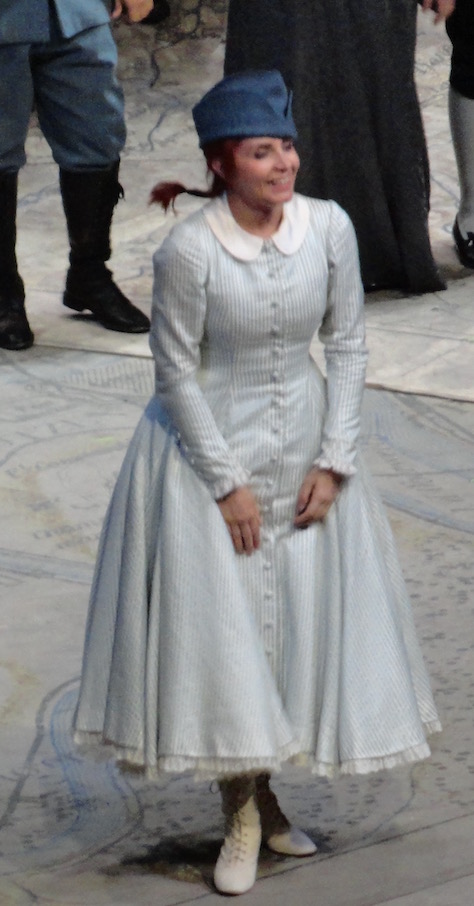
A Marie foi interpretada pela espanhola Sabina Puértolas. Foi uma boa interpretação, o papel de soprano lírico é muito exigente e esteve quase sempre em grande nível. Apenas no registo mais agudo por vezes o som era algo nasalado e perdia qualidade. Em palco foi a melhor. A figura ajuda muito e a encenação também.


O tenor mexicano Javier Camarena foi um Tonio estupendo. Tem um timbre vocal muito bonito, a voz é extensa e intensa e ouve-se sempre sobre a orquestra. Na mais famosa ária da ópera Pour mon ame foi excelente e recebeu uma ovação de quase 10 minutos. Repetiu a ária e, na repetição, foi ainda melhor. Foi, de longe, o melhor cantor da noite.


A Marquesa de Berkenfield foi interpretada pela contralto polaca Ewa Podles. A senhora tem uma voz com um registo grave impressionante e cumpriu o papel com correcção.


O baixo barítono italiano Simone Alberghini foi um Sulpice de voz muito agradável e muito boa presença cénica.


O Hortensius do barítono espanhol Isaac Galán tem um papel pequeno mas esteve ao nível dos restantes.


Foi um espectáculo muito agradável, mas não a obra prima que presenciei quando assisti à mesma produção cantada pela Natalie Dessay e pelo Juan Diego Florez.


****


LA FILLE DU RÉGIMENT, Liceu, Barcelona, ​​May 2017

Once again I had the opportunity to see the opera La Fille du Régiment by Donizetti in the staging/direction by Laurent Pelly of. It's a very nice production, well designed and entertaining, which has already been commented on this blog here. here and here.

In this performance the musical direction was ok, by maestro Giuseppe Finzi who, when appeared on stage to thank the applause, stumbled on one of the props of the ground and fell on the ground, which is rarely seen.

Incidentally, this was not the only stage incident. In the first act, one of Tonio's boots loosened and the long strings dragged on the floor which, in the scenes with several players (choir) also caused several stumbles but, fortunately, without any falls.

Marie was interpreted by Spanish singer Sabina Puértolas. She was a good performer, the role of lyric soprano is very demanding and she was almost always at her best. Only in the top notes was the sound sometimes nasal and lost quality. On stage she was the best. The figure helps a lot and the staging also.

Mexican tenor Javier Camarena was a great Tonio. He has a very beautiful vocal tone, the voice is extensive and intense and is always heard over the orchestra. In the most famous aria of the opera Pour mon ame he was excellent and received an ovation of almost 10 minutes. He repeated the aria and, in the second time, he was even better. He was by far the best singer of the night.

Marquise of Berkenfield was Polish contralto Ewa Podles. She has a voice with an impressive low register and interpreted the role with correction.

Italian bass baritone Simone Alberghini was a Sulpice with a very pleasant voice and very good stage presence.

Hortensius by the Spanish baritone Isaac Galán plays a small role but was at the quality level of the other soloists.

It was a very good performance, but not the masterpiece I witnessed when I saw the same production sung by Natalie Dessay and Juan Diego Florez.


****

domingo, 25 de setembro de 2016

COSÌ FAN TUTTE, Royal Opera House, Londres / London, Setembro / September 2016


(review in English below)

A nova produção da opera de Mozart Così fan Tutte é mais um triunfo da prestigiada Royal Opera House de Londres.

A encenação do jovem Jan Philipp Gloger é interessante, original e muito agradável, embora misture épocas o que, por vezes, quebra a continuidade da acção. Gloger recorre, mais uma vez, ao espectáculo dentro do espectáculo.


Logo durante a abertura aparecem os cantores solistas, vestidos à época, a agradecer os aplausos do público, fazendo os gestos que habitualmente os cantores e as cantoras fazem nesta ocasião. Depois percebemos que estes não são os cantores solistas. Os dois casais aparecem na plateia e são espectadores da Royal Opera.

Don Alfonso será um dirigente da peça de teatro que decorrerá até final. Guglielmo e Ferrando vão para a guerra. O quadro com uma estação de comboios de meados do século passado é bem conseguido. Reaparecem disfarçados num bar moderno e aí começam a conquista das suas noivas. Noutro quadro aparece o jardim do Éden, com muitas maçãs, dinheiro e a serpente. Há também quadros em que a acção decorre num ambiente de teatro barroco.


Já no final, a festa do casamento é muito dinâmica. Num grande painel luminoso em que está escrito COSÌ FAN TUTTE, retiram algumas lâmpadas do E e passa a COSÌ FAN TUTTI.


A encenação é vistosa, alegre, muito diversificada, mas um pouco confusa. Uma das mensagens principais que o encenador pretende dar é que a instabilidade das emoções humanas não se aplica apenas no feminino, mas a todos e em todas as épocas.


O maestro russo Semyon Bychkov foi muito bom, embora tenha imposto alguns tempos excessivamente lentos. A orquestra esteve ao mais alto nível.


Os cantores solistas foram todos excelentes. Os dois pares de noivos eram jovens, o que deu grande credibilidade à interpretação cénica e permitiu alguns momentos de erotismo bem conseguidos.

O baixo-barítono italiano Alessio Arduini foi um Guglielmo de voz bonita, firme e potente. Presença sempre muito ágil e insinuante, muito favorecido pela sua figura.


O tenor alemão Daniel Behle fez um Ferrando muito credível e mais romântico. Na belíssima aria Un’aura amorosa foi magnífico, com um registo agudo de invulgar beleza.


Corinne Winters, soprano americana, foi a Fiordiligi indecisa de voz quente e belo soprano. Esteve particularmente bem nas árias Come scoglio e, sobretudo, Per pietà, ben mio, perdona tocante na sensibilidade e tristeza. Fantástica.


A mezzo americana Angela Brower foi uma Dorabella de voz lírica e firme que esteve sempre bem e afinada ao longo de toda a récita.


O barítono alemão Johannes Martin Kränzle fez um Don Alfonso seguro e muito bem adaptado à personagem.


A soprano espanhola Sabina Puértolas foi uma Despina enérgica e de grande qualidade, vocal e cénica.


A Royal Opera apostou na juventude (produtor e cantores) e, mais uma vez, ganhou.


*****


Così fan Tutte, Royal Opera House, London

The new production of Mozart's opera Così fan tutte is another triumph of the prestigious Royal Opera House in London.

The staging by young director Jan Philipp Gloger is interesting, unique and very pleasant, although it mixes different periods of time that sometimes breaks the continuity of the action. Gloger uses, again, a show within the show.

Just in the opening the soloists singers appear, dressed in Mozart’s time, and thank the applause of the audience, making the gestures usually singers make on this occasion. Quickly we realize that these are not the soloists. The two couples appear in the audience and are members of the audience of the Royal Opera.

Don Alfonso is a director of the play and will run until the end. Guglielmo and Ferrando go to war. The setting with a train station in the middle of last century is well managed. Disguised, they reappear in a modern bar and then begin the conquest of their brides. In another setting the garden of Eden appears, with many apples, money and the serpent. There are also settings in which the action takes place in a baroque theater environment.

At the end, the wedding party is very dynamic. In a large display panel where it is written COSÌ FAN TUTTE, the removal some lamps from the E and turns into COSÌ FAN TUTTI.

The staging is fine, cheerful, very diverse, but a little confusing. One of the main messages that the director wants to give is that the instability of human emotions does not only apply only to women, but to all and at all times.

Russian maestro Semyon Bychkov was very good, although some times he imposed excessively slow tempi. The orchestra was at the highest level.

The soloists were all excellent. The two couples were young, which gave great credibility to the stage interpretation and allowed some moments of eroticism.

Italian bass-baritone Alessio Arduini was a Guglielmo with a beautiful, firm and powerful voice. His presence always very agile and ingratiating, much favored by his figure.

German tenor Daniel Behle was a more romantic and very credible Ferrando. The beautiful aria Un'aura amorosa was magnificent, with a top register of unusual beauty.

Corinne Winters, American soprano, was a fragile Fiordiligi with a warm beautiful soprano voice. She was particularly well in the arias Come scoglio and especially Per pieta, ben mio, perdona that she sang with touching sensitivity and sadness. Fantastic.

American mezzo Angela Brower was a lyrical Dorabella with firm voice that was always in tune throughout the performance.

German baritone Johannes Martin Kränzle was a firm and very well suited to the character of Don Alfonso, and Spanish soprano Sabina Puértolas was an energetic Despina with high quality, vocal and scenic.

The Royal Opera bet on youth (director and singers) and, once again, won.


*****

domingo, 24 de maio de 2015

Così fan tutte de Wolfang Amadeus Mozart — Gran Teatre del Liceu, Barcelona, 22.05.2015

(Review in English below)

(imagens do site do Gran Teatre del Liceo; fotos de camo.opera)

Assisti à ópera Così fan tutte, ossia La scuola degli amanti de Wolfgang Amadeus Mozart. Trata-se de uma ópera estreada em 1790 no Burgtheater de Viena e a última da colaboração do compositor com o libretista Lorenzo da Ponte.


A ópera trata do amor e da fidelidade. Fá-lo com recurso a um libreto dotado de múltiplas simetrias na construção das personagens e das cenas e que, em forma de comédia, tenta mostrar como o amor é efémero e a fidelidade das mulheres como a Fénix: que existiu todos dizem, mas ninguém sabe onde está.


Fá-lo com recurso a um conjunto de peripécias tão inverosímeis que todo o trágico-cómico que se possa tentar vislumbrar desaparece, para se centrar apenas na comédia e no absurdo.

A moralidade existente nas duas anteriores colaborações com da Ponte também desaparece para dar lugar a uma aceitação do status quo, o que fez com que esta ópera não tivesse, à época, conhecido o mesmo sucesso das anteriores. Não nos podemos esquecer que da Ponte tinha uma amizade estreita com Giacomo Casanova...

A produção de Damiano Michieletto foi estreada no Teatro La Fenice (Veneza). No meu ver, foi o ponto mais forte da récita. Coloca a acção no tempo actual e transporta-nos para um hotel de luxo e bem decorado.


Don Alfonso é o gerente do hotel: quase omnipresente, manipula os seus hóspedes para provar a sua teoria. Apresenta-se quase sempre com o seu copo de whisky na mão e é, por natureza, um sedutor, o que vai de encontro à sua desculpabilização (racional?) da volubilidade do amor e, consequentemente, da fidelidade. Despina é uma empregada de hotel despachada e atrevida, sempre num jogo de sedução com o gerente, e com espírito «aberto» (seja lá o que isso for...).


As irmãs Fordiligi e Dorabella (muito histriónicas) são duas hóspedes mais do hotel que estão apaixonadas por Guglielmo e Ferrando, também eles hóspedes. O encenador acaba, depois, por transformar os dois jovens em bonacheirões e divertidos bacanos (perdoem-me a expressão) que se vestem com camisas havaianas e que tentam a todo o custo seduzir as irmãs abandonadas pelo “fabricado” funesto destino. Queriam provar a Don Alfonso a constância das suas namoradas, mas, ao contrário do que era a sua crença, estas rapidamente se transformam na famigerada Fénix e voam para outros braços, esfumando-se as juras de amor eterno (lá está: já alguém viu a Fénix?).

As cenas desenrolam-se sempre nos espaços do hotel: com recurso a uma plataforma circular, as cenas sucedem-se com excelente fluidez entre o lobby, o quarto, o corredor e o bar. E há sempre uma cadeirão (fora da plataforma) que vai servindo de apoio à acção aqui e ali.


A comicidade foi sempre muito bem conseguida, com particular evidência na cena 2 do II acto: passa-se no bar do hotel e os “havaianos” cantam um karaoke em ritmo de festa e todos dançam qual discoteca (a serenata é doutros tempos!). Este karaoke levou a uma ligeira alteração de estilo de canto para um registo mais pop, o que se aceita tendo em conta a naturalidade da acção proposta. De notar a constante inconstância (passe o paradoxo) no par de casais: Don Alfonso tinha de esforçar-se para que os disfarçados não seduzissem as suas companheiras iniciais, o que me pareceu interessante. A realçar a constância masculina contrastante com a feminina... Também o final tem uma interpretação diferente: é certo que aceitam a sua sorte, mas as 6 personagens terminam cada uma para seu lado e claramente abatidas. Uns ficam com as certezas que tinham, outros com a desilusão dos torvelinhos (inevitáveis) da vida.

A Orquestra Simfònica foi dirigida por Josep Pons. Adoptou um ritmo lento (demorou 3h!) o que por um lado favoreceu os cantores, mas por outro perdeu o frenesim mozartiano e alguma da sua beleza. A interpretação foi harmoniosa, sem desencontros evidentes e em sintonia com os cantores, mas a denotar pouco entendimento (ou processamento) do repertório. O Coro teve uma prestação apenas regular.


O trio masculino esteve melhor. Don Alfonso de Pietro Sapgnoli teve bastante qualidade. A voz é talvez um pouco grave para o papel e não demasiado mozartiana, mas a sua capacidade interpretativa veio ao de cima, sendo, na minha opinião, o melhor da noite. Joel Prieto foi um Ferrando em crescendo vocal e decrescendo interpretativo. A voz é bonita, mas não destaca, e as qualidades enquanto intérprete ainda têm de ser trabalhadas.  Quando sabe que é traído, mais parecia que estava a beber vermute... A ária Una aura amorosa correu bem, bem como Ah, lo veggio, quell’anima bella, mas não conseguiu surpreender.  Será um tenor razoável, mas não creio que chegará a papéis dramáticos que exijam uma voz maior. Joan Martín-Royo foi um Guglielmo de voz segura e divertido, mas não foi de encher o ouvido. Esteve bem na sua ária Donne mie, la fate a tanti.

O trio feminino esteve bem na generalidade, mas foi mais fraco. A Despina de Sabina Puértolas teve uma excelente presença em palco, mas não foi especialmente divertida no aspecto vocal, não dando as múltiplas nuances vocais que se esperam neste papel. Dorabella foi Maite Beaumont: pareceu-me que era a que tinha o timbre mais agradável e a voz mais equilibrada das três, mas perdia por pouca potência. Interpretativamente não foi fantástica e acabou por se destacar menos do que as colegas. Por fim, Fiordiligi foi Juliane Banse: tem uma voz potente e boa capacidade interpretativa, mas o seu registo mais agudo é um pouco estridente e, por vezes, ataca as notas de forma mais agreste, não tendo apresentado a coloratura para as partes mais exigentes.


O sexteto de cantores teve, pois, uma prestação globalmente homogénea, mas ninguém conseguiu brilhar. E o público exigente de Barcelona fê-lo notar com aplausos pouco efusivos.


No fim de contas: bom espectáculo, mas não memorável, em que se destaca a encenação.

----------------
(Review in English)

I attended the opera Così fan tutte, ossia La Scuola degli amanti of Wolfgang Amadeus Mozart. It is an opera premiered in 1790 at the Burgtheater in Vienna and the last of the composer's collaboration with the librettist Lorenzo da Ponte.

The opera deals with love and faithfulness. It does so using a libretto endowed with multiple symmetries in the construction of the characters and the scenes and that, in comedy form, tries to show how love is ephemeral and fidelity of women as the phoenix: that existed all say, but no one have seen it. It does so using a set of stories as improbable that the whole tragic-comic that you can try to envision disappears, focusing only on comedy and absurdity. The existing morality in the two previous collaborations with da Ponte also disappears to make way for an acceptance of the status quo, which has made this opera had not, at the time, the same success of the previous. We cannot forget that the da Ponte had a close friendship with Giacomo Casanova...

The production of Damiano Michieletto was premiered at La Fenice (Venice). In my view, it was the strongest aspect of the recital. Places the action in the present time and transports us to a luxury hotel, beautifully decorated. Don Alfonso is the hotel manager: almost ubiquitous, handles guests to prove their theory. He is presented almost always with his whiskey glass in hand and is, by nature, a seductive, which runs counter to its (rational?) excuse of the fickleness of love and consequently fidelity. Despina is a hotel maid always playing seduction and an open-spirit (whatever that is...). The sisters Dorabella and Fordiligi (very histrionic) are two more guests of the hotel that are in love with Guglielmo and Ferrando, they also guests. The director just then by turning the two good-spirited and entertaining young fellas who dress in Hawaiian shirts and trying at all costs to seduce the sisters abandoned by the "manufactured" evil destiny. They wanted to prove to Don Alfonso constancy of their girlfriends, but, contrary to what was their belief, they quickly turn into Phoenix and fly to other arms, breaking their vows of eternal love (here it is: has anyone ever seen phoenix?). The scenes unfold always in the hotel spaces: using a circular platform, the scenes follow one another with great fluidity between the lobby, the room, the hall and the bar. And there is always a chair (off the platform) that will serve as support for the action here and there. The comic was always very well done, with special emphasis on the scene 2 of act II: is set in the hotel bar and the "Hawaiian" sing a karaoke party in rhythm and everyone dance in disco style (the serenade is of older times!). This led to a slight change in singing style to a more pop register, which is accepted in view of the ease of the action. Note the constant inconstancy in the pair of couples: Don Alfonso had to strive for that disguised not seduced their early companions, which seemed to me interesting. Also the end has a different interpretation: it is certain that accept their fate, but ends with each of the 6 characters to his side and clearly slaughtered. One with the certainties they had, others with the disillusionment of (inevitable) eddies of life.

Josep Pons directed the Orchestra Simfònica. He adopted a slow pace (it took 3 hours!). On the one hand it favored the singers and on the other lost some of Mozartian frenzy. The interpretation has always been harmonious and cared and there was harmony with singers. He was generally well without transcended. The Choir had only a regular performance.

The male trio looked better. Don Alfonso of Pietro Sapgnoli had enough quality. The voice is excellent for the role and his interpretative ability came to the fore, and, in my opinion, he was the best of the evening. Joel Prieto was a Ferrando in vocal crescendo and interpretation decrescendo. The voice is beautiful, but not outstanding, and qualities as an interpreter have yet to be worked. When he realizes that was betrayed, he looked like he was drinking vermouth... The aria Una aura amorosa went well, as well as Ah, lo veggio, quell’anima bella. Joan Martín-Rojo was a secure and fun Guglielmo, but despite a good mozartian timbre he did not reach to captive too much the audience. He was right in aria Donne mie, la fate a tanti.

The female trio was good in general, but was weaker. The Despina of Sabina Puértolas had an excellent stage presence, but she was not particularly funny or given the multiple vocal nuances we expected in this role. Dorabella was Maite Beaumont who seemed to me that was the one that had the most pleasant timbre and the most balanced voice of the three, although not very powerful. Interpretively she was not fantastic and eventually stands out less the other colleagues. Finally, Juliane Banse was Fiordiligi: has a powerful voice and good interpretive ability, but her most high register is a little raucous and sometimes attacks the notes in a harsher way and did not submit the coloratura for the most demanding parts.

The sextet of singers had therefore a globally uniform performance, but no one could shine. And the demanding public of Barcelona made it notice with little effusive applause.


After all: good operatic recital, but not memorable, in which I highlight the staging.