Mostrar mensagens com a etiqueta Carlos Alvarez. Mostrar todas as mensagens

quarta-feira, 5 de outubro de 2022

MADAMA BUTTERFLY, Royal Opera House, Setembro / September 2022

(Review in English below)

Já várias vezes escrevi neste blogue sobre a Madama Butterfly, uma das minhas operas favoritas de Puccini. E algumas delas sobre a excelente produção, clássica, da Royal Opera House, que é frequentemente levada à cena nos últimos anos.

Ao contrário do que é a regra nesta excelente catedral da ópera, nos últimos anos os elencos escolhidos têm sido maus, o que não faz justiça à magnífica obra do compositor.

Infelizmente desta vez voltou a ser assim, exceptuando a interpretação da protagonista, que salvou a récita porque a ópera vive sobretudo dela.

O maestro Nicola Luisotti, com créditos afirmados, teve uma direcção nada empolgante ou emotiva.

O tenor Joshua Guerrero, de boa figura, foi vocalmente débil, deixou-se afogar frequentemente pela orquestra e cantou com idêntica expressão quer os momentos de felicidade, quer os de tristeza e remorso.


O barítono Carlos Alvarez parecia que estava a cantar em mono e a ensaiar. Mal se ouviu e também sem transparecer qualquer sensibilidade.


A mezzo Christine Rice cumpriu o papel de Suzuki sem deslumbrar, tal como Carlo Bosi como Goro. Em papéis curtos estiveram 2 artistas do Jette Parker, Josef Jeongmeen Ahn como Princepe Yamadori e Gabriele Kupsyte como Kate Pinkerton


A protagonista, soprano Maria Agresta não começou da melhor maneira mas, após o primeiro acto, teve uma interpretação magnífica, irrepreensível do ponto de vista vocal e em palco foi muito convincente, transbordando as emoções próprias de cada momento. É uma interpretação enorme e de grande exigência cénica e vocal e esteve à altura. Salvou a récita.


**

MADAMA BUTTERFLY, Royal Opera House, September 2022

I have written several times on this blog about Madama Butterfly, one of my favorite operas by Puccini. And some of them about the excellent, classic production of the Royal Opera House, which has been frequently brought to the scene in recent years.

Contrary to what is the rule in this excellent cathedral of opera, in recent years the chosen casts have been bad, which does not do justice to the magnificent work of the composer.

Unfortunately this time it was like that again, with the exception of the protagonist's interpretation, who saved the performance because the opera lives mainly on her.

Conductor Nicola Luisotti, with his credits affirmed, had an unexciting or emotional direction.

Tenor Joshua Guerrero, of good figure, was vocally weak, often let himself be drowned by the orchestra and sang with the same expression both the moments of happiness and those of sadness and remorse.

Baritone Carlos Alvarez looked like he was singing in mono and rehearsing. He was barely heard and also without showing any emotions.

Mezzo Christine Rice sung the role of Suzuki without dazzling, as did Carlo Bosi as Goro. In short roles were 2 artists from Jette Parker, programme Josef Jeongmeen Ahn as Princepe Yamadori and Gabriele Kupsyte as Kate Pinkerton

The protagonist, soprano Maria Agresta, did not start off in the best way, but after the first act, she had a magnificent interpretation, irreproachable from a vocal point of view and on stage she was very convincing, overflowing with the emotions of each moment. It's a huge interpretation of great scenic and vocal demand and it lived up to it. She saved the performance.

**

segunda-feira, 29 de abril de 2019

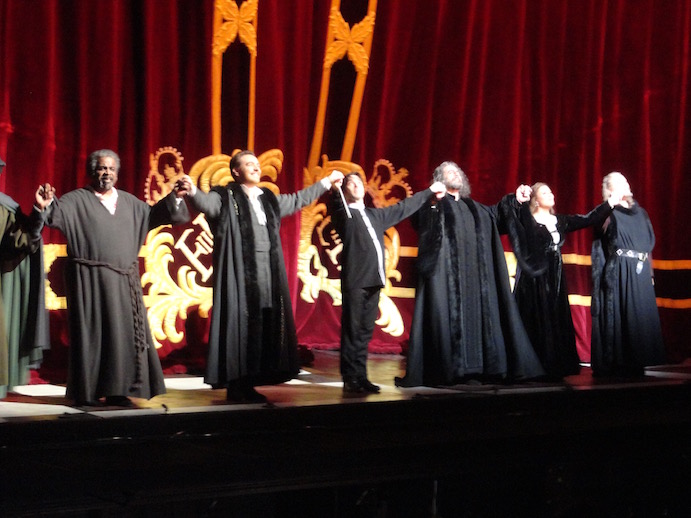
SIMON BOCCANEGRA, Royal Opera House, Dezembro / December 2018


(review in English below)

Tive oportunidade de ver a “velhinha” encenação de Elijah Moshinsky da ópera Simon Boccanegra de Verdi na Royal Opera House. É clássica, explícita e muito bonita.


O espectáculo foi dirigido pelo jovem maestro húngaro Henrik Nánási que fez um bom trabalho, muito atento aos cantores e impondo andamentos correctos para a acção.


Os cantores solistas foram todos excelentes. Um dos melhores foi Carlos Alvarez como Simon Boccanegra. Tem um barítono verdiano excelente, potente e de timbre muito agradável. Teve um desempenho irrepreensível em palco, transbordando emoções nas diferentes partes e terminando, ao mais alto nível, quando morre envenenado.


Continuando nas vozes graves, Ferruccio Furlanetto, mais uma vez, impôs o seu instrumento de forma inigualável. É um baixo de fazer tremer o chão, com uma potência invulgar e uma beleza assinalável. No 3º acto, o diálogo reconciliatório com o Boccanegra foi de arrepiar.


O tenor Francesco Meli foi um óptimo Gabriele Adonno. Tem um timbre bonito e ofereceu-nos uma interpretação marcante em qualidade e expressividade vocais.


A Amelia Grimaldi da soprano Hrachuhi Bassenz tem uma voz algo baça mas nem por isso deixou de ter uma interpretação superior. Cantou sempre de forma bem audível, sem gritar e sem perder qualidade em todos os registos. Foi, contudo, bastante estática em palco.


Mark Rucker também esteve bem como Paolo Albiani, 


o mesmo aconteceu com Simon Shimbambu como Pietro.

Um Simon Boccanegra de grande qualidade na Royal Opera.


****


SIMON BOCCANEGRA, Royal Opera House, December 2018

I had the opportunity to see Elijah Moshinsky's "old" staging of Verdi's opera Simon Boccanegra at the Royal Opera House. It is classic, explicit and very beautiful.
The performance was conducted by young Hungarian conductor Henrik Nánási who did a good job, very attentive to the singers and imposing correct paces for the action.

The soloist singers were all excellent. One of the best was Carlos Alvarez as Simon Boccanegra. He has an excellent verdian baritone, powerful and very pleasant timbre. He had an irreproachable performance on stage, overflowing emotions in different parts and ending at the highest level when he dies poisoned.

Continuing in the low voices, Ferruccio Furlanetto, once again, imposed his unsurpassed instrument. It is a bass to shake the floor, with an unusual power and remarkable beauty. In the 3rd act, the reconciliation dialogue with Boccanegra was thrilling.

Tenor Francesco Meli was a great Gabriele Adonno. He has a beautiful timbre and offered us a remarkable performance in vocal quality and expressiveness.

Amelia Grimaldi of soprano Hrachuhi Bassenz has a somewhat opaque voice but nevertheless had a superior interpretation. She always sang very audibly, without shouting and without losing quality in all registers. She was, however, quite static on stage.

Mark Rucker was also very well as Paolo Albiani, the same happened with Simon Shimbambu as Pietro.

A fine Simon Boccanegra at the Royal Opera.

****

segunda-feira, 13 de janeiro de 2014

LA FILLE DU RÉGIMENT — Wiener Staatsoper, Outubro de 2013

(Review in English below)


A ópera La Fille du Régiment (A Filha do Regimento) de Gaetano Donizetti é uma ópera cómica em dois actos com libreto de Jules Henri Vernoy de Saint-Georges e Jean-François Bayard.


É uma ópera do bel canto que Donizetti estreou na Opéra-Comique de Paris em 1840. A sua história é um conjunto de imbróglios entre uma rude e jovem rapariga criada por militares e um ingénuo tirolês desde que se apaixonam até que finalmente se casam.


A encenação é a muito conhecida de Laurent Pelly, Christian Rath e Chantal Thomas. Os seus méritos são infindáveis. É simples, muito cuidada, cheia de bons pormenores, ajuda imenso ao desenrolar da história de uma forma cómica (tal como se pretende) e é de extremo bom gosto.


Passa-se, boa parte dela, sobre um mapa e o pormenor vai até ao pano com que a ópera é apresentada. Absolutamente magnífica.


O soprano da Costa Rica Íride Martínez foi Marie. A sua voz tem muita qualidade, com um timbre muito agradável e um bom fraseado. A sua presença em palco foi de assinalável qualidade, muito cómica. As comparações com Natalie Dessay são inevitáveis, mas não lhe ficou muito atrás!


O tenor peruano Juan Diego Flórez foi Tonio. É um dos melhores tenores da actualidade e, sem qualquer dúvida, o melhor neste registo operático e neste papel. Que dizer da sua prestação? Basta lembrar que foi ele que acabou com o embargo de 70 anos de encores no Scala de Milão com a ária Ah mes amis precisamente desta ópera.


Aqui cantou-a de forma perfeita!!! Foi aplaudido efusivamente com um coro de bravos de cerca de 5 minutos e foi obrigado a repetir a famosa ária que se diz ser o Monte Everest dos tenores. Fabuloso!


Deixo-vos uma fotografia e um autógrafo que simpaticamente deu depois da récita.


O barítono espanhol Carlos Álvarez foi Sulpice. Muito habituado ao papel, ofereceu-nos uma prestação de excelência, quer vocal, quer cenicamente.


No final, deu também autógrafos, confessando-me que “é sempre com enorme prazer que canto este papel. A produção é magnífica!”


O mezzo-soprano romeno Aura Twarowska foi Marquise de Berkenfield. Teve um início menos regular com uma ligeira dificuldade na projecção, mas depois cresceu vocalmente para uma prestação de qualidade. Cenicamente foi muito cómica e eficaz.


Foi, pois, uma boa e muito agradável Marquise. E é também muito simpática!


O soprano neo-zelandês Dame Kiri Te Kanawa foi a Duchesse de Crakentorp. Aplaudida quando entra em cena, esta Senhora do canto lírico cumpriu eficazmente e com muita piada o seu pequeno papel. A voz já não tem a potência de outros tempos, mas o timbre continua o seu que é de invulgar beleza.


O restante elenco com Marcus Pelz (Hortensius), Konrad Huber (Korporal), Dritan Luca (Bauer) e François Roesti (Notar) teve bons desempenhos nos seus papéis secundários.


A Orquestra da WSO foi dirigida pelo italiano Bruno Campanella com muita maestria e qualidade. O Coro da WSO teve, também, um óptimo desempenho.


A terminar, deixo-vos uma vídeo da sala da WSO. Muito bonita!


Foi uma récita memorável com um Juan Diego Flórez absolutamente de outro planeta!


------------------
(Review in English)

The opera La Fille du Régiment by Gaetano Donizetti is a comic opera in two acts with libretto by Jules Henri Vernoy de Saint-Georges and Jean-François Bayard. It is an opera of Donizetti's bel canto that he premiered at the Opéra-Comique in Paris in 1840. Its history is a set of imbroglios from a rude young girl raised by the military and a naïve Tyrolean since they fall in love until their final wedding. You can read a synopsis here.

The staging is the very well known by Laurent Pelly, Christian Rath and Chantal Thomas. Its merits are endless. It's simple, carefully disegned, full of good details, immense on helping unfolding the story in a comic way (as intended) and is extremely tasteful. It takes place much of it on a map and the attention to details goes to the cloth with which the opera is presented. It is absolutely magnificent.

The soprano Íride Martínez of Costa Rica was Marie. Her voice has great quality, with a very nice tone and good phrasing. Her stage presence was of remarkable quality, very comical. Comparisons with Natalie Dessay are inevitable, but she was not far behind!

The Peruvian tenor Juan Diego Flórez was Tonio. He is one of the greatest tenors of today, and undoubtedly the best in these operatic roles of bel canto and in this role particularly. What about his performance? You must remember that he was the one who broke the 70 years embargo of encores at La Scala with the aria Ah mes amis, precisely of this opera. Here he sang it perfectly! He was warmly applauded with a chorus of bravos of about 5 minutes and he was then forced to repeat the famous aria said to be the Mount Everest for tenors. Fabulous or miraculous! I leave you a picture and an autograph that he kindly gave after the recitation.

The Spanish baritone Carlos Álvarez was Sulpice. He is very accustomed to the role, offered us a performance of excellence, whether vocal or scenically. Also at the end, he gave autographs, confessing me that "it is always with great pleasure that I sing this role. The production is magnificent!"

The Romanian mezzo-soprano Aura Twarowska was Marquise de Berkenfield. She had a less regular start with a slight difficulty in projecting her voice, but then grew vocally for a performance of great quality. Scenically she was very comical and effective. It was therefore a good and very enjoyable Marquise. She is also very kind!

The New Zealander soprano Dame Kiri Te Kanawa was the Duchesse de Crakentorp. Applauded when she enters the scene, this opera Lady singing fulfilled effectively and very funny her small role. The voice no longer has the power of other times, but the timbre continue to be of unusual beauty.

The rest of the cast with Marcus Pelz (Hortensius), Konrad Huber (Korporal), Dritan Luca (Bauer) and François Roesti (Note) had good performances in their supporting roles.

Bruno Campanella directed the WSO Orchestra with great mastery and quality. The WSO Choir had a great performance, too.

Finally, I leave you a video from the WSO hall. It is very beautiful!


It was a memorable recitation with a Juan Diego Flórez from another planet!