Mostrar mensagens com a etiqueta Ailyn Pérez. Mostrar todas as mensagens

sábado, 23 de janeiro de 2021

UMA NOITE NA ÓPERA / A Night at the Opera - Fundação Calouste Gulbenkian


Enquanto a pandemia de COVID-19 continua a arrasar a cultura, a Fundação Calouste Gulbenkian disponibiliza no site abaixo referido o concerto "Uma Noite na Ópera". 

A Orquestra Gulbenkian foi dirigida pelo maestro Lorenzo Viotti e o concerto teve como solistas Aylin Pérez (soprano), Joshua Guerrero (tenor), Margarita Gritskova (mezzo) e Roman Brudenko (barítono).


Interpretaram-se peças de Bizet, Mascagni, Puccini, Giordano, Tchaikovsky, Rachmaninov, Bernstein e Lara.

Apesar de muito meritório por parte da Fundação Gulbenkian, é um fraco consolo que nos é oferecido, na impossibilidade actual de assistir a concertos ou óperas ao vivo.


segunda-feira, 17 de fevereiro de 2020

CARMEN, Royal Opera House, Julho / July 2019


(review in English below)

Música fantástica e cantores excelentes numa encenação grotesca, a pior que alguma vez vi na Royal Opera House. E pensava eu que era impossível arruinar a Carmen de Bizet … Estava enganado!


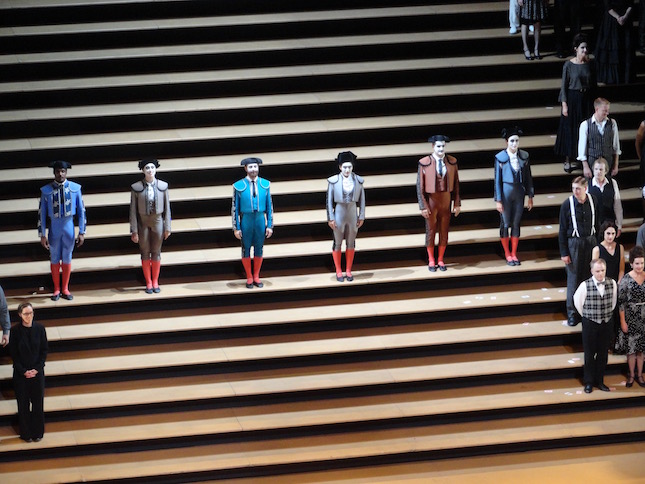
Já comentei aqui esta encenação que vi no início da temporada. O palco está ocupado, do início ao fim, por uma enorme escadaria de madeira que todos os participantes sobem e descem ruidosamente ao longo do espectáculo. Nada mais acontece. Não há acção, não há história (esta vai sendo contada por uma narradora), quase não há adereços, nada para ver. Não houve paixão, energia, cor ou vivacidade. A actuação em palco foi desastrosa, inexistente. 


O ruído constante na subida e descida da escadaria perturba totalmente a audição. A Carmen aparece inicialmente vestida de toureiro e depois de gorila! O que tem o gorila a ver com ela e com Sevilha? E a cena final é inenarrável, amorfa, estática, sem qualquer paixão ou emoção e termina de forma totalmente ridícula, com a Carmen a ressuscitar depois de esfaqueada e a encolher os ombros.
A coreografia é também deplorável, apesar da elevada qualidade dos bailarinos.


Não é habitual ver este tipo de lixo na Royal Opera, mas desta vez uma das melhores catedrais da ópera mundiais permitiu a um encenador australiano, Barrie Kosky, trazer um dos bons exemplos do que habitualmente se designa de Eurotrash! Coitados dos cantores.

Esquecendo a encenação (o que não é possível num espectáculo de ópera), a música foi óptima e o coro e os cantores excepcionais.

A maestrina Julia Jones teve uma direcção de orquestra correcta e respeitou os cantores.


A Carmen foi cantada por uma mezzo francesa que desconhecia, Anaïk Morel. Foi óptima, voz magnífica, sempre afinada, bem audível tanto na frente do palco como no cimo das escadarias e uma figura excelente.


O Don Jose do Bryan Hymel foi muito bem cantado. Para mim este é o melhor tenor norte-americano da actualidade e, como sempre, esteve em grande. Cantou a ária La fleur que tu m’avais jetée de forma superior, apesar de ter lutado com o agudo final.


 Ailyn Pérez foi uma Micaela marcante, de voz muito poderosa e afinada, embora resvalando por vezes para a estridência.


O Escamillo de Luca Pisaroni começou contido, depois melhorou mas, sendo muito bom, não atingiu a qualidade de topo dos restantes.


Nos papéis secundários Stuart Patterson (Remendado) foi muito bom e as restantes interpretações foram fantásticas: Jacquelyn Stucker (Frasquita) e Hongni Wu (Mercédes), ambas jovens do programa Jette Parker da ROH foram deslumbrantes, assim como também o foram mais três jovens deste programa,  Germán Alcántara (Moralés), Michael Mofidian (Zuniga) e Dominic Sedgwick (Dancaïro), o que atesta a excelente qualidade da formação na ROH.


Enfim, cantores excelentes num espectáculo para ver de olhos bem fechados!
A ROH deveria repor a produção anterior de Francesca Zambello, essa sim, digna desta obra prima da ópera.


***** (cantores)
0 (produção / encenação)


CARMEN, Royal Opera House, July 2019

Fantastic music and excellent singers in a grotesque staging, the worst I've ever seen at the Royal Opera House. And I thought it was impossible to ruin Bizet's Carmen ... I was wrong!

I already commented here this production that I saw at the beginning of the season. The stage is occupied, from beginning to end, by a huge wooden staircase that all participants climb and descend noisily throughout the performance. Nothing else happens. There is no action, no story (this is being told by a female narrator), there are almost no props, nothing to see. There was no passion, energy, color or liveliness. The performance on stage was disastrous, nonexistent. The constant noise in the ascent and descent of the staircase totally disturbs the hearing. Carmen appears initially dressed as a bullfighter and then as a gorilla! What does the gorilla have to do with Seville? And the final scene is unmentionable, amorphous, static, without any passion or emotion and ends in a totally ridiculous way, with Carmen resurrecting after being stabbed and shrugging.
The choreography is also deplorable, despite the high quality of the dancers.

It is not usual to see this type of garbage at the Royal Opera, but this time one of the best opera cathedrals in the world has allowed an Australian director, Barrie Kosky, to bring one of the good examples of what is usually called Eurotrash! I feel sorrow for the singers.

Forgetting the staging (which is impossible in an opera), the music was great and the singers exceptional.

Julia Jones was a correct orchestra director and respected the singers.

Carmen was sung by an unknown (to me) French mezzo, Anaïk Morel. She was great, magnificent voice, always tuned, very audible both in front of the stage and at the top of the stairs, and an excellent figure.

Bryan Hymel's Don Jose was very well sung. For me, he is the best American tenor of our days and, as always, he was great. He sang the aria La fleur que tu m'avais jetée very impressively, although he struggled with the top note at the end.

 Ailyn Peréz was a remarkable Micaela, of very powerful and tuned voice, although sometimes sliding towards stridency.

Escamillo by Luca Pisaroni started contained, then improved but, being very good, did not reach the superior quality of the other soloists.

In the supporting roles Stuart Patterson (Remendado) was very good and the remaining interpretations were fantastic: Jacquelyn Stucker (Frasquita) and Hongni Wu (Mercédes), both young singers from the Jette Parker program of the ROH were stunning, as were three other youngsters of this program, Germán Alcántara (Morales), Michael Mofidian (Zuniga) and Dominic Sedgwick (Dancaïro), which testifies to the excellent quality of training at the Royal Opera.

Anyway, excellent singers in an opera to see with eyes closed!
The Royal Opera should restore the previous production of Francesca Zambello that yes, is worthy of this masterpiece of the opera.

***** (singers)
0 (production / staging)

quarta-feira, 2 de outubro de 2019

PAGLIACCI/CAVALLERIA RUSTICANA — DE NATIONALE OPERA, Amesterdão, setembro de 2019


(in English bellow)

Assisti à apresentação das óperas Pagliacci de Leocavallo e Cavalleria Rusticana de Mascagni na ópera de Amesterdão.


A encenação ficou a cargo de Robert Carsen. Como lhe é típico, sugere que o público faz parte da obra. Assim, coloca o coro nas primeiras três filas do teatro, movimentando-se este depois para o palco que é um enorme camarim, cheio de espelhos e luzes, mas despido e escuro. Toda a ação se passa aí e num teatro ambulante que surge mais tarde para o desfecho trágico final onde as personagens são apresentadas nas mesmas roupagens, mas extremamente caricaturadas pelo tamanho excessivo. A transição para a Cavalleria faz-se com a cena final de Pagliacci em que os “atores” permanecem estáticos como se de um quadro se tratasse. Continua a aparecer um palco despido cheio de cadeiras que é tanto a taberna como a igreja. Os recursos são simples, mas eficazes para a dramaturgia e, também como é típico em Carsen, a comédia acaba com um grande espelho que transporta toda a assistência em palco.


A direção da Nederlands Philharmonisch Orkest por Lorenzo Viotti foi competente e colorida, imprimindo ritmos adequados e uma vivacidade que captou o público. O coro da De Nationale Opera e o coro infantil Nieuw Amsterdams Kinderkoor estiveram em bom plano.

Começando pelos Pagliacci, o prólogo e Tonio foram cantados pelo barítono Roman Burdenko que tem uma excelente projeção vocal e um timbre agradável, sendo capaz de interpretar a maléfica personagem de forma capaz. O Peppe do tenor Marco Ciaponi teve uma excelente prestação e o Sílvio do barítono Mattia Olivieri também esteve em bom plano com a sua voz quente e expressiva.

As personagens principais também se apresentaram em bom plano. Ailyn Pérez foi uma Nedda muito credível e fez uso da sua excelente voz, projetando-a sobre uma orquestra por vezes em forte, e com uma excelente capacidade dramática. Já o Canio do tenor Brandon Jovanovich esteve também excelente cenicamente, tendo uma voz com grande volume, mas um pouco áspera, e em que o italiano mais rude não ajudou a sobressair.


Passando à Cavalleria Rusticana, o elenco não foi tão uniforme quanto o do Pagliacci, porque teve duas vozes mais cintilantes. Anita Rachvelishvili foi uma Santuzza com uns graves e uns agudos absolutamente inexcedíveis, sendo uma das melhores mezzosoprano da atuliadade. Contudo, senti que lhe falta ainda maturar o papel para ser mais convincente do ponto de vista dramático onde Garanca a superou nas récitas a que assistimos na ROH. Brian Jadge foi um Turiddu maduro, com uma voz muito bonita, agudos potentes e fáceis a que alia uma grande capacidade interpretativa, características que fazem dele um dos tenores mais interessantes dos nossos dias. Alfio foi Roman Burdenko que se manteve no nível de Pagliacci. A Lola de Rihab Chaieb (terceira classificada do Operalia 2018 em Lisboa) também ofereceu uma boa interpretação, sensual e quente, e de voz cheia e muito homegena, só não sendo melhor por contrastar com a superlativa mezzo Rachvelishvili. Finalmente, a Lucia de Elena Zilio também se apresentou em bom plano, muito embora não goste particularmente do seu timbre de voz.


Uma excelente récita!

-------------------------------
(translation in English)

I attended to Leoncavallo’s Pagliacci and Mascagni’s Cavalleria Rusticana at Amsterdam’s opera house.

Robert Carsen’s staging, as he typically suggests, put the public as part of the work. Thus, he puts the choir in the first three rows of the hall, moving them later to the stage that is presented as a huge dressing room, full of mirrors and lights, but naked and dark. All the action takes place there and in a rustic theatre that comes later for the final tragic outcome where the characters are presented in the same guise, but extremely caricatured by their excessive size. The transition to Cavalleria is with the final scene of Pagliacci in which the “actors” remain static as if they were a living painting.The staging continues to be naked but now full of chairs, representing both the tavern and the church. The features are simple but dramaturgically effective and, as is typical of Carsen, comedy ends up with a large mirror that projects all the assistance to the stage.

Nederlands Philharmonisch Orkest's direction by Lorenzo Viotti was competent and colourful with proper rhythms and liveliness that captured the audience. The De Nationale Opera choir and the Nieuw Amsterdams Kinderkoor children's choir were in good shape.

Starting with the Pagliacci, the prologue and Tonio were sung by the baritone Roman Burdenko who has excellent vocal projection and a pleasant timbre, being able to interpret the evil character in a capable way. Tenor Marco Ciaponi's Peppe had an excellent performance and baritone Mattia Olivieri as Silvio had also a good performace with his warm and expressive voice.

The main characters also performed well. Ailyn Pérez was a very credible Nedda and made use of her excellent voice, projecting it over a sometimes strong orchestra, and with excellent dramatic ability. Tenor Brandon Jovanovich's Canio was also dramatically excellent, having a great high notes but slightly harsh, and in which his rudest Italian did not help to stand out.

Turning to Cavalleria Rusticana, the cast was not as uniform as Pagliacci's because it had two more sparkling voices. Anita Rachvelishvili was a Santuzza with an absolutely unbeatable bass and treble, being one of the best mezzosoprano of our days. However, I felt that she still needs to mature the role to be more convincing from the dramatic point of view where Garanca overcame her in the recitals we attended at ROH. Brian Jadge was a mature Turiddu, with a very beautiful voice, powerful and easy treble that combines great interpretive ability, characteristics that make him one of the most interesting tenors of our days. Alfio was Roman Burdenko who remained at the level of Pagliacci. Rihab Chaieb's Lola (2018 Operalia’s third ranked in Lisbon) also offered a good interpretation, sensual and warm, with a full and very homogeneous voice, that was not so good just because of the contrast with the superlative mezzo Rachvelishvili. Finally, Elena Zilio's Lucia also performed well, although I didn't particularly like her voice.

An excellent evening!

domingo, 8 de setembro de 2019

LA TRAVIATA, Bayreshe Staatsoper, Julho / July 2019


(review in English below)

Texto de camo_opera

La Traviata começou pelo anúncio apenas em alemão do cancelamento de Plácido Domingo no papel de Germont-pai. Foi um ooohhhh! enorme na sala, mas o meu contentamento, confesso! Acho que pode vender muitos bilhetes, mas a sua voz de barítono já deu o pouco que tinha para dar, pelo que agradeci.

O ponto forte da noite foi mesmo a direção perfeita de Marco Armiliato: para mim, é um dos grandes maestros da atualidade e vê-lo de perto foi um privilégio e um deleite auditivo. Também o Coro esteve em bom plano. A encenação de Gunter Kramer não é interessante em nenhum momento, mas não estraga, o que já não é mau, dado que neste teatro tenho visto muita porcaria.

No que respeita ao elenco de cantores, pautou-se pela qualidade geral muito elevada e homogénea que elevaram a récita a um nível muito, muito bom. A Violeta de Ailyn Pérez esteve muito bem do ponto de vista vocal: intensa e acertada. Pena que cenicamente se tenha sentido pouca ligação, porque teria sido ainda melhor, e que tenha dito “ritorno a vincere” em vez de “a vivere”. Quase pareceu incomodada com essa falha mesmo a terminar!

O Alfredo de Atalla Ayan esteve igualmente em bom plano: gosto muito do timbre e da presença, tem sempre muito bom volume, embora estivesse algo irregular sobretudo no primeiro ato.
O Germont do barítono romeno George Petean foi muito bom: timbre quente, volume elevado, cenicamente interessante, foi uma das figuras da noite e, talvez, até por estar em substituição, o mais ovacionado. Pena que se tenha enganado duas vezes na letra, dizendo coisas algo disparatadas. Mas aposto que passou ao lado para a maior parte do público.
Os restantes cantores eram todos muito, muito bons, pelo que a récita valeu pela homogeneidade e pelo brilhantismo da direção de Armiliato.


LA TRAVIATA, Bayreshe Staatsoper, July / July 2019

Text by camo_opera

La Traviata began by announcing, in German only, the cancellation of Placido Domingo in the role of Giorgio Germont. It was an ooohhhh! in the room, but my contentment, I confess! I think he can sell a lot of tickets, but his baritone voice has already given the littlehe had to give, so thank you.

The strong point of the evening was even the perfect direction of Marco Armiliato: for me, he is one of the great maestros of today and seeing him up close was a privilege and an auditory delight. Also the choir was in good plan. The staging of Gunter Kramer is not interesting at any time, but it does not spoil, which is not bad, since in this theater I have seen a lot of crap.
With regard to the cast of singers, the general quality was very high and homogeneous that raised the performance to a very, very good level. Violeta by Ailyn Pérez was very well from the vocal point of view: intense and correct. It is a pity that a little connection has been made, because it would have been even better, and that she said "ritorno a vincere" instead of "a vivere". She almost seemed bothered by this failure to finish!
Alfredo by Atalla Ayan was also good: I really like the timbre and the presence, always has very good volume, although he was somewhat irregular especially in the first act.
The Germont of the Romanian baritone George Petean was very good: warm timbre, high volume, richly interesting, was one of the figures of the night and getting the most ovation. It's a shame that he was mistaken twice in the lyrics, saying something crazy. But I bet it passed along for most of the audience.
The remaining singers were all very good so the performance was worth the homogeneity and brilliance of the direction of Armiliato.

domingo, 17 de fevereiro de 2019

LA BOHÈME, METropolitan OPERA, Dezembro / December 2018


 (review in English below)


É sempre um gosto rever esta encenação espectacular de La Bohème de Franco Zeffirelli que a Metropolitan Opera mantém há décadas. Os cenários são sempre aplaudidos pelo público, algo que praticamente só por aqui acontece. Desta vez assistimos a uma récita em que quase todos os intervenientes eram norte americanos.


O jovem maestro James Gaffingan ofereceu-nos uma leitura correcta da partitura, interpretada ao mais alto nível pela orquestra.


A Mimì da soprano Ailyn Pérez não começou bem (a aria Si mi chiamano Mimì foi frouxa) mas nos dois últimos actos teve uma bela interpretação, vocal e cénica e conseguiu transmitir emoção no final, no leito de morte.


Já o Rodolfo do tenor Michael Fabiano esteve muito aquém do desejável. Apesar de ter um timbre vocal aceitável, o fraseado é muito feio e a emissão irregular. Foi muito aplaudido e ouviram-se “bravos” após a ária Che gélida manina, totalmente imerecidos na minha opinião, mas o factor “casa” seguramente pesou.


O barítono Lucas Meachem foi um Marcello de voz potente e bem colocada, esta sim uma interpretação de qualidade superior.


A Musetta da soprano Angel Blue cumpriu sem impressionar, foi mais exuberante no desempenho cénico do 2º acto (a encenação presta-se a isso) do que no desempenho vocal.


O baixo-barítono Christian van Horn foi um Colline de voz pouco impressionante


e o barítono escocês Duncan Rock fez um Schaunard decente mas de voz algo opaca. 


Outro barítono escocês, Donald Maxwell, interpretou os papéis pequenos de  Benoit e Alcindoro.

Para uma grande récita nesta que é uma das principais catedrais mundiais da ópera não basta ser-se americano.


***


LA BOHÈME, METropolitan OPERA, December 2018

It is always a pleasure to see again this spectacular staging by Franco Zeffirelli of La Bohème that the Metropolitan Opera has maintained for decades. The scenarios are always applauded by the public, something that practically only happens here. This time we saw a performance in which almost all the soloists were North Americans.

Young conductor James Gaffingan offered us a correct reading of the score, interpreted at the highest level by the orchestra.

Mimì of soprano Ailyn Pérez did not start well (the aria Si mi chiamano Mimì was loose) but in the last two acts had a beautiful interpretation, vocal and on stage, and managed to convey emotion in the end, on the deathbed.

But tenor Michael Fabiano’s Rodolfo was far from desirable. Despite having an acceptable vocal tone, the phrasing was ugly and the emission irregular. He was much applauded, with"bravos" after the aria Che gelida manina, totally undeserved in my opinion, but the factor "house" surely weighed.

Baritone Lucas Meachem was a Marcello with a powerful and well tuned voice, this one yes an interpretation of superior quality.

Musetta of soprano Angel Blue was ok without impressing. She was more exuberant in the scenic performance of the second act (the staging pays itself to that) than in the vocal performance.

Bass-baritone Christian van Horn was a weak Colline and Scottish baritone Duncan Rock was a decent Schaunard but with a rather opaque voice. Another Scottish baritone, Donald Maxwell, interpreted the small roles of Benoit and Alcindoro.

For a great performance in this thrater that is of the main world cathedrals of the opera it is not enough to be American.

***