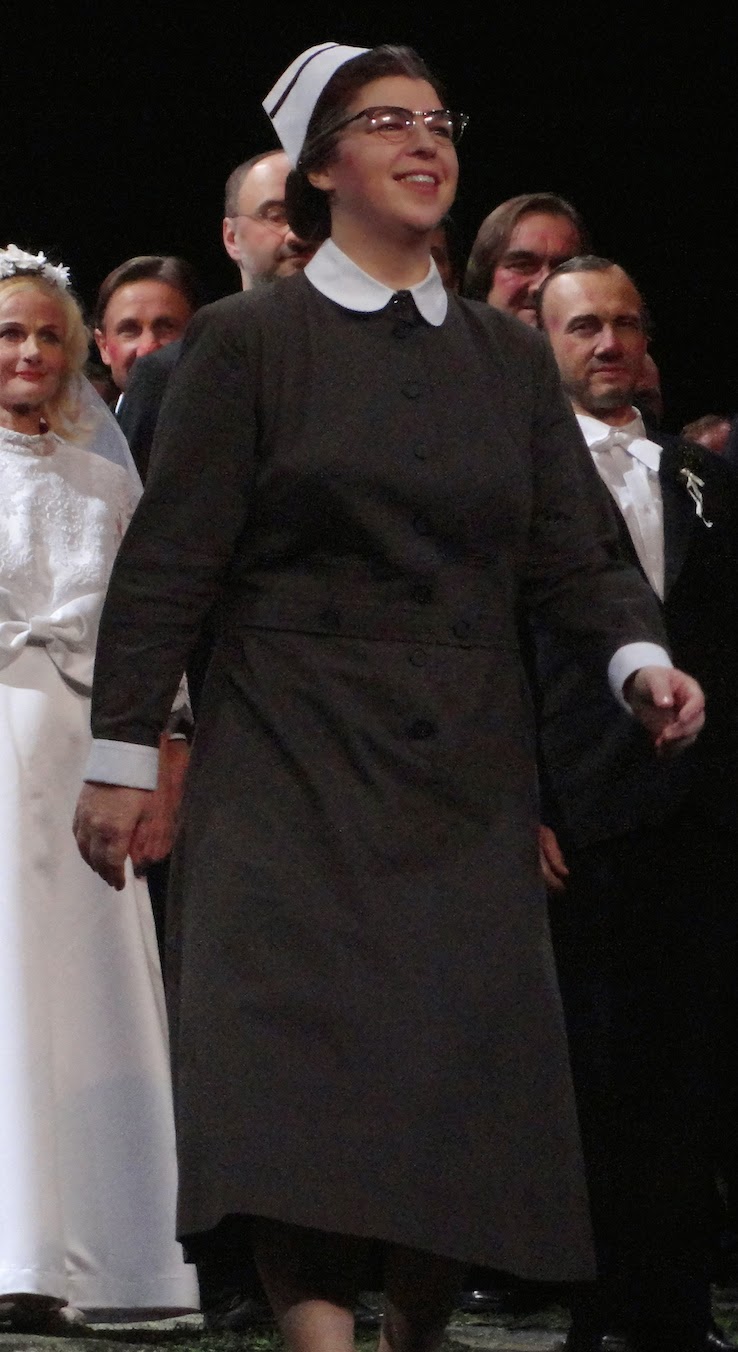
Mostrar mensagens com a etiqueta Christa Mayer. Mostrar todas as mensagens

sexta-feira, 7 de outubro de 2022

A CANÇÃO DA TERRA / DAS LIED VON DER ERDE, Fundação Gulbenkian, Outubro 2022

(review in English below)

Sob a direcção do maestro Hannu Lintu, o meu primeiro espectáculo desta temporada na Fundação Calouste Gulbenkian foi “Das Lied von der Erde / A Canção da Terra” de Gustav Mahler. O concerto incluiu também uma obra para piano e Orquestra de Thomas Adès.

Como nos foi recordado no texto da Fundação Gulbenkian, trata-se de um ciclo de canções orquestrais melancólicas, inspirado em poemas chineses, sobre como lidamos com a natureza e a vida. Sempre tive em relação a esta obra alguns sentimentos ambivalentes porque, das 6 canções que a integram, não sou grande fã das primeiras mas considero a última (Der Abschied / A despedida) uma das mais belas peças musicais do compositor.

A Orquestra Gulbenkian ofereceu-nos um bom espectáculo. O tenor letão Mihails Culpajevs cumpriu sem deslumbrar. A mezzo alemã Christa Mayer, que admirei há 2 meses no Festival de Bayreuth foi a melhor da noite, com interpretações muito boas, em particular na última canção (Der Abschied).


***

 DAS LIED VON DER ERDE, Gulbenkian Foundation, October 2022.

Under the direction of conductor Hannu Lintu, my first show this season at the Calouste Gulbenkian Foundation was “Das Lied von der Erde / A Canção da Terra” by Gustav Mahler. The concert also included a work for piano and Orchestra by Thomas Adès.

As we were reminded in the text by the Gulbenkian Foundation, it is a cycle of melancholic orchestral songs, inspired by Chinese poems, about how we deal with nature and life. I've always had some ambivalent feelings about this work because, of the 6 songs that make it up, I'm not a big fan of the first ones but I consider the last one (Der Abschied / A Farewell) one of the most beautiful pieces of music by the composer.

The Gulbenkian Orchestra offered us a good show. Latvian tenor Mihails Culpajevs sung without dazzling. The German mezzo Christa Mayer, whom I admired 2 months ago at the Bayreuth Festival, was the best of the night, with very good performances, particularly in the last song (Der Abschied).

***

quinta-feira, 18 de agosto de 2022

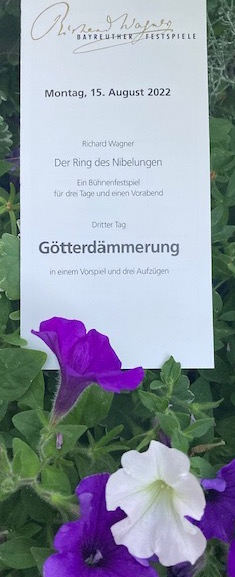
GÖTTERDÄMMERUNG / O CREPÚSCULO DOS DEUSES / THE TWILIGHT OF THE GODS, Festival de Bayreuth / Bayreuther Festspiele, Agosto / August 2022

(review in English below)

O Crepúsculo dos Deuses começa no quarto de Siegfried e Brünhilde que têm um filho. As 3 Norns aparecem vestidas como seres fantasmagóricos, elementos de um sonho da criança, outra novidade desta encenação. Na sala abastada dos Gibichung, encimada por uma fotografia de caça "pesada" (à zebra) do Hagen, Gunter e Gutrune, Hagen põe em prática o seu plano de casar Brünhilde com Gunter e Gutrune com o Siegfried. O Gunter tem escrito na camisola “Who the fuck is Grane?”, mesmo antes de conhecer a Brünhilde e o seu companheiro humano (Grane seria originalmente o cavalo). A frase diz muito da abordagem do encenador. Para conseguir os seus intentos, a poção mágica preparada não é bebida pelo Siegfried, mas antes derramada sobre a cabeça do Grane. Novamente nos aposentos do casal, o diálogo entre a Waltraute e a irmã Brünhilde não conduz a nada de concreto e Gunter maltrata a criança e amarra-a à cadeira. Um desenho da máscara alada encarnada volta a aparecer.


No 2º acto Hagen luta com o pai Alberich num recinto de boxe. Ao convocar os vassalos para receberem os novos casais, aparecem os membros do coro vestidos de negro e com as máscaras aladas encarnadas em bastões, num dos momentos de maior impacto visual de todo o Anel. 


O 3º acto passa-se numa piscina vazia, mas onde Siegfried e o filho pescam à linha. Hagen continua a comportar-se como amigo do Siegfried, mas mata-o com uma punhalada nas costas. Ele fica caído no local até a ópera terminar. A marcha fúnebre, magnificamente interpretada pela orquestra, não é marcha nem é acompanhada de qualquer acção no palco. Pelo menos podemos concentrar-nos totalmente num dos momentos mais belos e marcantes da música de todo o Anel. 

O Gunter deixa um saco de plástico na piscina e desaparece. A criança acaba também por morrer com uma das máscaras encarnadas na mão. A morte da Brünhilde acontece com ela deitada ao lado do Siegfried, depois de se ter regado, inconsequentemente, com gasolina, e de ter ido buscar ao saco deixado por Gunter a cabeça do Grane, e com ela estabelecer contacto íntimo (por momentos pensei estar a ver a cena final da Salome de Strauss, mas não, foi mesmo o fim do Crepúsculo dos Deuses!). Não houve qualquer fogo nem destruição visível do Valhalla. A ópera termina como começou, com o filme dos dois gémeos in utero, desta vez abraçados um ao outro.


A Orquestra foi excelente e o maestro Cornelius Meister fez um bom trabalho, embora com algumas inconsistências. Houve no público quem não tenha gostado, dado que foi bastante vaiado.


O tenor Stephen Gould foi um bom Siegfried, voz poderosa, afinada, sempre sobre a orquestra. O barítono Albert Dolmen tem um papel muito importante como Hagen e foi um dos melhores da noite. Para além da excelente interpretação vocal, representou como um ser pérfido, como lhe competia. No final não morre, apenas sai de cena. O seu pai Alberich foi novamente bem cantado pelo barítono Ólafur Sigurdarson. Michael Kupfer-Radecky foi outro barítono excelente como Gunter, interpretando uma personagem tonta e desequilibrada. 

A Brünhilde voltou a ser a soprano Iréne Teorin que, cantando alto, manteve os problemas da ópera anterior, vibrato excessivo e estridência no registo mais agudo. Excelente foi a soprano Elisabeth Teige como Gutrune (já tivera uma interpretação notável como Freia), de voz clara, versátil, bonita e sempre audível sobre a orquestra. A mezzo Christa Mayer voltou a impressionar pela qualidade interpretativa, desta vez como Waltraute. As 3 Norns foram fantásticas (Okka von der Dammerau, Stéphanie Müther e Kelly God) e as 3 Filhas do Reno não lhes ficaram atrás (Lea-ann Dunbar, Stephanie Houtzeel, Katie Stevenson).

Um naipe de cantores de topo para encerrar um Anel memorável!


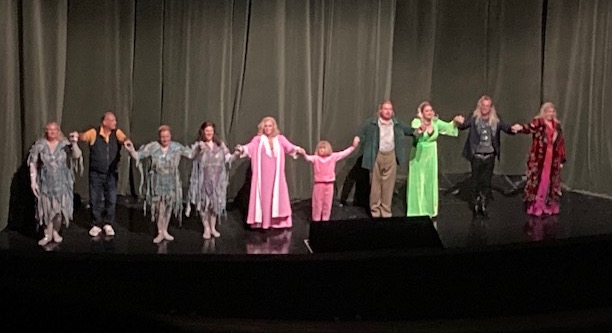
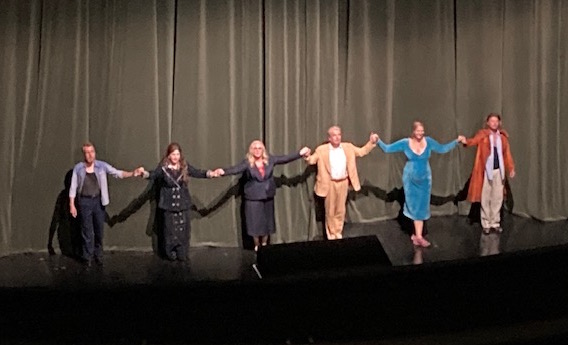
No final houve grandes protestos, alternados com aplausos, inicialmente penso que dirigidos à encenação. Os cantores foram muito ovacionados, com excepção de Iréne Teorin que, no meio dos aplausos, também ouviu muitos boos. O maestro foi também contestado, os protestos competiram com os aplausos. O responsável pela produção, Valentin Schwarz, não teve a coragem de aparecer, antecipando a vaia monumental que ouviria, como aconteceu na semana anterior na estreia, dizem que a maior alguma vez ouvida em Bayreuth.

Não tenho nada contra as encenações modernas, desde que se percebam e façam sentido. Não foi para mim o caso deste inesquecível Anel que está muito distante do que Wagner escreveu. Mas mais tarde voltarei ao assunto.

****

GÖTTERDÄMMERUNG / THE TWILIGHT OF THE GODS, Bayreuther Festspiele, August 2022

The Twilight of the Gods begins in the bedroom of Siegfried and Brünhilde who have a child. The 3 Norns appear dressed as phantoms, elements of the child's dream, another novelty of this staging. In the Gibichungs' rich living room, topped by a zebra-hunting photograph of Hagen, Gunter and Gutrune, Hagen puts into practice his plan to marry Brünilde to Gunter and Gutrune to Siegfried. Gunter has written “Who the fuck is Crane?” on his shirt, even before he met Brünhilde and her human companion (Grane is originally a horse). The phrase says a lot about the scenic approach. To achieve his aims, the magic potion is not drunk by Siegfried, but poured over Grane's head. Back at the couple's house, the dialogue between Waltraute and her sister Brünhilde leads nowhere and Gunter mistreats the child and ties her to the chair. A drawing of the red winged mask reappears.

In the 2nd act Hagen fights with his father Alberich in a boxing arena. When summoning the vassals to receive the new couples, the members of the choir appear dressed in black and with red winged masks, in one of the moments of greatest visual impact in the entire Ring.

The 3rd act takes place in an empty swimming pool, but where Siegfried and his son are fishing by line. Hagen kills Siegfried with a stab in the back. He lies there dead until the opera is over. The funeral march, magnificently performed by the orchestra, is not a march, unaccompanied by any action on stage. At least we can fully focus on one of the most beautiful and memorable moments of music in the entire Ring. Gunter leaves a plastic bag in the pool and disappears. The child also ends up dying with one of the winged red masks in his hand. Brünhilde's death happens with her lying next to Siegfried, after having showered herself with gasoline, inconsequentially, and having gone to get Grane's head from the bag and making intimate contact with it (for a moment I thought I was watching the final scene of Salome by Strauss, but no, that was the end of Twilight of the Gods!). There was no fire or destruction of Valhalla. The opera ends as it began, with the film of the two twins in utero, this time embracing each other.

The Orchestra was excellent and the conductor Cornelius Meistner did a good job, although with some irregularities, that some members of the public did not appreciate at all.

Tenor Stephen Gould was a good Siegfried, powerful voice, in tune, always over the orchestra. Baritone Albert Dolmen plays a very important role as Hagen and was one of the best of the night. In addition to the excellent vocal interpretation, he played the role as a perfidious being, as he was supposed to. In the end he doesn't die, he just leaves the scene. His father Alberich was again well sung by the baritone Olafur Sigurdarson. Michael Kupfer-Radecky, another excellent baritone as Gunter, despite playing a dizzy and unbalanced character.

Brünhilde was again soprano Iréne Teorin who, singing loudly, kept the problems of the previous opera, excessive vibrato and some stridency in the upper register. Elisabeth Teige was an excellent soprano (she had already had a remarkable performance as Freia), with a clear, versatile, beautiful voice that was always audible over the orchestra. Mezzo Christa Mayer impressed again for her interpretive quality, this time as Waltraute. The 3 Norns were fantastic (Okka von der Dammerau, Stéphanie Müther and Kelly God) and the 3 Daughters of the Rhine were not far behind them (Lea-ann Dunbar, Stephanie Houtzeel, Katie Stevenson).

A group of top singers to end a memorable Ring!

In the end there were big protests, alternating with applause, initially I think aimed at the staging. The singers received a great ovation, with the exception of Iréne Teorin who, in the midst of the applause, also heard a lot of boos. The conductor was also contested, the protests competed with the applause. Production manager Valentin Schwarz didn't have the courage to show up, anticipating the monumental booing he would hear, as happened last week at the premiere, said to be the biggest ever heard in Bayreuth.

I have nothing against modern staging, as long as they are perceived and make sense. This was not the case for me in this unforgettable Ring that is much far away from what Wagner wrote. But I will come back to the subject later on.

****

domingo, 14 de agosto de 2022

A VALQUÍRIA / DIE WALKURE, Bayreuther Festspiele, Agosto / August 2022


                                               (review in English below)


Se achei a encenação do Ouro do Reno difícil de perceber, nem sei o que dizer da Valquíria. Começa na casa (moderna) do Hunding e Sieglinde, que está em avançado estado de gravidez. Aparentemente o pai poderá ser o Hunding (?) mas não é o Siegmund. A tempestade avaria o quadro eléctrico que o Hunding tenta reparar ao longo de quase todo o período em que está acordado. Próximo do fim, o cenário muda e aparecem 2 quartos e 2 crianças que deverão ser o Siegmund e a Sieglinde na infância. No final, a Nothung não é uma espada, é uma pistola (mais uma) que é retirada de uma pirâmide iluminada de branco numa caixa que está presente também na opera anterior.


No 2º acto voltamos à casa dos deuses, onde decorre o velório da Freia (que se terá suicidado). Acentuam-se as relações problemáticas entre membros desta abastada família. Aparecem Siegmund e a Sieglinde e, quando esta está a dormir, Wotan tira-lhe as cuecas e introduz as mãos entre as pernas, dando a entender que será ele o pai da criança em gestação. Siegmund é morto pelo Wotan com um tiro de pistola à queima roupa, mas Hunding sai sem morrer em palco.


O 3º acto começa numa clínica de cirurgia plástica, onde as valquírias, para além dos tratamentos estéticos, bebem champanhe, trocam presentes caros e maltratam as e os empregados. Brünhilde aparece com a Sieglinde já com o filho nascido. Não morreu de parto. Vêm também acompanhadas do Grane que não é um cavalo mas um homem. Tudo se passa nesse cenário até quase o fim, quando Wotan fica sozinho, separado por uma cortina. A Brünhilde sai de cena e não há fogo nem nada de semelhante a isolá-la. Nos momentos finais aparece Fricka com um carrinho de bebidas alcoólicas e partilha uma com o Wotan, um gesto de aparente reconciliação, mas ele não aceita.


Tudo algo confuso, pouco consequente e com poucas ligações ao Ouro do Reno, o que causa ainda mais dificuldade em perceber a abordagem cénica. Wagner deve ter dado mais uma cambalhota no túmulo!

A Orquestra esteve óptima e a direcção do maestro Cornelius Meister foi boa, mas ocasionalmente lenta e sem por sempre em evidência os momentos mais emotivos.


Já em relação aos cantores, imperou a qualidade: O primeiro acto foi o melhor, com 3 cantores de excepção. O tenor Klaus Florian Vogt não tem uma voz heróica de heldentenor como outros mas escureceu a voz e a interpretação foi notável, quer em beleza, quer em emissão e emoção. Foi bem reconhecido pelo público, que o aplaudiu ruidosamente e por muito tempo. O Hunding do baixo Georg Zeppenfeld foi também excepcional. Voz grande, profunda, muito agradável e sempre bem audível acima da orquestra. 

A soprano Lise Davidsen foi colossal! Fez-me lembrar a Nina Stemme quando estava no auge e a ouvi na Brünhilde no Anel de Munique. Uma voz poderosíssima, bem timbrada, e a senhora canta, não grita. Foi, de longe, a mais aplaudida por este público conhecedor. As intervenções nos 2º e 3º actos foram avassaladoras! Que enorme Brünhilde aí virá!!

A mezzo Christa Mayer repetiu uma Fricka de óptima qualidade. O baixo-barítono Tomasz Konieczny foi um Wotan de voz segura e bem timbrada, excelente na emissão. Achei, contudo, pouco autoritário na sua condição de deus (talvez uma exigência desta interpretação cénica). A soprano Iréne Theorin foi uma Brünhilde bem audível, mas a voz está gasta e com um vibrato marcado e irritante. Talvez por isto tenha ouvido alguns boos, no meio dos aplausos.

Finalmente as valquírias foram globalmente muito boas: Kelly God (Gerhilde), Brit-Tone Müllertz (Ortlinde), Stephanie Houtzeel (Waltraute), Christa Mayer (Schwertleite), Daniela Köhler (Helmwige), Nada Dzidziguri (Siegrune), Marie Henriette Reinhold (Grimgerde) e Katie Stevenson (Rossweisse).


Veremos se na continuação do Anel a encenação de Valentin Schwarz se clarifica mais.

****


DIE WALKÜRE, Bayreuther Festspiele, August 2022

If I found the staging of Das Rheingold difficult to understand, I don't even know what to say about Valkyrie. It starts at Hunding and Sieglinde's (modern) house, which is in an advanced stage of pregnancy. Apparently the father could be Hunding (?) but not Siegmund. The storm breaks the electrical panel which Hunding tries to repair for most of his waking hours. Towards the end, the scenario changes and 2 rooms and 2 children appear, who must be Siegmund and Sieglinde in childhood. In the end, Nothung is not a sword, it is a pistol (another one) that is taken from an illuminated white pyramid in a box that was also present in the previous opera.

In the 2nd act we return to the house of the gods, where the wake of Freia (who has committed suicide) takes place. Problematic relationships between members of the wealthy family are accentuated. Siegmund and Sieglinde arrive and, when Sieglinde is sleeping, Wotan takes off her underwear and puts his hand upper between her legs, implying that he is the father of the unborn child. Siegmund is killed by Wotan with a pistol shot, but Hunding leaves without dying on stage.

The 3rd act begins in a plastic surgery clinic, where the Valkyries, in addition to aesthetic treatments, drink champagne, exchange expensive gifts and mistreat employees. Brünhilde appears with Sieglinde with her child already born. She didn't die in childbirth. They are also accompanied by Crane, who is not a horse but a man. Everything happens in this scenario until almost the end, when Wotan is alone, separated by a curtain. Brünhilde leaves the scene and there is no fire or anything similar to isolate her. In the final moments, Fricka appears with a cart of alcoholic drinks and shares one with Wotan, a gesture of apparent reconciliation, but he does not accept it.

All somewhat confusing and with few connections to Das Rheingold, which makes it even more difficult to understand the scenic approach. Wagner must have done another somersault in the grave!

The Orchestra was great and the direction of conductor Cornelius Meister was good, but occasionally slow and without always highlighting the most emotional moments.

As for the singers, top quality prevailed: The first act was the best, with 3 exceptional singers. Tenor Klaus Florian Vogt does not have a heroic heldentenor voice like others but he darkened the voice and the interpretation was remarkable, both in beauty and in emission and emotion. He was well recognized by the public, who applauded him loudly and for a long time. Bass Georg Zeppenfeld's Hunding was also exceptional. Big, deep voice, very pleasant and always well audible above the orchestra. 

Soprano Lise Davidsen was colossal! She reminded me of Nina Stemme when she was in her prime and I heard her as Brünhilde on the Munich Ring. A very powerful voice, excelent timbre, and she sings, not screams. She was by far the most applauded by this knowledgeable audience. The interventions in the 2nd and 3rd acts were overwhelming! What a huge Brünhilde here to come!!

Mezzo Christa Mayer repeated a Fricka of excellent quality. Bass-baritone Tomasz Konieczny was a Wotan with a strong and well-toned voice, excellent in emission. I found, however, little authoritative in his condition of god (perhaps a requirement of this scenic interpretation). Soprano Iréne Theorin was a very audible Brünhilde, but her voice is worn and with a marked and irritating vibrato. Maybe that's why she heard some boos, amidst the applause.

Finally, the Valkyries were overall very good: Kelly God (Gerhilde), Brit-Tone Müllertz (Ortlinde), Stephanie Houtzeel (Waltraute), Christa Mayer (Schwertleite), Daniela Köhler (Helmwige), Nada Dzidziguri (Siegrune), Marie Henriette Reinhold ( Grimgerde) and Katie Stevenson (Rossweisse).

We will see if in the continuation of The Ring, Valentin Schwarz's staging becomes more noticeable.

****
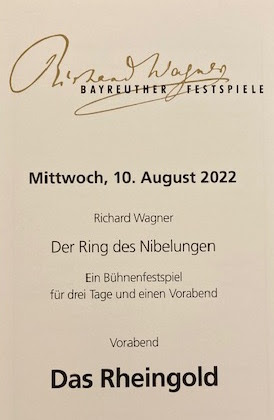
quinta-feira, 11 de agosto de 2022

O OURO DO RENO / DAS RHEINGOLD – Festival de Bayreuth / Bayreuther Festspiele, Agosto / August 2022

(review in English below)

A nova produção do Festival de Bayreuth do ciclo do Anel do Nibelungo de R Wagner foi encenada pelo jovem austríaco Valentin Schwartz. É uma encenação moderna, muito afastada da concepção de Wagner. Apenas assisti ainda à primeira ópera, o Ouro do Reno, que me deixou perplexidade e muitas dúvidas, que espero ver clarificadas com o decorrer do ciclo.


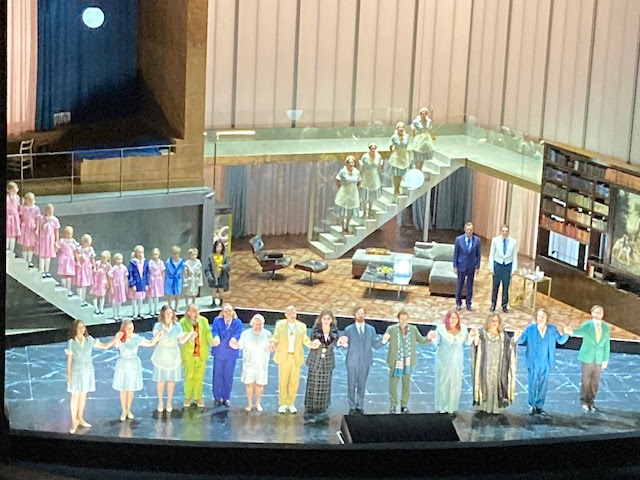
A ópera abre não nas águas do Reno mas com um filme de um liquido amniótico onde dois gémeos em gestação (Wotan e Alberich?) se agridem. A primeira cena passa-se numa pequena piscina onde Alberich é gozado pelas 3 filhas do Reno (empregadas de uma creche?) e por um grupo de 6 meninas loiras. Há uma 7ª criança, um rapaz de cabelos pretos e um boné amarelo e preto, com comportamento agressivo, que não se mistura com as restantes. No final é raptado pelo Alberich. Não há ouro, como não há nenhum dos outros adereços tradicionais da obra.

A 2ª e a 4ª cenas passam-se numa sala moderna, na garagem e num quarto anexo. Todos são personagens familiares muito abastados que interagem uns com os outros, há muitos criados e criadas mas não fazem nada. O Wotan é loiro, de calções. O Donner é jogador de golfe. Os gigantes, cabelos pretos, são os ocupantes do carro e parecem 2 mafiosos. É tudo muito estático. Claro que não há fogo nem elmo nem espada, apenas pistolas, muitas.

A 3ª cena é a mais bizarra para mim. O Nibelheim é uma creche envidraçada onde há 8 meninas loiras (serão as Valquírias?) a desenhar umas máscaras vermelhas aladas. São mal tratadas pelo rapaz de boné, que destrói os desenhos e grande parte do cenário, mas que aqui até parece ser filho de Alberich (será o Hagen em criança?). Enfim, muito difícil de entender, aparentemente sobre violência infantil, e qualquer semelhança com o original é mera coincidência. Veremos o que acontece nas próximas óperas...

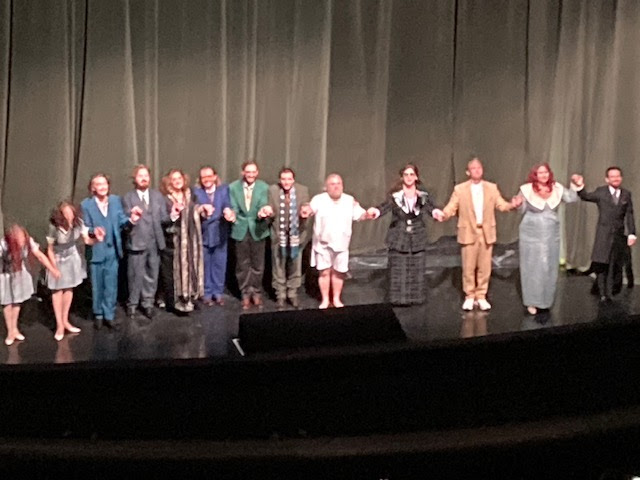
A orquestra excelente e o maestro Cornelius Meister também teve uma direcção muito boa, mas muita gente não gostou. No final foi muito vaiado, no meio dos aplausos.

Os cantores muito bons, como seria de esperar. Admirei especialmente a soprano Elisabeth Teige (Freia) com uma voz brutal e bem timbrada, a mezzo Christa Mayer foi uma Fricka muito correcta e expressiva, e a mezzo Okka von der Damerau (Erda) também se impôs pela qualidade. 

O baixo Egils Silins foi um Wotan correcto mas de voz algo desgastada, o barítono Ólafur Sigurdarson foi um Alberich muito expressivo tanto no desempenho cénico (e a sua parte é exigente) como no vocal e o tenor Arnold Bezuyen fez um Mime excelente. O baixo Wilhelm Schwinghammer esteve bem como Fafner, qualitativamente acima do outro gigante, o baixo Jens-Erik Aasbo (Fasolt). 

Num patamar inferior esteve o baixo-barítono Raimund Nolte (Donner), o tenor Attilio Glaser (Froh) e, sobretudo, o tenor Daniel Kirch (Loge) que por vezes quase se não ouvia. Finalmente as 3 Filhas do Reno Lea-ann Dunbar (Woglinde), Stephanie Houtzeel (Wellunde) e Katie Stevenson (Flossilde) foram óptimas.


****
DAS RHEINGOLD  / THE RHEIN GOLD– Bayreuth Festival, August 2022

The new Bayreuth Festival production of the Ring of the Nibelung cycle was staged by the young Austrian Valentin Schwartz. It is a modern staging, far away from Wagner's conception. I only watched the first opera, Das Rheingold, which left me with perplexity and many doubts, which I hope to see clarified as the cycle progresses.

The opera opens not on the waters of the Rhine but within an amniotic fluid film in which two unborn twins (Wotan and Alberich?) attack each other. The first scene takes place in a small swimming pool where Alberich is teased by 3 daughters of the Rhein (employees at a daycare centre?) and by a group of 6 blonde girls. There is a 7th child, a boy with black hair and a yellow and black cap, with aggressive behavior, which does not mix with the others. In the end he is kidnapped by Alberich. There is no gold, as there are none of the work's other traditional props.

The 2nd and 4th scenes take place in a modern room, in the garage and in an annex bedroom. All are rich familiar characters that interact with each other, there are many maids but they do nothing. Wotan is blond, in shorts. Donner is a golfer. The giants, black hair, are the occupants of the car and look like 2 mobsters. It's all very static. Of course there is no fire or helmet or sword, only pistols, lots of them.

The 3rd scene is the most bizarre for me. The Nibelheim is a glassed-in daycare where there are 8 blonde girls (the Valkyries?) designing winged red masks. They are badly treated by the boy in the cap, who destroys the drawings and a large part of the scenery, but who here even seems to be Alberich's son (Hagen as a child?). Anyway, very difficult to understand, apparently about child violence, and any resemblance to the original is purely coincidental. We'll see what happens in the next operas...

The excellent orchestra and conductor Cornelius Meister also had a very good direction, but a lot of people didn't like it. In the end there was a lot of booing, amidst the applause.

The singers very good, as you would expect. I especially admired the soprano Elisabeth Teige (Freia) with a fabulous and well-timbred voice, mezzo Christa Mayer was a very correct and expressive Fricka, and mezzo Okka von der Damerau (Erda) also stood out for her quality.

Bass Egils Silins was a correct Wotan but with a slightly worn voice, baritone Ólafur Sigurdarson was a very expressive Alberich both in the scenic performance (and his part is demanding) and in the vocal and  tenor Arnold Bezuyen was an excellent Mime. Bass Wilhelm Schwinghammer was fine as Fafner, qualitatively above the other giant, bass Jens-Erik Aasbo (Fasolt).

On a lower level of quality were bass-baritone Raimund Nolte (Donner), tenor Attilio Glaser (Froh) and, above all, tenor Daniel Kirch (Loge), who was sometimes barely heard. 

Finally the 3 Daughters of the Rhein Lea-ann Dunbar (Woglinde), Stephanie Houtzeel (Wellunde) and Katie Stevenson (Flossilde) were great.

****

segunda-feira, 27 de agosto de 2018

TRISTÃO E ISOLDA / TRISTAN UND ISOLDE, Bayreuth, Agosto / August 2018


(Review in English below)

Direcção musical – Christian Thielemann
Encenação – Katharina Wagner
Tristan – Stephen Gould
Marke –Georg Zeppenfeld
Isolde – Petra Lang
Kurwenal – Iain Paterson
Melot – Raimund Nolte
Brangäne – Christa Mayer

O Tristão e Isolda encerrou este meu ano em Bayreuth. A abertura foi algo rápida de mais e um pouco agressiva para o meu gosto mas o que se seguiu é trabalho de um verdadeiro génio da batuta como o Thielemann... uma intensidade dramática e uma precisão impressionantes!!!

Vocalmente estiveram todos a um nível estratosférico! A grande surpresa foi a Brangane da Christa Mayer (uma Magdalene excelente nos Mestres Cantores de Nuremberga) que fez um papel poderosíssimo. Que voz de mezzo brilhante!

A Petra Lang e o Stephen Gould estão incríveis. No 1º acto, a cena do Tristan... Isolde... (aqui não bebem mas jorram de mão dada o filtro sobre as outras) foi de uma intensidade e beleza vocal ímpar... a suavidade com que cada nome saiu da laringe de cada um deles derrete qualquer um!

No 2º acto o mais perfeito O sink hernieder... que eu já ouvi ao vivo ou em gravação. E com a óbvia grande contribuição de Thielemann. Zeppenfeld colossal (como já tenho dito, ele e o Groissbock são os melhores baixos wagnerianos da actualidade)!

Gould foi incansável e imparável no 3º acto, titânico, aliviando o quão pesaroso pode ser ouvir este acto por alguém que não cante e interprete como ele! Lang com um final estrondoso! Zeppenfeld parecia pouco emotivo mas compreendi porquê... Katharina Wagner coloca-o não simpático com a razão da traição de Tristão e com a sua morte, mas mantém-no marcado por essa mesma traição, em completo escárnio em relação a Tristão. Isolda “morre” para aquela relação com Tristão mas vive, arrastada do palco, em mão, por Marke.


No global foi excelente, apenas diminuído pelo meu encarar da obra (não é a minha favorita…) e pelo lugar pouco convidativo na galeria (onde qualquer som “acessório” é amplificado) para uma encenação não necessariamente minimalista.

Mesmo da estação de comboios ainda é possível um adeus (quiçá até para o ano...) à “Colina Verde”...


Texto de wagner_fanatic


TRISTAN UND ISOLDE, Bayreuth, August 2018

Musical direction - Christian Thielemann
Production - Katharina Wagner
Tristan - Stephen Gould
Marke - Georg Zeppenfeld
Isolde - Petra Lang
Kurwenal - Iain Paterson
Melot - Raimund Nolte
Brangäne - Christa Mayer

Tristan and Isolde ended my year in Bayreuth. The opening was a bit too fast and a bit aggressive for me but what followed is the work of a true genius of the baton like Thielemann ... dramatic intensity and stunning precision!!!

Vocally all have been on a stratospheric level! The big surprise was Christa Mayer's Brangane (an excellent Magdalene in Die Meistersinger von Nurnberg) who performed a very powerful role. What a brilliant mezzo voice!

Petra Lang and Stephen Gould were amazing. In the 1st act, the scene of Tristan ... Isolde ... (here they do not drink but hand jets given the filter over the others) was of an unique intensity and vocal beauty... the softness with which each name left the larynx of each of them melts either!

In the 2nd act the most perfect O sink hernieder ... I've heard live or in recording. And with the obvious great contribution of Thielemann. Colossal Zeppenfeld (as I have said, he and Groissbock are the best Wagnerian basses today)!

Gould was tireless and unstoppable in the 3rd act, titanic, relieving how sorry it can be to hear this act by someone who does not sing and interpret like him! Lang with a booming end! Zeppenfeld seemed unemotional but I understood why ... Katharina Wagner makes him unfriendly with the reason for Tristan's betrayal and his death, but keeps him scarred by this same betrayal, in complete derision of Tristan. Isolde "dies" for that relationship with Tristan but lives, dragged from the stage, in hand, by Marke.

Overall it was excellent, only diminished by my view of the work (not my favorite ...) and by the uninviting place in the gallery (where any "accessory" sound is amplified) for a non-minimalist staging.

To say goodbye, the railway station.

Text by wagner_fanatic.

quinta-feira, 21 de maio de 2015

DER FLIEGENDE HOLLÄNDER / O NAVIO FANTASMA – Semperoper Dresden, Maio / May 2015


(review in English below)

Visitei pela primeira vez a Semperoper de Dresden e, com sorte, pude assistir à apresentação de uma opera de R Wagner, O Navio Fantasma (Der Fliegende Holländer).


A encenação de Florentine Klepper, muito vistosa, foi das mais bizarras que vi. O início é magnífico, com imagens no palco e projecção de uma tempestade onde voam aves negas, a condizer perfeitamente com a belíssima música da abertura. Na penumbra vê-se uma criança de costas.


Fotografias de Matthias Creutziger (Semperoper Dresden)

É Senta em criança, que acompanha Senta adulta no funeral do pai, Daland. Há sempre 2 Sentas presentes e toda a ópera é o reviver do passado da criança.
Não há navios em palco mas uma grande empresa de pesca e é nesse meio hostil que Senta vive.


A criança recolhe uma ave negra morta das que esvoaçam o palco e tem o primeiro encontro com a figura mística protectora do Holandês, que tem um braço com penas negras.


O pai Daland negoceia e oferece-a ao Holandês. O 2º acto é totalmente disparatado. As fiandeiras são mulheres todas vestidas de igual, grávidas de termo, e é a Mary quem faz o parto a todas, numa cama colocada a meio do palco!


Talvez uma alusão ao papel menorizado da mulher naquela sociedade, de servir apenas para ser mãe, mas o efeito é péssimo. Também Erik sai debaixo da cama, noutro momento ridículo. No dueto com o Holandês, parece ser ele quem poderá salvar Senta, e não o contrário.


Mas tal não acontece, no final Daland está no leito de morte, Senta vestida de noiva (de negro) e todas as restantes grávidas e vestidas de noivas de branco.


Senta liberta-se do pai (que é enterrado), do Holandês e dessa sua vida traumática de infância.
A ópera termina com a Senta a partir para uma nova vida de mala na mão.

Dirigiu a Sächische Staatskapelle Dresden  e o Sächischer Staatsopernchor Dresden o maestro Constantin Trinks que nos ofereceu uma excelente audição.


O baixo austríaco Michael Eder foi um Daland com algumas dificuldades de afinação no início. Depois melhorou mas ficou sempre aquém do desejável, nomeadamente na potencia e musicalidade vocais

Senta foi superiormente interpretada pelo soprano norte americano Marjorie Owens que impôs a sua capacidade vocal e encheu a sala com a voz poderosa e expressiva.


O tenor austríaco Bernhard Berchtold esteve bem como Erik mas por vezes a voz foi submersa pela orquestra.


O contralto alemão Christa Mayer foi uma Mary de voz forte e agreste.


Simon Esper, tenor americano, foi um Steuermann muito agradável, de voz doce, afinada e melódica.


O Holandês foi interpretado pelo baixo-barítono alemão Markus Marquardt que nos ofereceu uma interpretação excelente, em potência e musicalidade vocais, associadas a uma presença em palco inexcedível.


Um espectáculo marcante.


****

DER FLIEGENDE HOLLÄNDER - Semperoper Dresden, May 2015

I first visited Semperoper Dresden and, with luck, could attend the presentation of an opera by R Wagner, Der Fliegende Holländer.
 The staging by Florentine Klepper, very showy, was the most bizarre I've seen. The beginning is magnificent, with images on stage and projection of a storm where black birds fly around, matching perfectly with the beautiful music of the opening. In the dim light one sees a child.
 It is Senta as a child, accompanying adult Senta on her father's (Daland) funeral. There are always the two Sentas throughout the opera and it is the revival of the child's past. There are no ships on stage but a large fishing factory and it is in this hostile environment that Senta lives.
The child picks up a dead black bird and has the first meeting with the protective mystical figure of the Dutchman, which has one arm with black feathers.
The father Daland negotiates and offers her to the Dutchman.
The 2nd act is completely ridiculous. The spinners are women all dressed the same, term pregnant, and Mary is the one who delivers all babies on a bed placed in the middle of the stage! Perhaps an allusion to the minor role of women in that society, serving only to be a mother, but the scenic effect is bad. Erik also appears from under the bed, another ridiculous moment. In duet with Senta, the Dutchman seems to be him who can save Senta, and not the opposite.
But this does not happen. At the end Daland is on his deathbed, Senta in a black wedding dress and all other women pregnant and in white bridal dresses. Senta is liberated from her father (who is buried), the Dutch and her traumatic childhood life. The opera ends with Senta to leave for a new life with a suitcase in hand.
 Conductor Constantin Trinks directed the Sächische Staatskapelle Dresden and the Sachischer Staatsopernchor Dresden who offered us an excellent performance.
 Austrian bass Michael Eder was a Daland with some tuning difficulties at the beginning. Afterword he improved but he was always away from the desired, particularly in the power and vocal musicality.
 Senta was superiorly interpreted by North American soprano Marjorie Owens who imposed her vocal capability and filled the room with powerful and expressive voice.
 Austrian tenor Bernhard Berchtold was a pleasant Erik but sometimes the voice was submerged by the orchestra.
 German contralto Christa Mayer was a strong and harsh voiced Mary.
 Simon Esper, American tenor, was a very nice Steuermann, with sweet, refined and melodic voice.
 The Dutchman was interpreted by German bass-baritone Markus Marquardt who offered us an excellent interpretation in power and vocal musicality, associated with an unsurpassed presence on stage.


****