Mostrar mensagens com a etiqueta Dolora Zajick. Mostrar todas as mensagens

quarta-feira, 5 de julho de 2017

DER FLIEGENDE HOLLÄNDER / O Navio Fantasma, METropolitan Opera, New York, Abril / April 2017


 (Review in English below)

A segunda opera de Wagner que a Metropolitan Opera House de Nova Iorque apresentou na presente temporada foi Der Fliegende Holländer.


A encenação de August Everding é magnífica. Abordagem clássica, o primeiro acto começa no convés do barco de Daland. Quando o timoneiro adormece, surge no meio da neblina a enorme proa do navio fantasma, donde o holandês desce numa escada. No segundo acto Mary supervisiona o trabalho das mulheres, incluindo o de Senta, filha de Daland que está impressionada com um retrato de um homem vestido de negro – o holandês. Erik vê o seu amor rejeitado por Senta que seguirá o holandês. Quando está sozinha este surge completamente vestido de negro, noutro efeito cénico estupendo. O terceiro acto passa-se no porto, sob neve e nevoeiro. O coro e movimentação dos marinheiros são magníficos. Quando Erik aborda a Senta, o holandês observa de cima e decide partir, subindo para o navio fantasma. Mais um momento visualmente impressionante. Sem dúvida uma das melhores encenações da ópera que alguma vez vi e acho que Wagner gostaria que assim fosse.

A direcção musical de Yannick Nézet-Séguin foi sublime em som e drama wagnerianos! Logo na abertura se percebeu que iríamos assistir a um espectáculo de excepção, e assim foi! O Coro e a Orquestra também a um nível estratosférico. James Levine fica muito bem substituído.


Daland foi superiormente interpretado pelo baixo Franz-Josef Selig, como aliás sempre aconteceu quando o vi. É daqueles cantores que não falha e, mais uma vez, assim aconteceu.


O barítono Michael Volle fez um Holandês perfeito. Falta-lhe no registo mais grave aquele tom cavernoso que sempre fica bem neste papel, mas o cantor compensa com uma interpretação notável em tudo. A voz é magnífica, potente, timbre belíssimo e técnica insuperável. Há partem que que quase fala, o que dá um tom mais sombrio à interpretação. Em palco é insuperável, uma figura sempre assustadora, muito ajudado pela encenação. O primeiro encontro com a Senta é paradigmático.


Verdadeiramente sensacional foi a soprano Amber Wagner como Senta. Uma interpretação brutal, ao nível dos grandes sopranos dramáticos wagnerianos. Uma cantora a seguir. Voz poderosíssima, sempre bem sobre a orquestra e de grande emotividade dramática. Melhor seria impossível. Fantástica! Diria que o apelido diz tudo.


A Mary da mezzo Dolora Zajick foi outra interpretação de grande nível, apesar de curta para uma cantora com os créditos de Zajick.


Duas agradáveis surpresas foram os jovens tenores norte americanos Ben Bliss como timoneiro e Aj Glueckert como Erik. Ambos muito bons, vozes frescas e límpidas, e interpretações cénicas dinâmicas e convincentes.


Um dos melhores espectáculos de ópera que vi na presente temporada.


*****


DER FLIEGENDE HOLLÄNDER, METropolitan Opera, New York, April 2017

The second Wagner opera that the Metropolitan Opera House of New York presented this season was Der Fliegende Holländer.

August Everding's staging is magnificent. Classical approach, the first act begins on the deck of Daland's boat. When the helmsman falls asleep, the huge prow of the ghost ship rises in the haze, where the Dutchman descends on a ladder. In the second act Mary oversees the work of the women, including that of Senta, daughter of Daland who is impressed by a portrait of a man dressed in black - the Dutchman. Erik sees his love rejected by Senta who will follow the Dutchman. When she is alone he appears completely dressed in black, in another top scenic effect. The third act takes place in the harbor, under snow and fog. The choir and sailors movements are magnificent. When Erik approaches Senta, the Dutchman watches from above and decides to leave, climbing to the ghost ship. Another moment visually impressive. Undoubtedly one of the best performances of this opera I have ever seen and I think this way was as Wagner would like it to be.

Musical direction of Yannick Nézet-Séguin was sublime in wagnerian sound and drama! At the opening we realized that we were going to see an exceptional performance, and it was! The Choir and Orchestra were also on a stratospheric level. James Levine will be very well replaced.

Daland was superiorly interpreted by bass Franz-Josef Selig, as always happened when I saw this singer. He is one of those singers that does not fail and, once again, it was so.

Baritone Michael Volle was a perfect Dutchman. He lacks in the lower record that cavernous tone that always isounds well in this role, but the singer compensated with a remarkable interpretation. The voice is magnificent, powerful, beautiful timbre and unsurpassed technique. There are parts where he almost speaked, which gave a darker tone to the interpretation. On stage he was unsurpassed, an always scary figure, greatly aided by staging. The first meeting with Senta was paradigmatic.

Truly sensational was soprano Amber Wagner as Senta. A sublime interpretation, at the top level of the great Wagnerian dramatic sopranos. She is a singer to follow. Powerful voice, always over the orchestra and great dramatic emotion. Better would be impossible. Fantastic! I'd say the name says it all.

Mary of mezzo Dolora Zajick was another high-level interpretation, though short for a singer with Zajick's credits.

Two pleasant surprises were the young North American tenors Ben Bliss as helmsman and Aj Glueckert as Erik. Both were very good, fresh and clean voices, and dynamic and convincing stage interpretations.

One of the best operas I've seen this season.


*****

sábado, 10 de outubro de 2015

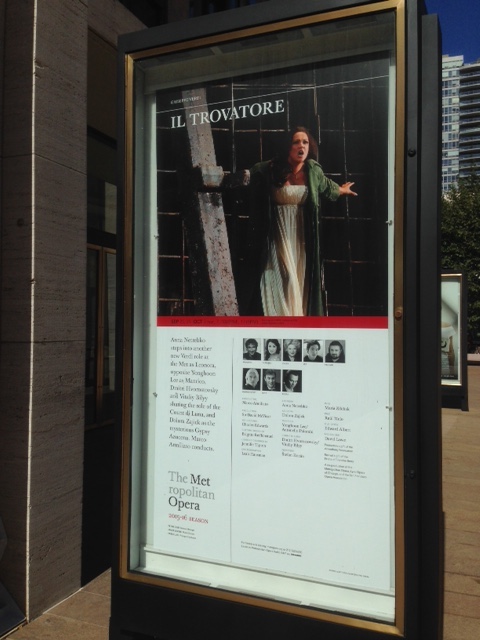
IL TROVATORE, METropolitan OPERA, Nova Iorque, Outubro 2015 / New York, October 2015

(review in English below)

Tive oportunidade de ver ao vivo a ópera Il Trovatore de G. Verdi na Metropolitan Opera, a mesma récita que foi transmitida em MetLive na Gulbenkian e que o camo_opera já comentou aqui.


Na praça em frente à Metropolitan Opera decorria uma muito pequena manifestação contra os cantores russos, por apoiarem a guerra na Ucrânia.


A reposição da encenação de David McVicar, é sempre agradável de ver porque tira o melhor partido do palco rotativo e dá um dinamismo particular a esta ópera sempre difícil de encenar.


Foi um excelente espectáculo, sob a direcção eficaz de Marco Armiliato. Orquestra e coro ao mais alto nível e os solistas foram fantásticos.


O tenor sul-coreano Yonghoon Lee foi um dos bons intérpretes da noite. Teve uma interpretação correcta, cénica e vocal. A voz tem um timbre claro, agradável e ouve-se sempre bem, embora no registo mais agudo perca alguma qualidade. O cantor é alto e magro, o que ajuda, embora não tenha qualquer parecença com um espanhol.


A Anna Netrebko já tem o estatuto de estrela que é aplaudida logo que entra em palco, mesmo antes de começar a cantar. Mais uma vez deslumbrou, aqui no papel de Leonora. Teve uma interpretação em crescendo, começando algo contida, mas revelando todo o esplendor da sua voz na difícil aria D’amor sull’ali rosee, onde foi insuperável. Continua a ser um privilégio ouvir a Netrebko que nunca grita e é detentora de uma voz lindíssima, potente, penetrante e afinada.


A Azucena do mezzo “da casa” Dolora Zajick é um papel que a artista canta com segurança e potência há várias décadas, mantendo uma qualidade aceitável.


Nos papéis secundários estiveram Stefan Kocan como Ferrando (excelente), Maria Zifchak como Ines e Raúl Melo como Ruiz.

Mas foi o baritono Dmitri Hvorostovsky (Conde di Luna) que foi o foco de todas as atenções nesta tarde. É um cantor carismático, detentor de uma bela voz e forte presença em palco. Cantou muito bem, com lirismo e dramatismo adequados à personagem, mas não foi isso que condicionou o que aconteceu.

Em Junho, Hvorostovsky anunciou que cancelaria toda a temporada de verão por lhe ter sido diagnosticado um tumor cerebral. Está em pleno tratamento, em Londres, mas interrompeu-o para vir à Metropolitan opera cantar as primeiras 3 das 10 récitas em que a sua presença estava prevista.
Logo que apareceu em palco, foi alvo de uma grande ovação. (Quando ia começar a cantar, tocou demoradamente um telemóvel!!). Foi sempre muito aplaudido durante o espectáculo mas seria no final que as demonstrações de afecto principais apareceriam. Terminada a ópera, foi longamente aplaudido de pé quando apareceu pela primeira vez nos agradecimentos.


Para além das flores do público, 


quando o maestro já estava no palco, empurrou-o para a frente para uma segunda ovação e foi então brindado com uma chuva de rosas brancas atiradas pelos membros da orquestra.


Atitudes bonitas, do cantor, dos músicos e do público. E não sei se haveria melhor local para a fazer que Nova Iorque, dada a constante generosidade do público para com os cantores.


Uma tarde para recordar.

*****


Il Trovatore - Met Opera, New York, October 2015

I had the opportunity to see live the opera Il Trovatore by G. Verdi at the Metropolitan Opera, the same performance that was broadcast on MetLive at the Gulbenkian Foundation and that camo_opera already commented here.

In the square in front of the Metropolitan Opera stemmed a very small demonstration against Russian singers, for supporting the war in Ukraine.

David McVicar staging is always nice to see because it takes full advantage of the rotating stage and gives a particular dynamism to this opera always difficult to stage.

It was an excellent performance, under the efficient direction of Marco Armiliato. Orchestra and choir were at the highest level and the soloists were fantastic.

South Korean tenor Yonghoon Lee was one of the good singers of the night. We had a correct approach, scenic and vocal. The voice has a light, pleasant timbre and it was always well heard, although in the upper register it lost some quality. The singer is tall and thin, which helps, but bears no resemblance to a Spanish.

Anna Netrebko already has the star status that is applauded as soon as she comes on stage, even before starting to sing. Once again she dazzled here in the role of Leonora. She had a performance in growing quality, starting contained, but revealing all the splendour of her voice in the difficult aria D’amor sull’ali rosee, where she was unsurpassed. It remains a privilege to hear Netrebko who never shouts and holds a beautiful, powerful, penetrant and tuned voice.

"House" mezzo-soprano Dolora Zajick was Azucena. This is a role that the artist sings with security and power for decades, and she maintains a high quality performance.

In supporting roles were Stefan Kocan as Ferrando (excellent), Maria Zifchak as Ines and Raúl Melo as Ruiz.

But it was Russian baritone Dmitri Hvorostovsky (Count di Luna) who was the focus of attention this afternoon. He is a charismatic singer, owner of a beautiful voice and strong stage presence. He sang very well, with lyricism and drama appropriate to the character. But that was not what has conditioned what happened.
In June, Hvorostovsky announced he would cancel the entire summer season by having been diagnosed with a brain tumor. He is now in full treatment in London, but interrupted it to come to the Metropolitan Opera to sing the first 3 of the 10 performances in which he was scheduled.

Once he appeared on stage, he was presented with a long ovation. (When he would start singing, a mobile phone was heard from the audience!!). He has always been applauded during the performance but the main demonstrations of affection would appear at the end. After the opera, he was received with a long standing ovation when he appeared for the first time. When the maestro was on stage, he pushed him forward to a second ovation and he was then the target of a rain of white roses thrown by the members of the orchestra.

Beautiful attitudes by the singer, the musicians, and the public. I do not know of a better place to do it other than New York, given the constant generosity of the audience towards singers.

An afternoon to remember.


*****

domingo, 4 de outubro de 2015

IL TROVATORE de Guiseppe Verdi — MET Live in HD, FCG, 3.10.15

(Review in English below)

A ópera em 4 actos Il Trovatore de Guiseppe Verdi foi estreada em 1853 em Roma. O libretista Salvadore Cammarano baseou-se na peça de Antonio García Gutiérrez El trovador. Contudo, a sua morte prematura em 1852, obrigou Verdi a convidar Bardare, poeta napolitano, para uma revisão do texto.

Trata-se de uma das mais conhecidas e representadas óperas de Verdi e é, sem dúvida, um marco do reportório italiano. Pessoalmente, não a considero das mais interessantes se atender apenas ao texto. Mas musicalmente é sublime. Poderão ler uma sinopse aqui.

Não se trata de uma nova produção, mas sim da reposição da clássica, sóbria e eficaz encenação de Sir David McVicar que situa a acção na Guerra Peninsular (1808-1814) contra as forças napoleónicas.


A Orquestra do Metropolitan foi dirigida pelo maestro italiano Marco Armiliato que já nos habitou a interpretações vívidas e enérgicas. Assim foi mais uma vez, adoptando um ritmo rápido e alegre ou pesado e dramático quando a partitura o exigiu.


O Coro do Metropolitan teve uma óptima prestação nomeadamente nas passagens mais conhecidas como, por exemplo, o Coro dos Ciganos.


Anna Netrebko foi Leonora. E foi magnífica. Não há muitas palavras para descrever a excelência da voz e das suas interpretações sem mácula. O privilégio é de todos nós que podemos acompanhar a carreira brilhante desta montanha mágica do canto.


Dolora Zajick foi uma Azucena perfeita, aliás como já nos habitou há muitos anos. Voz poderosa, interpretação sentida e negra. Encarnou magnificamente a personagem.


Yonghoon Lee foi um Manrico fraco. Não gosto do timbre da sua voz, que é amorfo e sem vida, nem da capacidade de interpretação. Abusou do falsete para minimizar a sua dificuldade para atingir os agudos vivos e pujantes que a obra exige. Apesar de tudo, melhorou depois do Di quela pira. Mas, tendo em conta que cantava Netrebko, esta merecia melhor acompanhante.


Dmitri Hvorostovsky foi um Conte de Luna estupendo. Depois de recuperado de uma doença, apresentou-se numa forma invejável. É um dos melhores barítonos verdianos da actualidade e, mais uma vez, o demonstrou. E essa sua qualidade foi acolhida com um entusiasmo pouco comum pelo simpático público nova-iorquino.


Stefan Kocán foi Ferrando. Voz grave, profunda e quente, teve uma muito boa performance.

Maria Zifchak foi uma Inês de boa qualidade. O mesmo se pode dizer dos restantes intervenientes: Edward Albert (velho cigano), David Lowe (mensageiro) e Raúl Melo (Ruiz).

Foi, pois, mais uma tarde de ópera extraordinária e para reter na memória.

----------
(Review in English)

The opera in four acts Il Trovatore of Giuseppe Verdi was premiered in 1853 in Rome. Salvadore Cammarano based his libretto on the play by Antonio García Gutiérrez El trovador. However, his untimely death in 1852, forced Verdi to invite Bardare, Neapolitan poet, for a revision of the text.

Il Trovatore is one of the most known and represented Verdi's operas and is undoubtedly a landmark of the Italian lyric repertoire. I personally do not consider this opera the most interesting if we attend only the text. But musically it is sublime. You can read a synopsis here.

It is not a new production, but rather the replacement of classical, sober and effective staging of Sir David McVicar which places the action in the Peninsular War (1808-1814) against the Napoleonic forces.

The Metropolitan Orchestra was led by Italian conductor Marco Armiliato who already dwelt in the vivid and forceful interpretations. So it was again, adopting a fast and happy, or heavy and dramatic pace when the score required.

The Metropolitan Choir had a great performance especially in the most famous passages like, for example, the Chorus of Gypsies.

Anna Netrebko was Leonora. She is magnificent. There are no words to describe the excellence of her voice and her interpretations. The privilege belongs to us all that can follow the brilliant career of this magical mountain of lyrical singing.

Dolora Zajick was a perfect Azucena, in fact she is the best Azucena of the last many years. Powerful voice, dark interpretation, she magnificently embodied the character.

Yonghoon Lee was a weak Manrico. I do not like the tone of his voice, which is amorphous and lifeless, or his playability. He abused of falsetto to minimize his difficulty to achieve the living and thriving acute that the work requires. After all, he improved a bit after Di quela pira. But Netrebko was singing, so she deserved a better companion.

Dmitri Hvorostovsky was a stupendous Conte di Luna. After recovering from an illness, he presented himself in a prime shape. He is one of the best Verdi baritone voices of our times, and again he demonstrated it. He was warmfully greeted with an unusual enthusiasm by the friendly Met audience.

Stefan Kocan was Ferrando. Deep voice, dark and warm, he had a very good performance.

Maria Zifchak was an Ines of good quality. The same is true for the other minor roles: Edward Albert (old Gypsy), David Lowe (messenger) and Raúl Melo (Ruiz).


So it was another extraordinary afternoon of opera that will be retained in our memory.