Mostrar mensagens com a etiqueta Michael Fabiano. Mostrar todas as mensagens

quinta-feira, 24 de novembro de 2022

TOSCA, METropolitan OPERA, New York, Outubro / October 2022

(review in English below)

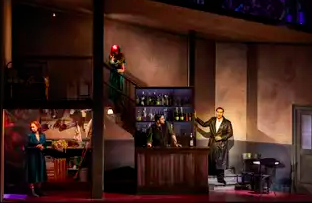
A Tosca de G Puccini voltou a ser posta em cena na Metropolitan Opera de Nova Iorque, na magnífica e sumptuosa produção de David McVicar que, depois da curta e muito má recepção da anterior encenação desta ópera (da autoria de Luc Bondy, muito feia e um perfeito exemplo do eurotrash que, por estes lados, não é nada apreciado) mostrou ser capaz de fazer uma abordagem clássica com a mesma qualidade de outras mais modernas que tem assinado.


Dirigiu a Orquestra (que, surpreendentemente, não esteve isenta de falhas, sobretudo nos metais) o maestro Carlo Rizzi. O Coro foi excelente.


A soprano Aleksandra Kurzak foi uma Tosca magnífica, tanto na representação cénica como vocal. Tem uma voz muito bonita, agudos seguros e não forçados e ouve-se sempre sobre a orquestra. Foi, de longe, a melhor da noite.

O tenor Michael Fabiano cumpriu o papel de Cavaradossi sem grande brilho vocal. Em cena esteve bem, mas a emissão foi por vezes irregular e tem um timbre algo agreste.

O Scarpia do barítono George Gagnidze foi muito ajudado pela encenação mas o cantor foi muito estático, algo monocórdico, pouco emotivo e sempre que a orquestra tocava mais alto, deixava de se ouvir. 

Nos papéis secundários, com interpretações correctas mas sem impressionar, estiveram Kevin Short (Cesare Angelotti), Patrick Carfizzi (Sacristão), Rodell Rosel (Spoletta), Christopher Job (Sciarrone) e Paul Corona (carcereiro). O pastor jovem foi Davida Dayle.


***

TOSCA, METROpolitan OPERA, New York, October / October 2022

G Puccini's Tosca was revived at the Metropolitan Opera in New York, in the magnificent and sumptuous production of David McVicar who, after the short and very bad reception of the previous staging of this opera (by Luc Bondy, very ugly and a perfect example of the eurotrash that, in these geographic areas, is not appreciated at all) has shown to be able to make a classic approach with the same quality as the more modern ones he has signed.

Conductor Carlo Rizzi directed the Orchestra (which, surprisingly, was not without faults, especially in the metals). The Choir was excellent.

Soprano Aleksandra Kurzak was a magnificent Tosca, both on stage and vocal representation. She has a very beautiful voice, steady and unforced highs and we always hear her over the orchestra. She was by far the best of the night.

Tenor Michael Fabiano interpreted the role of Cavaradossi without great vocal brilliance. On stage he was fine, but the singing was sometimes irregular and has a somewhat harsh tone.

Baritone George Gagnidze's Scarpia was greatly helped by the staging, but the singer was very static, somewhat monotonous, not very emotional and whenever the orchestra played louder, he stopped being heard.

In the supporting roles, with correct but unimpressive performances, were Kevin Short (Cesare Angelotti), Patrick Carfizzi (Sacristan), Rodell Rosel (Spoletta), Christopher Job (Sciarrone) and Paul Corona (gaoler). The young sheppard was Davida Dayle.

***

quinta-feira, 31 de outubro de 2019

MANON, METropolitan Opera, Outubro / October 2019


(review in English below)


A Metropolitan Opera de Nova Iorque voltou a levar à cena a Manon de Jules Massenet, uma ópera baseada no romance de Antoine-François Prévost L´Histoire du Chevalier Des Grieux et de Manon Lescaut, novela que também serviu de base à ópera Manon Lescaut de Puccini. Esta produção já foi comentada no blogue anteriormente.

A encenação de Laurent Pelly, simples e vazia, mas eficaz, traz a acção para o período da Belle Époque, cerca de século e meio após o romance ter sido escrito. No primeiro acto o cenário está encimado de casas em miniatura e uma escadaria que dá acesso à zona central do placo, sem adereços, onde grande parte da acção decorre. Na cena seguinte o quarto simples de Manon e Des Grieux está também colocado ao cimo de vários troços de escadas. Na primeira parte, Manon é uma jovem vestida de forma muito humilde e inocente. No 3º acto, nas margens do Sena, a encenação lembra um quadro de um pintor impressionista. Manon aparece na máxima exuberância (vestido, jóias e postura). Na cena seguinte, em Saint Sulpice, talvez a mais notável de toda a produção, dá-se o reencontro com Des Grieux, agora padre. Depois de uma rejeição inicial, Des Grieux não resiste e  Manon deita-se na cama austera do amante e despindo-lhe o hábito. Segue-se a cena do jogo, onde apenas há as mesas como objectos no palco, com as interpretações vocais a superarem as cénicas, mas o glamour mantém-se. Finalmente, o último quadro, é um contraste total com os anteriores. Manon, desfigurada, é arrastada pelo chão, pontapeada e ultrajada pelos guardas. Apenas uns candeeiros sóbrios de rua estão no palco. Morre nos braços de Des Grieux.


A direcção musical, desinteressante, foi do maestro Maurizio Benini.

A Manon foi interpretada pela soprano americana Lisette Oropesa, já vencedora este ano de dois prémios musicais. Teve uma interpretação de qualidade mas pouco emotiva. A voz é ágil, agradável, sobre a orquestra e com uma amplitude apreciável. Em cena esteve bem.


Des Grieux foi interpretado pelo tenor americano Michael Fabiano. Foi a melhor interpretação vocal em que o ouvi, porque foi constante na emissão e sempre audível. O problema é que a voz não tem cor, é “a preto e branco” e, por isso, não transmite emoção. É sempre entoada da mesma forma, quer nos momentos de alegria, quer nos de tristeza, quer nos de angustia. Nos duetos com a Oropesa não houve transmissão de qualquer sentimento de atracção ou paixão pela Manon, o que “matou” o espectáculo, que teve o momento mais confrangedor na cena em Saint Sulpice, (N'est-ce plus ma main).


Nos papéis secundários Guillot de Morfontaine foi interpretado de forma agradável pelo tenor italiano Carlo Bosi


o barítono canadiano Brett Polegato foi um De Brétigni de forma regular, 


mas o Lescaut foi interpretado ao mais alto nível  pelo barítono polaco Artur Rucinski, o melhor da noite,


e o Conde Des Grieux, também óptimo, pelo baixo sul coreano Kwangchul Youn.


As três”meninas”,  Jacqueline Echols (Poussette),  Laura Krumm (Javotte) e Maya Lahyani (Rosette) cumpriram também sem destoar.


***


MANON, METropolitan Opera, October 2019

The Metropolitan Opera of New York has once again presented Manon by Jules Massenet, an opera based on the novel by Antoine-François Prévost L'Histoire du Chevalier Des Grieux and Manon Lescaut, a novel that also served as the basis for the opera Manon Lescaut by Puccini. This production has been commented on the blog before.

Laurent Pelly's production, simple but effective, brings action to the Belle Époque period, about a century and a half after the novel was written. In the first act the scenery is topped with miniature houses and a staircase that gives access to the central area, without props, where much of the action takes place. In the next scene the simple bedroom of Manon and Des Grieux is also placed at the top of several sections of stairs. In the first part, Manon is a young girl dressed in a very humble and innocent way. In the third act, on the banks of the Seine, the performance resembles a painting by an impressionist painter. Manon appears in the most exuberance (dress, jewelry and posture). In the next scene in Saint Sulpice, perhaps the most remarkable of all the production, is the reunion with Des Grieux, now priest. After an initial rejection, Des Grieux does not resist and reconciliation takes place, laying Manon on his lover's austere bed and undressing his habit. This is followed by the game scene, where there are only tables as objects on stage, with vocal interpretations surpassing the scenic ones, but the glamor remains. Finally, the last scene is a total contrast to the previous ones. Manon, disfigured, is dragged across the floor, kicked and outraged by the guards. Only a few sober street lamps are on stage. She dies in Des Grieux's arms.

The musical direction, without interest, was by conductor Maurizio Benini.
Manon was performed by American soprano Lisette Oropesa, already this year's winner of two music awards. She had a quality interpretation but with few emotion. The voice is agile, pleasant, over the orchestra and of appreciable amplitude. On stage she was always fine.
Des Grieux was interpreted by American tenor Michael Fabiano. It was the best vocal interpretation in which I heard him, because he was constant in vocal emission and always audible. The problem is that the voice has no color, it is "in black and white" and therefore does not convey emotion. He always sings in the same way, whether in moments of joy or in sadness or in anguish. In the duets with Oropesa there was no transmission of any feeling of attraction or passion for Manon, which "killed" the show, which had the worst moment on the scene in Saint Sulpice, (N'est-ce plus ma main).

In supportiny roles Guillot de Morfontaine was played pleasantly by Italian tenor Carlo Bosi, Canadian baritone Brett Polegato played De Brétigni on a regular basis, but Lescaut was interpreted at the highest level by Polish baritone Artur Rucinski, the best of the night, and Count Des Grieux was also great by South Korean bass Kwangchul Youn.
The three 'girls', Jacqueline Echols (Poussette), Laura Krumm (Javotte) and Maya Lahyani (Rosette) were correct in their roles.

***

domingo, 4 de agosto de 2019

RIGOLETTO, Staatsoper unter den Linden, Berlin, Julho /July 2019


(texto de camo_opera)

Assisti também ao Rigoletto de Verdi. A orquestra foi dirigida por Andrés Orozco-Estrada e esteve em altíssimo nível, além de ter tido um respeito excelente pelos cantores.


A nova produção deste Rigoletto ficou a cargo de Bartlett Sher: que encenação! Clássica, simples, fluente e fluida. Tem tudo para ser uma referência na obra e por muitos anos. E foi a melhor encenação que vi desta obra até hoje. Também o coro se apresentou em grande nível.


A grande estrela da noite foi Nadine Sierra: não tem um volume enorme, mas tem uma técnica excelente e foi vocalmente perfeita. Teve um Caro nome divinal! Associa a isso, uma presença cénica muito carismática e uma figura mais do que adequada ao papel. É, sem dúvida, uma jovem a despontar e com grande futuro.


O Duca de Michael Fabiano foi uma desgraça: não tem agudos (bem se esforça por disfarçar o indisfarçável) e tem pouca presença, mas dá-se a ares de estrela. Evidentemente, no final, não estava satisfeito com a total ausência de entusiasmo do público que reagiu muito friamente ao seu aparecimento para os aplausos. A sorte, para não estragar a récita, é que ouvia outra voz no papel dentro da minha cabeça e imaginava-a lá.


Quem mais me surpreendeu foi Christopher Maltmann como Rigoletto: a voz tem uma enorme potência e, sem atingir o brilhantismo de um Nucci, foi um Rigoletto convincente cenicamente e vocalmente muito competente, pelo que ofereceu uma óptima prestação.


O Sparafucile de Jan Martinik, assim como a Maddalena de Elena Maximova estiveram bastante bem nos seus pequenos papéis, embora não tenha gostado particularmente dos timbres.


Foi uma muito boa récita, desde logo pela belíssima encenação e pela prestação de Nadine Sierra.


RIGOLETTO, Staatsoper Berlin, July 2019

I also watched Verdi's Rigoletto. The orchestra was directed by Andrés Orozco-Estrada and was at a very high level, in addition to having had an excellent respect for the singers.
The new production of this Rigoletto was in charge of Bartlett Sher: what staging! Classical, simple, fluent and fluid. It has everything to be a reference in the work and for many years. And it was the best staging I have seen of this opera until today. Also the choir performed at a great level.
The big star of the night was Nadine Sierra: she does not have a huge volume, but has an excellent technique and was vocally perfect. We heard a divine Caro nome! Associated with the singing, a very charismatic scenic presence and a figure more than adequate to the role. She is, without doubt, a young woman to emerge and with a great future.
The Duca by Michael Fabiano was a disgrace: he has no top notes (he well strives to disguise the undisguised) and has bad presence, but he gives the look of a star. Of course, in the end, he was not satisfied with the total lack of enthusiasm of the public that reacted very coldly to his appearance to the applause. Luckly, not to spoil the recital, was that I heard another voice in the role inside my head and imagined him there.
Who surprised me the most was Christopher Maltmann as Rigoletto: the voice has an enormous power and, without achieving the brilliance of Nucci, was a convincingly enigmatic Rigoletto and vocally very competent, so he offered a great performance.
Jan Martinik's Sparafucile as well as Elena Maximova's Maddalena did quite well in their small roles, though I did not particularly like the timbres.
It was a very good performance, right from the beautiful staging and the performance of Nadine Sierra.

quarta-feira, 26 de junho de 2019

FAUST, Royal Opera House, Londres / London, Maio / May 2019


(review in English below)

A Royal Opera House voltou a apresentar a encenação de David McVicar da opera Faust de C-F Gounod (libretto de Jules Barbier e Michel Carré). 


Esta produção já foi comentada no blogue aqui. Como referido então, a encenação é muito vistosa mas tem algumas bizarrias e uma cena orgiática de gosto muito duvidoso perto do final.


O maestro Dan Ettinger foi banal na direcção da orquestra que não esteve perfeita. Os cantores, com uma excepção, foram banais. E foram uma sombra em relação aos que vi e ouvi em 2011, num elenco de luxo: Vittorio Grigolo, René Pape, Angela Gheorghou e o saudoso Dmitri Hvorostovsky.


Michael Fabiano (Faust) tem uma má dicção do francês e canta com uma emissão algo irregular e teve manifestas dificuldades no registo mais agudo, quase cantou em falsete. Erwin Schrott (Méphistophélès), mais à vontade em palco, também não foi regular na linha de canto. Irina Lungu (Marguerite) que substituiu Diana Damrau, foi dura e nada expressiva. Carole Wilson (Marthe) e Germán Alcántara (Wagner) cumpriam sem impressionar. Contudo houve duas grandes interpretações, ao nível da qualidade habitual deste teatro, mas que não salvaram a récita, a jovem  Hongni Wu (Siébel), fantástica e Stéphane Degout (Valentin), excelente em cena, na interpretação vocal muito emotiva e sempre bem audível e, na verdade, o único que cantou em francês perceptível.


**


FAUST, Royal Opera House, London, May 2019

The Royal Opera House presented again David McVicar's staging of C-F Gounod's opera Faust (libretto by Jules Barbier and Michel Carré). This production has already been commented in the blog here. As stated then, the staging is very showy but has some bizarre and an orgiastic scene of very dubious interest near the end.

Conductor Dan Ettinger was banal in the direction of the orchestra that was not perfect. The singers, with one exception, performed without impressing. And they were a shadow over what I saw and heard in 2011, with a luxury cast: Vittorio Grigolo, René Pape, Angela Gheorghou and Dmitri Hvorostovsky.

Michael Fabiano (Faust) has a bad diction of French and sings with a somewhat irregular emission and had manifest difficulties in the top register, almost sang in falsetto. Erwin Schrott (Méphistophélès), more at ease on stage, was also not regular on the singing. Irina Lungu (Marguerite) who replaced Diana Damrau, was harsh and not expressive. Carole Wilson (Marthe) and Germán Alcántara (Wagner) performed without impressing. However, there were two top quality interpretations in the usual quality of this theater, but they did not save the performance: Hongni Wu (Siébel) was fantastic, and Stéphane Degout (Valentin), excellent on stage, in a very emotional and always well audible vocal performance and, in fact, the only one who sung in understandable French.

**