Mostrar mensagens com a etiqueta Matti Salminen. Mostrar todas as mensagens

domingo, 18 de agosto de 2013

DON CARLO, Salzburger Festspiele, Agosto / August 2013

(in english below)

Tivemos ontem a possibilidade de assistir a uma transmissão “quase” directa, pelo canal arte, da nova produção do Don Carlo de G. Verdi, do Festival de Salzburgo. Ouviu-se a versão francesa em 5 actos, traduzida para italiano, sem o ballet. É a minha ópera favorita do compositor e já foi comentada aqui e aqui e aqui.

A produção de Peter Stein é clássica, austera, minimalista, mas agradável. As personagens aparecem quase sempre vestidas de negro, excepto no Auto-de-Fé onde há colorido excessivo. Não se criam ambientes dramáticos, estes são deixados à actuação dos cantores, que os cumpriram na perfeição.

A Orquestra Filarmónica de Viena, o Coro da Ópera de Viena e os solistas foram dirigidos, novamente de forma soberba, pelo maestro Antonio Pappano.

A interpretação do Don Carlo pelo tenor alemão Jonas Kaufmann foi excepcional. Transmitiu de forma marcante o conflito psicológico da personagem, em cena foi sempre expressivo e emotivo. A interpretação vocal foi ao nível do que tem feito neste papel, que já vi ao vivo, absolutamente irrepreensível. A voz é segura e ampla em todos os registos, os agudos são fabulosos e alcançados na perfeição e sem esforço aparente. Ofereceu-nos uma interpretação em crescente e, nos últimos actos, foi excelente.

(Fotografia / Photo: Monika Ritterhaus)

 Também insuperável na qualidade interpretativa foi o soprano alemão Anja Harteros como Elisabetta. Tem uma amplitude vocal invulgar, um timbre muito bonito e mantém a qualidade em todos os registos. Os agudos são estratosféricos, impecavelmente afinados, sem nunca gritar, e os pianissimi são impressionantes. Na ária Tu che le vanità foi arrepiante.

(Fotografia / Photo: Monika Ritterhaus)

Outra cantora marcante foi o mezzo russo Ekaterina Semenchuk na princesa Eboli. A voz é muito poderosa, bela, forte no registo médio, com graves imponentes e agudos brilhantes. Em O don fatale foi insuperável.

(Fotografia / Photo: Monika Ritterhaus)

O barítono americano Thomas Hampson, não tendo a voz ideal para a personagem, foi um Rodrigo muito bom vocalmente e excepcional na interpretação dramática, que alcançou a expressão mais elevada quando é ferido mortalmente e canta O Carlo, ascolta.

(Fotografia / Photo: Monika Ritterhaus)

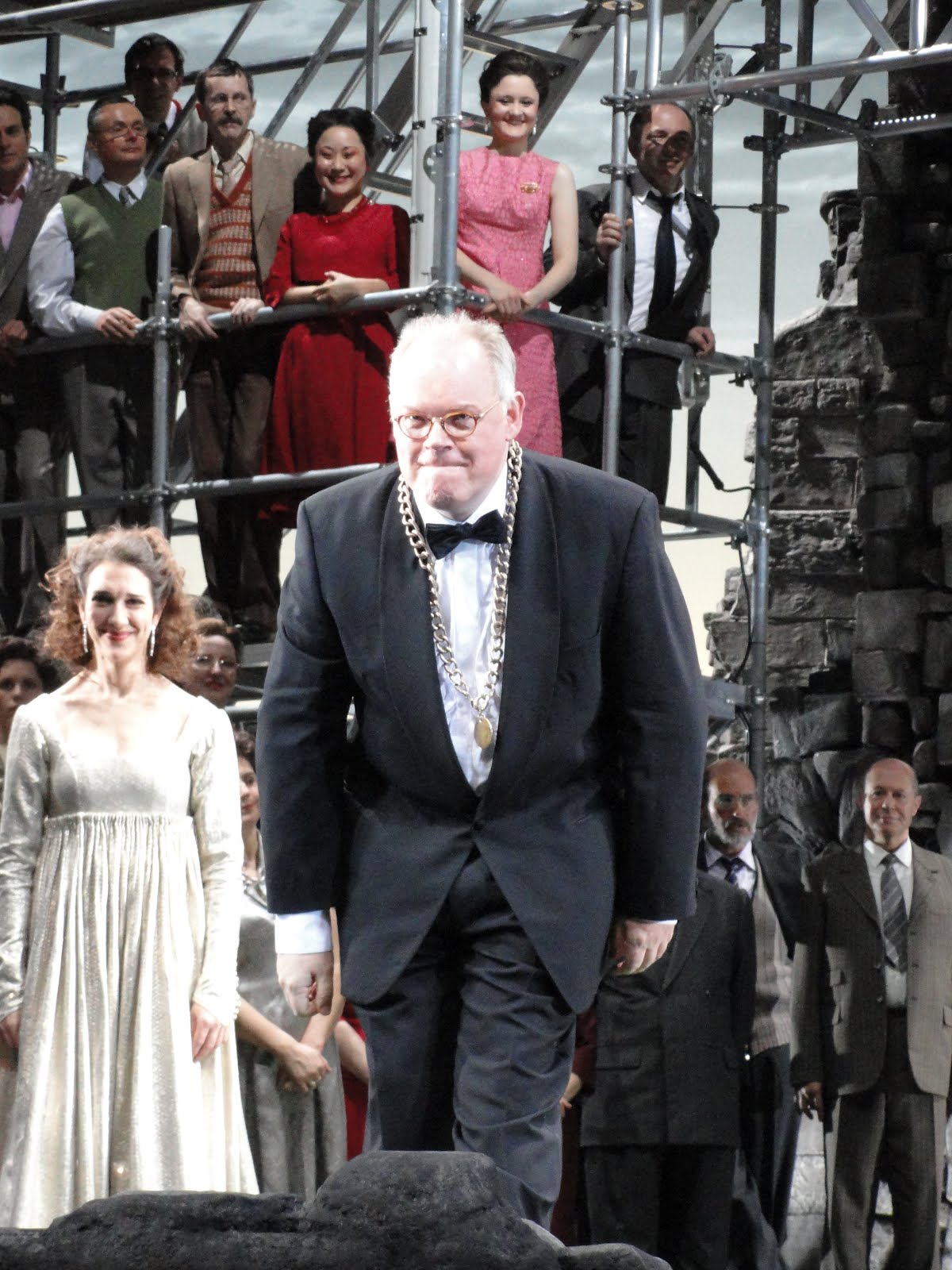
Matti Salminen, baixo finlandês, foi o rei Filippo II. É um cantor excelente embora vocalmente não tenha estado ao mesmo nível dos anteriores. Mas a interpretação dramática foi tocante e o monólogo Ella giammai m’amo e, depois, o dueto com o Grande Inquisidor foram marcantes.

(Fotografia / Photo: Monika Ritterhaus)

O baixo norte americano Eric Halfvarson foi um Grande Inquisidor duro e autoritário, de voz poderosa e impressionante. É um papel que interpreta frequentemente. Como referi, o dueto com Fillipo foi assinalável.

(Fotografia / Photo: Monika Ritterhaus)

Os cantores secundários também não destoaram. Um Don Carlo de grande qualidade.

****


DON CARLO, Salzburger Festspiele,  August 2013

Yesterday we had the opportunity to watch an "almost" direct broadcast, at arte tv, the new production of Don Carlo by G. Verdi for the Salzburg Festival. It was the French version in 5 acts, translated into Italian and without ballet. It's my favorite opera of the composer and it has been commented here and here and here..

The production by Peter Stein is classic, austere, minimalist but correct. The singers appear almost always dressed in black, except during the Auto-da-Fe where there are excessive colorful. The staging does not create dramatic atmosferes, these are left to the acting of the singers, who perfectly fulfilled them.

The Vienna Philharmonic, the Vienna State Opera Chorus and soloists were directed again superbly by Antonio Pappano.

The interpretation of Don Carlo by German tenor Jonas Kaufmann was exceptional. He transmitted well the psychological conflict of the character, on stage he was always expressive and emotive. The vocal performance was at the level of what he has made in this role, I have seen live, absolutely faultless. The voice is safe and wide in all registers, the top notes are fabulous and achieved flawlessly and without apparent effort. He offered us an interpretation in crescendo and in the last acts, was excellent.

Also unsurpassed in interpretive quality was German soprano Anja Harteros as Elisabetta. She has an unusual vocal range, very beautiful timbre and maintains quality in all registers. The top notes are stratospheric, impeccably tuned, she never screams, and the pianissimi are impressive. In the aria Tu che le vanità she was creepy.

Another striking singer was Russian mezzo Ekaterina Semenchuk the Princess Eboli. The voice is very powerful, beautiful, strong in the middle register, with impressive low notes and bright trebles.
O don fatale was unsurpassed.

American baritone Thomas Hampson, not having the ideal voice for the character, was a very good Rodrigo vocally and exceptional in dramatic interpretation, which reached the highest expression when he was mortally wounded and sang O Carlo, ascolta.

Matti Salminen, Finnish bass, was King Filippo II. He is a great singer vocally, though not at the same level as the previous. But the acting was touching and the dramatic monologue Ella giammai m'amo and then the duet with the Grand Inquisitor were striking.

North American bass Eric Halfvarson was a tough and authoritative Grande Inquisitor,  of powerful and impressive voice.
It is a role that he plays often. As mentioned, the duet with Fillipo was remarkable.

The other supporting singers were also good. A Don Carlo of great quality.

****

quinta-feira, 30 de maio de 2013

DER FLIEGENDE HOLLÄNDER, Zürich Opernhaus, Janeiro de 2013

(review in english below)

O Navio Fantasma (Der Fliegende Holländer) é uma das primeiras óperas de R. Wagner, escrita quando o compositor tinha 28 anos. É uma ópera romântica por excelência que, como outras que lhe seguiram, foi inspirada numa lenda nórdica. Mais curta que o habitual no compositor, é frequentemente apresentada sem intervalo, como foi o caso. A música é belíssima e de grande intensidade dramática.


O Holandês errante está condenado a navegar eternamente pelos mares, vindo a terra uma vez de sete em sete anos, na costa norueguesa, em busca de uma mulher que lhe seja fiel, o que nunca aconteceu. Daland, um capitão norueguês, em troca de ouro, oferece-lhe a mão da filha Senta que é amada por Erik mas que jura fidelidade ao Holandês. O final é trágico com o Holandês (julgando-se traído) a partir e naufragar e Senta a suicidar-se, saltando de um rochedo para o mar.


A encenação de Andreas Homoki é interessante. Transporta a acção para um escritório de navegação no início do Século XX. Todos os intervenientes, homens e mulheres, estão vestidos a rigor, de forma semelhante e de escuro. O Holandês surge como uma figura imponente, com um grande casaco negro e chapéu com penas. As fiandeiras trocam as rocas por máquinas de escrever. O palco é giratório. No centro aparece um mapa de África com os portos assinalados por setas. Há também um escravo negro. Em cima, está um relógio com ponteiros que vão avançando nas horas, ou recuando quando a narrativa è sobre o passado. No centro e nas paredes laterais dominam grandes quadros (hologramas) representando o mar que ora está calmo, ou ligeiramente ondulante ou muito agitado, consoante a acção retratada. O efeito cénico é bem conseguido. A única opção desajustada, para mim, foi a morte de Senta que, em vez de se lançar ao mar, mata-se com um tiro de espingarda.


O jovem maestro francês Alain Altinoglu dirigiu de forma superior a orquestra Philharmonia de Zurique. O Coro a Ópera de Zurique foi excepcional. E os solistas foram superlativos:


Bryn Terfel, barítono galês especialista em papéis wagnerianos e muito apreciado pelos autores deste blogue, não desiludiu. Foi um Holandês imponente e, como sempre, associou a sua excepcional qualidade vocal a uma presença marcante em palco. Penso que posso resumir de forma simples e clara se imaginar que Wagner teria gostado de ver esta sua ópera interpretada por um cantor deste calibre. Terfel é mais um caso que tem tudo, boa figura, voz magnífica e uma presença em palco insuperável.


Senta foi interpretada pelo soprano alemão Anja Kampe. É uma das minhas cantoras favoritas na actualidade e foi arrasadora! A voz é magnífica, de uma potência avassaladora e de grande beleza tímbrica. A tessitura é perfeita para o papel. Foi muito expressiva na personagem e acho que é impossível fazer melhor.

O Daland do baixo finlandês Matti Salminen foi também uma agradável surpresa pela consistência e qualidade interpretativas. Salminen, um sexagenário respeitável, é mais uma demonstração de que a idade mais avançada pode não ser sinal de decadência vocal, sobretudo nos baixos.

Marco Jentzsch, tenor alemão, foi um Erik de voz clara e limpa, bem audível e também com boa figura e presença cénica.

A Mary do jovem mezzo romeno Liliana Nikiteanu impressionou pela qualidade e projecção vocais. Apesar de bem caracterizada, este papel é habitualmente interpretado por cantoras mais velhas, o que em nada diminuiu a óptima prestação da intérprete.


Uma récita muito interessante!

****


DER FLIEGENDE HOLLÄNDER, Opernhaus Zürich, January 2013

The Flying Dutchman (Der Fliegende Holländer) is one of the first operas of R. Wagner, written when the composer was 28 years old. It is a typical romantic opera that, like others that followed, was inspired by a Nordic tail. Shorter than usual within the composer operas, it is often presented without intermission, as was the case. The music is beautiful and of great dramatic intensity.

The flying dutchman is eternally condemned to sail the seas, coming to earth once every seven years, to the Norwegian coast, in search of a woman who is faithful to him, which never happened before. Daland, a Norwegian captain, in exchange for gold, offers his daughter's hand, Senta, that is loved by Erik but who swears fidelity to the Dutch. The ending is tragic with the Dutch (suspecting that he was betrayed) leaving again to the sea and sank, and Senta killing herself by jumping from a cliff into the sea.

The staging of Andreas Homoki is very interesting. The action is in a shipping office at the beginning of the twentieth century. All actors, men and women, are dressed properly, identically and in dark outfits. The Dutchman emerges as an imposing figure, with a large black coat and a hat with feathers. The spinners exchange the rattles for typewriters. The stage rotates frequently. In the center is a big map of Africa with the ports indicated by arrows. There is also a black slave on stage. On top there is a clock that goes forward or, when a narrative about the past is mentioned, backword. In the center and side walls dominate large paintings of the sea. It is usually calm ans static, but, the waves either ondulate slightly or heavily, depending on the action portrayed. The scenic effect is magnificent. The only option that I did not like was the death of Senta, that instead of jumping into the sea, she killing herself with a shotgun blast.

 Young French conductor Alain Altinoglu directed Philharmonia Orchestra of Zurich. The Chorus of the Zurich Opera House. They were exceptional. And the soloists were superlatives:

Bryn Terfel, Welsh baritone, expert on Wagnerian roles and greatly appreciated by the authors of this blog, did not disappoint. He was an impressive Dutchman and, as always, associated his exceptional vocal quality to a remarkable presence on stage. I think I can summarize in a simple and clear way if I say that I imagine that Wagner would have liked to see his opera performed by a singer of this caliber.Terfel is another artist that has everything, good figure, magnificent voice and an unsurpassed stage presence.

Senta was interpreted by German soprano Anja Kampe. She is one of my favorite singers at present and she was overwhelming! The voice is magnificent, overwhelming power of a great beauty and timbre. It is perfect for the role. She was very expressive on stage and for me it is impossible to do better.


Finnish bass Matti Salminen’s Daland was also a pleasant surprised by the quality and consistency of the interpretation. Salminen, a respectable over 60 year old man, is a further demonstration that older age may not be a sign of vocal decadence, especially in bass singers.

Marco Jentzsch, German tenor, was a clear, clean voice and very audible Erik, also with good figure and good stage presence.

Young Romanian mezzo Liliana Nikiteanu impressed as Mary by the quality and vocal projection. Although well characterized, this role is usually played by older singers, which in no way diminished the optimal performance of the interpreter.

A very interesting performance!

****

segunda-feira, 12 de março de 2012

Die Meistersinger von Nürnberg - Zurich Opera House - 5 Fevereiro 2012


(review in english below)
Os Mestres Cantores de Nuremberga subiram ao palco da Ópera de Zurique numa nova produção de Harry Kupfer.


Falarmos desta encenação é, para mim, algo que tem de ser encarado em dois planos: primeiro, a direcção de actores que foi realmente excelente, com tudo tratado ao pormenor, o que enriqueceu a interpretação vocal de todos os intervenientes; no segundo plano temos o cenário como Kupfer o procura tornar dinâmico. É aqui que me parece que falha ou, pelo menos, não consegue ser totalmente feliz. Kupfer transporta os Mestres para o pós-grande guerra, em que a cena inicial e tradicional da igreja se passa dentro das muralhas de uma Catedral, com aspecto de ter sido destruída por bombardeamentos aéreos e já com andaimes para restauro (pode ser uma boa metáfora para a renovação da arte que se encerra nesta ópera).


Por detrás vê-se uma imagem projectada da cidade como fundo, com algumas gruas. Numa tentativa, do meu ponto de vista, de imitar Claus Guth, a Catedral assenta sobre um palco giratório pelo que toda a ópera se passa em várias visões destas ruínas da Catedral. Se no 1º acto isto funciona, porque classicamente a reunião dos Mestres é na Igreja, e também no final do 3º acto porque o interior se transforma no local do Festival do dia de São João, o mesmo já não é eficaz no 2º acto e início do 3º acto. A casa de Pogner, de acordo com a acção, é tida como nos andaimes de restauro, onde Lena disfarçada ouve Beckmesser na sua serenata, e não se vê referencia à casa de Sachs (que parece funcionar no vazio, em frente às ruínas).


À parte disto, existiram pormenores que considerei interessantes: todos os Mestres estão no coro inicial na Igreja e Sachs, ao sair vê que Eva está a interagir apaixonadamente com Walther; a forma como a paixão de Eva e Walther percorre toda a obra em termos cénicos e de forma tão evidente e sensível; como Eva acena com a cabeça para o público no festival e depois para os Mestres aquando do final da canção de Walther como que a pedir a aprovação de ambos os grupos para que este seja o vencedor; o facto de Sachs ser coroado no final (contra vontade) mas oferecendo depois a coroa a uma imagem de São João que destapa durante o monólogo final; e a reconciliação final com Beckmesser, selada com aperto de mão.


A grande estrela desta produção foi, sem dúvida, Michael Volle, na sua estreia no papel de Hans Sachs. Volle foi o maior Sachs que já vi ao vivo! Brutal! De arrepiar! Interpreta o papel de modo tão expressivo e natural que humaniza ainda mais o já humano Sachs. Não é um Sachs nada pensativo ou introspectivo na sua postura mas sim um indivíduo muito terra-a-terra que se impressiona pelo canto de Walther mas que transparece mais não o que este lhe provoca como sentimento mas reservando mais as emoções para os Mestres, incentivando-os a ouvir a canção e a esquecer as regras. É frequente a sua interacção com o público em diversas trocas de olhares e expressões sentidas, o que nos aproxima mais da personagem e facilita a sua compreensão. A minha grande dúvida é se esta caracterização é só de Volle, se é de Volle e Kupfer, ou só de Kupfer. Se for só de Volle, estamos na presença de um dos maiores Sachs de sempre; se for maioritariamente de Kupfer, pode-se perdoar as falências do cenário que já referi.


Roberto Saccà foi imbatível. Voz sublime, bela e com potência inigualável. O melhor Walther que já ouvi, também!


Juliane Banse, com a sua postura jovial, com cara de adolescente, jogou em grande sintonia interpretativa com Saccà; revelou apenas algum esforço vocal no quinteto do 3º acto mas globalmente foi excelente.


Martin Gantner foi um Beckmesser com mais dignidade do que é habitual ver noutras produções, não levando a personagem a uma postura demasiado ridícula, circense, no transmitir da sua arrogância e frivolidade. Vocalmente impecável, foi um dos pontos altos da récita. A lamentar a quase completa ausência de comédia nos seus movimentos quando vai a casa de Sachs e se depara com a canção escrita pela mão do sapateiro.


Matti Salminen, depois de um Gurnemanz aquém do esperado vocalmente, foi sublime como Pogner (também porque é um papel mais pequeno e tenha podido, no estadio da sua carreira, arriscar mais).


Peter Sonn fez um David com grande confiança vocal, embora com os harmónicos no registo mais agudo, por vezes, parecendo algo rudes.


Wiebke Lehmkuhl foi uma Magdalene de muito bom nível.


Os restantes intérpretes estiveram muito bem, à excepção de Andreas Hörl como guarda nocturno, não tendo uma voz suficientemente profunda para marcar no papel.


Danielle Gatti esteve, mais uma vez, fabulástico na direcção desta potente orquestra da Ópera de Zurique. Som wagneriano de estremecer as paredes, o que, juntamente com a prestação coral de cinco estrelas, elevou as interpretações individuais, levando o público, praticamente na sua totalidade, a aplaudir de pé esta récita.


Die Meistersinger von Nürnberg - Zurich Opera House - February 5, 2012

Die Meistersinger von Nürnberg took to the stage of the Zurich Opera House in a new production by Harry Kupfer.


This production must be seen on two levels: first, the direction of actors that was really great with all aspects treated in detail, which enriches the vocal performance of all singers; second, we have the scenario that Kupfer seeks to make dynamic. It is here that he seems to fail or at least cannot be totally happy. Kupfer carries the Masters for the post-Great War period, in which the opening scene and traditional church is set inside the walls of a cathedral, with the appearance of having been destroyed by air bombing and now with scaffolding for restoration (can be a good metaphor for the renewal of art that is a major theme of this opera).


Behind you see a projected image of the city full of construction material. In an attempt, in my view, to imitate Claus Guth, the cathedral sits on a revolving stage so that the entire opera takes place in several of these visions of the Cathedral ruins. If in the 1st act this works, because classically the meeting of the Masters is in the Church, and at the end of the 3rd act because the interior becomes the site of the Festival of St. John's Day, it is no longer effective in the 2nd act and start of the 3rd act. The house of Pogner, according to the action is seen as the scaffolding for restoration, where Lena in disguise hears Beckmesser’s serenade, and you do not see references to the house of Sachs (which seems to work in an empty space, in front of the ruins).


Apart from that, there were details that I found interesting: all the Masters are in the first choir in the Church and Sachs, coming out, sees already that Eve is interacting passionately with Walther; the way Eva nods to the audience at the festival and then to the Masters at the end of the Walther’s song as if asking for the approval of both groups for him to be the winner; the fact Sachs be crowned at the end (reluctantly) but then offering the crown to an image of St. John which he uncovers during the final monologue; and the final peace making with Beckmesser, sealed with a handshake.


The big star of this production was undoubtedly Michael Volle, on his debut in the role of Hans Sachs. Volle’s Sachs was the best I've ever seen! Brutal! Creepy! He plays the role in such an expressive and natural way that humanizes the already human Sachs. Sachs is not a too much introspective one in his approach but rather a subject very down-to-earth that is impressed by the singing of Walther but instead of letting us know his feelings (or being still and amazed) he encourages the Masters to hear the song and forget the rules. Often he interacts with the public in several eye exchanges and expressions, which brings us closer to the character and facilitates his understanding. My big question is whether this is just from Volle, if it is Volle and Kupfer, or just Kupfer. If it is only from Volle, we are in the presence of one of the biggest Sachs ever, if it is mainly from Kupfer, you can forgive the less well accomplished sets of the scenario that I mentioned.


Roberto Saccà was unbeatable, with a sublime voice, with beautiful and unique power. The best Walther I've ever heard, too!


Juliane Banse, with her youthful posture, looking like a teenager, she played very much in the great interpretative connection with Saccà. She revealed only some vocal effort in the quintet of the 3rd act, but overall was excellent.


Martin Gantner was a Beckmesser with more dignity than usually seen in other productions. The character did not take a stance too ridiculous, circus-like, in the stream of his arrogance and frivolity. Vocally flawless, he was a highlight of the recital. The only set back was the almost complete absence of comedy in his movements when he goes to Sachs house and stumbles across the song written by the hand of Sachs.


Matti Salminen, after a vocally weaker than anticipated Gurnemanz, was sublime as Pogner (also because it is a smaller role and was able, at the stage of his career, to risk more).


Peter Sonn played David with a great vocal confidence, although the more acute register sometimes sounded somehow rude.


Wiebke Lehmkuhl was a very good Magdalene.


The other performers were very good, except Andreas Hörl as night watchman. His voice is not deep enough for what we can expect for this role.


Danielle Gatti was, once again, superb in the direction of this potent orchestra of the Zurich Opera. Wagnerian sound of shaking the walls, which, along with five stars choral performance, increased the individual interpretations, leading the audience, almost in full, to stand up while applauding at the end.