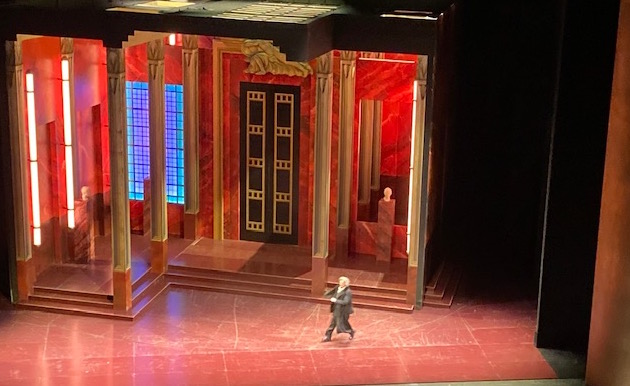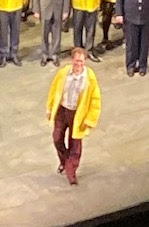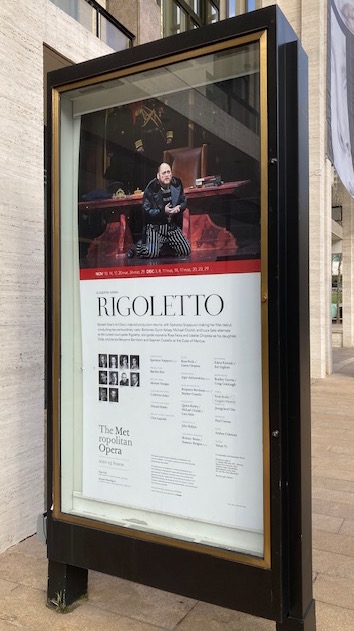
Mostrar mensagens com a etiqueta John Relyea. Mostrar todas as mensagens

terça-feira, 20 de dezembro de 2016

GUILLAUME TELL, METropolitan Opera, Outubro / October 2016


 (review in English below)
Uma nova produção da monumental opera Guillaume Tell, última obra de G. Rossini, esteve em cena na Metropolitan Opera de Nova Iorque.


A encenação de Pierre Audi, originária da Dutch National Opera, é vazia e abstracta. A ópera retrata a guerra entre suíços (oprimidos) e austríacos (opressores) na idade média até à libertação da Suiça, encabeçada pelo arqueiro Guilherme Tell. Tudo se passa entre grandes pedras e rochas, que vão mudando de posição ao longo da récita. Os dois grupos rivais são facilmente identificados, os suíços sempre vestidos de cinzento claro (o que os faz confundir com o fundo do cenário, espelhado e também dessa cor), e os austríacos de negro.


Fabio Luisi dirigiu o espectáculo e, mais uma vez, houve uma excelente interpretação da Orquestra e também do Coro, omnipresente em toda a ópera. Os solistas foram de grande qualidade.


O baixo-barítono canadiano Gerald Finley foi o protagonista Guilherme Tell e cantou e interpretou o papel ao mais alto nível. A voz é cheia de matizes coloridas e o cantor usou-a com elegância e emotividade.


O papel mais exigente é o de Arnold, interpretado pelo tenor norte americano Bryan Hymel. A personagem requer um tenor lírico e heróico, o que Hymel cumpre na perfeição. A voz é clara e algo nasalada mas é poderosa e afinada em todos os registos. Foi particularmente impressionante na ária Asile héreditaire do 4º acto.


O baixo-barítono canadiano John Relyea foi o vilão Gesler de voz grave, potente e autoritária, bem adequada à personagem.


Outro baixo de grande qualidade foi a sul coreano Kwanchul Youn que interpretou o Melcthal, pai assassinado de Arnold.
 Finalmente Walter teve outra interpretação de classe, do baixo italiano Marco Spotti.


As senhoras também estiveram em grande destaque. A jovem soprano norte americana Janai Brugger foi um Jemmy, filho de Tell, de excelente qualidade, tanto cénica como vocal.


Hedwige foi interpretada com correcção pela mezzo norte americana Maria Zifchak.


Deixei para o fim a soprano letã Marina Rebeka que foi a pricesa austríaca Mathilde. Cantou ao mais alto nível, a voz é bem timbrada e sempre perfeitamente audível, com um fraseado impecável. Transmitiu dramatismo e vulnerabilidade à interpretação da personagem, entre a paixão por um inimigo e a fidelidade ao seu povo. A ária principal do 3º acto Pour notre amour, plus d’espérance foi impressionante.


Um excelente espectáculo na Met Opera


*****


GUILLAUME TELL, Metropolitan Opera, October 2016

A new production of the monumental opera Guillaume Tell, last work of G. Rossini, was on stage at the Metropolitan Opera in New York.

The production of Pierre Audi, originally from the Dutch National Opera, is empty and abstract. The opera depicts the war between Swiss (oppressed) and Austrian (oppressors) in the Middle Ages until the liberation of Switzerland, headed by archer William Tell. Everything takes place between large stones and rocks that change position along the performance. The two rival groups are easily identified, the Swiss always on light grey dresses (which makes them confused with the background scenery, mirrored and also grey), and the Austrians in black.

Fabio Luisi directed and, again, there was an excellent performance of the Orchestra and the omnipresent Choir, throughout the opera. The soloists were of great quality.

Canadian bass-baritone Gerald Finley was William Tell and sang and played the role at the highest level. The voice is full of colorful hues and the singer used it with elegance and emotion.

The most demanding role is that of Arnold, interpreted by North American tenor Bryan Hymel. The character requires a lyrical and heroic tenor, which Hymel meets perfectly. The voice is clear and somewhat nasal but powerful and tuned in all registers. He was particularly impressive in the aria Asile héréditaire the 4th act.

Canadian bass-baritone John Relyea was Gesler the villain, powerful and authoritative voice, well-suited to the character.

Another high quality bass was the South Korean Kwanchul Youn who played Melcthal the murdered father Arnold.

Finally Walter was another class interpretation, by Italian bass Marco Spotti.

The ladies were also in great prominence. The young American soprano Janai Brugger was Jemmy, son of Tell, of excellent quality, both on stage and vocal.

Hedwige was interpreted with correction by North American mezzo Maria Zifchak.

I left for the end of the Latvian soprano Marina Rebeka who was that the Austrian pricess Mathilde. She sang at the highest level, the voice is always perfectly audible, with impeccable phrasing. She transmitted drama and vulnerability to the interpretation of the character, between the passion for an enemy and fidelity to his people. The main aria of the 3rd act Pour notre amour, plus d'espérance was impressive.

An excellent performance at the Met Opera


*****

segunda-feira, 4 de julho de 2016

NABUCCO, Royal Opera House, Londres / London, Junho / June 2016

(review in English below)

Depois de assistir recentemente a esta opera no Teatro de São Carlos, tive a oportunidade de ver o Nabucco de G. Verdi na Royal Opera House de Londres.
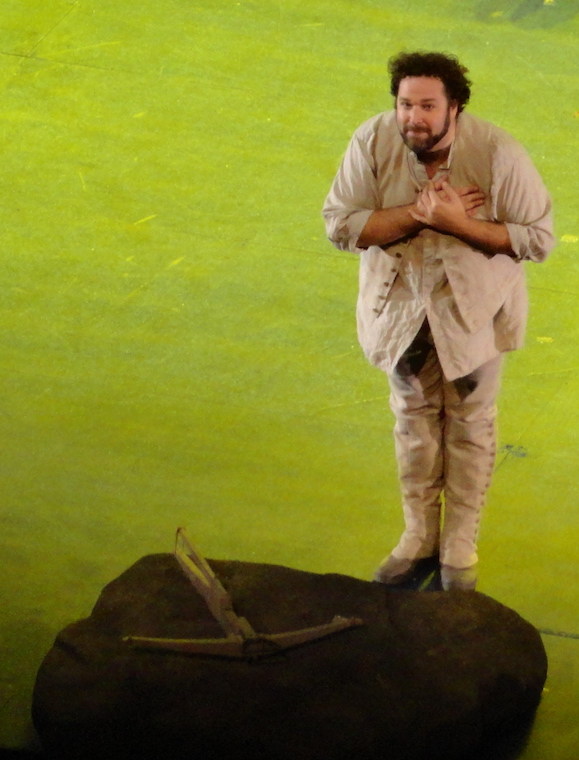
A produção de Daniele Abbado é excessivamente austera e algo confusa. O palco está ocupado por vários paralelepípedos de tamanhos diferentes assentes num chão de areia, podendo simular pedras tumulares, e assim permanece ao longo de quase toda a ópera. Só nos últimos actos o palco fica totalmente vazio, sendo para ele transportadas figuras de partes humanas em construções de arame que, no final, representarão um deus a ser destruído pelos hebreus. Há projecções de vídeos no fundo, mas o efeito não é muito eficaz. Procura-se uma transição da acção para o que se passou na 2ª guerra mundial com a perseguição e exílio dos judeus, mas esta não é claramente conseguida.


Dirigiu a Orquestra da Royal Opera o maestro Daniele Abbado, numa actuação que não foi perfeita, ao contrário do Coro da Royal Opera que foi fantástico.


O melhor cantor da noite foi o baixo John Relyea que fez um Zaccaria muito convincente, de bela voz e timbre cavernoso, mantendo a mesma qualidade vocal em todos os registos.


A Fenena foi interpretada por Jamie Barton que tem uma voz imponente e sempre afinada, mas a figura não ajuda a personagem.


O Ismaele do tenor Leonardo Capalbo esteve muito bem, a voz é bonita e bem colocada e o cantor teve um bom desempenho cénico.


A soprano ucraniana Tatiana Melnychenko foi uma Abigaille de voz forte e timbre agreste, excessivamente dura na interpretação, com grande tendência para gritar. A personagem e desempenho cénico não são nada ajudados pela figura da cantora.


O barítono Dimitri Platanias foi um Nabucco correcto, de voz bonita e sempre bem audível, mas sem aquela centelha de excelência que sempre se espera ver nestas paragens.


No cômputo final, foi um bom espectáculo, mas aquém do Nabucco que se pôde ver há poucas semanas no Teatro de São Carlos em Lisboa.


***

NABUCCO, Royal Opera House, London, June 2016

After recently attending this opera at the Teatro de São Carlos in Lisbon, I had the opportunity to see Nabucco by G. Verdi at the Royal Opera House in London.
The production of Daniele Abbado is too austere and somewhat confusing. The stage is occupied by several cobblestones of different sizes based on a sandy ground, simulating gravestones, and remains so throughout almost the entire opera. In the last act the stage is completely empty, and figures of human parts in wire constructions are brought in that, in the end, represent a god to be destroyed by the Hebrews. There are projections of videos in the background, but the effect is not fantastic. There is a transition of the action to what happened in the 2nd World War the persecution and exile of the Jews, but this is not clearly achieved.

Maestro Daniele Abbado conducted the Orchestra of the Royal Opera in a performance that was not perfect, unlike the Royal Opera Choir that was fantastic.

The best singer of the night was bass John Relyea who was a very convincing Zaccaria, a beautiful voice and cavernous timbre, with the same quality in all registers.

Fenena was played by Jamie Barton. She has an imposing and always tuned voice, but the figure does not help the character.

Tenor Leonardo Capalbo was a very good Ismaele, the voice is beautiful and well placed and the singer had a good scenic performance.

Ukrainian soprano Tatiana Melnychenko was a strong voiced Abigaille with a rough timbre and excessively harsh interpretation, with great tendency to scream. The character and stage performance were jeopardized by the figure of the singer.

Baritone Dimitri Platanias was a correct Nabucco, with a beautiful always well audible voice, but without that spark of excellence we always expected to get in these theaters.

Overall, it was a good performance, but inferior to the Nabucco that I could see a few weeks ago at the Teatro São Carlos in Lisbon.


***

sexta-feira, 21 de fevereiro de 2014

RUSALKA de ANTONÍN DVORÁK, MET Live in HD, Culturgest, 09.02.2014


Rusalka, ópera em 3 actos, foi composta em 1901 por Antonín Dvorák. O libreto em checo é de Jaroslav Kvapil e baseia-se no conto de Kabel Jaromír Erben e Bozena Nemcová.

Pode ler-se uma sinopse no site do Metropolitan.


A encenação de Otto Schenk é clássica, de enorme beleza, cheia de pormenores sumptuosos, não falta nenhum elemento do texto que segue na perfeição, é muito agradável de seguir e transporta-nos para o mundo paralelo do fantástico. As caracterizações de Tritão, pai de Rusalka, e de Jezibaba são fabulosas. De uma perfeição absoluta e de grande impacto visual!


A interpretação de Yannick Nézet-Séguin aos comandos da New York Metropolitan Opera Orchestra foi óptima. Explorou as sonoridades mais dramáticas de forma intensa e colorida e as mais líricas de modo leve e etéreo. Em grande nível!


Renée Fleming era a estrela da tarde no seu aclamado papel de Rusalka. É verdade que a sua interpretação foi de qualidade, com excelente expressividade e desempenho dramático, os agudos saíram fáceis e a voz é melodiosa e tem a extrema beleza que lhe conhecemos. Ainda assim, já se ouviu em melhor nível neste papel.


A mais famosa ária da Canção à Lua cantou-a muito bem do cimo da árvore.


John Relyea foi um Vodník, o Tritão pai de Rusalka, com voz de baixo cheia, enorme potência, com modulações fáceis e com uma assinalável agilidade cénica. Grande performance.


Dolora Jajick, apesar de nas entrevistas estar com uma tosse que justificou com o frio de NYC, foi uma Jezibaba impecável. O tom escuro da sua voz é lindíssimo e a sua expressividade ímpar. Tudo isto aliado a capacidades interpretativas fora de série permitem-lhe que seja indiscutivelmente um dos melhores mezzo-sopranos da actualidade. Isto apesar da sua actualidade ter mais de 25 anos no MET!


O tenor polaco Piotr Beczala foi o Príncipe. Teve uma interpretação imaculada, tirando um agudo que lhe saiu um nadinha mais agreste e um pianissimi que não arrancou logo quando cantava já quase morto e deitado. Voz de beleza invulgar, potência avassaladora, figura extremamente adequada e enormes capacidades expressivas. É, para mim, talvez o melhor tenor da actualidade nos papéis que tem vindo a cantar. Em grande forma!


Emily Magee foi a Princesa estrangeira. Tem muita potência vocal, timbre delicado e cenicamente é convincente. Teve uma interpretação de grande qualidade. Poderemos ouvi-la ao vivo no dia 25 de Abril na Fundação Gulbenkian a cantar o espectacular conjunto de canções que Richard Strauss compôs aos 84 anos — Vier letzte Lieder — com base em poemas de Hermann Hesse e Joseph von Eichendorff. A fazer crescer água na boca até porque vai ser acompanhada pela Gustav Mahler Jundenorchester dirigida pelo jovem e magnífico maestro alemão David Afkham.


Os restantes elementos, Disella Làrusdóttir (primeira ninfa), Renée Tatum (segunda ninfa), Maya Lahyani (terceira ninfa), Alexey Lavrov (Caçador) e Julie Boulianne (rapaz da cozinha) tiveram todos em bom nível vocal e cénico.

Assistiu-se, pois, a uma récita de elevadíssima qualidade de todos os intervenientes potenciando a qualidade musical da partitura do grande compositor checo.

-------
(Review in English)

Rusalka, opera in 3 acts, was composed in 1901 by Antonín Dvorák. It has a Czech libretto by Jaroslav Kvapil and is based on the tale of Jaromír Erben and Kabel Bozena Nemcova.

You can read a synopsis of the Metropolitan website.

The staging of Otto Schenk is classic, of great beauty, full of sumptuous details, not missing element of the text that follows perfectly, is very pleasant to follow and takes us to the parallel world of the fantastic. The characterizations of Triton, Rusalka's father, and Jezibaba are fabulous. Of absolute perfection and great visual impact!

The interpretation of Yannick Nézet-Séguin conducting the New York Metropolitan Opera Orchestra was great. He explored the most intense and dramatic sounds with colorful fashion and the most lyrical with full of light and ethereal mystic. What an outstanding performance!

Renée Fleming was the star of the afternoon in her acclaimed role of Rusalka. It is true that her interpretation was of quality, with great expressiveness and dramatic performance, with high notes easily achieved and with a voice of extreme beauty that we all know. Still, we had heard her at better level in this role. She sang the most famous aria of the Song to the Moon very well from the top of the tree.

John Relyea was Vodník, Triton Rusalka’s father, with an exclellent bass voice, huge power with easy modulation and a remarkable scenic agility. Great performance.

Dolora Jajick, despite in the interviews being with cough that she justified witj the cold of NYC, was a flawless Jezibaba. The dark tone of her voice is beautiful and she has a unique expressiveness. All this combined with interpretative capabilities out of range allow her to be arguably one of the best mezzo-sopranos of our time. This despite her “our time” has over 25 years in the MET!

The Polish tenor Piotr Beczala was Prince. He had an immaculate interpretation, despite a little more rugged sharp high note and one pianissimo not plucked right but when he sang almost dead and lying on the stage ground. Voice of unusual beauty, overwhelming power, extremely appropriate figure and huge expressive capabilities. He is, for me, perhaps the greatest tenor of our time in the roles he has been singing lately. In great shape!

Emily Magee was the foreign princess. She has a lot of vocal power, delicate timbre and is scenically compelling. She had an interpretation of great quality. We can hear her live on April 25 at the Gulbenkian Foundation to sing the spectacular set of songs that Richard Strauss composed when he was 84 old based on poems by Hermann Hesse and Joseph von Eichendorff. Making mouthwatering up because Gustav Mahler Jundenorchester directed by the young and magnificent German conductor David Afkham will accompany her.

The remaining elements, Disella Lárusdóttir (First Nymph), Renée Tatum (second Nymph), Maya Lahyani (third Nymph), Alexey Lavrov (Hunter) and Julie Boulianne (kitchen boy) were all in good level vocal and scenically.


Therefore, it was performance of the highest quality for all stakeholders enhancing the quality of the musical score of the great Czech composer.