Mostrar mensagens com a etiqueta Alex Esposito. Mostrar todas as mensagens

domingo, 28 de maio de 2017

L’ELISIR D’AMORE, Royal Opera House, Londres / London, Maio / May 2017


(review in English below)

Esta é uma ópera de enredo simples, passada numa aldeia basca so Séc. XIX. Adina lê a história de Tristão e Isolda e refere que ela conquistou o Tristão com uma poção mágica. Nemorino, um rapaz da aldeia reconhece que não consegue conquistar uma mulher tão bela como Adina. Declara-lhe o seu amor mas ela rejeita-o. O sargento Belcore com o seu pelotão, declara-se e pede Adina em casamento. Surge o Dr. Dulcamara, um charlatão ambulante a quem Nemorino pede um elixir do amor. Vende-lhe uma garrafa de vinho barato como elixir que fará efeito em 24 horas. Belcore é chamado aos deveres militares e marca casamento de imediato. Adina surpreende-se com a indiferença do Nemorino. Ele quer comprar mais elixir ao Dulcamara mas, como está sem dinheiro, alista-se, recebe um pagamento do Belcore e bebe mais uma garrafa do “elixir” ficando embriagado. Uma das raparigas da aldeia dá a notícia que um tio do Nemorino morreu e deixou-lhe uma fortuna. Todas se interessam subitamente por ele que, desconhecendo as notícias da morte do tio, pensa que é o elixir a surtir efeito. Adina reconhece que ama o Nemorino, paga para o libertar do exército e ele, ao ver uma lágrima furtiva na face de Adina, percebe que ela o ama. O sargento Belcore conforma-se com a perda e o Dr. Dulcamara diz que o seu elixir traz não só amor como fortuna, vende todas as garrafas de vinho barato aos camponeses e abandona a aldeia.


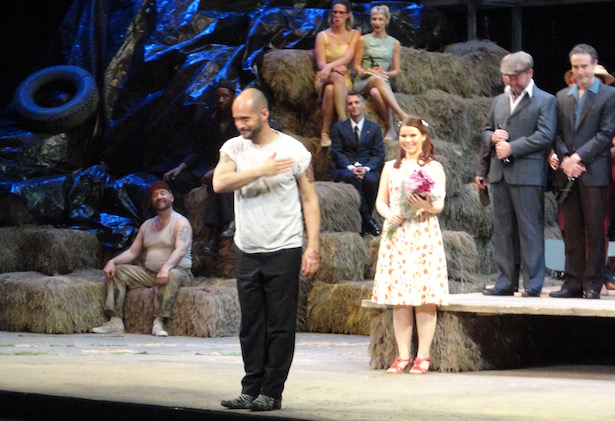
A encenação de Laurent Pelly da opera L’Elisir d’Amore de Donizetti, trazendo a acção para uma aldeia rural italiana nos anos 50-60 do século passado é um regalo para os olhos. Tudo se passa no meio de uma imensidão de fardos de palha, o guarda roupa é excelente, há bicicletas, scooters, tractores e uma camioneta ambulante de venda dos produtos do charlatão Dr. Dulcamara, sempre vestido a preceito. O Nemorino está vestido como um pobre rapaz campónio. O pelotão do sargento Belcore é constituído por dois elementos magros, um negro muito alto e um asiático muito baixo. Os pormenores agradáveis e engraçados são inúmeros, a direcção de actores excelente e, como os solistas são jovens, prestam-se a movimentações acrobáticas que não se costumam ver em cantores de ópera. E há um cão que atravessa o palco em dois momentos, uma maravilha!


O maestro Bertrand de Billy cumpriu sem deslumbrar, a orquestra não foi perfeita, mas o espectáculo foi magnífico.


A Adina foi interpretada pela Sul Africana Pretty Yende. Tem um soprano lírico de extraordinária beleza, sempre afinada em todos os registos, com agudos estratosféricos, nunca grita e com uma coloratura notável. A figura jovem e elegante da cantora ajudaram muito. Foi uma interpretação superlativa.


No mesmo nível de qualidade esteve o Nemorino do tenor arménio Liparit Avetisyan. Tem uma voz muito bonita, segura e sempre bem audível. Foi muito emotivo ao longo de toda a récita e um verdadeiro atleta, vocal e na movimentação cénico, revelando uma invulgar agilidade física. A ária Una furtiva lágrima foi tocante e, por ela, recebeu uma estrondosa e merecida ovação.


E o que dizer do baixo barítono italiano Alex Esposito? Que foi a melhor interpretação do Dr. Dulcamara que vi e ouvi até hoje? Sim, mas muito mais. Voz magnífica, bem timbrada, potente e afinada em todas as intervenções. E em cena foi melhor que muitos actores profissionais. A encenação ajuda muito, está muito focada na sua personagem, a figura do cantor também, mas o principal foi a sua capacidade artística. Fantástico.


Outro barítono italiano, Paolo Bordogna, também esteve ao mais alto nível como Belcore que, em linha com os restantes solistas, foi impecável na interpretação vocal e na cénica.


A jovem soprano russa Vlada Borovko do programa Jette Parker young Artists da ROH fez uma Giannetta muito engraçada, apesar de o papel ser pequeno.


Um espectáculo inesquecível que mostra a ópera em todo o seu esplendor!


*****


L'ELISIR D'AMORE, Royal Opera House, London, May 2017

This is a simple plot opera, occurring in a Basque village in the 19th century. Adina reads the story of Tristan and Isolde and refers that she conquered Tristan with a magic potion. Nemorino, a village boy recognizes that he can not conquer a woman as beautiful as Adina. He declares his love to her, but she rejects him. Sergeant Belcore with his platoon, declares himself and asks Adina to marry him. Dr. Dulcamara appears, a walking charlatan whom Nemorino asks for an elixir of love. He sells ​​him a bottle of cheap wine as the elixir that will take effect in 24 hours. Belcore is called to military duties and wants to marry immediately. Adina is surprised by Nemorino's indifference. He wants to buy more elixir from Dulcamara but, since he's out of money, he enters the army and gets a payment from Belcore. Now he can buy another bottle of the "elixir", getting drunk. One of the girls from the village gives the news that Nemorino's uncle died and left him a fortune. All girls are suddenly interested in Nemorino who, unaware of the news of his uncle's death, thinks that it is the elixir to have an effect. Adina recognizes that she loves Nemorino, pays to free him from the army and he, seeing a furtive tear in Adina's face, realizes that she loves him. Sergeant Belcore complies with the loss and Dr. Dulcamara says that his elixir brings not only love but fortune, he sells all bottles of cheap wine to the peasants and leaves the village.

Laurent Perry's staging of the opera L'Elisir d'Amore by Donizetti, bringing action to an Italian rural village in the 50-60 years of the past century is beautiful. Everything is set amidst a bundle of straw bales, the outfits are excellent, there are bikes, scooters, tractors and a van selling the products of the charlatan Dr. Dulcamara. The pleasant and funny details are numerous, the directors of actors excellent and, as the soloists are young, they lend themselves to acrobatic movements not usually seen in opera singers. And there is a dog that crosses the stage in two moments, a marvel!

The conductor Bertrand de Billy fulfilled without dazzling, the orchestra was not perfect, but the performance was magnificent.

Adina was interpreted by South African Pretty Yende. She has a lyrical soprano of extraordinary beauty, always tuned in every record, with stratospheric top notes and she never screams. The young and elegant figure of the singer helped a lot. She had a superlative performance.

At the same level of quality was Nemorino of the Armenian tenor Liparit Avetisyan. He has a very beautiful voice, firm and always well audible. He was very emotional throughout the performance and a true athlete, vocal and in the scenic movement, revealing an unusual physical agility.

And what about the Italian bass baritone Alex Esposito? Was his the best interpretation of Dr. Dulcamara I've seen and heard to this day? Yes, but much more. Magnificent voice, beautiful timbre, powerful and tuned in all the interventions. And on the scene he was better than many professional actors. The staging helps a lot, it is very focused on his character, the figure of the singer too, but the main thing was his artistic ability.

Another Italian baritone, Paolo Bordogna, was also at the highest level as Belcore, who, in line with the other soloists, was impeccable in vocal and stage acting.

The young Russian soprano Vlada Borovko from ROH's Jette Parker Young Artists programme was a very funny Giannetta, even though the role was small.

An unforgettable performance that shows the opera in all its splendour!


*****

quinta-feira, 11 de julho de 2013

LUCREZIA BORGIA, Deutsche Oper, Berlim, Abril 2013

(review in english below)

Lucrezia Borgia, ópera de G. Donizetti, foi-nos oferecida pela Deutsche Oper em versão concerto. Juntaram quatro solistas excepcionais e, por isso, assistimos a um espectáculo inesquecível.

A Orquestra e o Coro da Deutsche Oper foram dirigidos pelo maestro Andriy Yurkevych.


A grande atracção do espectáculo foi Edita Gruberova que interpretou a Lucrezia Borgia. Só ela teria valido o espectáculo, mas houve muito mais. Gruberova mantém uma capacidade interpretativa, vocal e cénica, absolutamente invulgares. A cantora está a caminho dos 70 anos mas continua a ser uma das melhores intérpretes de belcanto da actualidade. Foi extraordinária e acho que ninguém conseguiria fazer melhor o papel. Os pianissimi são fabulosos, as notas mais agudas continuam estratosféricas, poderosas e perfeitamente afinadas. O público assim o reconheceu e, no final, foi chamada ao palco várias vezes, sempre sob uma intensidade de aplausos invulgar nos dias de hoje.
Edita Gruberova é um raro exemplo de longevidade canora na plenitude das suas qualidades, só igualada por Plácido Domingo nos dias que correm.


 Mas os restantes solistas foram também excelentes:

O tenor eslovaco Pavel Breslik foi um Gennaro irrepreensível e, pela primeira vez, fiquei totalmente convencido das suas capacidades vocais. É um papel que interpreta há vários anos mas fá-lo ao mais alto nível.


Verdadeiramente excepcional foi o baixo barítono italiano Alex Esposito como Don Alfonso. O cantor foi arrasador. Tem uma voz enorme, belíssima e sempre afinada. A figura é também óptima, o que deixa adivinhar uma interpretação cénica marcante. Uma total revelação para mim e um cantor que tentarei acompanhar.


Maffio Orsini foi interpretado, de forma superior, pelo mezzo eslovaco Jana Kurucová. Outra grande interpretação, a ajudar ao sucesso da récita.


Os papeis secundários estiveram a cargo de Andrew Williams, Seth Carico, Jörg Schörner, Simon Pauly, Álvaro Zambrano, Tobias Keher e Paul Kaufmann e, não destuaram.


Uma Lucrezia Borgia excepcional, que foi pena não ter sido em versão encenada.

*****


Lucrezia Borgia, Deutsche Oper, Berlin, April 2013

Lucrezia Borgia,opera by G. Donizetti was offered to us by the Deutsche Oper in concert version. It joined four exceptional soloists and therefore we witnessed an unforgettable concert.

The Orchestra and Chorus of the Deutsche Oper were directed by conductor Andriy Yurkevych.

The major attraction of the concert was Edita Gruberova who played Lucrezia Borgia. Only she would have justified the performance, but there was more. Gruberova maintains an absolutely unusual interpretive capacity, vocal and artistic. The singer is on the way to 70 years but she is still one of the best interpreters of belcanto of our times. She was extraordinary and I think nobody could do a better job. The pianissimi are fabulous, the high notes are still stratospheric, powerful and perfectly tuned. The public well recognized it and, in the end, she was called to the stage several times, always under an intensity of applause, unusual these days.
Edita Gruberova is a rare example of longevity in all of her qualities, matched only by Placido Domingo these days.

 But the remaining soloists were also excellent:

Tenor Pavel Breslik was a blameless Gennaro. For the first time I was totally convinced of his vocal abilities. It's a role he plays for several years but he does so at the highest level.

Truly exceptional was bass baritone Alex Esposito as Don Alfonso. The singer was astonishing. He has a huge voice, beautiful and always in tune. His figure is also excellent, which helps him in a striking artistic interpretation. A complete revelation to me and I will try to follow this singer.

Maffio Orsini was fantastically interpreted by mezzo Jana Kurucová. Another great interpretation to help the success of the concert.

The secondary roles were given to Andrew Williams, Seth Carico, Jörg Schörner, Simon Pauly, Álvaro Zambrano, Tobias Keher and Paul Kaufmann and all them were good.

An exceptional Lucrezia Borgia, which was a pity to be in concert version, not staged version.

*****

quinta-feira, 30 de agosto de 2012

DON GIOVANNI – Royal Opera House, Londres – Fevereiro 2012


O FanaticoUm já vos transmitiu a impressão sobre a reposição do Don Giovanni na Royal Opera House na passada temporada

Tive a oportunidade de assistir a 2 récitas com os dois elencos e gostava de vos deixar umas fotos e a minha impressão comparativa.

DON GIOVANNI


Gerald Finley foi melhor que Erwin Schrott. Schrott fez um Don menos especial, menos nobre, encarando tudo com piada e leveza, cercando tudo com sedução física e beijos, menos psicológico no primeiro acto. No início do segundo acto, principalmente no início onde domina a intervenção cómica esteve excelente ao simular uma crise de asma quado Leporello lhe pede para deixar as mulheres; interagiu com expectadores nesta passagem e esteve muito bem na troca de papéis com Leporello. Schrott é principalmente eficaz nas passagens cómicas  mas quando a acção pede mais dramatismo não o faz tão bem como Finley. O final da ópera foi bombástico com Finley, enquanto que com Schrott tudo pareceu muito pouco sentido.


LEPORELLO

Alex Esposito fez um Leporello mais interessante do ponto de vista cénico do que Lorenzo Regazzo. Altamente cómico na troca de papéis com Don Giovanni – finge que se mata com a espada, treme as pernas deitado como que a “esticar o pernil”, Don faz-lhe massagem cardíaca e quando vai para a ventilaçãoo desiste e ri-se; agarra-e a Elvira de modo apaixonado, mexe-lhe de modo sexualmente hilariante e inesperado nas mamas, insinua-se com moviemntos pélviso sobre ela de modo tão cómico que em nada se pareceu ordinário. Na cena da estátua revelou o medo na voz e na postura de modo credível. Do mesmo modo fez crer que temia estarem ambos mortos quando o Comendador entra para jantar. Excelente!!!


DONNA ANNA

Carmela Remigio vence Hibla Gerzmava em presença física (grande classe e beleza) e na voz, levando ao júbilo sensorial na sua última ária. Profundamente irritante o vibrato nos agudos de Gerzmava...


DONNA ELVIRA

Ruxandra Donose com timbre mais quente e meloso que Katarina Karnéus.


ZERLINA

Kate Lindsey mais chamativa, particularmente pela cumplicidade e química ternurenta especial que revelou com Matthew Rose.


DON OTTAVIO

Pavol Breslik com voz mais cristalina e muito expressivo no “dalla sua pace” e “il mio tesoro”, embora Matthew Polenzani tenha estado em grande nível.


MASETTO

Adam Planchetka e Matthew Rose perfeitos, sobressaindo talvez mais Rose ao dar um ar mais rústico à personagem.


COMENDADOR

Reinhard Hagen preferível a Marco Spotti, com voz mais profunda e sem vibrato.


Constantino Carydis não esteve perfeito. Melhor no segundo elenco mas a abertura sempre pouco sentida, muito rápida, pouco melosa e sem se sentir o medo, nem na abertura, nem na entrada do Comendador. Na minha opinião é porque escolhe fazer estas passagens muito rápidas e pouco solenes. A entrada dos camponeses muito lenta... Melhor no lamento de Anna, mais lento e lírico.


No geral, gostaria de ter assistido ao segundo elenco (Esposito, Remigio, Donose, Lindsey, Breslik, Rose e Hagen) mas com Gerald Finley como Don Giovanni.


segunda-feira, 7 de maio de 2012

LA CENERENTOLA, Palácio Garnier, Paris, Dezembro de 2011


(review in english below)

La Cenerentola é uma ópera de Gioacchino Rossini com libreto de Jacopo Ferretti, baseado no conto Cendrillon de Charles Perrault.


 É a história da Cinderela com algumas modificações, incluíndo nas personagens. A madrasta é aqui um padrasto (Don Magnífico) e em vez de uma fada é Alidoro, o preceptor do príncipe Don Ramiro, que assegura essa função. Também em vez do sapato, é uma pulseira o objecto de identificação da rapariga.


 Angelina (Cenerentola) sonha que casará com um rei mas é ridicularizada pelas meias-irmãs Clorinda e Tisbe. Alidoro, preceptor do príncipe, bate à porta disfarçado de pedinte, é rejeitado pelas irmãs, mas Angelina recolhe-o e alimenta-o. É anunciado que o príncipe Don Ramiro vai escolher a noiva num baile. As duas irmãs preparam-se e acordam o pai, Don Magnífico, que sonha com a ascensão social por uma das filhas se vir a tornar rainha. Don Ramiro aparece disfarçado de criado, vê Angelina e apaixonam-se. O criado, Dandini, disfarçado de príncipe, é cortejado pelas irmãs. Don Magnífico recusa a ida ao baile de Angelina mas ela é convidada por Alidoro. No baile aparece uma mulher deslumbrante que é reconhecida pelo príncipe e também são notadas as suas semelhanças com Angelina pelo padrasto e meias-irmãs. O criado Dandini, ainda disfarçado de príncipe, declara-se a Angelina mas ela diz-lhe que está apaixonada pelo “criado”. Antes de partir, Angelina dá uma pulseira ao “criado”. Tudo volta ao habitual em casa. A carruagem do príncipe avaria-se perto e Dandini, já não disfarçado, anuncia a entrada de Don Ramiro. Este, ao ver a pulseira no braço de Angelina, declara-lhe o seu amor, para desespero das meias-irmãs e do padrasto. Tudo acaba em bem, com o perdão generalizado de Angelina e promessas de vida feliz.


 A recuperação da encenação de Jean-Pierre Ponnelle foi uma homenagem póstuma que a Ópera de Paris fez a este encenador francês já falecido. É clássica, simples e funciona bem. Está muito dentro do que é habitual ver nesta ópera. Os cenários são maioritariamente feitos de pano pintado. Os quartos das irmãs estão nos lados, o de Don Magnifico em cima, com acesso ao centro da acção através de uma escada. Tudo se passa aqui, com encerramento e abertura de algumas partes mas sem grandes variações.


 O experiente maestro italiano Bruno Campanella assegurou uma direcção musical de qualidade e que ajudou a minimizar algumas limitações dos cantores. A Orquestra Nacional e o Coro da Ópera de Paris estiveram muito bem.


 Don Ramiro foi interpretado pelo tenor mexicano Javier Camarena. Cenicamente não esteve bem porque foi muito notória a sua quase exclusiva preocupação com o canto. A voz tem um timbre agradável mas o cantor não interpretou o papel sem mácula. A coloratura foi esforçada e o fraseado, por vezes, imperceptível. No registo mais agudo foi onde esteve melhor. Na ária Si, ritrovarla io giuro no início do 2º acto, “safou-se”, muito com a ajuda do maestro.


 Dandini, o seu criado, foi o excelente barítono italiano Riccardo Novaro, o melhor cantor da noite. A voz é cheia, bem projectada e afinada. Sempre que cantava era claramente audível sobre a orquestra e, em cena, foi muito convincente, não obstante o tipo de encenação.


 Karine Deshayes, mezzo francês, foi uma Angelina digna. Começou à defesa, quase sem se ouvir, mas foi melhorando. A voz não é particularmente bela mas, sobretudo no 2º acto, foi bem audível e cumpriu vocal e cenicamente. Na cena final esteve bem na Nacqui all’affanno… Non più mesta apesar de ter omitido algumas notas nas partes de coloratura mais exigente.


 O baixo-barítono espanhol Carlos Chausson foi um Don Magnifico interessante, de voz cheia e boa presença em palco, mas não foi magnífico.

Muito bem esteve o outro baixo, o italiano Alex Esposito que foi um Alidoro sem mácula, apesar de ter um papel pequeno. A par do seu compatriota Novaro, foi outro dos grandes cantores da noite.

As irmãs Clorinda (Jeannette Fischer) e Tsibe (Anna Wall) estiveram bem, cantaram, mas não encantaram.


Apesar de ter sido um bom espectáculo, faltou algo que o fizesse sair da mediania espectável. De facto, Rossini não é para todos.

***


LA CENERENTOLA, Palais Garnier, Paris, December 2011

La Cenerentola is an opera by Gioacchino Rossini with a libretto by Jacopo Ferretti, based on the tale Cendrillon by Charles Perrault.

It is the story of Cinderella with some modifications, including the characters. The stepmother is here a stepfather (Don Magnifico) and instead of a fairy is Alidoro, the preceptor of the prince Don Ramiro, which provides this function. Also instead of a shoe, a bracelet is the purpose of identifying the girl.

Angelina (Cenerentola) longs to marry a king but is ridiculed by the stepsisters Clorinda and Thisbe. Alidoro, tutor to the prince, knocks on the door disguised as a beggar, is rejected by the sisters, but Angelina collects him and feeds him. It is announced that prince Don Ramiro will choose his bride at a ball. The two sisters prepare for the ball. Their father, Don Magnifico dreams of having a higher position in society as one of the daughters might become queen. Don Ramiro appears disguised as a servant, sees Angelina and falls in love. The valet, Dandini, disguised as a prince, is courted by the sisters. Don Magnifico does not give permission to Angelina to go to the ball but she is invited by Alidoro. At the ball a stunning woman appears who is recognized by the prince and also her similarities to Angelina are noted by her stepfather and half-sisters. The servant Dandini, still disguised as a prince, declares himself to Angelina but she tells him she is in love with the valet. Before leaving, Angelina gives a bracelet to the valet Everything goes back to normal at home. Dandini, at  Don Magnifico’s home, no longer disguised, announces the arrival of Don Ramiro. He sees the bracelet on the arm of Angelina and declares his love, to the despair of her half-sisters and stepfather. Everything ends well with the global pardon of Angelina and promises of happiness.

The revival of the production by Jean-Pierre Ponnelle was a posthumous tribute of the Paris Opera to this deceased French director. It is a classic and simple staging that works well. The scenarios are mostly made of painted cloth. The rooms of the sisters are on the sides, on top is the bedroom of Don Magnifico, with access to the center of the action via a ladder. Everything happens here, with closure and opening of some parts but no major stage changes.

The experienced Italian conductor Bruno Campanella was responsible for a musical direction of quality that helped minimize some limitations of the singers.
The National Orchestra and Chorus of the Paris Opera were very good.

Don Ramiro was played by Mexican tenor Javier Camarena. Artistically he was not well because he was almost exclusively concern with the singing. The voice has a nice timbre but the artist did not sing the role perfectly. The coloratura was effortful and the phrasing was sometimes imperceptible. The upper register was where he was better. In the aria Si, ritrovarla io giuro at the beginning of the 2nd act, he overcame it in an acceptable way, with the help of the conductor.

Dandini, his valet, was a great Italian baritone Riccardo Novaro, the best singer of the night. The voice is full and refined. When singing he was clearly audible over the orchestra. Artistically he was very convincing, despite the “type” of staging.

Karine Deshayes, French mezzo, was a worthy Angelina. She started defending herself, almost without being heard, but shes improved. The voice is not particularly beautiful but, especially in the 2nd act, she was convincing both in vocal and artistic playing. In the final scene she sang well Nacqui all’affanno… Non più mesta despite having missed a few notes in the most demanding coloratura parts.

Spanish bass-baritone Carlos Chausson was an interesting Don Magnifico with a full voice and good stage presence, but he was not magnificent (magnifico).

Very good was the other bass soloist, the Italian Alex Esposito who playiec a spotless Alidoro, despite having a small role. Together with his compatriot Novaro, he was another of the great singers of the night.

The sisters Clorinda (Jeannette Fischer) and Tsibe (Anna Wall) sung well but they were not fantastic.

Although it was a good performance, it lacked something to make it leave the expected banality. Indeed, Rossini is not for everyone.

***