Mostrar mensagens com a etiqueta João Merino. Mostrar todas as mensagens

sexta-feira, 18 de março de 2022

LA BOHÈME – Teatro Nacional de São Carlos


(review in English below)

Foi com satisfação que finalmente voltei a ver uma ópera devidamente encenada no Teatro de São Carlos, a popular La Bohème de G. Puccini

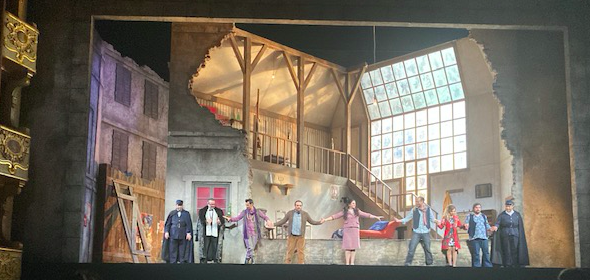
E começo pela encenação, de Emilio Sagi, que gostei muito. Foi uma abordagem clássica sem grandes inovações (para além de ter sido aproximada da actualidade), muito vistosa e bem conseguida. Esteve ao nível das boas encenações de qualquer grande teatro de ópera internacional.  Como quase sempre, há pormenores discutíveis mas na globalidade gostei muito, não foi uma encenação minimalista ou pindérica, como tantas vezes vemos entre nós.

No extremo oposto esteve a direcção musical de Domenico Longo. Foi muito má, a orquestra tocou quase sempre "à bruta", abafando frequentemente os cantores. A grande beleza de várias das magníficas partes musicais mais líricas não pode ser realçada. Lamentável.

Os dois protagonistas, o tenor Gianluca Terranova (Rodolfo) e a soprano Natalia Tanasii (Mimi) também estiveram muito aquém do desejável. Terranova tem um timbre feio e revelou grande dificuldade no registo mais agudo, que cantou em falsete e soava mais gritado que cantado. A voz de Tanasii era bem audível mas foi sempre dura e sem qualquer lirismo. E a interacção dos dois amantes não funcionou de todo, não houve a mínima expressão de cumplicidade amorosa.


Christian Luján
(Marcello) esteve muito bem. Tem uma voz grande, bem colocada, e boa presença em palco. A Museta de Bárbara Barradas foi exuberante, como acontece frequentemente com esta personagem. Foi notável em palco e também cantou bem, em forte, mas penso que propositadamente.

Os restantes cantores tiveram participações mais apagadas, Diogo Oliveira (Schaunard), João Merino (Benoit/Alcindoro), Miguel Reis (Parpignol) e André Henriques (Colline), o último com um tipo de voz pouco adequada à personagem. O programa diz que é um baixo, mas não tem graves.


**


LA BOHÈME – Teatro Nacional de São Carlos, Lisbon

It was with satisfaction that I finally returned to see an opera properly staged at the Teatro de São Carlos, the popular La Bohème by G. Puccini.

And I start with the staging, by Emilio Sagi, which I really liked. It was a classic approach without major innovations (in addition to turning the action close to the present), very showy and well done. It was at the level of the good stagings of any major international opera house. As almost always, there are debatable details but overall I really liked it, it wasn't a minimalist or kitsch staging, as we so often see between us.

At the opposite end was the musical direction of Domenico Longo. It was very bad, the orchestra almost always played "gross", often drowning out the singers. The great beauty of several of the more lyrical musical parts could not be appreciated. Regrettable.

The two soloists, tenor Gianluca Terranova (Rodolfo) and soprano Natalia Tanasii (Mimi) were also far from acceptable. Terranova has an ugly timbre and showed great difficulty in the higher register, which sang in falsetto and sounded more shouted than sung. Tanasii's voice was quite audible but it was always harsh and without any lyricism. And the interaction of the two lovers did not work at all, there was not the slightest expression of loving complicity.

Christian Luján (Marcello) did very well. He has a big nice voice, and good stage presence. Bárbara Barradas' Museta was exuberant, as is often the case with this character. She was remarkable on stage and also sang well, loudly, but I think on purpose.

The other singers had lesser participation, Diogo Oliveira (Schaunard), João Merino (Benoit/Alcindoro), Miguel Reis (Parpignol) and André Henriques (Colline), the last one with a type of voice that was not suitable for the character. The program says he's a bass, but the lower register was nonexistent.

**

terça-feira, 15 de outubro de 2019

LA FORZA DEL DESTINO, Teatro Nacional de São Carlos, Lisboa, Outubro 2019


(review in English below)

O Teatro de São Carlos abriu a temporada com a opera de Verdi La Forza del Destino, numa encenação de David Pountney. Há projecções numa tela translúcida à frente do palco. Abre com a palavra Paz, vê-se uma borboleta e uma roda (da sorte?) e a pistola a disparar uma bala aparece várias vezes ao longo do espectáculo. No início da segunda parte é a palavra Guerra que surge. No palco há dois grandes painéis móveis que permitem criar os diversos cenários, um deles com uma cortina e os figurantes trazem e levam frequentemente mesas. No primeiro acto dominam imagens de cruzes de grandes dimensões e pouco mais, com um efeito cénico interessante no início mas depois muito repetitivo. Há situações bem conseguidas mas a encenação, para além de escura como a história da ópera, é estranha em várias partes. Há padres com enormes mitras trajados de branco mas todos ensanguentados (final do 2º acto), a morte aparece frequentemente retratada nos elementos do coro e há um “Piccolo Teatro di Guerra” no 3º acto de efeito algo bizarro.

O maestro Antonio Pirolli fez um óptimo trabalho, a Orquestra Sinfónica Portuguesa esteve bem e o Coro também muito bem.


O baixo barítono Miklós Sebestyén foi o Marquês de Calatrava e o Padre Guardiano. Esteve bem, algo discreto, mas com um timbre agradável e boa presença em palco.

Leonora foi a soprano Julianna Di Giacomo que tem uma voz potente, com vibrato acentuado e, no registo mais agudo, perde qualidade e sai mais gritado que cantado. Contudo, teve partes muito boas, nomeadamente  Madre, pietosa Vergine” no 2º acto e o “Pace pace mio Dio...” no último.

O barítono Damiano Salerno foi um Don Carlo de qualidade superior. Voz poderosa, timbre muito agradável e sempre afinado. Para mim o melhor cantor da récita.

No extremo oposto esteve o tenor Rafael Alvarez como Don Alvaro. Voz agreste, desafinou frequentemente e com enormes dificuldades nos agudos. Em cena também não foi interessante.

De entre os cantores portugueses, Cátia Moreso foi uma Preziosilla muito vistosa mas a voz resvala frequentemente para a estridência, Luís Rodrigues foi um Melitone excelente, tanto na interpretação vocal como cénica, João Merino um Alcaide e um Cirurgião digno e Carlos Guilherme um Trabuco algo apagado.


**


LA FORZA DEL DESTINO, Teatro Nacional de São Carlos, Lisbon, October 2019

The Teatro Nacional de São Carlos opened the season with the opera by Verdi La Forza del Destino, produced by David Pountney. There are projections on a translucent screen in front of the stage. It opens with the word Peace, you see a butterfly and a wheel (lucky?) and the pistol firing a bullet is appearing several times throughout the show. At the beginning of the second part is the word War that appears. On the stage there are two large moving panels that create the various scenarios, one with a curtain and the extras often bring and carry tables. In the first act dominate large crosses and little more, with an interesting scenic effect at first but later very repetitive and unimaginative. There are interesting scenic situations but the staging, as dark as the history of the opera, is strange in many parts. There are priests with huge white-clothed miter but all bloody (end of 2nd act), death often appears in the choir elements and there is a “Piccolo Teatro di Guerra” in the 3rd act of somewhat bizarre effect.

Conductor Antonio Pirolli did a good job, the Portuguese Symphony Orchestra was well and the Choir was very good.

Bass baritone Miklós Sebestyén was Marquis of Calatrava and Padre Guardiano He was fine, somehow discreet, but a nice timbre and good presence on stage.

Leonora was soprano Julianna Di Giacomo who has a powerful voice, but with strong vibrato and, in the top register, loses quality and the voice is more shouted than sung. However, she had very good parts, namely Madre, pietosa Verginein the second act and "Pace pace mio Dio..." in the last.

Baritone Damiano Salerno was a top quality Don Carlo. Powerful voice, very pleasant tone and always tuned. For me the best singer of the night.

At the opposite extreme of the interpretation was tenor Rafael Alvarez as Don Alvaro. Wild voice, often detuned and with great difficulties in the top register. On stage he was not interesting either.

Among Portuguese singers, Cátia Moreso was a very showy Preziosilla but her voice often slips to stridency, Luís Rodrigues was an excellent Melitone, both in vocal and scenic interpretation, João Merino was a correct Mayor and Surgeon and Carlos Guilherme made a  weak Trabuco.

**


quarta-feira, 15 de maio de 2019

LA GAZZA LADRA, Teatro Nacional de São Carlos, Lisboa, Maio 2019


(review in English below)

O Teatro de São Carlos apresentou a ópera La Gazza Ladra de Rossini. Infelizmente foi em versão concerto, pelo que apenas pudemos ouvir. Foi um bom espectáculo que se deveu, sobretudo, à escolha dos intérpretes principais. Foram trazidos vários cantores estrangeiros jovens, de bom nível, que contracenaram com cantores portugueses, estes na maioria em papéis menos exigentes.

Rossini não é para todos, instrumentistas ou cantores e, com esta tolerância em mente, assistimos a um bom espectáculo. O maestro foi o jovem italiano Sesto Quatrini que esteve bem, com resposta à altura quer da Orquestra Sinfónica Portuguesa, quer do Coro do Teatro de São Carlos.


A qualidade dos cantores solistas foi bastante homogénea e acima do que habitualmente nos é oferecido, mas alguns destacaram-se pela sua superior qualidade. A Ninetta foi cantada pela soprano georgiana Sofia Mchedlishvili. De entre as senhoras foi, de longe, a melhor. Tem uma voz de timbre agudo mas agradável, afinada e sempre bem audível sobre a orquestra. Safou-se na coloratura.


O Gianetto foi o tenor italiano Michele Angelini, uma voz adequada à interpretação rossiniana, boa projecção e bem timbrada. Foi muito bom. O baixo italiano Mirco Palazzi interpretou de forma surpreendente o Magistrado. Tem uma voz grave sempre bem colocada, muito expressiva e foi, para mim, o melhor da noite.


Num patamar um pouco mais abaixo estiveram o baixo italiano Ugo Guagliardo como Fernando, pai de Ninetta, e a mezzo também italiana Paola Gardina, de voz escura mas por vezes pouco audível, no papel masculino de Pippo.


Os solistas portugueses foram a mezzo Cátia Moreso que esteve bem como Lucia embora, por vezes, tenha roçado a estridência, o excelente baixo André Henriques como Ernesto e Pretor, o melhor dos nacionais apesar do papel pequeno, e o tenor Marco Alves dos Santos como Isacco e Antonio, sempre bem como nos habituou. Mais discretos estiveram os barítonos Luís Rodrigues como Fabrizio e João Merino como Giorgio. Ana Serro teve uma pequena mas simpática presença como a pega.


***


LA GAZZA LADRA, Teatro Nacional de São Carlos, Lisbon, May 2019

The Teatro de São Carlos presented the opera La Gazza Ladra by Rossini. Unfortunately it was in concert version, so we could only hear it. It was a good show that was mainly due to the choice of the main performers. A number of good young foreign singers were brought along with Portuguese singers, mostly in less demanding roles.

Rossini is not for everyone, instrumentalists or singers and, with this tolerance in mind, we witnessed a good performance. The maestro was young Italian Sesto Quatrini who was well, with a good response from both the Portuguese Symphony Orchestra and the São Carlos Theater Choir.

The quality of the soloist singers was quite homogeneous and above what is usually offered to us, but some stood out for their superior quality. Ninetta was sung by Georgian soprano Sofia Mchedlishvili. Among the ladies she was by far the best. Shee has a high-pitched but pleasant voice, tuned and always well audible over the orchestra. She got away in th coloratura.

Gianetto was the Italian tenor Michele Angelini, a voice adequate to the rossinian interpretation, good projection and nice timbre. He was very good. Italian bass Mirco Palazzi interpreted superiorly the Magistrate. He has a bass voice always well tuned, very expressive and was, for me, the best of the night.

On a little lower quality level were Italian bass Ugo Guagliardo as Fernando, father of Ninetta, and Italian mezzo Paola Gardina, dark voice but sometimes not very audible, in the trousers role of Pippo.

The Portuguese soloists were mezzo Cátia Moreso who was as well as Lucia although at times she has touched the stridency, the excellent bass André Henriques as Ernesto and Pretor, the best of the nationals despite the small role, and the tenor Marco Alves dos Santos as Isacco and Antonio, always well as we are used to. More discreet were the baritones Luís Rodrigues as Fabrizio and João Merino as Giorgio. Ana Serro had a small but nice presence as the bird.

***

sábado, 16 de junho de 2018

LA TRAVIATA – Teatro de São Carlos, Lisboa / Lisbon, Junho / June 2018


(review in English below)


A opera La Traviata de Verdi encerrou a temporada do Teatro de São Carlos em Lisboa. Felizmente que se abandonou a concretização da nova produção (ao que se soube a Violeta seria um travesti com SIDA!) e se recuperou a encenação de Pier Luigi Pizzi, clássica, digna e que cumpre perfeitamente. Foi talvez a melhor encenação da temporada.

Já muito foi escrito neste espaço sobre esta ópera pelo que farei apenas um pequeno apontamento sobre os cantores e o público.

(fotografia do Teatro Nacional de São Carlos)

A soprano russa Ekaterina Bakanova foi uma Violeta de excelente qualidade, muito acima dos restantes cantores e do melhor que se tem ouvido em São Carlos nos últimos tempos. Voz bonita, potente, sempre bem colocada e coloratura eficaz. A cantora tem uma figura que ajuda muito no papel, é alta e magra, embora no último acto mais parecia que estava a morrer com uma peritonite do que com tuberculose pulmonar (mas a culpa não foi dela). Esteve sempre bem, mas no 2º acto foi fabulosa!

(fotografia do Teatro Nacional de São Carlos)

O Alfredo foi o jovem tenor português Luís Gomes. O timbre vocal não é bonito, a figura também não ajuda, mas conseguiu cumprir com dignidade este grande papel, que será um marco na sua carreira.

O barítono britânico Alan Opie não esteve bem. Foi irregular na emissão, parecia perder o controlo vocal com frequência, a voz foi excessivamente nasalada e, ocasionalmente, tinha muito “grão”.

Dos cantores secundários, destacaria a boa prestação de Carolina Figueiredo como Annina. Os restantes cumpriram sem deslumbrar,  João Merino como Marquês d’Obigny, João Oliveira como Dr. Grenvil e Joana Seara como Flora. Mário Redondo como Barão Douphol e João Cipriano como Gastone foram os mais apagados.

(fotografia do Teatro Nacional de São Carlos)

Uma nota final para o público, pelo menos no local onde estive. Para além das tosses contínuas, uma mulher sentada atrás de mim teve o telemóvel a vibrar durante grande parte do 2º Acto. Apesar de estar no silêncio, ouvia-se perfeitamente a vibração e ela nada fez, ou melhor, logo depois resolveu desembrulhar demoradamente um rebuçado, perturbando a audição de algumas das partes mais dramáticas da ópera. 
Tivemos ainda como surpresa adicional o maestro Michele Gamba a trautear a área Addio, del passato enquanto a Bakanova a cantava!
Não há paciência!!

***


LA TRAVIATA - Teatro de São Carlos, Lisbon, June 2018

Verdi's opera La Traviata closed the São Carlos Theater season in Lisbon. Fortunately, the new production announced was abandoned (in which Violeta was known to be a transvestite with AIDS!) and recovered the production by Pier Luigi Pizzi, classic, dignified and that perfectly fulfils the staging of the opera. It was perhaps the best staging of the season.

Much has already been written in this blog about this opera so I will only make a small note about the singers and the audience.

Russian soprano Ekaterina Bakanova was a Violet of excellent quality, far above the other singers and the best that has been heard in São Carlos in recent times. Beautiful powerful voice, always well tuned and effective coloratura. The singer has a figure who helps a lot in the role, she is tall and lean, although in the last act more seemed to be dying with a peritonitis than with pulmonary tuberculosis (but it was not her fault). She was always good, but in the 2nd act she was fabulous!

Alfredo was the young Portuguese tenor Luís Gomes. The vocal tone is not beautiful, the figure also does not help, but he managed to perform with dignity this big role, which will be a milestone in his career.

British baritone Alan Opie was not well. He was irregular in the vocal emission, seemed to lose vocal control frequently, the voice was excessively nasal and occasionally had much "grain".

Of the secondary singers, I would emphasize the good performance of Carolina Figueiredo as Annina. The rest performed without being dazzled, João Merino as Marquis d'Obigny, João Oliveira as Dr. Grenvil and Joana Seara as Flora. Mário Redondo as Baron Douphol and João Cipriano as Gastone were the most discreet.

A final note about the public, at least where I've been. In addition to the continuous coughs, a woman sitting behind me had the cell phone vibrate during much of the 2nd Act. Despite being in the silence, the vibration was heard perfectly, and she did nothing, or rather, she soon resolved to slowly unwrap a candy, disturbing the hearing of some of the most dramatic parts of the opera. We also had as an additional surprise maestro Michele Gamba treading the area Addio, del passato while Bakanova was singing!
There is no more patience !!

***