Mostrar mensagens com a etiqueta Katarzyna Knucio. Mostrar todas as mensagens

terça-feira, 21 de junho de 2022

DIE WALKÜRE / A VALQUÍRIA, Deutsche Oper am Rhein, June / Junho 2022

(Text in English below)

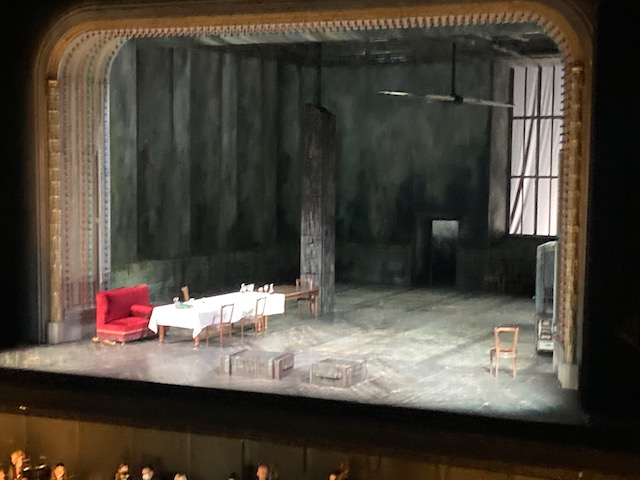
A encenação de Dietrich W Hilsdorf é, mais uma vez, um misto de realidade actual com elementos do passado. O ambiente é de Guerra, o cenário é semelhante nos 3 actos mas os símbolos principais da obra de R Wagner estão presentes – a espada Nothung cravada no freixo, a lança e uma abordagem convencional, num cenário diferente. 

(1º acto)

                                                     (2º acto)

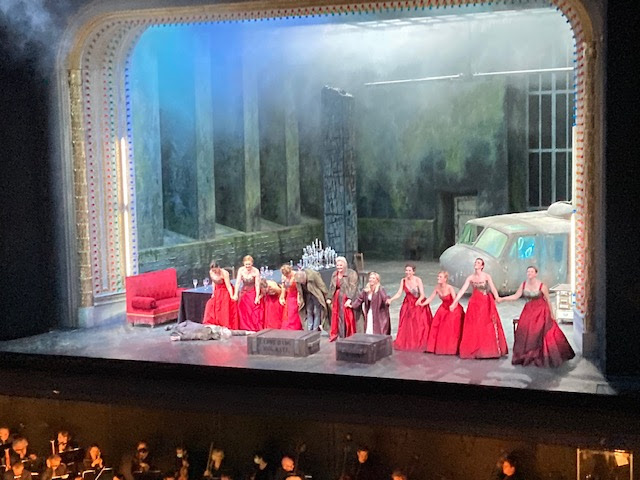
Wotan é retratado como um ser algo frágil, pouco compatível com a sua condição de Deus. O 3º acto começa com a queda e destroços de um helicóptero, donde saem os heróis mortos com as feridas visíveis. As valquírias, vestidas de vermelho, oferecem-lhes vinho. Termina com a Brünhilde sentada numa cadeira e o fogo sagrado visível por uma janela. 


                                                      (3º acto)

A Düsseldorfer Symphoniker, orquestra pouco vagneriana, dirigida por Alex Kober, esteve hoje bem melhor que há dias no Ouro do Reno.


Os cantores solistas foram todos muito bons. O melhor foi o primeiro acto, com duas interpretações excelentes, a do tenor Michael Weinius de voz potente, viril e timbre muito bonito. Se tivesse menos 20kg seria um Siegmund ideal. 


A soprano Elisabet Strid fez uma Sieglinde perfeita na interpretação vocal e cénica. O timbre é claro, sempre afinada e sobre a orquestra. 


O Hunding do baixo-barítono Thorsen Grümbel não destoou e ajudou a compor um primeiro acto excelente.


No 2º acto também assistimos a boas interpretações. Katarzyna Knucio fez uma Fricka irrepreensível e tem uma figura excelente.

O Wotan de Simon Neal impôs-se pela qualidade vocal. Em cena representa um personagem excessivamente frágil para a sua condição de Deus.

Linda Watson cantou mais uma vez a Brünhilde, personagem que terá interpretado inúmeras vezes nesta companhia de ópera. Vai ser alvo de uma homenagem de fim de carreira dentro de poucos dias e apenas cantará mais duas vezes o papel. Apesar de a voz denotar desgaste, merece o nosso cumprimento pela longevidade e qualidade da carreira.


As valquírias foram Helmige (Anka Krabbe), Gerhilde (Luiza Fatyol), Ortlinde (Sylvia Hamvasi), Waltraute (Romana Noack), Siegrune (Anna Harvey), Rossweisse (Kimberley Boettger-Soller), Grimgerde (Carmen Artaza) e Schertleite (Susan Maclean).



****

DIE WALKÜRE / THE VALKYRIA, Deutsche Oper am Rhein, June 2022

Dietrich W Hilsdorf's staging is, once again, a mixture of current reality with elements of the past. The atmosphere is from War, the setting is similar in the 3 acts but the main symbols of R Wagner's work are present – ​​the Nothung sword stuck in the ash tree, the spear and a conventional approach, in a different setting. Wotan is portrayed as a somewhat fragile being, little compatible with his condition of God. The 3rd act begins with the fall and wreckage of a helicopter, from which the dead heroes emerge with visible wounds. The Valkyries, dressed in red, offer them wine. It ends with Brünhilde sitting on a chair and the sacred fire visible through a window.

The Düsseldorfer Symphoniker, a slightly Vagnerian orchestra, conducted by Alex Kober, was much better today than it was in the Rhine Gold.

The soloist singers were all very good. The best was the first act, with two excellent interpretations, that of tenor Michael Weinius with a powerful, virile voice and a very beautiful timbre. If he were 20 kg less he would be an ideal Siegmund.

Soprano Elisabet Strid made a perfect Sieglinde in both vocal and scenic interpretation. The timbre is clear, always in tune and over the orchestra.

Bass-baritone Thorsen Grümbel's Hunding did not disappoint and helped to compose an excellent first act.

In the 2nd act we also witnessed good interpretations. Katarzyna Knucio did an irreproachable Fricka and has an excellent figure.

Simon Neal's Wotan stood out for its vocal quality. On stage, he represents a character that is excessively fragile for his condition of God.

Linda Watson once again sang Brünhilde, a character she will have played countless times in this opera company. She will be the subject of an end-of-career tribute in a few days and will only sing the role twice more. Although her voice denotes wear and tear, she deserves our compliments for the longevity and quality of her career.

The Valkyries were Helmige (Anka Krabbe), Gerhilde (Luiza Fatyol), Ortlinde (Sylvia Hamvasi), Waltraute (Romana Noack), Siegrune (Anna Harvey), Rossweisse (Kimberley Boettger-Soller), Grimgerde (Carmen Artaza) and Schertleite (Susan Maclean).

****


terça-feira, 14 de junho de 2022

DAS RHEINGOLD / O OURO DO RENO, Deutsche Oper am Rhein, Junho / June 2022


(Text in English below)

Na Deutsche Oper am Rhein de Düsseldorf tive oportunidade de ver O Ouro do Reno, de R Wagner. Deste ciclo do Anel havia já visto a Valquíria e o Crepúsculo dos Deuses, em anos anteriores à pandemia. 


A encenação de D. W. Hilsdorf traz a acção para a actualidade. Nesta ópera não é espectacular, passa-se quase toda no mesmo cenário com uma escadaria lateral e umas mesas redondas centrais, mas tem partes bem conseguidas, como as cenas no Nibelhein e a transformação do Alberich em dragão.


A direcção musical de Axel Kober foi correcta e a Düsseldorfer Symphoniker cumpriu com algumas falhas, sobretudo nos metais.

Os cantores solistas tiveram interpretações equilibradas e de bom nível, o que nos proporcionou um bom espectáculo.

Loge (Norbert Ernst) e Wotan (Simon Neal)


Fricka (Katarzyna Knucio) Freia (Anna Princeva) e Erda (Susan Maclean)


Alberich (Michael Kraus) e Mime (Florian Simson)


Fasolt (Thorsten Grümbel) e Fafner (Sami Luttinen)


Woglinde (Anke Krabbe), Wellgunde (Kimberley Boettger-Soller) e Flossilde (Anna Harvey)

Completaram o elenco Donner (Richard Sveda) e Froh (Jussi Myllys).


***


DAS RHEINGOLD, Deutsche Oper am Rhein, June 2022

At the Deutsche Oper am Rhein in Düsseldorf I had the opportunity to see Das Rheingold by R Wagner. From this Ring cycle I had already seen the Valkyrie and the Twilight of the Gods, in years before the pandemic.

D. W. Hilsdorf's staging brings the action up to date. This opera is not spectacular, it takes place almost entirely in the same setting with a side staircase and central round tables, but it has parts that are well achieved, such as the scenes in Nibelheim and the transformation of Alberich into a dragon.

Axel Kober's musical direction was correct and the Düsseldorfer Symphoniker fulfilled some flaws, especially in the brass.

The soloist singers had balanced and good interpretations, which gave us a good show.

Loge (Norbert Ernst) and Wotan (Simon Neal)

Fricka (Katarzyna Knucio) Freia (Anna Princeva) and Erda (Susan Maclean)

Alberich (Michael Kraus) and Mime (Florian Simson)

Fasolt (Thorsten Grümbel) and Fafner (Sami Luttinen)

Woglinde (Anke Krabbe), Wellgunde (Kimberley Boettger-Soller) and Flossilde (Anna Harvey)

Donner (Richard Sveda) and Froh (Jussi Myllys) completed the cast.

***

quarta-feira, 21 de novembro de 2018

GÖTTERDÄMMERUNG / O CREPÚSCULO DOS DEUSES, Deutsche Oper am Rhein, Düsseldorf, Novembro / November 2018


(review in English below)


A Ópera de Düsseldorf que, com a de Duisburg, integra a Deutsche Oper am Rhein é um edifício austero e sóbrio, de dimensão e acústica adequadas para assistir a um bom espectáculo de ópera.


O Crepúsculo dos Deuses, última ópera do Anel de R. Wagner, na encenação de Dietrich Hilsdorf, passa-se nas margens do Reno e num navio (MS Wodan) que nele navega. 


É uma crítica ao capitalismo e aos perigos da industrialização.


A encenação tem partes muito interessantes e outras nem tanto. Logo no início as Nornas, vestidas como senhoras do início do século passado, tomam chá numa mesa de um café nas margens do Reno, servidas por um empregado de rabo de cavalo vestido como nos dias de hoje. Este e outro que por vezes o acompanha estarão presentes ao longo da récita.


O navio ou vai viajando ao longo do Reno, ou atraca em determinados portos. Os elementos simbólicos chave mantêm-se conservados – o anel, a lança e a espada. As Filhas do Reno surgem e desaparecem no rio. O Hagen é uma figura tenebrosa e nunca larga a lança. Um dos momentos mais eficazes da récita é o início do 2º acto em que ele, agarrado aos ferros do navio, “ouve” o pai Alberich, excelentemente caracterizado, sem nunca mudar de posição ou olhar para ele. Menos interessante é a Gutrune que aparece como toxicodependente e o Coro (muito bom) 


que vem vestido em trajes militares coloridos e com uma bebida na mão.


No 3º acto, após o Hagen ferir mortalmente o Siegfried, ele cai para um porão. Durante a marcha fúnebre vão sendo içadas bandeiras pelos militares, na popa do navio, e lançadas para o porão. Primeiro a do império, depois as nazis, a bandeira actual da Alemanha (que é colocada no chão), a da República Democrática Alemã e, finalmente, uma bandeira branca. Depois desta, a bandeira da Alemanha é também para lá lançada.
No final, a Brünhilde lança fogo ao porão do navio e são projectadas chamas em todo o seu redor, ficando ela estática na parte mais elevada. Tudo deste mundo é destruído para que um novo surja em seu lugar.


O maestro Axel Cober dirigiu a orquestra que, apesar do bom desempenho global, teve ocasionalmente notas falhadas, sobretudo nos metais.


Nas interpretações vocais dominou a qualidade e homogeneidade. O Siegfried do tenor sueco Michael Weinius foi consistente, voz agradável e sem falhas. O cantor é obeso o que não favorece a personagem do herói interpretado.


A soprano norte americana Linda Watson cumpriu com valentia o exigente papel de Brünhilde. Esteve bem, embora no final da ópera não tenha atingido a excelência interpretativa que sempre desejamos ouvir.


O Hagen do baixo dinamarquês Stephen Milling foi sensacional, para mim o melhor intérprete da noite. Voz forte, grave, bem audível e uma postura sempre sinistra. Fantástico.


O barítono alemão Johannes Martin Kränzle foi um Gunter de referencia, tanto na interpretação vocal como cénica.


Sylvia Hamvasi, soprano húngara, interpretou a Gutrune com qualidade, embora a encenação não a favoreça.


Também esteve muito bem a mezzo polaca Katarzyna Knucio como Waltraute,


e o barítono alemão Michael Kraus no curto papel de Alberich.


Das 3 Nornas Susan Maclean (1ª), Sarah Ferede (2ª) e Morenike Fadayomi (3ª), a última foi claramente inferior às outras duas, mas já em relação às Filhas do Reno (Woglinde, Anke Krabbe; Wellgunde, Kimberley Boettger-Soller e Flossilde Ramona Zaharia) a consistência e qualidade imperaram.


Um espectáculo de grande qualidade.


****


GÖTTERDÄMMERUNG, Deutsche Oper am Rhein, Düsseldorf, November 2018

The Düsseldorf Opera House which, with the one of Duisburg, is part of the Deutsche Oper am Rhein, is an austere and sober building of size and acoustics suitable for a good opera performance.

Götterdämmerung, the last opera of R. Wagner’s  Ring cycle, in a production of Dietrich Hilsdorf, takes place on the banks of the Rhine and on a ship (MS Wodan) traveling on it. It is a critique of capitalism and the dangers of industrialization.

The staging has very interesting parts and others not so much. In the beginning of the performance the Norns, dressed as ladies from the beginning of the last century, drink tea on a table on the banks of the Rhine, served by a waiter dressed in present outfits. This one and another that sometimes appears with him will be present throughout the performance.

The ship either goes traveling along the Rhine, or docks in certain ports. The key symbolic elements remain preserved - the ring, the spear and the sword. The Daughters of the Rhine appear and disappear in the river. Hagen is a dark figure and always carries the spear. One of the most effective moments of the opera is the beginning of the second act in which he, clinging to the irons of the ship, "listens" to his (excellently characterized) father Alberich, without ever changing his position or looking at him. Less interesting is Gutrune who appears as a drug addict and the (very good) Choir comes dressed in colorful military outfits and with a drink in hand.

In the 3rd act, after Hagen mortally wounded Siegfried, he falls into the basement. During the funeral march flags are raised by the military at the stern of the ship and thrown into the basement. First the empire flag, then the Nazi flags, the current flag of Germany (which is placed on the ground), the German Democratic Republic flag and finally a white flag. After this, the current flag of Germany is also launched there.
In the end, Brünhilde sets fire to the ship's basement and flares are projected all around it. She remains static at the top of the ship. Everything in this world is destroyed so that a new one will arise in its place.

Maestro Axel Cober directed the orchestra which, despite its good overall performance, occasionally missed some notes, especially on metals.

Vocal interpretations were dominated by quality and homogeneity. Siegfried of Swedish tenor Michael Weinius was consistent, pleasant voice and without flaws. The singer is obese which does not favor the character of the interpreted hero. North American soprano Linda Watson was brave in the demanding role of Brünhilde. She was well, although at the end of the opera did not reach the interpretive excellence that we always want to hear.

Hagen of the Danish bass Stephen Milling was sensational, for me the best interpreter of the night. Strong, bass voice, well audible and always a sinister posture. Fantastic. German baritone Johannes Martin Kränzle was a reference Gunter, both in vocal and scenic interpretation. Sylvia Hamvasi, Hungarian soprano, interpreted Gutrune with quality, although the staging does not favor it. Polish mezzo Katarzyna Knucio was also very well as Waltraute, and the German baritone Michael Kraus in the short role of Alberich.

From the 3 Norns Susan Maclean (1st), Sarah Ferede (2nd) and Morenike Fadayomi (3rd), the latter was clearly inferior to the other two. The Daughters of the Rhine (Woglinde, Anke Krabbe, Wellgunde, Kimberley Boettger-Soller and Flossilde, Ramona Zaharia) were consistent and of remarkable quality.

A performance of great quality.

****