Mostrar mensagens com a etiqueta Tim Mead. Mostrar todas as mensagens

terça-feira, 26 de novembro de 2019

MORTE EM VENEZA / DEATH IN VENICE, Royal Opera House, Novembro / November 2019


(review in English below) 

A última ópera de Benjamin Britten, Morte em Veneza (segundo a obra homónima de Thomas Mann) foi apresentada pela Royal Opera de Londres numa encenação de David McVicar.


O escritor alemão Gustav von Aschenbach viaja para Veneza na procura de inspiração criativa. No hotel impressiona-se com a beleza de um jovem polaco, Tadzio, que está de férias com a família. Observa-o diariamente na praia, onde brinca com outros rapazes, e segue-o nas ruas de Veneza, mas não lhe consegue falar. Reconhece que está apaixonado por ele. Surgem notícias de um surto de cólera em Veneza, a maioria dos turistas abandona rapidamente a cidade, sucedem-lhe uma série de incidentes mas a obsessão por Tadzio impede-o de partir. No dia em que a família polaca sai do hotel, von Aschenbach observa o rapaz mais uma vez na praia, este luta com outro e, quando se levanta para tentar parar a luta, cai morto.


A encenação de McVicar é excelente. A acção decorre na época e o guarda roupa é magnífico. O palco tem uma série de colunas móveis e os cenários são muitos e dinâmicos, permitindo acompanhar perfeitamente a acção: o escritório de von Aschenbach na Alemanha, as viagens de Gôndola e os canais, os vários cenários no hotel, as ruas de Veneza, a Praça de São Marcos, a praia no Lido, tudo aparece em cenários bem conseguidos. 


Apenas achei a encenação escura no início (o nevoeiro nos canais é excelente, mas a ópera só “escurece” na segunda metade). 
Nesta produção o Tadzio não é um rapaz mas um homem jovem e todas as cenas passadas na praia são coreografadas e interpretadas (ao mais alto nível) por bailarinos, o que beneficia muito o espectáculo.

Dirigiu a Orquestra da Royal Opera o maestro Richard Farnes.


O tenor Mark Padmore foi excelente como Gustav von Aschenbach. Está quase sempre em cena e manteve a qualidade interpretativa sem vacilar até ao final. Tem uma dicção perfeita, das partes quase faladas às mais cantadas, tudo tão perceptível que dispensaria legendas.


Outro cantor de nível excepcional foi o barítono Gerald Finley nas 7 personagens que representa. Tem um timbre bonito, a voz é magnífica, e interpretou as diferentes personagens com um cariz específico para cada uma. À parte desta ópera, foi também homenageado por completar 30 anos de interpretações na Royal Opera.


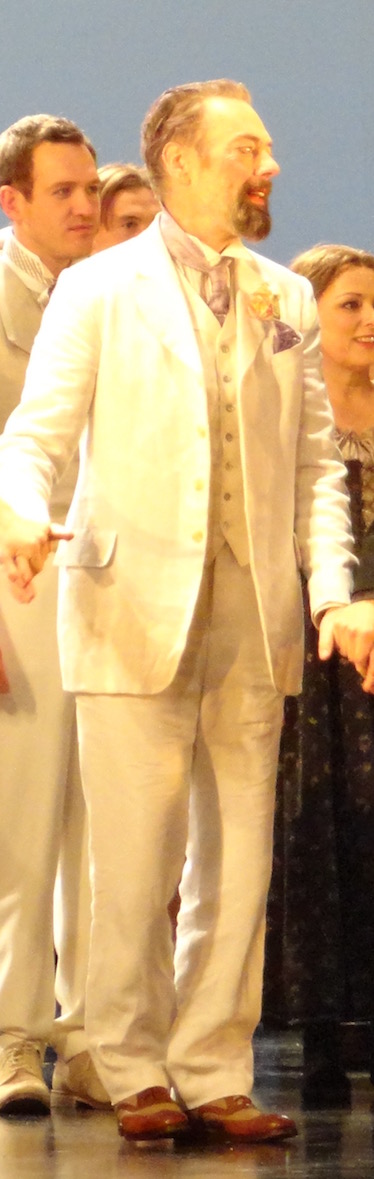
O contratenor Tim Mead esteve também irrepreensível na interpretação de Apollo.


Leo Dixon, que interpretou o Tadzio, é um jovem bailarino do Royal Ballet que dançou superiormente. A coreografia (de Lynne Page) é óptima. 


Participaram muitos outros intervenientes, cantando papéis secundários, dançando ou representando.

(os bailarinos)

(os bailarinos)


(equipa de produção)


A música de Britten não é fácil, mas foi um excelente espectáculo.

****


DEATH IN VENICE, Royal Opera House, November 2019

Benjamin Britten's last opera, Death in Venice (according to the homonymous novel by Thomas Mann) was presented by the Royal Opera in a production by David McVicar.

German writer Gustav von Aschenbach travels to Venice for creative inspiration. At the hotel he is struck by the beauty of a young Polish boy, Tadzio, who is on holiday with his family. He watches him daily on the beach, where he plays with other boys, and follows him on the streets of Venice, but cannot speak to him. He realises he is in love with him. There is news of a cholera outbreak in Venice, most tourists leave the city quickly, a series of incidents follows, but his obsession by  Tadzio keeps him from leaving. The day the Polish family leaves the hotel, von Aschenbach watches the boy once again on the beach that fights with another boy. When he gets up to try to stop the fight, he falls dead.

McVicar's staging is excellent. The action takes place at the time and the dresses are magnificent. The stage has a series of moving columns, and the scenery is dynamic, making it perfectly possible to follow the action: von Aschenbach's office in Germany, the gondola rides and canals, the various parts in the hotel, the streets of Venice, St. Mark's Square, the beach in Lido, all appear in well-done scenarios. I just found the staging dark at first (the fog in the canals is great, but the opera only “gets dark” in the second half). In this production Tadzio is not a boy but a young man and all the scenes on the beach are choreographed and performed (at the highest level) by dancers, what is good for the show.

The Royal Opera Orchestra was conducted by Richard Farnes.

Tenor Mark Padmore was excellent as Gustav von Aschenbach. He is almost always on stage and has maintained interpretive quality without wavering until the end. He has a perfect diction, from almost spoken parts to the most sung, all so clear that it would require no subtitles.

Another exceptional level singer was baritone Gerald Finley in the 7 characters he performs. He has a beautiful tone, the voice is magnificent, and interpreted the different characters with a specific touch for each one. Apart from this opera, he was also honored for completing 30 years of performances at the Royal Opera.

Countertenor Tim Mead was also impeccable in Apollo's interpretation.

Leo Dixon, who played Tadzio, is a young Royal Ballet dancer who danced superiorly. The choreography (by Lynne Page) is great. Many other actors participated, singing secondary roles, dancing or acting.

Britten's music is not easy, but it was a great performance.

****

sábado, 24 de maio de 2014

WRITTEN ON SKIN de George Benjamin — FCG, 23.05.2014

(Review in English below)

(Fotos da internet)

A FCG apresentou a ópera Written on Skin de George Benjamin. O compositor britânico compô-la em 2012 para o Festival Aix-en-Provence e recebeu uma óptima recepção da crítica especializada. Saíram críticas com frases como «a melhor ópera dos últimos 20 anos» ou descrições como «apaixonada, sensualmente bela, terrivelmente dramática». O libreto ficou a cargo de Martin Crimp que se baseou num manuscrito anónimo do século XIII.

O texto é rico e interessante, tratando temáticas como o poder, o género, a mulher como objecto, a submissão ou a fuga para a libertação. Mas também trata do amor, da arte, da morte, da violência física e verbal, ou do suicídio. É uma obra que se divide em Primeira, Segunda e Terceira partes sem intervalo, podendo ler-se uma sinopse e um interessante texto introdutório de Susana Duarte nesta ligação.


A Orquestra Gulbenkian apresentou-se num nível muito elevado sob direcção do próprio compositor — George Benjamin. A música é, no meu entender, interessante, explorando várias tonalidades harmónicas e com um elevado sentido dramático. É música contemporânea de inegável qualidade e que merece uma audição atenta e despreconceituosa. Penso que o pouco público presente lhe soube dar valor.

Os cantores estiveram num plano muito elevado. O canto não era tecnicamente fácil e a expressividade e dramatismo constantes exigiam uma presença e entrega totais. Isto para não falar de que, apesar de em muitos momentos o volume sonoro da orquestra não ser fácil de combater, os cantores revelaram sempre facilidade em ouvir-se.


Christopher Purves, barítono inglês, esteve num nível elevadíssimo. Expressividade dramática vocal e corporal excelentes, voz de colocação e potência magníficas, além de um timbre muito agradável. O melhor do trio de personagens principais.


Elin Rombo, soprano sueca foi uma Agnès também excepcional. Voz com um timbre bonito, óptima amplitude vocal, projecção de nível (a soar sempre por cima da orquestra: destaque para o final da Segunda parte). Tem, também, uma excelente expressividade corporal e ofereceu uma interpretação dramática intensa.


Tim Mead, contratenor inglês, fez de Anjo 1 e de Rapaz. A voz surpreendeu-me pela qualidade e timbre de beleza muito invulgar. Teve uma interpretação de muito elevada qualidade. Aliás, este trio esteve brutal!


Depois, em papéis mais pequenos, tivemos o meio-soprano Victoria Simmonds como Anjo2/Marie e o tenor Rupert Charlesworth como Anjo3/John em bom plano.


Foi, pois, uma récita bem interessante com destaque para a qualidade da Orquestra FCG e para o trio Purves, Rombo e Mead, além, obviamente, do compositor Benjamin.

Fica uma pequena entrevista do compositor para a ROH.


-------------
(Review in English)

The FCG presented the opera Written on Skin by George Benjamin. The British composer presented it in 2012 for the Festival Aix-en-Provence and received a great reception from critic. There were critics saying "the best opera of the last 20 years” or descriptions as "passionate, sensuously beautiful, terribly dramatic". Martin Crimp that was based on an anonymous manuscript of the thirteenth century did the libretto.

The text is rich and interesting, dealing with themes such as power, gender, woman as object, submission or escape to freedom. But comes to love, art, death, physical and verbal violence, or suicide. It is a work that is divided into First, Second and Third parties without intermission, and you can read a synopsis and an interesting introductory text by Susana Duarte at this link.

The Gulbenkian Orchestra has performed at a very high under the direction of the composer himself — George Benjamin. The music is, in my view, interesting, exploring various harmonics and high dramatic sense tonalities. It is contemporary music of undeniable quality and deserves an attentive and unprejudiced hearing. I think the little audience in the hall knew to value it.

The singers were on a very high level. The singing was not technically easy and dramatic expressiveness required a constant presence and total giving. Not to mention that, although many times the loudness of the orchestra were not be easy to surpass, the singers always proved easier to hear.

Christopher Purves, English baritone, was on a very high level. Excellent dramatic vocal and corporal expressiveness, and voice placement and magnificent power, plus a very nice timbre. He was the best singer within the main characters’ trio.

Elin Rombo, Swedish soprano was an Agnès equally exceptional. Voice with a beautiful timbre, great vocal range, projection of high level quality (always soar above the orchestra: highlight to the end of the Second Part). She also has a great body expressiveness and offered an intense dramatic interpretation

Tim Mead, English countertenor, did Angel 1 and Boy. The voice surprised me by the quality and timbre. He had an interpretation of very high quality. Indeed, this trio was amazing!

Then, in smaller roles, had at good level the mezzo-soprano Victoria Simmonds as Angel 2/Marie and tenor Rupert Charlesworth as Angel3/John.

It was therefore a very interesting recitation highlighting the quality of FCG Orchestra and the trio Purves, Rombo and Mead, besides, obviously, the composer Benjamin.