Mostrar mensagens com a etiqueta Stephanie Blythe. Mostrar todas as mensagens

quinta-feira, 4 de abril de 2019

LA FILLE DU RÉGIMENT, METropolitan Opera, Fevereiro / February, 2019


(review in English below)


La Fille du Régiment de Donizetti é uma ópera verdadeiramente “da treta”, com uma história ridícula e sem interesse. Contudo, para os amantes de belcanto e do fogo de artifício vocal é um pitéu. A produção da Metropolitan Opera de Nova Iorque é em parceria com a Royal Opera de Londres e com a Ópera estatal de Viena e já foi comentada neste blogue várias vezes porque, para além destes teatros, também tem sido apresentada noutros, incluindo Barcelona e Paris.


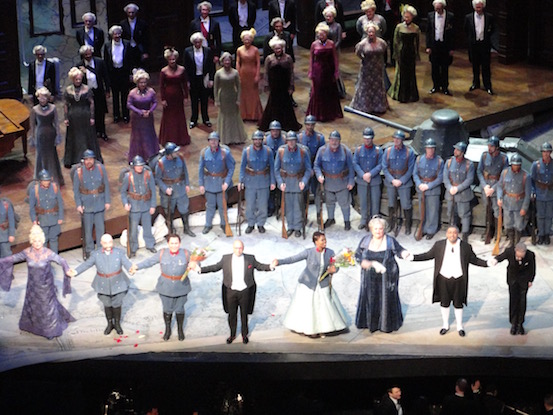
A encenação de Laurent Pelly é muito bem conseguida, situa a acção na altura da primeira guerra mundial e é cheia de momentos cómicos que ajudam a relativzar o ridículo do argumento. O 1º acto passa-se nas montanhas do Tirol (feitas de uns mapas gigantes) e o 2º numa sala do castelo da Marquesa de Berkenfield. A Marie é a única rapariga, uma maria-rapaz que veste calças e marcha no meio de um grande regimento. É levada pela “tia” (que é a mãe) para o seu castelo para ser educada como uma verdadeira senhora e casar com o filho da Duquesa de Krakentorp, por conveniência familiar. Nada disto acontece e a ópera acaba com um elogio à França. Só visto se consegue avaliar um espectáculo a qualidade cénica do espectáculo.


Fui com as expectativas em alta e, apesar de vários condicionantes, não saí defraudado.
Os condicionantes:
- Já vi esta produção umas 3 vezes, por isso não haveria grande surpresa na componente visual e cénica.

- É cantada e falada em francês. Estava ao meu lado um casal de franceses a quem, no intervalo, perguntei se estavam a perceber o que se dizia ou cantava no palco. Disseram-me que não, que tinham que ler as legendas (!). Nenhum dos cantores era francês e até eu percebi que o que se falava não soava a francês decente.

- Vi duas récitas com o Juan Diego Florez (talvez o meu tenor ligeiro favorito de sempre) como Tonio e com a Natalie Dessay como Marie. Para mim, ela é a referência absoluta no papel de Marie, uma actriz que cantava e que terá sido a intérprete que Donizetti, quando escreveu a ópera, sabia que um dia surgiria. Nunca haverá melhor e, possivelmente, nem igual. É pena que já se tenha retirado.


Mas..., apesar disto, foi um espectáculo deslumbrante, graças aos dois cantores solistas e ao Laurent Pelly:

- O tenor mexicano Javier Camerana tem uma voz arrepiante, fabulosa, com um registo agudo maravilhoso em beleza, intensidade e afinação. Tivemos não 9 mas 18 dós de peito pois bisou o Pour mon ame… E se o público do Met é muito generoso para com todos os cantores, bons e maus, nesta récita a casa veio abaixo com os aplausos e outras manifestações de apreço! Reconheço que foi melhor que o Florez quando o vi no mesmo papel.


- A soprano sul-africana Pretty Yende. é actualmente a melhor cantora neste registo. Tem uma voz limpa e cristalina, com um timbre lindíssimo, e de qualidade homogénea no registo médio e agudo. A desafinação forçada na lição de canto do 2º acto foi do mais hilariante que tenho visto. E as áreas dramáticas são de um lirismo arrepiante. Mas tem que se ouvir, não se consegue descrever por palavras. Como referi, a Natalie Dessay é passado porque já não canta ópera, muito menos estas que são extremamente exigentes.


- Apesar de ser uma ópera cómica, tem árias de grande lirismo e intensidade dramática, primorosamente interpretadas pelos dois solistas, mas sobretudo pela Yende.


- Os momentos de comicidade são muito bem concebidos e têm realmente muita graça. Na parte falada do 2º acto atingem o expoente máximo com a mistura de algumas expressões inglesas no francês e até com a evocação da Flauta Mágica (zu hilfe, zu hilfe) num momento de apuros do Hortensius, o mordomo da Marquesa. Mas é preciso ver. A Yende nos ensaios do 2º acto é também brilhante neste aspecto e quando se abraça ao Tonio com a condecoração e se magoa nela, também os dois são espectaculares.

O maestro Enrique Mazzola esteve bem, a Orquestra da Metropolitan Opera óptima e o Coro fantástico.


A mezzo norte-americana Stephanie Blythe foi uma Marquesa de Berkenfield de peso (em todos os sentidos) 


o barítono italiano Alessandro Corbelli foi um óptimo Sulpice, o protector da Marie, 


o papel falado da Duquesa de Krakenthorp foi interpretado pela norte-americana Kathleen Turner de voz marcadamente grave, 


e o mordomo Hortensius (baixo norte-americano Paul Corona) não destoou.


Um espectáculo fantástico!


*****


LA FILLE DU RÉGIMENT, METropolitan Opera, February, 2019

La Fille du Régiment by Donizetti is a truly "trash" opera, with a ridiculous and uninteresting story. However, for lovers of belcanto and the vocal firework is a “must see”. The production of the Metropolitan Opera of New York is in partnership with the Royal Opera of London and with the State Opera of Vienna and has already commented previously and several times on this blog because it has also been seen in other cities such as Paris and Barcelona.

The staging by Laurent Pelly is very well concieved, situates the action at the time of the first world war and is full of humorous moments that help to relativize the ridiculous of the argument. The first act takes place in the mountains of Tyrol (made of giant maps) and the 2nd in a room of the castle of Marquise of Berkenfield. Marie is the only girl, a wearing trousers and marching girl in the middle of a great regiment. She is taken by her "aunt" (who is in fact her mother) to her castle to be brought up as a true lady and to marry the son of the Duchess of Krakentorp for family convenience. None of this happens and the opera ends with a compliment to France. To appreciate the real quality staging of the opera you have to see it.

I went with high expectations and, despite several conditions, I was not disappointed.
The conditions:
- I've seen this production about 3 times, so there would be no big surprise in the visual and scenic component.

- It is sung and spoken in French. I was standing next to a couple of French people who, at the interval, told me that they could not understand what was being said or sang on the stage, they had to read the subtitles in French (!). None of the singers was French and I even realized that what was being said did not sound decent French.

- I saw two performances with Juan Diego Flórez (perhaps my favorite light tenor ever) as Tonio, and with Natalie Dessay as Marie. For me, she is the absolute reference in the role of Marie, an actress who sang and who would have been the interpreter that Donizetti, when he wrote the opera, knew that one day would arise. There will never be better and possibly not even as good as. It's a shame she's already retired.

But ... despite these, it was a dazzling performance, thanks to the two soloist singers and to Laurent Pelly:

- Mexican tenor Javier Camerana has an amazing, fabulous voice, with a marvelous register of beauty, intensity and tuning. We had not 9 but 18 high Cs because he gave an encore of the most famous aria Pour mon ame ... And if the audience of the Met is very generous to all the singers, good and bad, in this performance the house came down with the applause and other manifestations of appreciation! I admit he was better tonight than Flórez when I saw him in the same role.

- South African soprano Pretty Yende is currently the best singer in this register (liric coloratura soprano). She has a clean and crystalline voice, with a beautiful timbre, and of homogeneous quality in the mid and top registers. The detuning in the second act's singing lesson was the most hilarious thing I've ever seen in the several performances of this opera. And the dramatic areas are of a touching lyricism. But you have to listen, I can not describe it in words. As I mentioned, Natalie Dessay is past because she no longer sings opera, in particular these extremely demanding roles.

- Although it is a comic opera, it has Arias of great lyricism and dramatic intensity, exquisitely interpreted by the two soloists, but mainly by Yende.

- The moments of comedy are very well designed and really have a lot of fun. In the spoken part of the 2nd act they reach the maximum with the mixture of some English expressions in tne French and even with the evocation of the Magic Flute (zu hilfe, zu hilfe) in a moment of trouble of Hortensius, the butler of the Marquise. But it has to be seen. Yende is also brilliant in the rehearsals of the second act, and when she embraces Tonio with the decoration that hurts her. Here the two are spectacular.

Maestro Enrique Mazzola was fine, the Orchestra and the Choir of the Metropolitan Opera were fantastic.

American mezzo Stephanie Blythe was a weight (in every sense) Marquise of Berkenfield, Italian baritone Alessandro Corbelli was a terrific Sulpice, Marie's protector, the spoken role of the Duchess of Krakenthorp was played by Kathleen Turner with a markedly bass voice, and the butler Hortensius (American bass Paul Corona) was also very good.

A fantastic performance!

*****

quinta-feira, 21 de março de 2019

IT TRITTICO, METropolitan OPERA, Dezembro / December 2018


(review in English below)

Nunca tinha visto a produção do Il Trittico da Metropolitan Opera. A encenação de Jack O’Brien das 3 óperas de Puccini é globalmente muito boa, embora na Gianni Schicchi seja inferior às outras. 


O maestro foi o Bertrand de Billy que nos ofereceu uma abordagem convencional mas muito agradável, com a Orquestra ao seu habitual alto nível.


Contra uma cortina encarnada, as fotografias ficaram sempre péssimas.


IL TABARRO
Um cenário espectacular, uma enorme barcaça num canal de Paris, debaixo de uma ponte. Os cantores solistas todos bons. Amber Wagner impressionante como Giorgetta em potencia e qualidade vocal, não tanto na interpretação cénica, parecia igualmente apaixonada pelo Michele e pelo Luigi.
George Granidze muito bom na interpretação cénica e vocal do Michele, o marido traído. Marcelo Álvarez algo irregular na emissão como Luigi. Tiveram também óptimas interpretações vocais MaryAnn McCormik (Frugola), Tony Stevenson (Tinca) e Maurizio Murar (Talpa). Começou muito bem a tarde de ópera.


SUOR ANGELICA
Novamente um cenário espectacular, os jardins interiores de um convento. 


Esta é uma ópera muito dramática, de uma cantora só, mas todas as outras intervenientes foram excelentes, nomeadamente Maureen McKay como Genoveva, MaryAnn McCormick como Madre superiora 


e Stephanie Blythe, uma princesa gélida e cruel de voz avassaladora.


A grande intérprete da ópera, e da récita, foi a Kristine Opolais como Suor Angelica. Grande agilidade em cena e vocalmente impressionante. Uma voz bonita, afinada, muito emotiva e sempre sobre a orquestra. 


A segunda ópera excelente!


GIANNI SCHICHI
Quando tudo parecia que o espectáculo iria ser memorável, eis que surge uma terceira ópera decepcionante! Num cenário vulgar para esta ópera, o quarto do recém falecido Buoso Donati, a comicidade foi muito básica e de gosto discutível, quase sempre sem graça. No final aparece um jardim sobre Florença, a única nota mais original.
E os cantores foram quase todos fracos. O Rinuccio de Atalla Ayan mal se ouviu, o Simone de Maurizio Muraro cantou sempre no mesmo tom, a Lauretta da Kristina Mkhitaryan cumpriu sem o menor deslumbre e o Gianni Schicchi do Placido Domingo, num papel de barítono que não é o seu, apenas se ouviu no registo mais agudo. 


A Zita da Stephanie Blythe sim, ouviu-se bem, mas nada mais que isso. Uma decepção a finalizar o espectáculo.


***


IT TRITTICO, METropolitan OPERA, December 2018

I had never seen the Metropolitan Opera production of Il Trittico. Jack O'Brien's direction of Puccini's three operas is overall very good, although in Gianni Schicchi it is much inferior to the others. The conductor was Bertrand de Billy who offered us a conventional but very nice approach, with the Orchestra to its usual high level.
Against a red curtain, the photographs were always bad.

IL TABARRO
A spectacular scenery, a huge boat on a canal in Paris, under a bridge. The soloist singers were all good. Impressive Amber Wagner as Giorgetta in power and vocal quality, not so much in the stage interpretation, seemed equally in love with Michele and Luigi.
George Granidze was very good at the scenic and vocal interpretation of Michele, the betrayed husband. Marcelo Alvarez somehow irregular in the emission as Luigi. There were also excellent vocal performances by MaryAnn McCormik (Frugola), Tony Stevenson (Tinca) and Maurizio Murar (Talpa). It was a very good start of the operatic evening.

SUOR ANGELICA
Again a spectacular setting, the interior gardens of a convent. This is a very dramatic opera of a single singer, but all the other singers were excellent, notably Maureen McKay as Genoveva, MaryAnn McCormick as Mother Superior and Stephanie Blythe, a cold and cruel princess with an overwhelming voice.
The great interpreter of the opera, and of the night, was Kristine Opolais as Suor Angelica. She had great agility on stage and vocally she was impressive. A beautiful voice, tuned, very emotional and always above the orchestra. The second opera was excellent!

GIANNI SCHICHI
When it all seemed like the night was going to be memorable, here comes a third disappointing opera! In a vulgar scenario for this opera, the room of the recently deceased Buoso Donati, the comedy sketches were very basic and debatable, almost always bland. At the end there was a garden over Florence, the only more original note.
And the singers were almost all weak. Atalla Ayan’s Rinuccio was barely heard, Maurizio Muraro’s Simone always sang in the same tone, Kristina Mkhitaryan’s Lauretta was ok but without emotion, and Placido Domingo’s Gianni Schicchi, in a role of baritone that is not his, was only well heard in the top register. And yes, Stephanie Blythe's Zita was heard, but nothing more. A disappointment end the operatic evening.

***

domingo, 11 de novembro de 2018

CENDRILLON – METropolitan Opera, Nova Iorque / New York, Maio / May 2018


 (review in English below)

Cendrillon é uma ópera de Jules Massenet com libretto de Herni Cain baseado no conto de fadas Cendrillon (Cinderela) de Charles Perrault.


Era uma vez… um conto de fadas para o esplendor das vozes femininas!


A história é bem conhecida. Nesta versão Lucette (Cendrillon, Cinderela) vive com Pandolfe, o pai que casou em segundas núpcias com madame de la Haltière, uma madrasta terrível que tem duas filhas. Todos se preparam para um baile no palácio do príncipe Charmant. A madrasta proíbe Lucette de ir ao baile. Aparece uma fada que a transforma numa irreconhecível e bela jovem mas avisa-a que deve regressar antes da meia noite. No baile o príncipe rejeita todas as pretendentes e apaixona-se de imediato por Lucette. À meia noite desaparece, mas perde um sapato. De novo em casa, a madrasta descreve o baile a Lucette. Demasiado triste, decide fugir para a floresta para aí morrer. Aparece de novo a fada e, na floresta, encontra-se com o príncipe e cantam o seu amor. O pai encontra-a muito doente, leva-a para casa e diz-lhe que, enquanto dormia, falou num príncipe. Lucette pensa que afinal tudo foi um sonho. O príncipe pretende encontrar a sua amada e chama todas as jovens que foram ao baile para provarem o sapato. A madrasta tem a certeza que será uma das filhas a escolhida. Todas provam o sapato que não serve a nenhuma. Surge Lucette com a fada e é imediatamente reconhecida pelo príncipe. Toda a família fica subitamente feliz e cumprimenta a futura rainha.


A produção de Laurent Pelly de é muito bem conseguida para o conto de fadas. O cenário é constituído por painéis onde está escrita a história. Têm muitas portas e movem-se ao longo do espectáculo oferecendo-nos quadros muito diversos e de grande efeito visual, mantendo sempre as páginas da história como elemento central.


Os trajos são muito engraçados e exageradamente peculiares. Todas as personagens femininas aparecem de encarnado, com excepção das criadas (de cinzento), da madrasta (inicialmente de roxo), suas duas filhas (de cor de rosa e verde claro) e da fada (de azul celeste). 


Lucette aparece de cinzento mas, quando transformada pela fada, de branco prateado. Os homens, de fato preto, colete e camisa branca, muitos meias encarnadas e cabeleiras fartas.


A direcção musical foi do maestro francês Bertrand de Billy.


Joyce DiDonato, mezzo-soprano americano, foi uma Lucette (Cendrillon) extraordinária. A voz é de uma extensão invulgar (incluindo pelos terrenos de soprano), de timbre belíssimo, de potência avassaladora. Já várias vezes referi que aprecio muito DiDonato. Acho que consegue transmitir vocalmente os diferentes estados de alma como poucas. Aqui foi ora triste e melancólica ora alegre e radiosa. Em cena foi sempre muito credível. É uma actriz que canta. É sempre um privilégio ouvir Joyce DiDonato.


A madrasta Madame de la Haltière foi interpretada pela mezzo norte-americana Stephanie Blythe. Foi outra grande interpretação. A figura da cantora ajuda e a voz é potente e com um registo grave assinalável.


Outra cantora de topo foi o mezzo-soprano britânico Alice Coote que interpretou o príncipe Charmant. Mais uma voz sensacional, em potência e beleza tímbrica. O papel é extenso e esteve sempre afinada e nunca perdeu qualidade. Cenicamente foi também muito boa.


Para completar o conjunto de vozes femininas superiores que se juntaram nesta produção falta referir a soprano sul-coreana Kathleen Kim que interpretou a Fada. A voz esteve sempre muito afinada, audível sobre a orquestra e recheada de notas agudas de qualidade. A coloratura foi também notável.


O barítono francês Laurent Naouri, que foi Pandolfe, pai de Lucette. É um cantor que nunca falha e oferece-nos sempre óptimas interpretações, cénicas e vocais. Tem um timbre muito bonito e é sempre muito expressivo e bem audível.


Os cantores secundários Ying Fang (Noémie), Maya Lahyani (Dorothée), David Leigh (mestre de cerimónias), Jeongcheol Cha (Primeiro Ministro) e Bradley Garvin (Rei) e actores estiveram bem, mas a noite foi das Senhoras que nos ofereceram interpretações inesquecíveis em todos os registos vocais.


*****


CENDRILLON, METropolitan Opera, May 2018

Cendrillon is an opera by Jules Massenet with libretto by Herni Cain based on the fairy tale Cendrillon (Cinderella) by Charles Perrault.

Once upon a time ... a fairy tale for the splendour of the female voices!

The story is well known. In this version Lucette (Cendrillon, Cinderella) lives with Pandolfe, his father who marriage for a second time with Madame de la Haltière, a terrible stepmother who has two daughters. All are preparing for a ball in the palace of Prince Charmant. Lucette's stepmother forbids her to go to the ball. A fairy appears and transforms her into an unrecognizable and beautiful young woman, but warns her that she should come back before midnight. At the ball the prince rejects all girls and falls immediately in love by Lucette. At midnight she disappears, but leaves a shoe behind. At home again, the stepmother describes the ball to Lucette. Too sad, she decides to escape to the forest to die there. The fairy appears again and in the forest she meets the prince and both sing their love. Her father finds her very sick, takes her home and tells her that while she slept, she spoke about a prince. Lucette thinks that all was a dream. The prince wants to find his beloved and calls all the girls who went to the ball to test the shoe. The stepmother is sure that one of her daughters will be chosen. The shoe does not fit any of the girls. Lucette appears with the fairy and is immediately recognized by the prince. The whole family is suddenly happy and greets the future queen.

Laurent Pelly’s production is excellent for the fairy tale. The scenario consists of panels where the story is written. They have many doors and move throughout the show giving us very different scenes of great visual effect, keeping the pages of history as a central element.
The costumes are very funny and overly quirky. All the female characters appear in red, with the exception of the maids (gray), the stepmother (initially purple), her two daughters (of pink and light green) and the Fairy (light blue). Lucette appears in gray but when transformed by the fairy, she becomes silvery-white. The men were in black suit, vest and white shirt, red socks, and bushy hair.

The musical director was the French conductor Bertrand de Billy.

Joyce DiDonato,  American mezzo-soprano, was an extraordinary Lucette (Cendrillon). The voice is of an unusual extent (also throughout the soprano territory), with beautiful tone and overwhelming power. I have often mentioned that I really appreciate DiDonato. I think vocally she manages to convey the different feelings of the character as few others. Here she was either sad and melancholic or happy and radiant. Artistically she was always very credible. She is a singing actress. It is always a privilege to see Joyce DiDonato.

The stepmother, Madame de la Haltière, was interpreted by American mezzo Stephanie Blythe. Another great performer. The figure of the singer helped and her voice is strong and with a fantastic low register.

Another top singer was British mezzo-soprano Alice Coote who played Prince Charmant. She was another sensational voice, both in power and beauty of timbre. The role is extensive and she has always been in tune and never lost quality. On stage she was also very good.

To complete the set of female top quality voices that joined in this production I need to mention South Korean soprano Kathleen Kim who played the Fairy. Her voice was always well tuned, audible over the orchestra and filled with high notes of quality. The coloratura was also remarkable.

French baritone Laurent Naouri, was Pandolfe, Lucette's father. He is a singer who never fails and always offers us great interpretations, scenic and vocal. He has a very beautiful tone and is always very expressive and well audible.

Supporting singers Ying Fang (Noémie), Maya Lahyani (Dorothée), David Leigh (master of ceremonies), Jeongcheol Cha (Prime Minister) and Bradley Garvin (King) and actors were fine, but the evening was of the Ladies who offered us unforgettable performances in all vocal records.

*****