Text in English below)

A tetralogia de Berlim com encenação de Dmitri Tcherniakov começa, como já se poderia antever, atendendo a experiências passadas negativas (Parsifal, por exemplo), da pior maneira no que à encenação de Das Rheingold respeita.

Acabada a abertura, o cenário desce e passamos para uma espécie de sala de diálise, toda ela de vidro, onde está Alberich vendado, preso a um cadeirão (com o que parecem cintos de automóvel), com um soro azul a correr numa veia puncionada e ligado a uma máquina enorme — eventualmente de diálise e de eletroencefalograma (tudo muito exagerado). Tem ainda um “capacete” de eletroencefalograma colocado na cabeça. As filhas do Reno, vestidas à moda dos anos 60/70 onde parece decorrer a ação, são umas enfermeiras de caderno na mão. Respondem aos galanteios de um Alberich que esbraceja às cegas enquanto as procura. Quando percebe que está a ser gozado e desiste, destrói a sala de um jeito patético, partindo máquinas e cadeirões, e arrancando uns tantos cabos que fazem as vezes do ouro. Tudo isto para espanto delas e dos figurantes presentes, que parecem fazer as vezes dos administradores da clínica.
Voltamos depois a subir e os cenários vão mudando na horizontal, como se fossem salas de um palácio que são contíguas umas às outras (as portas entre elas disso dão ideia). Inicialmente, voltamos ao anfiteatro, onde se apresentam Fricka e Wotan que dialogam sobre o pagamento da construção do Wahalla. Tudo num diálogo sentado e com pouca interação. A esse cenário acorre, de seguida, uma Fricka aflita, de vestido para o dia-a-dia e, em sequência, os gigantes Fafner e Falsot que aqui são apenas dois homens simples: um obeso Lammermoor encarado vestido de casaco de pele comprido, outro alto, nada sisudo, de calças verdes e blazer piroso a condizer…
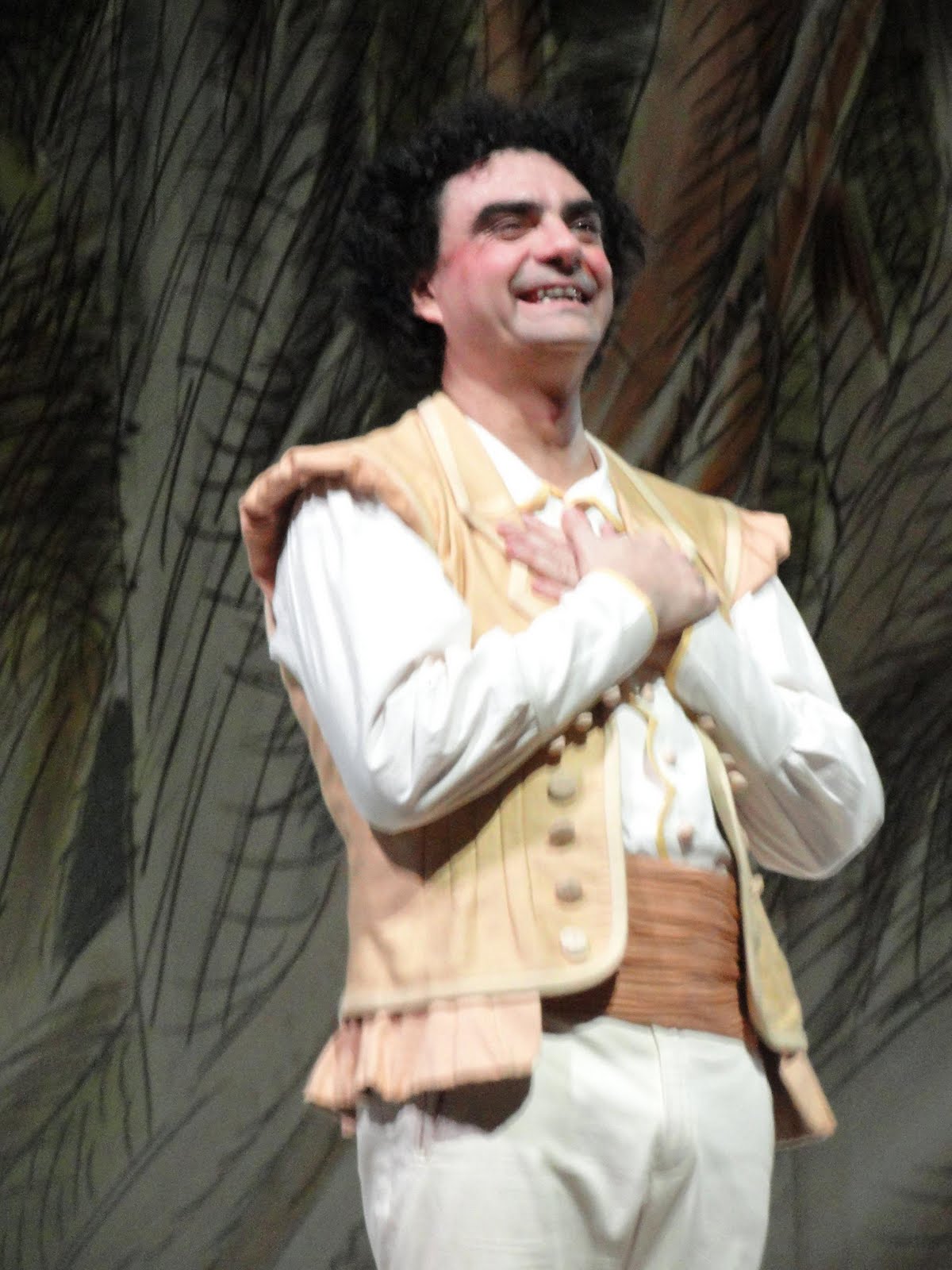
Para negociar, nada como uma mudança para uma sala mais pequena com várias cadeiras e muitos copos de água e jarros. Loge [que bebeu alguma água, não fosse o fogo queimá-lo], de fato mostarda e calças à boca de sino, chega mais tarde, como é suposto. Mas é aqui que começa a «versão comédia» de Das Rheingold. Loge, muito exagerado e expressivo, denotando traços histriónicos, goza, sem piedade e com sobranceria, com os gigantes, o que fica patente quer na expressão corporal quer até na vocal.
Combinado o pagamento, os gigantes, que se faziam acompanhar de uns indivíduos que impunham respeito, levam Freia, enquanto Wotan e Loge saem num elevador que os conduz a patamares inferiores: quem sabe se o esperado submundo de Nibelheim?
Nesse caminho, passam, primeiramente, por um laboratório cheio de jaulas preenchidas por coelhos vivos, mas silenciosos. Continuando a descida, chegam a um laboratório apelidado de «Laboratório para estudo do comportamento humano» com várias cabines de vidro onde homens com farda numerada trabalham e Mime se compraz queixando-se. Ouro nem vê-lo! Cabos também não… Chegado Alberich que importuna todos os presentes e começa numa sessão de cacetadas em Mime, vão-se abrindo portas e fechando, enquanto mudam de cabine em cabine. A dada altura, Mime exibe o tronco nu, sem propósito evidente. Talvez para se libertar do calor de tanta pancada. Entretanto, Wotan e Loge assistem, divertidos, do lado de fora. Quando Alberich se apercebe da sua presença e a pedido destes, usa o Tarnhelm - aqui representado por um capacete esquisito ao estilo de um de eletroencefalograma -, estende os braços e diz transformar-se numa serpente para gáudio dos demais que gritam divertidos, fazendo-se horrorizados. Segue-se a transformação em objeto pequeno que, uma vez mais, não acontece. Aqui, a mando de Wotan que os chamou num telefone de parede junto ao elevador, chegam dois enfermeiros psiquiátricos (daqueles que só se vêem nos filmes) que têm por missão conter Alberich fisicamente pelas mãos levá-lo - no elevador, para que não faltem detalhes - para uma outra sala da casa de Wotan, essa, como já é sabido, situada num piso superior.
Na sala do palácio, Alberich continua a ser vítima dos inoportunos comentários de Wotan e Loge. Depois, a custo, Wotan lá lhe arranca o anel do dedo e Alberich vai-se embora, apertando a mão aos enfermeiros-carcereiros (ridículo a ponto de se ouvirem alguns risos na plateia…) que assistiam à porta e amaldiçoando quem venha a ter o ambicionado anel do poder.
O ouro — que eventualmente tinha sido reunido enquanto Alberich, na cena anterior, falava com o anel — é entregue aos gigantes. Mas de ouro só mesmo o anel que brilha no dedo de Wotan. O demais será entregue de acordo com o que Loge vai rabiscando num pretenso contrato. Freia, presente na sala com o mesmo vestido já anteriormente descrito, é medida, mas nunca tapada ou coberta por ouro, por muito que os gigantes se tenham esforçado por vê-la menos do que na realidade a viam… Wotan lá acaba por ceder e entregar o anel, mas apenas depois de Erda ter surgido, de fato azul e sem qualquer misticismo ou aura, vinda do nada. Aparentemente, apesar do despropósito, ninguém pareceu ficar surpreendido com a aparição.
De seguida, todos os deuses passam para uma espécie de entrada onde, com letras grandes, está gravada a sigla E.S.C.H.E. (se não fosse uma sigla, significaria freixo) nas paredes. No meio, está uma árvore. Talvez os entendidos possam esclarecer-me se era um freixo, o que é provável.
Nessa cena, uns figurantes sentam-se nos bancos embutidos nas paredes juntamente com os deuses. Aqui, Donner usa e abusa de pequenos efeitos de fumo e de fogo — bem ruidosos - que saem dos seus punhos, de um caderno, de uma espada e de uma martelada. Depois Froh, com uma grande flor na mão que, num jeito tosco, se desfaz em panos de muitas cores, tenta a referência à ponte de arco-íris que dá acesso a Wahalla, mas esqueceu-se de trazer panos que representassem todo o espectro cromático. O que foi pena, porque tinha melhorado imenso o efeito… No fim, ainda lança rede mal enjeitada sem razão que se vislumbre, a não ser dar nota de que estávamos todos um pouco confusos com a trama de Tcherniakov. No fim, sem entusiasmo, lá vão todos por uma porta (nada arqueada, por sinal, mas quadrada) para aquilo que será (podemos supor) o novo palácio chamado Walhala.
O cenário sobe uma vez mais, mostrando uma estrutura de janelas brancas opacas que, a meio da subida, volta a descer para a entrada anterior. Aí Wotan ouve, para sua irritação, as filhas do Reno a pedir o ouro de volta, sempre na presença de um Loge desejoso de sair de cena, o que acontece porque cai o pano.
Em suma, mesmo desconhecendo a história, nada do que foi visto parece fazer sentido. É, pois, uma ode ao disparate!

Evidentemente, esta encenação não facilita a apreciação dos cantores, desde logo porque, ao contrário de um ambiente escuro e pesado, assim como de um desenrolar dramático da acção, vemos uma sequência inverosímil de cenas com um tom de paródia inesperado. Ainda assim, pode afirmar-se que os cantores foram globalmente equilibrados, ainda que sem deslumbrar.
O Wotan de Michael Volle tem potencial, dado que vocalmente esteve bem. A Fricka de Claudia Mahnke esteve bem, mas sem grande potência vocal. A Freia de Anett Fritsch foi das melhores da noite: emotiva e com uma voz com colocação impecável. O Donner de Lauri Vasar e o Froh de Siyabonga Maqungo estiveram bem, sem nada de negativo ou especialmente positivo a apontar. O Loge de Rolando Villazón, muito histérico e vocal e cenicamente expressivo, com os tons de comédia que lhe pediram, esteve bem, mas começou com a voz esforçada e, também atendendo ao que lhe pediram, levou ainda alguns boos bem audíveis. O Alberich de Martin Kranzle também esteve bem, mas sem grande potência vocal ou tom maléfico, porque fizeram dele mais tonto do que é (por isso levou uns boos também). O Mime de Stephan Rugamer esteve bem, sem encantar. Falsot esteve em muito bom plano, o que se agradece a Mika Kares. Já o Fafner de Peter Rose foi só pesado e lento, parecendo fazer um frete (talvez gigante). A Erda de Anna Kissjudit mostrou ter uma voz enorme, pelo que se pode esperar bastante. As filhas do Reno (Evelin Novak, Natalia Skrycka e Anna Lapkoskaja) estiveram em bom nível, sem destaque especial a dar a alguma delas.
Por fim, a Staatskapelle Berlin sob direção de Christian Thielmemann que substituiu Daniel Baremboim (que está com uma vasculite) foi quem nos permitiu ter o deleite que se espera quando se vai ver uma produção do Anel de Nibelungo. Grande interpretação! Amanhã espera-se muito da música de Dia Walkure.
Em suma, temos em cena um Anel para ver de olhos fechados. Os cantores ainda estão a arrancar e a orquestra — essa sim! — já vai lançada.
______________
The Berlin tetralogy with Dmitri Tcherniakov's direction starts, as one might expect in view of past negative experiences (Parsifal, for example), in the worst way as far as the staging of Das Rheingold is concerned.
The opening scene is an amphitheatre with lots of chairs. In the middle is a screen on which images of an axial section of a cranial MRI scan are projected. Afterwards, these images become a stain that, if it is not a stain, changes in the style of a cerebral angiography.
After the opening, the scene descends and we pass to a kind of dialysis room, all made of glass, where Alberich is blindfolded, tied to a chair (with what look like car belts), with a blue serum running in a punctured vein and connected to a huge machine - possibly dialysis and electroencephalogram (all very exaggerated). He also has an electroencephalogram "helmet" put on his head. Reno's daughters, dressed in the 60s/70s fashion in which the action seems to take place, are some nurses with notebook in hand. They respond to the gallantries of an Alberich who squints blindly as he looks for them. When he realises he is being teased and gives up, he destroys the room in a pathetic way, breaking machines and armchairs and tearing out a few cables that are used for gold. All this to their astonishment and that of the extras present, who seem to be acting as the administrators of the clinic.
We then go back up and the scenes change horizontally, as if they were rooms in a palace that are adjacent to one another (the doors between them give you an idea of this). Initially, we return to the amphitheatre, where Fricka and Wotan are presented and discuss the payment for the construction of the Wahalla. All in a seated dialogue with little interaction. Next, a distressed Fricka in an everyday dress arrives and, in sequence, the giants Fafner and Falsot, who here are just two simple men: one a staring, obese Lammermoor in a long fur coat, the other tall, not at all sombre, in green trousers and a matching tacky blazer...
To negotiate, nothing like a move to a smaller room with several chairs and lots of water glasses and jugs. Loge [who drank some water, were it not for the fire burning him], in a mustard suit and bell-bottoms, arrives later, as he is supposed to. But this is where the "comedy version" of Das Rheingold begins. Loge, very exaggerated and expressive, showing histrionic traits, mocks the giants mercilessly and with hubris, which is evident both in his body and even in his voice.
Once the payment has been agreed upon, the giants, who were accompanied by some respectful individuals, take Freia away, while Wotan and Loge leave in a lift which takes them to lower levels: who knows if the expected underworld of Nibelheim?
On this path, they first pass through a laboratory full of cages filled with live but silent rabbits. Continuing their descent, they reach a laboratory dubbed "Laboratory for the study of human behaviour" with several glass booths where men in numbered uniforms work and Mime is pleased to complain. Gold doesn't even see it! When Alberich arrives, he pesters everyone present and begins a session of hitting Mime, doors are opened and closed while they move from cabin to cabin. At a certain point, Mime displays her naked torso, with no obvious purpose. Perhaps to free herself from the heat of so much beating. Meanwhile, Wotan and Loge watch, amused, from outside. When Alberich becomes aware of their presence and at their request, he wears the Tarnhelm - here represented by a weird electroencephalogram-style helmet -, extends his arms and says he transforms into a snake to the delight of the others, who shout in amusement, making themselves look horrified. This is followed by the transformation into a small object which, once again, does not happen. Here, at the behest of Wotan who has called them on a wall telephone next to the lift, two psychiatric nurses arrive (the kind you only see in films) whose mission is to physically restrain Alberich by the hands and take him - in the lift, so as not to miss details - to another room in Wotan's house, this one, as is already known, situated on an upper floor.
In the palace room, Alberich continues to be the victim of Wotan and Loge's inappropriate comments. Then, with difficulty, Wotan rips the ring off his finger and Alberich leaves, shaking hands with the nurse-caretakers (ridiculously enough, some laughter can be heard in the audience...) who were watching from the doorway and cursing whoever will have the coveted ring of power.
The gold - which had eventually been gathered while Alberich, in the previous scene, was talking to the ring - is handed over to the giants. But of gold only the ring that shines on Wotan's finger. The rest will be handed over according to what Loge scribbles on a so-called contract. Freia, present in the room wearing the same dress described above, is measured, but never covered or covered by gold, however much the giants tried to see her less than they actually saw her... Wotan eventually gives in and gives the ring, but only after Erda appears, in a blue suit and without any mysticism or aura, from nowhere. Apparently, despite the pointlessness, no one seemed surprised by the appearance.
Next, all the gods pass into a sort of entrance where, in large letters, the acronym E.S.C.H.E. (if it were not an acronym, it would mean ash tree) is engraved on the walls. In the middle is a tree. Perhaps the experts can clarify for me whether it was an ash tree, which is likely.
In that scene, some extras sit on benches embedded in the walls along with the gods. Here Donner uses and abuses small smoke and fire effects - quite noisy - coming out of his fists, a notebook, a sword and a hammer. Then Froh, with a big flower in his hand that, in a clumsy way, shreds into cloths of many colours, tries the reference to the rainbow bridge that gives access to Wahalla, but forgot to bring cloths that represent the whole chromatic spectrum. Which was a pity, because it would have improved the effect immensely... At the end, he still throws out a badly thrown net for no reason that can be seen, except to note that we were all a little confused by Tcherniakov's plot. In the end, unenthusiastically, there they all go through a door (not arched at all, by the way, but square) to what will be (we can assume) the new palace called Walhala.
The scene rises once more, showing a structure of opaque white windows which, halfway up, descends back to the previous entrance. There Wotan hears, to his irritation, the daughters of the Rhine asking for their gold back, always in the presence of a Loge eager to leave the scene, which happens because the curtain falls.
In short, even unaware of the story, nothing seen seems to make sense. It is, therefore, an ode to nonsense!
Evidently, this staging does not make the singers any easier to appreciate, since, in contrast to a dark and heavy atmosphere, as well as a dramatic unfolding of the action, we see an improbable sequence of scenes with an unexpected tone of parody. Still, it can be said that the singers were balanced overall, albeit without dazzling.
Michael Volle's Wotan has potential, given that vocally he did well. Claudia Mahnke's Fricka was fine, but without much vocal power. Anett Fritsch's Freia was one of the best of the night: emotional and with a voice of impeccable placement. Lauri Vasar's Donner and Siyabonga Maqungo's Froh were fine, with nothing negative or especially positive to point out. The Loge by Rolando Villazón, very hysterical and vocally and scenically expressive, with the comedy tones that were asked of him, was fine, but started with a strained voice and, also given what was asked of him, he still had some audible boos. Martin Kranzle's Alberich was also good, but without much vocal power or evil tone, because they made him sound more silly than he is (so he got some boos too). Stephan Rugamer's Mime was okay, without charm. Falsot was in very good form, for which Mika Kares is to be thanked. Peter Rose's Fafner, on the other hand, was just heavy and slow, seeming to freight (maybe giant). Anna Kissjudit's Erda proved to have a huge voice, so one can expect quite a lot. Reno's daughters (Evelin Novak, Natalia Skrycka and Anna Lapkoskaja) were on a good level, with no special highlight to give to any of them.
Finally, the Staatskapelle Berlin under the direction of Christian Thielmemann who replaced Daniel Baremboim (who has vasculitis) was the one who allowed us to have the delight one expects when going to see a production of the Nibelungen Ring. Great interpretation! Tomorrow much is expected of Dia Walkure's music.
All in all, we have on stage a Ring to watch with our eyes closed. The singers are still getting started and the orchestra - yes, the orchestra! - is already launched.