

(review in english below)
Não sei se vou ter palavras
que sejam justas para descrever o quão espetacular foi a produção de La
Clemenza di Tito do Teatro Real de Madrid desta temporada. Mas vou tentar,
sumarizando numa expressão que me é querida: BRUTAL!!!
Quem ama a Ópera sabe que
poucas serão as vezes que se sai de uma récita com a noção de que não houve elo
mais fraco e que todos os intervenientes estiveram a um nível estrelar. Ainda
mais se tornam especiais essas récitas em que os astros parecem estar todos
alinhados sobre aquela casa de ópera e naquele momento, quando somos
surpreendidos por vozes que ainda não conhecíamos, que são jovens e
impressionantes. Foi isso que me aconteceu no passado dia 17 de Fevereiro.
Sem nunca o tendo visto ao
vivo, já conhecia a voz de Yann Beuron, a partir da gravação de Iphigenie en
Tauride de Gluck por Minkowski, e tinha a certeza de que faria um Tito fenomenal.
A sua voz tem uma frescura, constância e beleza pura irrepreensíveis, acoplada
a uma naturalidade expressiva impressionante.

(Yann Beuron)
Kate Aldrich conhecia menos,
apenas de excertos do Youtube, e que Sesto nos ofereceu!... Brilhante em todos
os aspectos!

(Kate Aldrich)
Os restantes eram-me
completamente desconhecidos. Serena Malfi (Annio), Maria Savastano (Servilia) e
Guido Loconsolo (Publio) surpreenderam pela qualidade e beleza tímbrica,
perfeita para o canto Mozartiano.

(Serena Malfi)

(Maria Savastano)

(Guido Loconsolo)
Estiveram todos espetaculares, como disse, mas se tivesse que realçar um (e vou fazê-lo), tinha de ser a Vitellia de Amanda Majeski. Acho que a cantora ruiva podia mudar o nome para Majestik, dado que a sua interpretação foi magistral! Tem uma potência vocal colossal, mantendo toda a qualidade em qualquer registo, modula-a conseguindo transmitir, de forma sempre sublime e sem exageros corporais, todos os sentimentos por que Vitellia passa ao longo da obra: raiva, medo, compaixão, arrependimento... Seduziu-me por completo e, com as devidas reservas, quase que tive vontade de matar Tito no primeiro acto, tomando o lugar de Sesto... J O modo como falou, em vez de cantar, a passagem em que se revela como culpada a Tito perfurou-me a alma.

(Amanda Majeski)
Thomas Hengelbrock dirigiu a
fantástica Orquestra do Teatro Real de forma transcendental, transmitindo uma
sonoridade mozartiana invejável. Tenho de destacar a excelente prestação do
clarinetista. Não me recordo de alguma vez ter ouvido alguém a tocar este
instrumento de forma tão sentida e doce. Não pude de deixar, por breves
momentos, de relembrar o concerto para clarinete e orquestra, também esta uma
criação sublime do último ano de vida de Mozart, e desejar ouvi-lo por este
conjunto.

(Thomas Hengelbrock)
A encenação, originalmente
para o Festival de Salzburgo, é simples, clara, cheia de luz, e complementa de
modo coerente uma acção que, nesta ópera, é maioritariamente psicológica.
Se as produções Mozartianas anunciadas
para a temporada 2012-2013 pelo Teatro Real de Madrid tiverem a mesma qualidade
desta produção de La Clemenza di Tito, Madrid será um dos locais de culto para
fanáticos desta arte e deste compositor...


Uns exemplos do que vos transmiti...


La Clemenza di Tito, Teatro Real, Madrid - February
17, 2012

I do not know if I have words that are fair to
describe how spectacular this production of La Clemenza di Tito was. But I will
try, summarizing in an expression that is dear to me: BRUTAL!!!
One that loves Opera knows that there not always you
get out of a performance with the notion that there was no weakest link and
that all players were at a star level. These performances become even more
special when the stars appear to be all lined up above that opera house and at
that moment, when you are surprised by voices that you still did not know, and who
are young and impressive. That happened to me on the past February 17.
Without ever having seen him live, I already knew the
voice of Yann Beuron from the recording of Gluck's Iphigenie en Tauride by
Minkowski, and I was sure ihe would make a phenomenal Tito. His voice has a
freshness, consistency and pure beauty, coupled with an impressive naturally
expressivity.
(Yann Beuron)
I knew less Kate Aldrich, only from videos on Youtube,
and what a Sesto she gave us! ... Brilliant in all aspects!
(Kate Aldrich)
The rest were completely unknown to me. Serena Malfi
(Annio), Maria Savastano (Servilia) and Guido Loconsolo (Publio) surprised me by
the quality and beauty of timbre, perfect for singing Mozart.
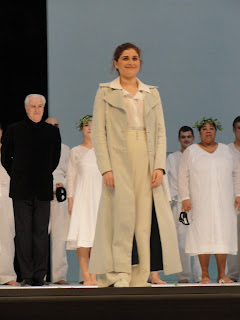


(Serena Malfi)
(Maria Savastano)
(Guido Loconsolo)
They were all spectacular, as I said, but if I had to
highlight one (and I'll do it), it had to be the Vitellia of Amanda Majeski. I
think the redheaded singer could change the name to Majestik, given that her interpretation
was masterful! She has a huge vocal power, keeping the quality in any level.
She modulates her voice in a perfect way, and without physical exaggeration,
conveying all the different Vitellia’s feelings: anger, fear, compassion,
repentance… She seduced me completely and, with appropriate reservations, I
almost wanted to kill Tito in the first act, taking the place of Sesto ... ☺
The way she spoke, instead of singing, in the passage in which she reveals
herself guilty to Tito, pierced my soul.

(Amanda Majeski)
Thomas Hengelbrock conducted the fantastic Orchestra
of the Teatro Real in a transcendental form, conveying an enviable Mozartian
sound. I have to highlight the excellent performance of the clarinetist. I do
not remember ever having heard anyone playing this instrument as he did. I briefly
remembered the concert for clarinet and orchestra, which is also a sublime
creation of the last year of Mozart's life, and desired to hear it by this
ensemble.

(Thomas Hengelbrock)
The staging, originally for the Salzburg Festival, is
simple, clear, light-filled and consistently adds on to an action that, in this
opera, is mostly psychological.
If the Mozart productions announced for the 2012-2013
season at the Teatro Real de Madrid have the same quality of this production of
this La Clemenza di Tito, Madrid is one of the places of worship for fans of
this art and this composer...
Some examples of what I have described to you...


