Mostrar mensagens com a etiqueta Marina Rebeka. Mostrar todas as mensagens

segunda-feira, 24 de outubro de 2022

MESSA DA REQUIEM, Verdi, Teatro Regio di Parma, Setembro / September 2022

(review in English below)

O Requiem de Verdi foi colossal!!! Isto é que é Verdi e isto é que faz qualquer um apaixonar-se por esta obra! 

O Mariotti é um dos meus maestros verdianos favoritos e hoje, mais uma vez, pude constatar que o seu conhecimento, a sua sensibilidade, a sua entrega a Verdi é ímpar e o resultado, quando se tem uma orquestra fenomenal e um coro sólido e harmonioso, só pode ser memorável. O detalhe às indicações vocais aos cantores, a dinâmica imprimida, tudo fantástico.


Dos solistas só não conhecia a contralto. A harmonia entre os 4 timbres individuais foi perfeita, sem sobreposições de qualidade numa homogeneidade perfeita. Riccardo Zanellato foi um autêntico sólido rochedo dramático. O Stefan Pop sublime nos seus pianos no Ingemisco e no Hostias, seguro, estabilidade vocal e emoção sincera a 100%. 


A contralto Varduhi Abrahamyan tem uma voz perfeita, timbre muito bonito e expressividade fantástica. A Marina Rebeka, já amplamente nossa conhecida, é um colosso. Voz inconfundível, daquelas que sabemos de quem é a voz só de a ouvir, com agudos seguros, transições sem falhas e suaves para os pianos e uma expressividade que o mundo da ópera lhe trouxe e que ela vai “devolvendo” sempre que canta. 


O Lacrymosa foi celestial, com uma harmonia entre todos tão… tão bonita. O Agnus Dei, uma perfeição das vozes femininas e as entradas do coro sem falhas, em uníssono, numa intensidade sonora tão equilibrada, tão celestial.

Que grande noite! 


(Texto de Wagner_fanatic)


REQUIEM, Verdi, Teatro Regio di Parma, September 2022

Verdi's Requiem was colossal!!! This is what Verdi is and this is what makes anyone fall in love with this work!

Mariotti is one of my favorite Verdian conductors and today, once again, I could see that his knowledge, his sensitivity, his dedication to Verdi is unique and the result, when you have a phenomenal orchestra and a solid and harmonious choir can only be memorable. The detail to the vocal prompts to the singers, the imprinted dynamics, all fantastic.

Of the soloists, I just didn't know the alto. The harmony between the 4 individual timbres was perfect, without quality overlaps in perfect homogeneity. Riccardo Zanellato was a solid dramatic rock. Stefan Pop sublime in his pianos at Ingemisco and Hostias, confidence, vocal stability and 100% sincere emotion.

Contralto Varduhi Abrahamyan has a perfect voice, very beautiful timbre and fantastic expressiveness. Marina Rebeka, already widely known to us, is a colossus. Unmistakable voice, of those we know whose voice it is just by listening to it, with safe highs, flawless and smooth transitions for pianos and an expressiveness that the world of opera brought her and that she “gives back” whenever she sings.

Lacrymosa was heavenly, with a harmony between everyone so… so beautiful. The Agnus Dei, a perfection of the female voices and the flawless choir entries, in unison, in a sound intensity so balanced, so heavenly.

What a great night!

(Text by Wagner_fanatic)

domingo, 23 de setembro de 2018

FAUST de Charles Gounod — Teatro Real, Madrid, 22/09/2018

(Review in English below)

Assisti à ópera Faust, produção que abre a temporada do Teatro Real de MadridCharles Gounod estreou a ópera em 1859 que teve como libretistas a dupla Jules Barbier Michel Carré que partiram da peça Faust et Marguerite inspirada no Faust de Goethe.

A ópera tem estado menos frequentemente no repertório atual do que nos anos que se seguiram à estreia, provavelmente por ser musicalmente interessante, mas ter um drama e texto algo inconsistentes.


A produção trazida ao Teatro Real é a que Álex Ollé (La Fura dels Blaus) estreou em 2014 em Amesterdão. Trata-se de uma produção muito intensa visualmente, com múltiplos números que pretendem modernizar a ópera e que o fazem com qualidade e sem desvirtuar a indicações cénicas originais. Traz a ação para o nosso século e para um laboratório que trabalha o projeto “Homunculus Project”. Recorrendo a um vestuário vistoso, a um jogo de luzes intenso, a diversos painéis que se vão transformando, a encenação proposta permite o desenrolar da ação de forma fluida e caricaturiza alguns estereótipos sociais. Sem ser genial, sugere uma leitura alternativa que vale a pena explorar.


Orquestra do Teatro Real soou de forma luxuosa sob a direção de Dan Ettinger que pecou pontualmente pelo ritmo e volume excessivos. O Coro do Teatro Real esteve imaculado, oferecendo momentos de grande qualidade.

A figura principal da abertura da temporada de Madrid é Piotr Beczala que foi um Faust apaixonado, dramaticamente convincente, e com uma voz poderosíssima de agudos estratosféricos que apenas pecou pelo seu francês peculiar.

A Marguerite de Marina Rebeka esteve fantástica (mais consistente que Beczala), exibindo uma voz cheia e de agudos fáceis, destacando eu a interpretação do “Il ne revient pas” do IV ato.

O Mefistófeles de Luca Pisaroni esteve um pouco abaixo vocalmente se comparado com Beczala ou Rebeka, apresentando alguma dificuldade no registo agudo e, apesar de cenicamente ter estado bem, não conseguiu ser muito diabólico.

O Valentin de Stéphane Degout foi magnífico e, no meu entender, o melhor da récita pela qualidade vocal (excelente em toda a tessitura) e intensidade dramática. Um barítono de invulgar qualidade.

O Siebel de Serena Malfi foi de grande qualidade, apesar de ter tido um ou outro agudo mais estridente.


Valeu, pois, bem a pena a deslocação à capital espanhola e ao Teatro Real.

__________________
(Review in English)

I attended the opera Faust which is the production that pretend to open the Madrid’s opera season in a glamorous way. Charles Gounod premiered the opera in 1859 with a libretto by Jules Barbier and Michel Carré based on the play Faust et Marguerite inspired by Goethe’s Faust.

This opera has been less frequently performed than in the years following the premiere, probably because of a drama and text that are somewhat inconsistent, despite the unquestionable musical quality.

The production brought to Teatro Real is Álex Ollé’s Faust premiered in 2014 at Amsterdam. It is a visually very intense production, intending to modernize the opera without detracting from the original scenic indications. Ollé’s production brings the action to our century and to a laboratory that works on the "Homunculus Project". Using a showy clothing, an intense palette of lights, different panels permanently in transformation, the proposed staging allows the unfolding of the action in a fluid way and try to caricature some social stereotypes. Despite it’s not a genial production, the alternative reading proposed worth to be explored.

The Orchestra sounded luxuriously under the direction of Dan Ettinger who sinned punctually due to excessive rhythm and volume. The Choir was immaculate, offering moments of great quality.

The main figure of the season is Piotr Beczala who was a passionate, dramatically convincing Faust, with a very powerful voice of stratospheric highs that only sinned for his peculiar French.

Marina Rebeka's Marguerite was fantastic (more consistent than Beczala). She has a beautiful voice and terrific high notes, and I highlight the interpretation of "Il ne revient pas" from IV act as her best moment.

The Mephistopheles of Luca Pisaroni was, if compared to Beczala or Rebeka, vocally not so convincing, presenting some difficulty in the acute register and, although he had been well cenically, he was not so diabolical as I would expect.

Stéphane Degout's Valentin was magnificent and, in my opinion, the best performer of the cast for vocal quality (excellent throughout the whole tessitura) and dramatic intensity. A baritone of unusual quality.

Serena Malfi's Siebel was of high quality, despite some harsh high notes.

This Faust worth well the trip to the Spanish capital and to Teatro Real.

quarta-feira, 26 de julho de 2017

DON GIOVANNI, METropolitan Opera, Abril / April 2017


 (review in English below)

Após ter visto em Outubro passado a produção de Michael Grandage do Don Giovanni de W.A. Mozart na Metropolitan Opera de Nova Iorque, tive oportunidade de a rever 7 meses depois, com novo maestro e novos intérpretes. Infelizmente, a qualidade deficiente do espectáculo não melhorou substancialmente.


Como escrevi aqui, é uma encenação clássica, feia, escura e pouco imaginativa, passada numa cidade espanhola no Sec. XVIII (assim diz o programa). Mas apenas se vêm três andares de janelas exteriores. Há alguma mobilidade do palco mas nada é  interessante. Apenas a cena final em que o Don Giovanni é consumido pelas chamas foi um pouco diferente da rotina em que tudo o resto decorreu, mas ainda assim sem originalidade.

A direcção musical foi de Placido Domingo. Como cantor, é uma referencia incontornável nas últimas décadas e, penso que por isso, é tolerado como maestro nesta grande catedral da ópera. Mas a direcção musical da excelente Orquestra da Metropolitan Opera foi má. Sempre muito “empastelada” desde a abertura, desencontros frequentes e sem alma mozartiana.


Em relação aos solistas, mais uma vez, um conjunto heterogéneo de cantores:

A soprano Angela Meade foi um erro de casting na Donna Anna. A voz é grande, afinada e sempre bem audível sobre a orquestra. Mas é totalmente desprovida da sensibilidade e lirismo da personagem. Meade é uma boa intérprete verdiana, mas Mozart não é para ela. Em cena foi um traste.


Pelo contrário, a soprano Marina Rebeka foi uma Dona Elvira de grande qualidade. Tem de voz lírica sempre afinada, de timbre muito agradável e uma presença em palco muito boa.


A Zerlina da mezzo Isabel Leonard foi também muito boa. A cantora tem uma voz agradável, muito expressiva, sempre bem audível. E também representou ou papel, não se limitando a cantar.


O Don Giovanni foi interpretado pelo barítono Mariusz Kwiecien. Fez um Don Giovanni de voz potente e bem timbrada, sempre audível sobre a orquestra. Foi convincente na prestação cénica, encarnando uma personagem vil e sem escrúpulos. Excelente.


O baixo Erwin Schrott fez um Leoporello muito agradável. Muito bem vocalmente, foi um verdadeiro actor cómico em todo o espectáculo.


O tenor Matthew Polenzani fez um Don Ottavio aceitável. A voz tem um timbre agradável mas a emissão foi algo irregular e cenicamente cumpriu sem deslumbrar.


Os dois baixos tiveram interpretações distintas. Jeongcheol Cha foi um Masetto de voz feia e frequentemente abafada pela orquestra 


mas Stefan Kocan impôs a sua qualidade vocal como Comendador.


***


DON GIOVANNI, METropolitan Opera, April 2017

After seeing Michael Grandage's production of Don Giovanni by W.A. Mozart last October at the Metropolitan Opera in New York, I had the opportunity to review it 7 months later with a new conductor and new interpreters. Unfortunately, the poor quality of the show has not improved substantially.

As I wrote here, it is a classic, ugly, dark and unimaginative staging, played in a Spanish city in the XVIII Century (so says the program). But we only see three floors of exterior windows. There was some stage mobility but nothing interesting. Only the final scene in which Don Giovanni was consumed by the flames was a little different from the routine in which everything else took place, but still without originality.

The musical direction was by Placido Domingo. As a singer, he has been a reference in the last decades and I think that is the reason why he is tolerated as a conductor in this great cathedral of the opera. The musical direction of the excellent Orchestra of the Metropolitan Opera was bad. Always very "jammed" since the overture, frequent small disconnections and no mozartian soul.

Concerning the soloists, once again, a heterogeneous set of singers:

Soprano Angela Meade was a casting error as Donna Anna. The voice is large, tuned and always well audible over the orchestra. But she is totally devoid of the character's sensitivity and lyricism. Meade is a good Verdian interpreter, but Mozart is not for her. On stage she was also to forget.

On the contrary, soprano Marina Rebeka was a high-quality Dona Elvira. She has a lyrical voice always in tune, with a very pleasant tone and a very good stage presence.

Zerlina by mezzo Isabel Leonard was also very good. The singer has a pleasant voice, very expressive, always well audible. And she also played the character, not just singing.

Don Giovanni was interpreted by baritone Mariusz Kwiecien. He was a Don Giovanni with a powerful and well-marked voice, always audible over the orchestra. He was convincing in the scenic performance, embodying a vile and unscrupulous character. Excellent.

Bass Erwin Schrott was a very pleasant Leoporello. Very well vocally, he was a real comic actor in the whole performance.

Tenor Matthew Polenzani was an acceptable Don Ottavio. The voice has a nice timbre but the emission was something irregular and on stage he was ok without dazzling.

The two basses had different interpretations. Jeongcheol Cha was a Masetto with an ugly voice and often muffled by the orchestra but Stefan Kocan imposed his vocal quality as Commendatore.


***

terça-feira, 20 de dezembro de 2016

GUILLAUME TELL, METropolitan Opera, Outubro / October 2016


 (review in English below)
Uma nova produção da monumental opera Guillaume Tell, última obra de G. Rossini, esteve em cena na Metropolitan Opera de Nova Iorque.


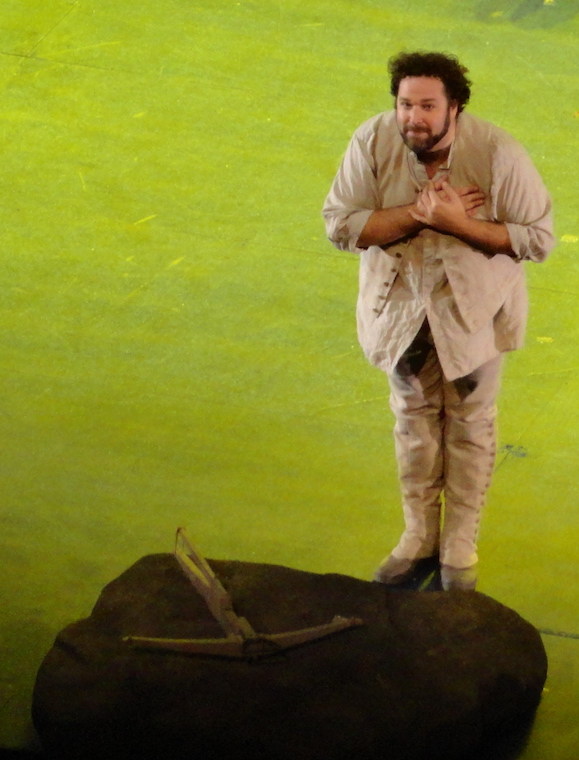
A encenação de Pierre Audi, originária da Dutch National Opera, é vazia e abstracta. A ópera retrata a guerra entre suíços (oprimidos) e austríacos (opressores) na idade média até à libertação da Suiça, encabeçada pelo arqueiro Guilherme Tell. Tudo se passa entre grandes pedras e rochas, que vão mudando de posição ao longo da récita. Os dois grupos rivais são facilmente identificados, os suíços sempre vestidos de cinzento claro (o que os faz confundir com o fundo do cenário, espelhado e também dessa cor), e os austríacos de negro.


Fabio Luisi dirigiu o espectáculo e, mais uma vez, houve uma excelente interpretação da Orquestra e também do Coro, omnipresente em toda a ópera. Os solistas foram de grande qualidade.


O baixo-barítono canadiano Gerald Finley foi o protagonista Guilherme Tell e cantou e interpretou o papel ao mais alto nível. A voz é cheia de matizes coloridas e o cantor usou-a com elegância e emotividade.


O papel mais exigente é o de Arnold, interpretado pelo tenor norte americano Bryan Hymel. A personagem requer um tenor lírico e heróico, o que Hymel cumpre na perfeição. A voz é clara e algo nasalada mas é poderosa e afinada em todos os registos. Foi particularmente impressionante na ária Asile héreditaire do 4º acto.


O baixo-barítono canadiano John Relyea foi o vilão Gesler de voz grave, potente e autoritária, bem adequada à personagem.


Outro baixo de grande qualidade foi a sul coreano Kwanchul Youn que interpretou o Melcthal, pai assassinado de Arnold.
 Finalmente Walter teve outra interpretação de classe, do baixo italiano Marco Spotti.


As senhoras também estiveram em grande destaque. A jovem soprano norte americana Janai Brugger foi um Jemmy, filho de Tell, de excelente qualidade, tanto cénica como vocal.


Hedwige foi interpretada com correcção pela mezzo norte americana Maria Zifchak.


Deixei para o fim a soprano letã Marina Rebeka que foi a pricesa austríaca Mathilde. Cantou ao mais alto nível, a voz é bem timbrada e sempre perfeitamente audível, com um fraseado impecável. Transmitiu dramatismo e vulnerabilidade à interpretação da personagem, entre a paixão por um inimigo e a fidelidade ao seu povo. A ária principal do 3º acto Pour notre amour, plus d’espérance foi impressionante.


Um excelente espectáculo na Met Opera


*****


GUILLAUME TELL, Metropolitan Opera, October 2016

A new production of the monumental opera Guillaume Tell, last work of G. Rossini, was on stage at the Metropolitan Opera in New York.

The production of Pierre Audi, originally from the Dutch National Opera, is empty and abstract. The opera depicts the war between Swiss (oppressed) and Austrian (oppressors) in the Middle Ages until the liberation of Switzerland, headed by archer William Tell. Everything takes place between large stones and rocks that change position along the performance. The two rival groups are easily identified, the Swiss always on light grey dresses (which makes them confused with the background scenery, mirrored and also grey), and the Austrians in black.

Fabio Luisi directed and, again, there was an excellent performance of the Orchestra and the omnipresent Choir, throughout the opera. The soloists were of great quality.

Canadian bass-baritone Gerald Finley was William Tell and sang and played the role at the highest level. The voice is full of colorful hues and the singer used it with elegance and emotion.

The most demanding role is that of Arnold, interpreted by North American tenor Bryan Hymel. The character requires a lyrical and heroic tenor, which Hymel meets perfectly. The voice is clear and somewhat nasal but powerful and tuned in all registers. He was particularly impressive in the aria Asile héréditaire the 4th act.

Canadian bass-baritone John Relyea was Gesler the villain, powerful and authoritative voice, well-suited to the character.

Another high quality bass was the South Korean Kwanchul Youn who played Melcthal the murdered father Arnold.

Finally Walter was another class interpretation, by Italian bass Marco Spotti.

The ladies were also in great prominence. The young American soprano Janai Brugger was Jemmy, son of Tell, of excellent quality, both on stage and vocal.

Hedwige was interpreted with correction by North American mezzo Maria Zifchak.

I left for the end of the Latvian soprano Marina Rebeka who was that the Austrian pricess Mathilde. She sang at the highest level, the voice is always perfectly audible, with impeccable phrasing. She transmitted drama and vulnerability to the interpretation of the character, between the passion for an enemy and fidelity to his people. The main aria of the 3rd act Pour notre amour, plus d'espérance was impressive.

An excellent performance at the Met Opera


*****