Mostrar mensagens com a etiqueta Die Walküre. Mostrar todas as mensagens

terça-feira, 18 de outubro de 2022

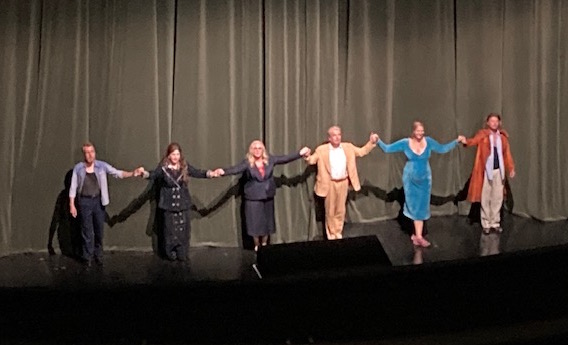
Die Walküre - Staatsoper Berlin - 3.10.2022

(Text in English below)


Como seria de esperar, a interpretação de Tcherniakov de Die Walküre esteve qualitativamente em linha com Das Rheingold. 


A ópera inicia-se com um pano em baixo sem qualquer projeção ou ação, perdendo-se a hipótese de representar a tempestade que Wagner tão bem recriou musicalmente. De repente, ao fim de uns 2 minutos, projetam imagens televisivas que diziam “Kriminal Report” com flashes de cenas criminais de rua e, posteriormente, com de video-vigilância. Nelas aparecem aquele que vem a ser Siegmund, aqui levado por dois polícias já na prisão. Tem uma madeixa branca no cabelo, o que é um sinal de que é filho de Wotan, pois este também tem uma madeixa branca no cabelo grisalho. Subido o pano, ainda há tempo para aparecer Wotan no seu escritório.


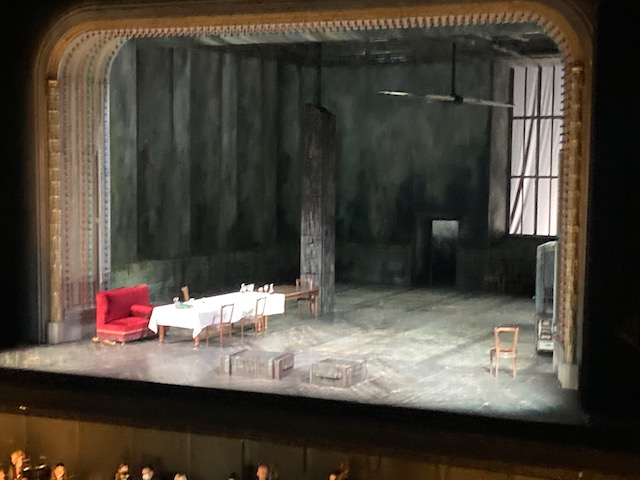
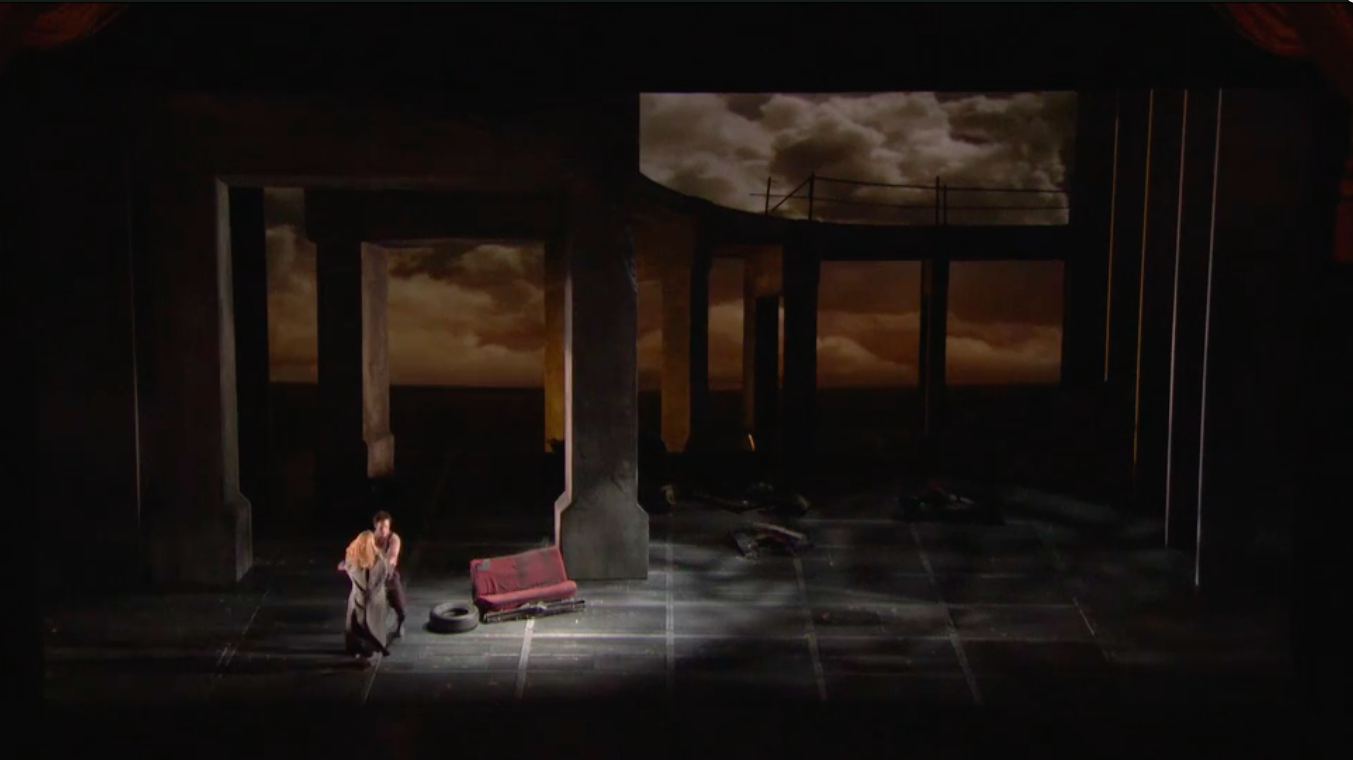
De seguida, o cenário roda 180º e passa a ser um loft/T1 básico onde encontramos Sieglinde sozinha. Chegado Siegmund, esta não mostra grande admiração e este parece estranho e desconfiado. Aparecido Hunding — aqui um polícia bem fardado com ares de chefe — o clima adensa-se: Sieglinde senta-se no seu colo para o apaziguar, enquanto este lhe abre o decote e expõe o sutiã (bem apropriado à presença do convidado…), a que se seguem diversas ameaças com pistola e loiças deitadas ao chão. Quando Hunding raivoso pede a bebida para dormir, Sieglinde acorre a prepará-la, ficando indecisa quanto às quantidades a deitar do pó soporífero, o que gerou alguns risinhos no público (o que idealmente seria incongruente com todo o ambiente esperado…). Hunding despe-se, ficando de camisola e calções, e deita-se, sendo seguido por Sieglinde. Antes algemara Siegmund, assim tendo mais um motivo para cantar os seus infortúnios. Quando soa o tema da espada, as luzes tornam-se mais brilhantes e parece haver algo espetado na parede (mas esse algo não está iluminado). Esse algo vem mesmo a ser a toda-poderosa espada Nothung. Sieglinde e Siegmund, entretanto reunidos pela paixão e pelo incesto, mas muito apressados, enfiam as roupas dela num saco e fogem, terminando o primeiro ato.


O segundo ato começa com uma recordação dessa fuga para que, no mesmo loft, logo apareçam Brunnhilde e Wotan, visivelmente cúmplices e satisfeitos, o que mereceu um festivo brinde com champanhe. Advertido da chegada de carroça (não há meios de transporte nesta encenação, devo dizer) de Fricka, o cenário mantém-se. Sai Brunnhilde e entra Fricka. Tão só! Entre o loft e o escritório (cujo vidro opaco escondia, afinal, o loft), uma Fricka histriónica convence Wotan de que os tratados são para cumprir e que a sua honra merece a morte de Siegmund. Ao mesmo tempo, voam dossiers da mesa para o chão, o que permite criar espaço para os contratos que a Fricka faz Wotan assinar. Regojizante, lança ares de desafio a Brunnhilde que entretanto voltara. Fricka sai, deixando-os a sós novamente. Wotan, preocupado e triste, conta as suas agruras a Brunnhilde sentado à porta do loft. Quando é posta em causa a sua autoridade, lá voam umas cadeiras, como não podia deixar de ser, não fosse Tcherniakov apreciador de atos clásticos. Entretanto, voltamos a Sieglinde e Siegmund: estamos novamente com as jaulas com coelhos de Das Rheingold, recordam-se? Sieglinde está sempre aflita e sem forças e acabam por ir parar ao cenários das cabines onde Alberich cacetou Mime. Brunnhilde surge para explicar o destino a Siegmund. Já sabemos que quem acaba convencida é Brunnhilde, que decide contrariar as ordens de Wotan. Fora do cenário, sem que se vejam (às escondidas?) dá-se o confronto de Hunding com Siegmund, confronto interferido por Wotan. Brunnhilde foge com Sieglinde e o loft dá lugar à caixa vazia do teatro. No vazio escuro, estão os três homens vivos e sem vislumbre de ferimento nem da longa lança dos tratados de Wotan (que essa é só do libreto e referida no canto). Wotan manda Hunding sair e este obedece, sem ripostar. E tudo termina com Siegmund a ser levado por uns polícias do corpo de intervenção. Daqueles da pesada que dão cacetadas e tudo. Finda o segundo ato.


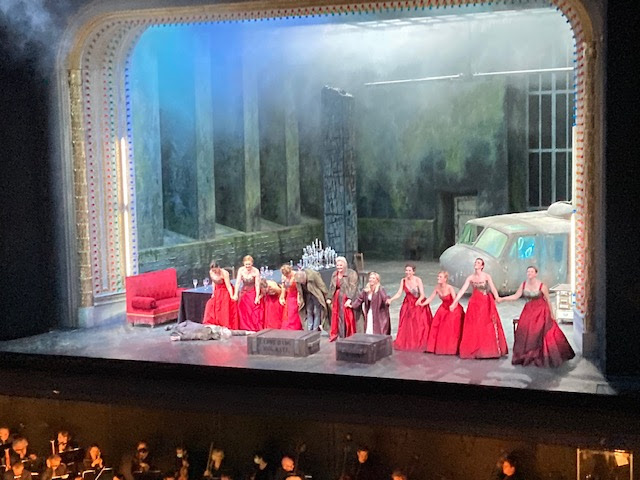
A cavalgada das Valquírias é o icónico início do terceiro ato. Aqui não há cavalos (claro!), mas o conhecido anfiteatro. Chegam lá quatro Valquírias e projeta-se numa tela a mensagem «Antes da entrega do relatório sobre violência». As Valquírias lá vão chegando todas enquanto se cumprimentam com um jovial ‘dá cá mais cinco!’… Só Brunnhilde não é recebida assim. Não merece, como sabemos. Traz uma debilitada Siegelinde que constantemente se atira para o chão, só recuperando quando lhe é anunciado o herói que traz no ventre. Quando Brunnhilde a leva embora, volta Wotan com Sieglinde pela mão, ficando esta arrumada a um canto, não participando em nada, nem sendo investida pela ira de ninguém. Entretanto, Brunnhilde senta-se numa das últimas cadeiras do anfiteatro, bem à vista de todos, enquanto Wotan, muito insatisfeito (sim, houve cadeiras e até um isqueiro a ri pelos ares!), insta as Valquírias a denunciar o seu paradeiro… Quando Brunnhilde desce até Wotan saem as Valquírias, encarregando-se Gerhilde de levar consigo Sieglinde (que não mais aparece, vá lá!).


Aqui começa o dueto de Wotan e Brunnhilde. Wotan nervoso, acende cigarros e dá mesmo umas passas. Vão formando um círculo de cadeiras enquanto se revê o castigo a dar a Brunnhilde. Wotan já está mais suavizado e até colinho acaba por dar. Estão ambos muito tristes o tempo todo, mas algo estáticos. Brunnhilde sobe a uma das cadeiras do círculo e Wotan chama Loge. Brunnhilde, muito infantil e perante a desfeita de Loge que não aparece, sai do círculo, pega num marcador laranja e — imagine-se! — desenha umas chamas nas costas das cadeiras para divertimento próprio e do seu pai babado. Com o fogo não se brinca, costuma dizer-se… No fim, Brunnhilde pega numa mochila e sai do anfiteatro, dando a mão ao pai que nele permanece. O enlace das mãos perde-se com o afastamento da secção Anfiteatro que recua no palco. E a música vai-se desenrolando até ao finda enquanto pai e filha se afastam, olhando-se lugubremente. Brunnhilde, aqui nada adormecida, está preparada para uma viagem. E assim termina Die Walküre. 


Não me parece que precisem de comentários sobre a encenação, dado que a descrição é exaustiva…


Relativamente aos cantores, uma vez mais, não veiculam a emoção esperada porque, no meu ver, Tcherniakov não permite. 


Individualizando. Robert Watson foi um Siegmund sem presença vocal e com vários problemas na emissão que foi irregular, sobretudo no registo médio, o que fez com que o público o brindasse muitos boos. Foi de tal modo exagerado que deu pena ver o semblante triste e carregado com que ficou e a necessidade de muitos “cheer up” dos colegas. Não se faz!


Vida Mikneviciutè foi uma Sieglinde vocalmente espetacular. Voz enorme, brilhante, sempre sobre a orquestra e com um timbre muito bonito. Para mim, o destaque da tarde/noite. E um evidente contraste com Watson.


Hunding foi interpretado por Mika Kares que já tinha sido um excelente Falsot e que aqui, uma vez mais, não defraudou o exigente público de Berlim.


A Fricka de Claudia Manke esteve hoje vocalmente melhor do que em Das Rheingold, muito embora não seja uma mezzo deslumbrante, nem uma Fricka memorável.


De todas as Valquírias, claro destaque para Clara Nadeshdin que fez uma Gerhilde fantástica: que voz imensa!


Termino com o duo Wotan/Brunnhilde. Michael Volle foi, novamente, um Wotan vocalmente em grande forma e cenicamente limitado, o que o impede de ser um Wotan que me vá recordar. Já Anja Kampe foi uma Brunnhilde competente, mas creio que, tendo estado sempre em bom plano, está a aquecer para as duas récitas finais.


A Staatskapelle Berlin sob direção de Christian Thielemann foi novamente fantástica e quase irrepreensível. Estão a ser, claramente, as grandes estrelas desta produção. Vai para eles o meu Bravo! Que assim continuem! 


_________________

Die Walküre


As one would expect, Tcherniakov's interpretation of Die Walküre was qualitatively in line with Das Rheingold. 


The opera begins with a curtain below without any projection or action, missing the chance to depict the storm that Wagner recreated so well musically. Suddenly, after about two minutes, television images are projected saying "Kriminal Report" with flashes of criminal street scenes and, later, with video surveillance. In them appears the one who turns out to be Siegmund, here taken by two policemen already in prison. He has a white streak in his hair, which is a sign that he is Wotan's son, for Wotan also has a white streak in his grey hair. Once the curtain rises, there is still time for Wotan to appear in his office.


Next, the scene turns 180º and becomes a basic loft/T1 where we find Sieglinde alone. When Siegmund arrives, she doesn't show much admiration and he seems strange and suspicious. When Hunding appears - here a well-uniformed policeman who looks like a boss - the atmosphere thickens: Sieglinde sits on his lap to appease him, while he opens her cleavage and exposes her bra (very appropriate to the presence of the guest...), which is followed by several threats with a pistol and crockery thrown on the floor. When Hunding angrily asks for the drink to sleep, Sieglinde wakes up to prepare it, being indecisive about the quantities to pour the sleeping powder, which generates a few giggles in the audience (which ideally would be incongruous with the whole expected atmosphere...). Hunding undresses, wearing a shirt and shorts, and lies down, followed by Sieglinde. Earlier he had handcuffed Siegmund, thus having one more reason to sing of his misfortunes. When the sword theme sounds, the lights become brighter and there seems to be something sticking out of the wall (but that something is not illuminated). That something turns out to be the all-powerful sword Nothung. Sieglinde and Siegmund, meanwhile brought together by passion and incest, but too hastily, stuff her clothes into a sack and flee, ending the first act.


The second act begins with a recollection of this escape so that, in the same loft, Brunnhilde and Wotan soon appear, visibly complicit and satisfied, which merited a festive champagne toast. Warned of Fricka's arrival by wagon (there are no means of transport in this staging, I must say), the scene is maintained. Out comes Brunnhilde and in comes Fricka. So alone! Between the loft and the office (whose opaque glass hid the loft, after all), a histrionic Fricka convinces Wotan that treaties are to be kept and that his honour deserves Siegmund's death. At the same time, dossiers fly off the table onto the floor, making room for the contracts Fricka makes Wotan sign. Gloating, he throws looks of defiance at Brunnhilde who had meanwhile returned. Fricka leaves, leaving them alone again. Wotan, worried and sad, tells Brunnhilde about his woes sitting outside the loft. When his authority is questioned, a few chairs fly out of the door, as one might expect, since Cherniakov is a lover of clastic acts. Meanwhile, we return to Sieglinde and Siegmund: we're back with the rabbit cages of Das Rheingold, remember? Sieglinde is always distressed and powerless and they end up in the cabin scenarios where Alberich has cackled Mime. Brunnhilde appears to explain her fate to Siegmund. We already know that the one who ends up convinced is Brunnhilde, who decides to go against Wotan's orders. Outside the scene, without being seen (on the sly?), Hunding and Siegmund confront each other, a confrontation interfered by Wotan. Brunnhilde flees with Sieglinde and the loft gives way to the empty theatre box. In the dark void are the three men alive and without a glimpse of injury or the long spear of Wotan's treatises (that one is only from the libretto and mentioned in the corner). Wotan orders Hunding to leave and he obeys, without fighting back. And it all ends with Siegmund being taken away by some policemen from the riot squad. Those heavy-handed ones who beat him up and everything. The second act is over.


The Ride of the Valkyries is the iconic start of the third act. Here there are no horses (of course!), but the well-known amphitheatre. Four Valkyries arrive there and the message "Before the report on violence" is projected on a screen. The Valkyries all arrive there while greeting each other with a jovial 'high-five'... Only Brunnhilde is not received like that. She doesn't deserve it, as we know. She brings a weakened Siegelinde who constantly throws herself to the ground, only recovering when the hero she carries in her womb is announced. When Brunnhilde takes her away, Wotan returns with Sieglinde by the hand, leaving her tidily in a corner, taking no part in anything, nor being invested by anyone's wrath. Meanwhile, Brunnhilde sits down on one of the last chairs in the amphitheatre, in full view of everyone, while Wotan, very dissatisfied (yes, there were chairs and even a lighter laughing in the air!), urges the Valkyries to report her whereabouts... When Brunnhilde goes down to Wotan the Valkyries come out, with Gerhilde taking Sieglinde with her (who no longer appears, come on!).


Here begins Wotan and Brunnhilde's duet. Wotan nervously lights cigarettes and even takes a few puffs. They form a circle of chairs as they review the punishment to be given to Brunnhilde. Wotan is more relaxed and even gives her a cuddle. They are both very sad all the time, but somewhat static. Brunnhilde climbs onto one of the chairs in the circle and Wotan calls Loge. Brunnhilde, very childish and at Loge's snub, who doesn't show up, leaves the circle, takes an orange marker and - imagine that! - draws some flames on the backs of the chairs for her own amusement and that of her drooling father. At the end, Brunnhilde takes a rucksack and leaves the amphitheatre, holding hands with her father who remains in the theatre. The linking of hands is lost as the amphitheatre section retreats on stage. And the music winds to a halt as father and daughter walk away, looking at each other lugubriously. Brunnhilde, here not at all asleep, is prepared for a journey. And so Die Walküre ends. 


I don't think you need any comments on the staging, since the description is exhaustive...


As regards the singers, once again they do not convey the expected emotion because, in my view, Cherniakov does not allow it. 


Individualising. Robert Watson was a Siegmund without vocal presence and with several problems in the emission that was irregular, especially in the middle register, which caused the audience to toast him many boos. It was so over the top that it was a shame to see the sad, heavy countenance he was left with and the need for lots of "cheer up" from his colleagues. It can't be done!


Vida Mikneviciutè was a vocally spectacular Sieglinde. Huge, brilliant voice, always over the orchestra and with a very beautiful timbre. For me, the highlight of the afternoon/evening. And an obvious contrast to Watson.


Hunding was played by Mika Kares who had already been an excellent Falsot and who here, once again, did not disappoint the demanding Berlin audience.


Claudia Manke's Fricka was vocally better today than in Das Rheingold, though not a stunning mezzo, nor a memorable Fricka.


Of all the Valkyries, of course the highlight is Clara Nadeshdin who made a fantastic Gerhilde: what a huge voice!


I finish with the Wotan/Brunnhilde duo. Michael Volle was, again, a Wotan vocally in great shape and scenically limited, which prevents him from being a Wotan that I will remember. Anja Kampe, meanwhile, was a competent Brunnhilde, but I think, having been consistently on top form, is warming up for the final two recitatives.


The Staatskapelle Berlin under Christian Thielemann was again fantastic and almost faultless. They are clearly being the big stars of this production. Bravo to them! May they keep it up! 

domingo, 14 de agosto de 2022

A VALQUÍRIA / DIE WALKURE, Bayreuther Festspiele, Agosto / August 2022


                                               (review in English below)


Se achei a encenação do Ouro do Reno difícil de perceber, nem sei o que dizer da Valquíria. Começa na casa (moderna) do Hunding e Sieglinde, que está em avançado estado de gravidez. Aparentemente o pai poderá ser o Hunding (?) mas não é o Siegmund. A tempestade avaria o quadro eléctrico que o Hunding tenta reparar ao longo de quase todo o período em que está acordado. Próximo do fim, o cenário muda e aparecem 2 quartos e 2 crianças que deverão ser o Siegmund e a Sieglinde na infância. No final, a Nothung não é uma espada, é uma pistola (mais uma) que é retirada de uma pirâmide iluminada de branco numa caixa que está presente também na opera anterior.


No 2º acto voltamos à casa dos deuses, onde decorre o velório da Freia (que se terá suicidado). Acentuam-se as relações problemáticas entre membros desta abastada família. Aparecem Siegmund e a Sieglinde e, quando esta está a dormir, Wotan tira-lhe as cuecas e introduz as mãos entre as pernas, dando a entender que será ele o pai da criança em gestação. Siegmund é morto pelo Wotan com um tiro de pistola à queima roupa, mas Hunding sai sem morrer em palco.


O 3º acto começa numa clínica de cirurgia plástica, onde as valquírias, para além dos tratamentos estéticos, bebem champanhe, trocam presentes caros e maltratam as e os empregados. Brünhilde aparece com a Sieglinde já com o filho nascido. Não morreu de parto. Vêm também acompanhadas do Grane que não é um cavalo mas um homem. Tudo se passa nesse cenário até quase o fim, quando Wotan fica sozinho, separado por uma cortina. A Brünhilde sai de cena e não há fogo nem nada de semelhante a isolá-la. Nos momentos finais aparece Fricka com um carrinho de bebidas alcoólicas e partilha uma com o Wotan, um gesto de aparente reconciliação, mas ele não aceita.


Tudo algo confuso, pouco consequente e com poucas ligações ao Ouro do Reno, o que causa ainda mais dificuldade em perceber a abordagem cénica. Wagner deve ter dado mais uma cambalhota no túmulo!

A Orquestra esteve óptima e a direcção do maestro Cornelius Meister foi boa, mas ocasionalmente lenta e sem por sempre em evidência os momentos mais emotivos.


Já em relação aos cantores, imperou a qualidade: O primeiro acto foi o melhor, com 3 cantores de excepção. O tenor Klaus Florian Vogt não tem uma voz heróica de heldentenor como outros mas escureceu a voz e a interpretação foi notável, quer em beleza, quer em emissão e emoção. Foi bem reconhecido pelo público, que o aplaudiu ruidosamente e por muito tempo. O Hunding do baixo Georg Zeppenfeld foi também excepcional. Voz grande, profunda, muito agradável e sempre bem audível acima da orquestra. 

A soprano Lise Davidsen foi colossal! Fez-me lembrar a Nina Stemme quando estava no auge e a ouvi na Brünhilde no Anel de Munique. Uma voz poderosíssima, bem timbrada, e a senhora canta, não grita. Foi, de longe, a mais aplaudida por este público conhecedor. As intervenções nos 2º e 3º actos foram avassaladoras! Que enorme Brünhilde aí virá!!

A mezzo Christa Mayer repetiu uma Fricka de óptima qualidade. O baixo-barítono Tomasz Konieczny foi um Wotan de voz segura e bem timbrada, excelente na emissão. Achei, contudo, pouco autoritário na sua condição de deus (talvez uma exigência desta interpretação cénica). A soprano Iréne Theorin foi uma Brünhilde bem audível, mas a voz está gasta e com um vibrato marcado e irritante. Talvez por isto tenha ouvido alguns boos, no meio dos aplausos.

Finalmente as valquírias foram globalmente muito boas: Kelly God (Gerhilde), Brit-Tone Müllertz (Ortlinde), Stephanie Houtzeel (Waltraute), Christa Mayer (Schwertleite), Daniela Köhler (Helmwige), Nada Dzidziguri (Siegrune), Marie Henriette Reinhold (Grimgerde) e Katie Stevenson (Rossweisse).


Veremos se na continuação do Anel a encenação de Valentin Schwarz se clarifica mais.

****


DIE WALKÜRE, Bayreuther Festspiele, August 2022

If I found the staging of Das Rheingold difficult to understand, I don't even know what to say about Valkyrie. It starts at Hunding and Sieglinde's (modern) house, which is in an advanced stage of pregnancy. Apparently the father could be Hunding (?) but not Siegmund. The storm breaks the electrical panel which Hunding tries to repair for most of his waking hours. Towards the end, the scenario changes and 2 rooms and 2 children appear, who must be Siegmund and Sieglinde in childhood. In the end, Nothung is not a sword, it is a pistol (another one) that is taken from an illuminated white pyramid in a box that was also present in the previous opera.

In the 2nd act we return to the house of the gods, where the wake of Freia (who has committed suicide) takes place. Problematic relationships between members of the wealthy family are accentuated. Siegmund and Sieglinde arrive and, when Sieglinde is sleeping, Wotan takes off her underwear and puts his hand upper between her legs, implying that he is the father of the unborn child. Siegmund is killed by Wotan with a pistol shot, but Hunding leaves without dying on stage.

The 3rd act begins in a plastic surgery clinic, where the Valkyries, in addition to aesthetic treatments, drink champagne, exchange expensive gifts and mistreat employees. Brünhilde appears with Sieglinde with her child already born. She didn't die in childbirth. They are also accompanied by Crane, who is not a horse but a man. Everything happens in this scenario until almost the end, when Wotan is alone, separated by a curtain. Brünhilde leaves the scene and there is no fire or anything similar to isolate her. In the final moments, Fricka appears with a cart of alcoholic drinks and shares one with Wotan, a gesture of apparent reconciliation, but he does not accept it.

All somewhat confusing and with few connections to Das Rheingold, which makes it even more difficult to understand the scenic approach. Wagner must have done another somersault in the grave!

The Orchestra was great and the direction of conductor Cornelius Meister was good, but occasionally slow and without always highlighting the most emotional moments.

As for the singers, top quality prevailed: The first act was the best, with 3 exceptional singers. Tenor Klaus Florian Vogt does not have a heroic heldentenor voice like others but he darkened the voice and the interpretation was remarkable, both in beauty and in emission and emotion. He was well recognized by the public, who applauded him loudly and for a long time. Bass Georg Zeppenfeld's Hunding was also exceptional. Big, deep voice, very pleasant and always well audible above the orchestra. 

Soprano Lise Davidsen was colossal! She reminded me of Nina Stemme when she was in her prime and I heard her as Brünhilde on the Munich Ring. A very powerful voice, excelent timbre, and she sings, not screams. She was by far the most applauded by this knowledgeable audience. The interventions in the 2nd and 3rd acts were overwhelming! What a huge Brünhilde here to come!!

Mezzo Christa Mayer repeated a Fricka of excellent quality. Bass-baritone Tomasz Konieczny was a Wotan with a strong and well-toned voice, excellent in emission. I found, however, little authoritative in his condition of god (perhaps a requirement of this scenic interpretation). Soprano Iréne Theorin was a very audible Brünhilde, but her voice is worn and with a marked and irritating vibrato. Maybe that's why she heard some boos, amidst the applause.

Finally, the Valkyries were overall very good: Kelly God (Gerhilde), Brit-Tone Müllertz (Ortlinde), Stephanie Houtzeel (Waltraute), Christa Mayer (Schwertleite), Daniela Köhler (Helmwige), Nada Dzidziguri (Siegrune), Marie Henriette Reinhold ( Grimgerde) and Katie Stevenson (Rossweisse).

We will see if in the continuation of The Ring, Valentin Schwarz's staging becomes more noticeable.

****

terça-feira, 21 de junho de 2022

DIE WALKÜRE / A VALQUÍRIA, Deutsche Oper am Rhein, June / Junho 2022

(Text in English below)

A encenação de Dietrich W Hilsdorf é, mais uma vez, um misto de realidade actual com elementos do passado. O ambiente é de Guerra, o cenário é semelhante nos 3 actos mas os símbolos principais da obra de R Wagner estão presentes – a espada Nothung cravada no freixo, a lança e uma abordagem convencional, num cenário diferente. 

(1º acto)


                                                     (2º acto)

Wotan é retratado como um ser algo frágil, pouco compatível com a sua condição de Deus. O 3º acto começa com a queda e destroços de um helicóptero, donde saem os heróis mortos com as feridas visíveis. As valquírias, vestidas de vermelho, oferecem-lhes vinho. Termina com a Brünhilde sentada numa cadeira e o fogo sagrado visível por uma janela. 


                                                      (3º acto)

A Düsseldorfer Symphoniker, orquestra pouco vagneriana, dirigida por Alex Kober, esteve hoje bem melhor que há dias no Ouro do Reno.


Os cantores solistas foram todos muito bons. O melhor foi o primeiro acto, com duas interpretações excelentes, a do tenor Michael Weinius de voz potente, viril e timbre muito bonito. Se tivesse menos 20kg seria um Siegmund ideal. 


A soprano Elisabet Strid fez uma Sieglinde perfeita na interpretação vocal e cénica. O timbre é claro, sempre afinada e sobre a orquestra. 


O Hunding do baixo-barítono Thorsen Grümbel não destoou e ajudou a compor um primeiro acto excelente.


No 2º acto também assistimos a boas interpretações. Katarzyna Knucio fez uma Fricka irrepreensível e tem uma figura excelente.

O Wotan de Simon Neal impôs-se pela qualidade vocal. Em cena representa um personagem excessivamente frágil para a sua condição de Deus.

Linda Watson cantou mais uma vez a Brünhilde, personagem que terá interpretado inúmeras vezes nesta companhia de ópera. Vai ser alvo de uma homenagem de fim de carreira dentro de poucos dias e apenas cantará mais duas vezes o papel. Apesar de a voz denotar desgaste, merece o nosso cumprimento pela longevidade e qualidade da carreira.


As valquírias foram Helmige (Anka Krabbe), Gerhilde (Luiza Fatyol), Ortlinde (Sylvia Hamvasi), Waltraute (Romana Noack), Siegrune (Anna Harvey), Rossweisse (Kimberley Boettger-Soller), Grimgerde (Carmen Artaza) e Schertleite (Susan Maclean).


****

DIE WALKÜRE / THE VALKYRIA, Deutsche Oper am Rhein, June 2022

Dietrich W Hilsdorf's staging is, once again, a mixture of current reality with elements of the past. The atmosphere is from War, the setting is similar in the 3 acts but the main symbols of R Wagner's work are present – ​​the Nothung sword stuck in the ash tree, the spear and a conventional approach, in a different setting. Wotan is portrayed as a somewhat fragile being, little compatible with his condition of God. The 3rd act begins with the fall and wreckage of a helicopter, from which the dead heroes emerge with visible wounds. The Valkyries, dressed in red, offer them wine. It ends with Brünhilde sitting on a chair and the sacred fire visible through a window.

The Düsseldorfer Symphoniker, a slightly Vagnerian orchestra, conducted by Alex Kober, was much better today than it was in the Rhine Gold.

The soloist singers were all very good. The best was the first act, with two excellent interpretations, that of tenor Michael Weinius with a powerful, virile voice and a very beautiful timbre. If he were 20 kg less he would be an ideal Siegmund.

Soprano Elisabet Strid made a perfect Sieglinde in both vocal and scenic interpretation. The timbre is clear, always in tune and over the orchestra.

Bass-baritone Thorsen Grümbel's Hunding did not disappoint and helped to compose an excellent first act.

In the 2nd act we also witnessed good interpretations. Katarzyna Knucio did an irreproachable Fricka and has an excellent figure.

Simon Neal's Wotan stood out for its vocal quality. On stage, he represents a character that is excessively fragile for his condition of God.

Linda Watson once again sang Brünhilde, a character she will have played countless times in this opera company. She will be the subject of an end-of-career tribute in a few days and will only sing the role twice more. Although her voice denotes wear and tear, she deserves our compliments for the longevity and quality of her career.

The Valkyries were Helmige (Anka Krabbe), Gerhilde (Luiza Fatyol), Ortlinde (Sylvia Hamvasi), Waltraute (Romana Noack), Siegrune (Anna Harvey), Rossweisse (Kimberley Boettger-Soller), Grimgerde (Carmen Artaza) and Schertleite (Susan Maclean).

****


quinta-feira, 1 de abril de 2021

A VALQUÍRIA / DIE WALKÜRE, Ópera de Viena / Wiener Staatsoper, Transmissão / Streaming, Março / March 2021


(Text in English below)

A Ópera de Viena ofereceu-nos esta semana a transmissão das 4 óperas do Anel do Nibelungo de R. Wagner. Aqui deixo as minhas impressões sobre a 2ª ópera do ciclo: A Valquíria.

A encenação de Sven-Eric Bechtolf é clássica e bem conseguida. Em cada acto o cenário mantém-se constante. O 3º acto é o mais original, com os 9 cavalos das valquírias sempre presentes no palco. A direcção musical foi de Adam Fischer.


Os cantores solistas foram todos impressionantes:

O Siegmund foi Christopher Ventris.


A Sieglinde foi Waltraud Meier, sempre ao mais alto nível.


O Hunding foi Ain Anger, excelente.


A Brünhilde foi Linda Watson.


A Fricka foi óptima, Michaela Schuster.


E o Wotan foi Tomasz Konieczny, para mim, o melhor. Tem um timbre muito bonito, canta sempre afinado e em palco é muito bom.

A ópera é um espectáculo para ouvir e para ver, apesar de tudo ser relativamente irreal. Neste caso houve uma grande dissociação entre as personagens e os cantores que as interpretaram: A Sieglinde e o Siegmund muito velhos e, sobretudo, o Wotan que parecia filho da Brünhilde e não o seu pai.

Mas foi um espectáculo excelente.

*****


THE VALKYRIE / DIE WALKÜRE, Wiener Staatsoper, Streaming, March 2021

This week the Vienna Opera offered us the transmission of the 4 operas of R. Wagner's Ring of the Nibelung. Here I leave my impressions about the 2nd opera of the cycle: The Valkyrie.

Sven-Eric Bechtolf's staging is classic and well accomplished. In each act the scenario remains constant. The 3rd act is the most original, with the 9 horses of the Valkyries always present on the stage. The musical direction was by Adam Fischer.

The soloist singers were all impressive: Siegmund was Christopher Ventris. Sieglinde was Waltraud Meier, always at the highest level. Hunding was Ain Anger, excellent. Brünhilde was Linda Watson. Fricka was great, Michaela Schuster. And Wotan was Tomasz Konieczny, for me, the best. He has a very beautiful timbre, he sings in tune and is very good on stage.

The opera is a spectacle to hear and to see, although everything is relatively unreal. In this case there was a great dissociation between the characters and the singers who played them: Too old Sieglinde and Siegmund and, above all, Wotan who looked like Brünhilde's son and not her father.

But it was an excellent show.

*****

sábado, 13 de março de 2021

DIE WALKÜRE / A VALQUÍRIA, San Francisco Opera, Transmissão / Streaming 13 Março / March 2021


(review in English below)

Foi um espectáculo muito interessante, que ainda pode ser visto durante mais um dia no site da San Francisco Opera (https://sfopera.com/). 

A encenação de Francesca Zambello, que disse ter sido inspirada no ambiente e no movimento #MeToo e ser essencialmente Americana, é interessante e vistosa. O primeiro acto é muito convencional, cenicamente bem conseguido, numa casa rural com muitos troféus de caça. A Sieglinde é vítima de violência domestica pelo marido Hunding. 

A primeira cena do 2º acto passa-se no alto de um arranha-céus, sala de Wotan. Pai, filha e depois a Fricka, todos partilham um whisky. 

A segunda cena passa-se debaixo de um viaduto, num emaranhado de auto-estradas. Sieglinde e Sigmund são “sem abrigos”.  A terceira cena acontece no mesmo cenário mas, num dos viadutos, a Fricka assiste, de cima, a tudo.

No início do 3º acto, passado numa estrutura com muitas escadas e andaimes metálicos, as valquírias chegam de pára-quedas e trazem retratos dos heróis. 

Tudo acontece neste cenário, o menos conseguido de toda a ópera.

Sob a direcção do maestro Donald Runnicles a orquestra teve uma interpretação de qualidade. Nos solistas há grandes cantores: Karita Mattila foi uma Sieglinde cenicamente interessante mas vocalmente banal,

Brandon Jovanovich fez um Siegmund estático e pouco emotivo, sobretudo no 1º acto,


Raymond Aceto foi um bom Hunding,


Iréne Theorin esteve muito bem como Brünhilde, 

Greer Grimsley foi um Wotan respeitável e


Jamie Barton foi excepcional como Fricka, a melhor da récita. 

A Valquíria é sempre um espectáculo excelente!

****


DIE WALKÜRE, San Francisco Opera, Streaming 13-14 March 2021

It was a very interesting show, which can still be seen for another day on the San Francisco Opera website (https://sfopera.com/).

The production by Francesca Zambello, who said she was inspired by the environment, the #MeToo movement and a production essentially American, is interesting and showy. The first act is very conventional, scenically well accomplished, in a rural house with many hunting trophies. Sieglinde is a victim of domestic violence by her husband Hunding. The first scene of the 2nd act takes place on top of a skyscraper, Wotan's room. Wotan, daughter and then Fricka, they all share a whiskey. The second scene takes place under an overpass, in a tangle of highways. Sieglinde and Sigmund are "homeless". The third scene takes place in the same scenario, but in one of the viaducts, Fricka watches everything from above. At the beginning of the 3rd act, carried out in a structure with many stairs and metallic scaffolding, the valkyries arrive by parachute and bring portraits of the heroes. Everything happens in this scenario, the least accomplished of the entire opera.

Under the direction of conductor Donald Runnicles, the orchestra had a quality interpretation.

In the soloists there are great singers: Karita Mattila was a Sieglinde that was scenically interesting but vocally banal, Brandon Jovanovich was a static and little emotional Siegmund, especially in the 1st act, Raymond Aceto was a good Hunding, Iréne Theorin was very well as Brünhilde, Greer Grimsley was a respectable Wotan and Jamie Barton was exceptional as Fricka, the best of the performance.

Die Walküre is always an excellent show!

****