quinta-feira, 10 de outubro de 2019

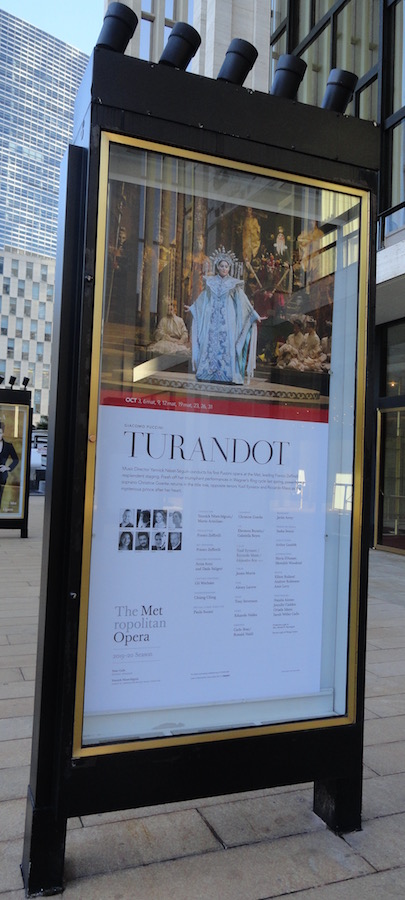
TURANDOT, METropolitan Opera, Outubro / October 2019


(review in English below)

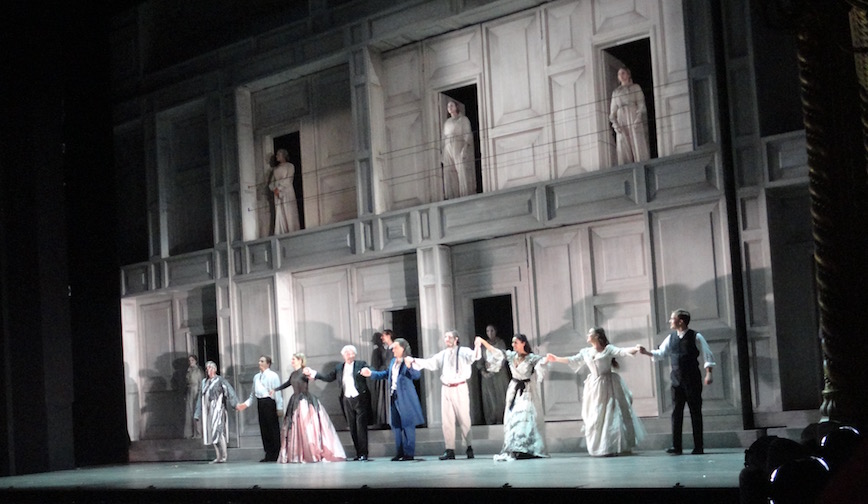
No ano da morte de Franco Zeffirelli, a Metropolitan Opera de Nova Iorque volta a exibir a produção que fez da ópera Turandot de G. Puccini, dedicada à sua memória, já comentada algumas vezes neste blogue. É uma encenação datada mas muito vistosa e exuberante, algo kitch, que ainda hoje desperta aplausos logo que a cortina sobe.


A direcção musical foi de qualidade e esteve a cargo do maestro Yannick Nézet-Séguin. A orquestra esteve muito bem e o coro esplêndido.


Nos protagonistas a soprano Christine Goerke foi uma princesa Turandot de voz forte e dura cumprindo sem deslumbrar.


O príncipe Calaf foi o tenor Yusif Eyvazov. Foi irregular na emissão vocal, muitas vezes não se ouviu e tem um timbre feio. E em palco é pouco expressivo. Em minha opinião não é um artista com o nível de qualidade que justifique a sua presença em papéis solistas de relevo numa companhia de ópera de topo como é a Metropolitan Opera de Nova Iorque. Contudo, como é o marido de Anna Netrebko, admito que faça parte do pacote da sua contratação (ela sim, uma cantora sublime), dado que está a cantar a ópera Macbeth no mesmo período.


A Liù foi superiormente interpretada pela soprano Eleonora Buratto, de longe a melhor cantora da noite. Voz sempre audível sobre o orquestra, timbre agradável e interpretação emotiva.


O Timur foi o veterano James Morris que cumpriu com dignidade.


 Ping (Alexey Lavrov) excelente, Pang (Tony Stevenson) e Pong (Eduardo Valdes) bons fizeram um trio interessante.


O Mandarim (Javier Arrey) mal se ouviu, mas cantou sempre na parte mais profunda do palco.


**


TURANDOT, METropolitan Opera, New York, October 2019

In the year of Franco Zeffirelli's death, the New York Metropolitan Opera re-exhibits his production of G. Puccini's opera Turandot, dedicated to his memory, already commented a few times on this blog. It is a dated but very showy and exuberant staging that still arouses applause as soon as the curtain rises.
The musical direction was of good quality and was conducted by Yannick Nézet-Séguin. The orchestra was very good and the choir splendid.

In the soloists soprano Christine Goerke was a princess Turandot of strong and hard voice. She was ok without impressing.
Prince Calaf was tenor Yusif Eyvazov. He was irregular in vocal emission, often not heard and has an ugly tone. And on stage is little expressive. In my opinion, he is not a quality artist who justifies his presence in soloist roles in a top opera company such as the Metropolitan Opera of New York. However, as he is the husband of Anna Netrebko, I admit that it is part of the package of her hiring (she is a sublime singer), since she is singing the opera Macbeth in the same period.

Liù was superiorly performed by soprano Eleonora Buratto, by far the best singer of the night. The voice was always audible over the orchestra, pleasant timbre and emotive interpretation.

Timur was veteran James Morris who performed and sung with dignity. Excellent Ping (Alexey Lavrov), good Pang (Tony Stevenson) and good Pong (Eduardo Valdes) made an interesting trio. The Mandarin (Javier Arrey) was barely heard, but always sang in the deepest part of the stage.

**

domingo, 6 de outubro de 2019

DON GIOVANNI, Royal Opera House, Londres, Setembro / September 2019


 (review in English below)

A perfeição num espectáculo de opera é muito rara mas existe. Foi o caso da récita do Don Giovanni de W.A.Mozart em Setembro de 2019 na Royal Opera de Londres.

A encenação de Kasper Holten é moderna e sofisticada, muito bem conseguida. Um complexo cubo central está em permanente rotação no palco, sobre o qual se projectam diversas imagens e há aberturas constantes de múltiplas portas que dão acesso a diversas salas em dois andares, ligados por escadas interiores. Logo na abertura vão aparecendo projectados os milhares de nomes das conquistas do Don Giovanni, uma imagem que aparecerá frequentemente ao longo da récita em momentos adequados. A movimentação cénica dos cantores / actores é também óptima. Magnífica!


A direcção musical de Hartmut Haenchen foi muito mozartiana e teve grande atenção aos cantores.


Os cantores, sem excepção, foram superlativos. Foi o melhor elenco que alguma vez vi nesta ópera. E a origem dos cantores fez justiça ao slogan da Royal Opera, a world stage, tal como no público: só à minha volta ouvia-se falar espanhol, francês, alemão, russo (e inglês!).

Roberto Tagliavini, um baixo italiano como raramente se ouve actualmente e um artista exímio foi o melhor Leoporello que alguma vez vi. Voz grave, poderosa, de belíssimo timbre e um actor fabuloso.


O Don Giovanni foi o Erwin Schrott , baixo-barítono uruguaio, em noite de grande inspiração, sem irregularidades de emissão, voz poderosa e sempre bem colocada. Cenicamente foi um Don insuperável, sedutor descarado, também muito ajudado pela encenação.


A soprano sueca Malin Byström foi uma Donna Anna brutal, com excelente presença em palco e um vozeirão que muitas cantoras wagnerianas não têm. Mas quando foi necessário lirismo e tristeza, elas estiveram lá!


Daniel Behle é um tenor alemão que nos ofereceu uma interpretação muito emotiva e uma voz lírica pura de invulgar beleza como Don Ottavio.


Mytrò Papatanasiu, soprano grega, foi uma Dona Elvira de referência tanto na interpretação cénica como vocal. Voz extraordinariamente viva, amplitude impressionante, afinação perfeita e poderio invejável. Só vista e ouvida.


Leon Kosavic, barítono croata, foi um Masetto cómico, desconfiado e de voz fresca e muito agradável, 


e Louise Alder, soprano britânica, fez uma Zerlina atrevida e magnífica em palco e no canto. Ambos cantores deliciosos, muito jovens.


E o Comendador, Petros Magoulas, baixo grego com um grande final.


Tudo fabuloso e magia na Royal Opera House!


*****


DON GIOVANNI, Royal Opera House, London, September 2019

Perfection in an opera performance is very rare but it does exist. This was the case of W.A.Mozart’s Don Giovanni in September 2019 at the Royal Opera in London.

The production of Kasper Holten is modern, complex and sophisticated and very efficient. A complex central cube is constantly rotating on the stage, several images are projected on, and constant openings of multiple doors giving access to several rooms on two floors, connected by interior stairs. At the opening the thousands of names of Don Giovanni's previous lovers are projected, an image that will often appear throughout the performance at appropriate times. The scenic movement of the singers / actors is also optimal. Magnificent!

Hartmut Haenchen's musical direction was very Mozartian and had great attention to the singers.

The singers, without exception, were superlatives. It was the best cast I've ever seen in this opera. And the origin of the singers has done justice to the Royal Opera's slogan, “a world stage”, as in the public: just around me I could heard Spanish, French, German, Russian (and English!).

Roberto Tagliavini, an Italian bass with a quality that is rarely heard today, and an expert artist, was the best Leoporello I have ever seen. He has a powerful bass voice, beautiful tone, and is a fabulous actor.

Don Giovanni was Erwin Schrott, Uruguayan bass-baritone, in a night of great inspiration, without emission irregularities, powerful voice and always well tuned. Scenically he was an unsurpassed, brazen seductive Don, also greatly aided by the staging.

Swedish soprano Malin Byström was a fabulous Donna Anna, with an excellent stage presence and a strong voice that many Wagnerian singers don't have. But when lyricism and sadness were needed, they were there!

Daniel Behle is a German tenor who offered us a very emotional interpretation and a pure lyrical voice of unusual beauty as Don Ottavio.

Mytrò Papatanasiu, Greek soprano, was a reference Dona Elvira in both scenic and vocal interpretation. Extraordinarily vivid voice, impressive range, perfect pitch and enviable power. Just seen and heard.

Croatian baritone Leon Kosavic was a comical, suspicious, very pleasant Masetto and British soprano Louise Alder was a sassy and magnificent Zerlina on stage and in singing. Both very young delicious singers.

And the Commendatore, Petros Magoulas, a Greek bass with a great ending.

All fabulous and magic in the Royal Opera House!

*****

quarta-feira, 2 de outubro de 2019

PAGLIACCI/CAVALLERIA RUSTICANA — DE NATIONALE OPERA, Amesterdão, setembro de 2019


(in English bellow)

Assisti à apresentação das óperas Pagliacci de Leocavallo e Cavalleria Rusticana de Mascagni na ópera de Amesterdão.


A encenação ficou a cargo de Robert Carsen. Como lhe é típico, sugere que o público faz parte da obra. Assim, coloca o coro nas primeiras três filas do teatro, movimentando-se este depois para o palco que é um enorme camarim, cheio de espelhos e luzes, mas despido e escuro. Toda a ação se passa aí e num teatro ambulante que surge mais tarde para o desfecho trágico final onde as personagens são apresentadas nas mesmas roupagens, mas extremamente caricaturadas pelo tamanho excessivo. A transição para a Cavalleria faz-se com a cena final de Pagliacci em que os “atores” permanecem estáticos como se de um quadro se tratasse. Continua a aparecer um palco despido cheio de cadeiras que é tanto a taberna como a igreja. Os recursos são simples, mas eficazes para a dramaturgia e, também como é típico em Carsen, a comédia acaba com um grande espelho que transporta toda a assistência em palco.


A direção da Nederlands Philharmonisch Orkest por Lorenzo Viotti foi competente e colorida, imprimindo ritmos adequados e uma vivacidade que captou o público. O coro da De Nationale Opera e o coro infantil Nieuw Amsterdams Kinderkoor estiveram em bom plano.

Começando pelos Pagliacci, o prólogo e Tonio foram cantados pelo barítono Roman Burdenko que tem uma excelente projeção vocal e um timbre agradável, sendo capaz de interpretar a maléfica personagem de forma capaz. O Peppe do tenor Marco Ciaponi teve uma excelente prestação e o Sílvio do barítono Mattia Olivieri também esteve em bom plano com a sua voz quente e expressiva.

As personagens principais também se apresentaram em bom plano. Ailyn Pérez foi uma Nedda muito credível e fez uso da sua excelente voz, projetando-a sobre uma orquestra por vezes em forte, e com uma excelente capacidade dramática. Já o Canio do tenor Brandon Jovanovich esteve também excelente cenicamente, tendo uma voz com grande volume, mas um pouco áspera, e em que o italiano mais rude não ajudou a sobressair.


Passando à Cavalleria Rusticana, o elenco não foi tão uniforme quanto o do Pagliacci, porque teve duas vozes mais cintilantes. Anita Rachvelishvili foi uma Santuzza com uns graves e uns agudos absolutamente inexcedíveis, sendo uma das melhores mezzosoprano da atuliadade. Contudo, senti que lhe falta ainda maturar o papel para ser mais convincente do ponto de vista dramático onde Garanca a superou nas récitas a que assistimos na ROH. Brian Jadge foi um Turiddu maduro, com uma voz muito bonita, agudos potentes e fáceis a que alia uma grande capacidade interpretativa, características que fazem dele um dos tenores mais interessantes dos nossos dias. Alfio foi Roman Burdenko que se manteve no nível de Pagliacci. A Lola de Rihab Chaieb (terceira classificada do Operalia 2018 em Lisboa) também ofereceu uma boa interpretação, sensual e quente, e de voz cheia e muito homegena, só não sendo melhor por contrastar com a superlativa mezzo Rachvelishvili. Finalmente, a Lucia de Elena Zilio também se apresentou em bom plano, muito embora não goste particularmente do seu timbre de voz.


Uma excelente récita!

-------------------------------
(translation in English)

I attended to Leoncavallo’s Pagliacci and Mascagni’s Cavalleria Rusticana at Amsterdam’s opera house.

Robert Carsen’s staging, as he typically suggests, put the public as part of the work. Thus, he puts the choir in the first three rows of the hall, moving them later to the stage that is presented as a huge dressing room, full of mirrors and lights, but naked and dark. All the action takes place there and in a rustic theatre that comes later for the final tragic outcome where the characters are presented in the same guise, but extremely caricatured by their excessive size. The transition to Cavalleria is with the final scene of Pagliacci in which the “actors” remain static as if they were a living painting.The staging continues to be naked but now full of chairs, representing both the tavern and the church. The features are simple but dramaturgically effective and, as is typical of Carsen, comedy ends up with a large mirror that projects all the assistance to the stage.

Nederlands Philharmonisch Orkest's direction by Lorenzo Viotti was competent and colourful with proper rhythms and liveliness that captured the audience. The De Nationale Opera choir and the Nieuw Amsterdams Kinderkoor children's choir were in good shape.

Starting with the Pagliacci, the prologue and Tonio were sung by the baritone Roman Burdenko who has excellent vocal projection and a pleasant timbre, being able to interpret the evil character in a capable way. Tenor Marco Ciaponi's Peppe had an excellent performance and baritone Mattia Olivieri as Silvio had also a good performace with his warm and expressive voice.

The main characters also performed well. Ailyn Pérez was a very credible Nedda and made use of her excellent voice, projecting it over a sometimes strong orchestra, and with excellent dramatic ability. Tenor Brandon Jovanovich's Canio was also dramatically excellent, having a great high notes but slightly harsh, and in which his rudest Italian did not help to stand out.

Turning to Cavalleria Rusticana, the cast was not as uniform as Pagliacci's because it had two more sparkling voices. Anita Rachvelishvili was a Santuzza with an absolutely unbeatable bass and treble, being one of the best mezzosoprano of our days. However, I felt that she still needs to mature the role to be more convincing from the dramatic point of view where Garanca overcame her in the recitals we attended at ROH. Brian Jadge was a mature Turiddu, with a very beautiful voice, powerful and easy treble that combines great interpretive ability, characteristics that make him one of the most interesting tenors of our days. Alfio was Roman Burdenko who remained at the level of Pagliacci. Rihab Chaieb's Lola (2018 Operalia’s third ranked in Lisbon) also offered a good interpretation, sensual and warm, with a full and very homogeneous voice, that was not so good just because of the contrast with the superlative mezzo Rachvelishvili. Finally, Elena Zilio's Lucia also performed well, although I didn't particularly like her voice.

An excellent evening!